
Biotechnology Instrumentation Market Overview
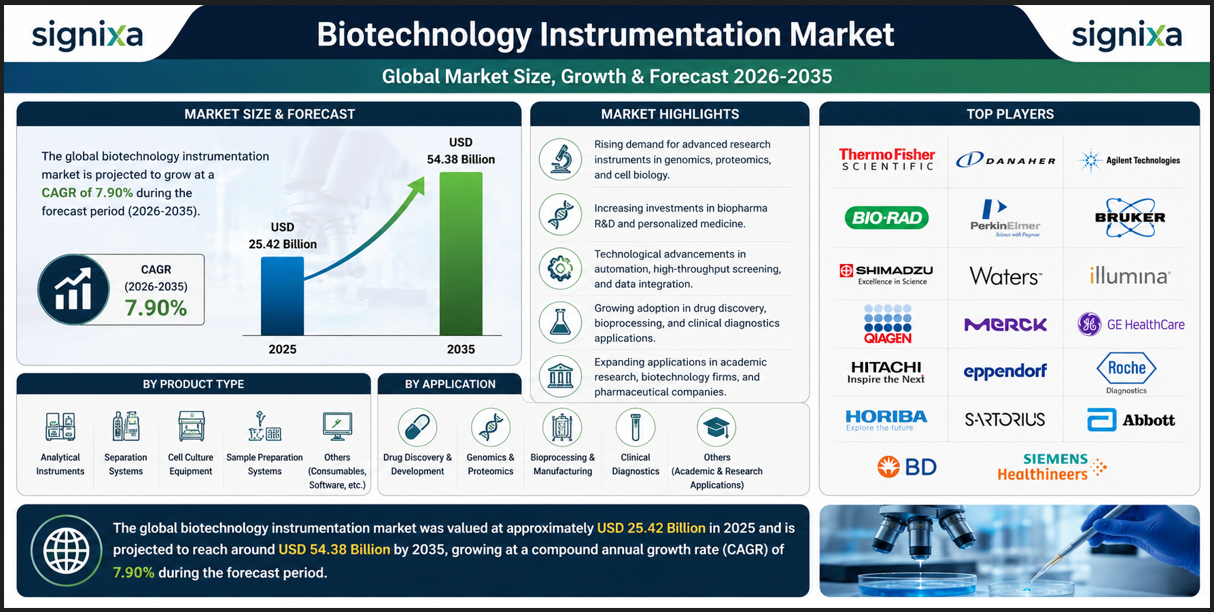
The global biotechnology instrumentation market was valued at approximately USD 25.42 Billion in 2025 and is projected to reach around USD 54.38 Billion by 2035, growing at a compound annual growth rate (CAGR) of 7.90% during the forecast period. The market's expansion is driven by increasing R&D activities in genomics and proteomics, the rise of biopharmaceutical production, and advancements in lab automation. This report provides an in-depth analysis of drivers, restraints, regional trends, and growth opportunities shaping the market.
Instrumentation in biotechnology refers to analytical instruments and broad-scale processing equipment involved in life sciences research, diagnostics, and biomanufacturing. The growth of the market is driven primarily by the increasing demand for high-throughput analytical devices, the growing field of personalized medicine, and laboratories receiving government funding for biotechnology research. Market presence in pharmaceutical, clinical, and academic industries is accelerating due to the adoption of next-generation sequencing, automation by bioprocessing workflows, and innovations in real-time monitoring.
The biotechnology instrumentation market is growing rapidly, fuelled by advancements in analytical tools and increasing R&D activities across pharmaceuticals, healthcare, and agriculture. Instruments like mass spectrometers, chromatography systems, and next-generation sequencing platforms are vital for genomics, proteomics, and drug discovery. Integration of AI and machine learning enhances data processing, improving diagnostic precision and research efficiency. North America leads due to strong biomedical research investment and established biotech hubs, while Asia Pacific is expanding fast with rising healthcare spending and infrastructure development. There is a growing trend toward portable, miniaturized, and automated instruments that support on-site diagnostics and streamline workflows. Additionally, adoption of cloud computing and IoT enables real-time data sharing and remote instrument monitoring. These innovations collectively boost productivity, reduce time to results, and foster collaboration across global biotech communities, positioning the market for sustained growth driven by increasing demand for precise and efficient biotechnological solutions.
Key Findings
- The global biotechnology instrumentation market is projected to grow at a CAGR of 7.90% between 2026 and 2035.
- The market size is anticipated to grow from USD 25.42 Billion in 2025 to USD 54.38 Billion by 2035.
- Mass spectrometry and liquid chromatography are dominant product categories.
- Biotechnology manufacturing and genomics are the leading applications.
- Biotechnology & biopharmaceutical companies are the largest end users.
- North America is expected to lead the global market during the forecast period.
Biotechnology Instrumentation Market Dynamics
Surging Biopharmaceutical Demand & Government Biomedical Research Funding
The surge in demand for biopharmaceuticals, personalized therapeutics, and analytical real-time solutions is driving market growth. Increasing investments in research institutes, greater emphasis on precision medicine, and government support are also driving market momentum. The NIH budget allocated more than USD 45 Billion in 2025 for biomedical research. Moreover, biomanufacturers are increasingly automating workflows to save costs and increase reproducibility, which further enhances the use of modern biotech instrumentations.
Expansion of Biopharmaceutical Manufacturing & Biologics Production
The quick growth in biopharmaceutical manufacturing is a principal factor for instrumentation associated with biotechnology. There is substantial demand for instrumentations that are accurate, automated, and compliant, as biologics such as monoclonal antibodies, vaccines, and gene therapies continue to capture market share. The biopharma market relies on many tools, including bioreactors, chromatography systems, and UV/vis spectrophotometers to support formulation development and quality control. The global biopharmaceutical market is expected to exceed USD 750 Billion by 2035, significantly increasing the appetite for instrumentation for biopharma or bioprocessing.
Genomics Expansion & Declining Sequencing Costs Driving NGS Adoption
The increasing utilization of genomics in diagnostics and personalized treatments is contributing significantly to the growth of the biotechnology instrumentation market. Instruments used in next-generation sequencing (NGS), polymerase chain reaction (PCR), and high-resolution electrophoresis are necessary for detecting genetic changes and leading to personalized treatment options. Decreasing sequencing costs and increasing investments in genomics projects at the population level have contributed to rapidly increasing adoption of genomics. Projects such as Genomics England in the UK and the All of Us Research Program in the U.S. are generating significant demand for genomic instrumentation that is scalable and accurate in clinical and research environments.
Biotechnology Instrumentation Market Segmentation Analysis
By Product Type Segment Analysis
The market is segmented by product type, with each instrument category serving distinct research, diagnostic, and manufacturing applications across the global biotechnology ecosystem:
Mass Spectrometry
Mass spectrometry leads the segment thanks to its better sensitivity, precision, and use in proteomics and metabolomics. It is one of the primary techniques used in drug development, quality assurance, and biomarker verification. The rapid growth of tandem mass spectrometry technology and high-resolution systems is driving mass spectrometry to be applied broadly in screening analytes to determine molecular profiles. In 2025, mass spectrometry solutions generated roughly 28% of the revenue in the instrumentation market.
Liquid Chromatography
Liquid chromatography is a method frequently used in the purification and quantification of biomolecules, being particularly important in both pharmaceutical and food biotechnology. The use of liquid chromatography has expanded as we continue to analyze and develop newer therapeutic proteins. High-performance liquid chromatography (HPLC) systems have become a common tool within quality assurance. The application of liquid chromatography coupled with mass spectrometry (LC/MS) has greatly improved the analytical capabilities of this methodology and will continue to dominate the market share for global liquid chromatography use.
Electrophoresis
Electrophoresis is an important method for separating nucleic acids and proteins in research and diagnostic procedures. It enables the spatial analysis of cells, analysis of nucleic acid fragments, and identification of proteins. Many laboratories are now adopting capillary electrophoresis systems that are easier to automate and require smaller sample volumes. Electrophoresis continues to be a favoured method for genetic screening and other molecular diagnostics in the clinical and academic setting.
Next-Generation Sequencing (NGS)
The field of genomics has been revamped by NGS technology, which allows researchers to conduct high-throughput, low-cost sequencing. NGS has become especially valuable in cancer genomics, rare disease research, and microbe analysis. The cost of genome sequencing has dropped from USD 10,000 per genome in 2010 to less than USD 200 today, further influencing the growing adoption of NGS platforms. The NGS segment is expected to have the largest CAGR in the forecast period because of its significance for the precision medicine field.
Bioreactors
Bioreactors play a pivotal role in large-scale manufacturing of biopharmaceuticals and cell therapy development. The preference for single-use bioreactors and ongoing bioprocessing has grown rapidly, particularly in contract manufacturing. Bioreactor sales are growing as a consequence of monoclonal antibody and vaccine production. Now that bioreactors can be used in conjunction with sensors to produce real-time control of parameters, the reliability and maximum output of the bioprocess has improved significantly.
Immunoassay
Immunoassay equipment is critical to the detection and quantitation of antigens, hormones, and antibodies. This instrumentation presents a quickly growing segment, leveraging improvements in multiplexed assays, microfluidic platforms, and other innovations. Enzyme-linked immunosorbent assay (ELISA) systems remain the mainstay, bolstered by demand from both clinical and research labs that necessitate quick and reproducible results.
Spectrophotometers
Spectrophotometry is a primary technique utilized in biotechnology laboratories for both nucleic acid/protein quantification and cell density quantification. UV-Vis spectrophotometers are predominant in this category, with accessibility and ease of operation as prominent features. These modern spectrophotometers are built on compact designs with software integration for rapid analysis of large amounts of data, allowing rapid quality control (QC) assessments of samples and other molecular applications.
Incubators
Laboratory incubators are indispensable devices for cell culture, microbiological, and tissue engineering research. The increase in demand for precise control of temperature, humidity, and CO₂ has grown alongside the growing demand for growth. Developments in automatic shaking incubators and contamination-free incubator designs also contribute to the growing popularity of the incubator segment of the market. The market will continue to develop, fueled by the expanding research on stem cells and cell therapy.
Centrifuges
Centrifuges facilitate sample separation in molecular biology, diagnostics, and clinical labs. Ultracentrifuges and microcentrifuges are commonly used in bioprocessing workflows. Centrifuges play an important role in the isolation of cellular components, viruses, and proteins in the context of research as well as production. Advances in technology have led to high-speed, low-noise, and easier-to-use centrifuge models becoming the standard in centrifuge operations globally.
Other Instruments
This segment encompasses biosensors, thermal cyclers, pH meters, and lab robots. As biotech labs increase automation, the utilization of complementary instruments for sample preparation, data analysis, and environmental control also increases. These instruments satisfy a variety of functions and provide increased productivity, accuracy, and consistency to biotechnology research and manufacturing environments. Growing adoption of AI-driven lab automation platforms is further expanding the role of these instruments in integrated, high-throughput research workflows.
By Application Segment Analysis
Biotechnology Manufacturing
From an applications viewpoint, demand is driven by biomanufacturing -namely biologics, vaccines, and therapeutic proteins. Biotech instrumentation is designed to be compliant with good manufacturing practice (GMP) and is utilized in downstream applications as well. There is increased demand for scalable, automated instrumentation for batch processing due to increased outsourcing and biosimilar production. Instrumentation demand in biomanufacturing activities accounted for over 35% in 2025.
Genomics
Genomics instrumentation continues to be a growth driver fuelled by decreased costs of sequencing and high demand for data collection in an era of personalized medicine. Instruments that facilitate DNA/RNA extraction, amplification, and sequencing are used for various applications from cancer diagnostics and inherited disease screenings. Applications in Genomics represented over 22% of the overall revenue attributed to application types in 2025, driven by large-scale population genomics programs and expanding clinical adoption of NGS.
Spatial Cell Analysis
A fast-evolving application space, biological spatial omics focuses on the study of cellular architecture and cellular interactions in tissues. Progress made in imaging techniques and platforms to study biological samples has advanced the field of immuno-oncology and regenerative medicine. This area benefits from increased investment into cell atlas projects and studies at the single-cell resolution level, making it a rapidly growing application space in research labs and institutes globally.
Proteomics
Proteomic studies favour mass spectrometry, electrophoresis, and immunoassay systems to elucidate protein structures and functions. The increased interest in both biomarker discovery and precision therapeutics keeps this area growing. Academic institutions and pharmaceutical companies are expanding their proteomic efforts, with that expansion creating a need for high-sensitivity and multiplexed instrumentation. Advances in data analysis software integrated with proteomic instruments are enabling faster and more actionable insights across drug discovery pipelines.
Other Applications
Other applications encompass microbiome analysis, environmental monitoring, food safety testing, and synthetic biology. The increase in demand across non-core applications is due to new applications for biotechnology, including agriculture, forensics, and industrial biotech. This, combined with advances in portability and miniaturization of technologies, results in lower barriers to access in these sectors. Growing regulatory requirements for food traceability and environmental contamination monitoring are further expanding biotech instrumentation into adjacent markets globally.
By End User Segment Analysis
Biotechnology & Biopharmaceutical Companies
This is the leading end-user segment, contributing over 40% of the market revenue in 2025. These companies depend on instrumentation for research, production, and quality assurance. As global biopharma spending is forecasted to reach more than USD 1.6 trillion by 2028, investment in advanced tools will continue to accelerate, specifically in biologics and gene therapies.
Government & Academic Institutes
These entities utilize biotechnology equipment for basic research, educational environments, and public health programs. Their demand is supported by national science funding agencies in the US, EU, China, and India. In 2025, academic spending on R&D in the higher education sector had surpassed USD 230 Billion, enabling institutions to procure the latest lab equipment for genomics and biomedical research.
Clinical Research Organizations (CROs)
Contract research organizations (CROs) help pharmaceutical R&D conduct preclinical or clinical trials with specialized instruments. The trend of outsourcing has driven up the demand for innovative tools that ensure reliable data generation, regulatory compliance, and efficient workflows. With the CRO market growing at an annual compound rate of over 6.5%, this end-user segment is continuing to grow its demand for instruments reliably over long periods of time.
Other End Users
Food and agriculture companies, environmental agencies, and forensic labs are all part of this trend. Their need for safety testing, traceability, and contamination analysis will propel their use of biotech instrumentation. Along with advances in portable and real-time monitoring tools, these are encouraging the uptake of biotech instrumentation in remote and resource-poor contexts. Growing regulatory requirements for food safety testing and environmental compliance are steadily expanding adoption across these diverse sectors globally.
Report Attributes & Market Scope
| Report Attribute | Details |
|---|---|
| Market Size Value in 2025 | USD 25.42 Billion |
| Market Size Value in 2035 | USD 54.38 Billion |
| CAGR (2026-2035) | 7.90% |
| Base Year Used for Estimation | 2025 |
| Historic Data | 2020 -2025 |
| Forecast Period | 2026 -2035 |
| Segments Covered -By Product Type |
|
| Segments Covered -By Application |
|
| Segments Covered -By End User |
|
| Regions Covered | North America, Europe, Asia Pacific, Latin America, Middle East and Africa |
| Major Countries Covered | U.S., Canada, Mexico, Germany, UK, France, Italy, Spain, Russia, China, Japan, South Korea, India, Southeast Asia Countries, Brazil, Argentina, GCC Countries, Turkey, Iran, Israel, South Africa, Egypt, Nigeria, etc. |
| Key Companies Profiled | Thermo Fisher Scientific, Agilent Technologies, Waters Corporation, Bio-Rad Laboratories, Sartorius AG, Danaher Corporation, PerkinElmer, Illumina Inc., Bruker Corporation, and Eppendorf AG. |
Biotechnology Instrumentation Market Regional Analysis
The North America biotechnology instruments market currently dominates its counterparts due to high investment in biomedical research, a strong healthcare system, and large biotech companies. The U.S. government allocated upwards of USD 47 Billion to NIH for 2025, driving instrument demand. Europe is next, buoyed by Horizon Europe funding aimed towards biotechnology innovation. The Asia-Pacific region is the fastest-growing region with a stronger emphasis on drug manufacturing in China and India, along with favorable government support in establishing biotech clusters and growing CRO presence. Latin America and Middle East & Africa are emerging markets benefitting from increases in academic and clinical research funding.
North America (Dominant Region)
The North America biotechnology instruments market currently dominates its counterparts due to high investment in biomedical research, a strong healthcare system, and the presence of large biotech companies. The U.S. government allocated upwards of USD 47 Billion to NIH for 2025, driving instrument demand across genomics, proteomics, and biomanufacturing applications. The region benefits from a highly digitized industrial landscape, widespread adoption of automation technologies, and a mature biopharmaceutical sector. The increasing digitalization trend across industries, coupled with the growing preference for cloud-connected and AI-enabled instrumentation for enhanced accuracy in challenging research environments, is further fueling market expansion.
Europe
The biotechnology instrumentation market in Europe is witnessing steady growth, driven by strong investments in life sciences research and a well-established healthcare infrastructure. European countries, including Germany, the UK, and France, host numerous biotech and pharmaceutical companies that rely heavily on advanced instrumentation for drug discovery, diagnostics, and personalized medicine. The region benefits from supportive government policies and funding initiatives including Horizon Europe. Europe is also focusing on integrating cutting-edge technologies such as artificial intelligence, automation, and microfluidics into biotechnology instruments to enhance precision and efficiency. Stringent regulatory standards push manufacturers to maintain high safety and quality benchmarks. Sustainability concerns are encouraging manufacturers to develop eco-friendly instruments with reduced energy consumption and waste, further shaping competitive dynamics in the European market.
Asia-Pacific
The Asia Pacific biotechnology instrumentation market is growing rapidly, driven by rising investments in R&D, expanding healthcare infrastructure, and increasing demand for precise diagnostics. Countries like China, India, Japan, South Korea, and Australia are leading this growth, supported by favorable government policies and funding. China is a major player, focusing on biopharmaceuticals and advanced biotech tools. India leverages a skilled workforce and cost advantages, with strong emphasis on biosimilars and agricultural biotech. Japan and South Korea focus on regenerative medicine and genetic engineering innovations. Technological advances like gene editing and bioinformatics are fueling breakthroughs, while collaborations and mergers enhance market strength. The region's increasing biotech applications in pharma, healthcare, and agriculture contribute to robust demand, positioning Asia Pacific as the fastest-growing biotechnology instrumentation market globally.
Middle East & Africa
The Middle East & Africa represents an emerging market for biotechnology instrumentation, benefitting from increases in academic and clinical research funding alongside growing healthcare modernization initiatives. GCC countries, particularly Saudi Arabia and the UAE, are investing in healthcare infrastructure and biotech research capabilities as part of Vision 2030 and similar national transformation strategies. South Africa serves as a regional hub for clinical research, contributing to instrument demand in its academic and CRO sectors. Across Africa, international funding for infectious disease research and public health surveillance programs is creating incremental demand for molecular diagnostic and genomic instrumentation in clinical and governmental research settings.
Latin America
Latin America is an emerging market for biotechnology instrumentation, benefitting from increases in academic and clinical research funding across countries including Brazil, Mexico, and Argentina. Brazil represents the largest market in the region, supported by government investment in its public research institutions and a growing biopharmaceutical manufacturing base. The expansion of CRO activities in Latin America is driving demand for reliable, regulatory-compliant instrumentation for clinical trial support. Growing partnerships between regional academic institutions and international biotech companies are further stimulating instrumentation procurement, particularly in genomics and molecular diagnostics applications across key urban research centers.
Recent Developments in the Biotechnology Instrumentation Market
-
2023
Thermo Fisher Scientific expanded its strategic partnership with Flagship Pioneering to develop new platform companies focused on life sciences technologies, aiming to accelerate innovation in biotechnology instrumentation and enhance research capabilities and product development.
-
2023
Agilent Technologies introduced an innovative water immersion technology to its BioTek Cytation C10 Confocal Imaging Reader, improving imaging quality and efficiency for applications in cell analysis and high-content screening.
Biotechnology Instrumentation Market: Competitive Landscape
The market for biotechnology instrumentation is very competitive, with global players making significant investments in product innovation, collaborative partnerships, and expansion into regions. Thermo Fisher Scientific, Agilent Technologies, Bio-Rad Laboratories, Danaher Corporation, Waters Corporation, PerkinElmer, Illumina Inc., Bruker Corporation, Sartorius AG, and Eppendorf AG are among the prominent competitors. As players focus on achieving a competitive advantage, they are always prioritizing high-throughput systems, automation, and ease of use. There are also increasing collaborations with academic institutions and biopharma companies, primarily to co-develop product platforms. Due to the increased focus on precision medicine and biologics, instrumentation companies are diversifying their product portfolios to better serve both research and development as well as production environments.
The competitive landscape of the biotechnology instrumentation market is defined by both broad-portfolio life sciences conglomerates and specialized niche instrument providers. Leading companies compete primarily through continuous product innovation, particularly in areas such as single-cell analysis platforms, AI-integrated analytical software, and miniaturized portable instrumentation. Strategic acquisitions remain central to portfolio expansion, enabling established players to rapidly enter high-growth segments such as spatial genomics, cell therapy manufacturing, and digital pathology. Investment in service infrastructure -including application support, calibration services, and remote monitoring capabilities -is increasingly a key differentiator as customers seek to maximize instrument uptime and operational efficiency across complex laboratory environments.
The growing emphasis on sustainability and reduced environmental impact is influencing product development strategies across the market, with leading manufacturers investing in energy-efficient instrument designs, single-use bioprocessing technologies, and reduced-waste analytical consumables. Partnerships between instrumentation companies and bioinformatics software providers are enabling the development of integrated end-to-end platforms that combine physical measurement with cloud-based data management and AI-driven analytics. These integrated ecosystem strategies are creating deeper customer lock-in and recurring revenue streams, reshaping the competitive dynamics of the global biotechnology instrumentation market for the forecast period.
Key Companies Profiled
- Thermo Fisher Scientific
- Danaher Corporation
- Agilent Technologies
- Bio-Rad Laboratories
- PerkinElmer
- Bruker Corporation
- Shimadzu Corporation
- Waters Corporation
- Illumina
- QIAGEN
- Merck KGaA
- GE HealthCare
- Hitachi High-Tech Corporation
- Eppendorf
- Roche Diagnostics
- Horiba
- Sartorius
- Abbott Laboratories
- Becton Dickinson
- Siemens Healthineers
Global Biotechnology Instrumentation Market Segmentation Summary
By Product Type
- Mass Spectrometry
- Liquid Chromatography
- Electrophoresis
- Next-Generation Sequencing
- Bioreactors
- Immunoassay
- Spectrophotometers
- Incubators
- Centrifuges
- Other Instruments
By Application
- Biotechnology Manufacturing
- Spatial Cell Analysis
- Genomics
- Proteomics
- Other Applications
By End User
- Biotechnology & Biopharmaceutical Companies
- Government & Academic Institutes
- Clinical Research Organizations
- Other End Users
By Region
- North America
- U.S.
- Canada
- Mexico
- Europe
- Germany
- France
- UK
- Spain
- Italy
- Rest of Europe
- Asia-Pacific
- China
- Japan
- India
- Australia
- South Korea
- Southeast Asia
- Rest of Asia-Pacific
- Latin America
- Brazil
- Argentina
- Rest of Latin America
- The Middle East & Africa
- GCC Countries
- South Africa
- Rest of the Middle East & Africa
Frequently Asked Questions (FAQs) About the Biotechnology Instrumentation Market
What is biotechnology instrumentation?
Biotechnology instrumentation refers to the tools and equipment used to carry out scientific processes in biotechnology, including research, diagnostics, and biomanufacturing. These instruments are designed for molecular analysis, cell analysis, genomics, proteomics, diagnostics, and more.
Which key factors will influence the Biotechnology Instrumentation market growth over 2026-2035?
The market is expected to grow due to increased demand for precision medicine, advancements in genomics, proteomics, and diagnostics, technological innovations in automation and AI integration, rising biopharmaceutical manufacturing activities, and expanding applications in research and healthcare sectors.
What will be the value of the Biotechnology Instrumentation market during 2026-2035?
The global Biotechnology Instrumentation market was valued at USD 25.42 Billion in 2025 and is predicted to grow to around USD 54.38 Billion by 2035, driven by technological advancements, increasing research investments, and rising demand for diagnostic tools.
What will be the CAGR value of the Biotechnology Instrumentation market during 2026-2035?
The Biotechnology Instrumentation market is projected to experience a steady CAGR of approximately 7.90% between 2026 and 2035, fueled by innovations in instruments and growing demand for biotechnological applications.
Which region will contribute notably towards the Biotechnology Instrumentation market value?
North America and Europe are expected to lead the biotechnology instrumentation market due to their advanced healthcare infrastructure, strong research activities, and high investments in biotechnology. However, the Asia-Pacific region is anticipated to show the most significant growth due to increasing healthcare demands and research activities.
Which are the major players leveraging the Biotechnology Instrumentation market growth?
Leading players in the biotechnology instrumentation market include Thermo Fisher Scientific, Agilent Technologies, Waters Corporation, Bio-Rad Laboratories, Sartorius AG, PerkinElmer, Danaher Corporation, Illumina Inc., Bruker Corporation, and Eppendorf AG. These companies focus on product innovations and strategic acquisitions to enhance their market position.
What can be expected from the global Biotechnology Instrumentation market report?
The report provides detailed insights into market trends, growth drivers, challenges, and opportunities. It includes segmentation analysis by product type, application, and end user, along with a comprehensive competitive landscape and regional growth outlook covering the forecast period from 2026 to 2035.