
Industry Prospective
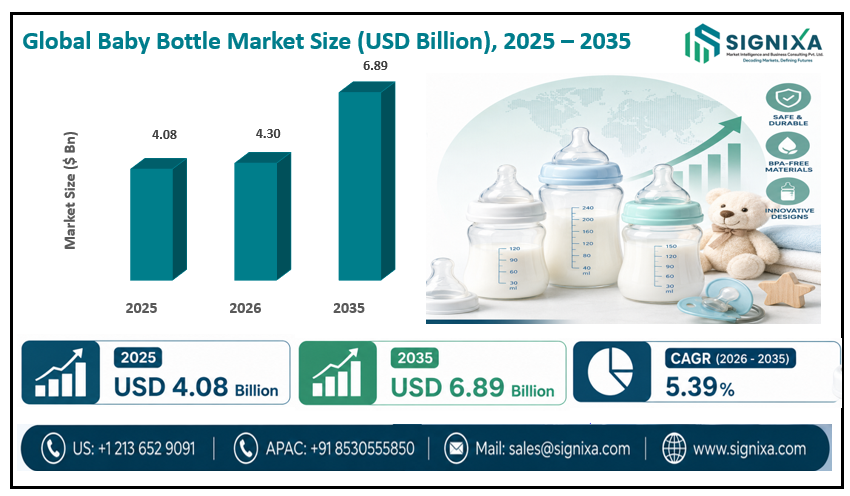
The size of the global baby bottle market was valued at approximately USD 4.08 Billion in 2025 and is projected to grow to around USD 6.89 Billion by 2035, at a CAGR of about 5.39% during the forecast period (2026-2035). The report evaluates the major growth drivers and challenges, and explores the opportunities emerging across key regions in the baby bottle market.
Baby Bottle Market Overview
The baby bottle category has many different types of feeding vessels designed to feed milk, formula and other liquids to an infant and/or toddler. With an increase in awareness of infant nutrition, a heightened preference for safe, non-toxic materials, and higher birth rates in developing parts of the world, sales of baby bottles are on the rise. This notable market change is toward improved quality of BPA-free products in combination with innovation in material and designs that lead to better safety and convenience for parents.
The global baby bottle market is experiencing consistent growth, driven by increasing birth rates in developing economies, growing awareness of infant nutrition, and rising demand for convenient feeding solutions. Baby bottles, used to feed infants with breast milk, formula, or other liquids, have become essential parenting tools across urban and rural households alike. Modern parents, especially working mothers, prefer bottles that are safe, hygienic, and easy to use, prompting strong demand for BPA-free plastic, silicone, and glass bottles. The popularity of anti-colic bottles that reduce air intake and prevent gas has also surged, contributing to market expansion.
Technological advancements have introduced baby bottles with heat sensors, self-sterilizing features, and temperature control to enhance feeding safety and convenience. E-commerce platforms, supermarkets, and baby product specialty stores are increasingly offering a wide range of bottles, making them more accessible to consumers. Brands are also focusing on ergonomic designs, lightweight materials, and compatibility with breast pumps, which adds to their appeal. However, concerns over plastic usage and increasing interest in eco-friendly alternatives have led to a rise in demand for sustainable materials like glass and stainless steel. Additionally, stringent health and safety standards across regions necessitate continuous product innovation and regulatory compliance. Growth is further supported by rising disposable incomes, increasing healthcare awareness, and global campaigns on breastfeeding and infant care. With ongoing innovation and expanding distribution networks, the baby bottle market is set to remain robust, particularly in Asia Pacific, North America, and parts of the Middle East over the next few years.
Key Findings
- The global baby bottle market is projected to grow at a CAGR of approximately 5.39% from 2026 to 2035.
- In terms of revenue, the market stood at USD 4.08 Billion in 2025 and is expected to reach USD 6.89 Billion by 2035.
- Based on Product Type, plastic baby bottles remain the dominant segment due to affordability and widespread availability.
- Silicone baby bottles are gaining traction as the fastest-growing material segment (6%+ CAGR), due to their flexibility and safety benefits.
- Glass baby bottles are preferred by health-conscious, premium-segment parents for their durability and chemical-free nature.
- Offline channels still lead in distribution (50%+ share), but online platforms are rapidly expanding at 7%+ CAGR through 2035.
- Asia Pacific is expected to be the fastest-growing region in the market, driven by birth rates and rising middle-class incomes.
Baby Bottle Market Dynamics
Parental Safety Awareness, BPA-Free Demand & Dual-Income Household Lifestyle Shifts
The rapid growth of the baby bottle industry is mainly due to the heightened awareness of parents regarding safe feeding options. Because parents are more knowledgeable about BPA and other chemicals that can be found in conventional plastic bottles, we are seeing consumers shift towards BPA-free and eco-friendly bottles. New government regulations and standards for quality of baby bottles are also increasing consumer confidence especially in developed nations. An increase in dual-income households and the fast-paced lifestyle of modern life are also pushing parents towards more reliable, durable, effective, and easy-to-use baby bottles.
The baby bottle market is being significantly shaped by evolving parental lifestyles, technological innovation, and heightened awareness of infant health. Urbanization and the rise of dual-income households have led to increased reliance on bottle feeding due to time constraints and work-life balance concerns. As a result, consumers are demanding bottles that offer both safety and convenience. Products with anti-colic features, ergonomic designs, and compatibility with breast pumps are gaining traction. Furthermore, the rise in premature births and adoption of formula feeding in cases of medical necessity have increased the demand for reliable feeding equipment. Health-conscious parents are also showing preference for bottles that are free from harmful chemicals such as BPA, phthalates, and PVC.
Material Innovation -Silicone, Borosilicate Glass & Stainless Steel Solutions
Manufacturers are looking at many innovations in material science to satisfy consumer desire for safety, durability, and eco-friendliness. Products are being made from silicone and borosilicate glass which are non-leaching and heat resistant, and seeing increased popularity. The premium segment is gaining popularity with stainless steel bottles. These innovations align with the shift towards sustainability on a global scale. The market is also being impacted by design innovation, such as changing to an anti-colic nipple, ergonomic shape, and indicating temperature changes, which improve both the user experience and child health.
E-Commerce Growth, Smart Feeding Tech & Social Media Parenting Communities
The growth of online retail is rapidly changing the baby bottle distribution landscape. E-commerce provides consumers with greater variety of products, access to global brands, and allows consumers to shop from home, all of which are appealing for technology-focused and urban consumers. Significant brands are using e-commerce to reach new customers and are turning to e-commerce to provide customers with personalized product recommendations. While offline retail is being significantly challenged by e-commerce, offline retail is holding firm, especially in developing areas, as many consumers are more comfortable evaluating products in person.
Another major dynamic influencing market growth is the rise of e-commerce and digital marketing strategies, which have expanded product visibility and availability. Online platforms enable parents to compare features, read reviews, and access global brands easily, helping niche products reach broader markets. Moreover, social media parenting communities are playing a critical role in product awareness and peer recommendations. Innovation in materials and smart feeding solutions, including temperature-sensing and self-sterilizing bottles, are gaining consumer interest, especially among tech-savvy parents. However, regulatory scrutiny related to material safety and infant health is intensifying, compelling manufacturers to adhere to strict quality standards.
Baby Bottle Market Segmentation Analysis
By Product Type Segment Analysis: Material Comparison
Plastic (BPA-Free)
Plastic baby bottles dominated revenue share in 2025 as they are generally inexpensive, lightweight, and largely available. Even though there are reservations regarding chemical-leaching from plastics, BPA-free plastics have largely regained consumer confidence. The durability, low cost, and easy utilization of a plastic baby bottle make it a staple to families who are budget-oriented in both developed and developing countries.
Silicone
Silicone bottles are projected to experience the strongest growth through 2035 due to their flexible, non-toxic, and heat-resistant features. The silicone baby bottle segment is expanding at a rate above 6% yearly. These bottles are increasingly being purchased by parents for newborns and infants seeking a squeezable soft bottle that is safe for children, specifically in North America and Europe.
Glass (Borosilicate)
Health-conscious parents who desire a chemical-free and durable alternative choose glass baby bottles. In 2025, the segment held a strong share and performed well in urban markets where there is better awareness of product safety. While the price point of glass baby bottles prevents mass adoption, they remain highly popular with premium buyers. Borosilicate glass offers superior heat resistance and durability compared to standard glass.
Stainless Steel
While still a niche segment, stainless steel baby bottles are gaining traction because of their unrivalled durability and temperature retention, as well as their eco-friendliness. They are very popular for travel, and demand is expected to increase steadily, particularly in the premium and environmentally-friendly segments. Parents seeking a lifetime-durable, completely non-toxic option increasingly gravitate toward stainless steel.
By Distribution Channel Segment Analysis
Offline (Pharmacies, Baby Stores, Supermarkets)
In 2025, offline continues to be the strongest form of channel distribution, accounting for over half of the market share. Physical stores provide a tactile shopping experience that allows parents to physically evaluate product quality. Important sales venues are pharmacies, specialty baby care and toy stores, and supermarkets. This segment benefits from trust and immediate product availability, as well as receiving aid from in-store promotional support. Healthcare professionals and hospitals in North America often recommend specific bottle types through in-store and pharmacy channels, reinforcing offline's dominant position.
Online (E-Commerce & Brand Websites)
The online channel is expected to grow by over 7% CAGR till 2035, due to the rise in internet penetration, digital payment methods and enticing discounts available in e-commerce channels. The strength is especially prominent in the urban parts of Asia Pacific and North America with the focus being convenience and access to global brands. Social media parenting communities and influencer-driven recommendations on platforms like Instagram and YouTube are increasingly driving online baby product purchases, particularly among millennial and Gen Z parents.
Report Attributes & Market Scope
| Report Attribute | Details |
|---|---|
| Market Size Value in 2025 | USD 4.08 Billion |
| Market Size Value in 2035 | USD 6.89 Billion |
| CAGR (2026-2035) | 5.39% |
| Base Year Used for Estimation | 2025 |
| Historic Data | 2020-2025 |
| Forecast Period | 2026-2035 |
| Segments Covered -By Product Type |
|
| Segments Covered -By Distribution Channel |
|
| Regions Covered | North America, Europe, Asia Pacific, Latin America, Middle East and Africa |
| Major Countries Covered | U.S., Canada, Mexico, Germany, UK, France, Italy, Spain, Russia, China, Japan, South Korea, India, Southeast Asia Countries, Brazil, Argentina, GCC Countries, Turkey, Iran, Israel, South Africa, Egypt, Nigeria, etc. |
| Key Companies Profiled | Philips Avent, the Pigeon Corporation, Dr. Brown's, Comotomo, MAM Babyartikel, NUK (Newell Brands), Tommee Tippee, Medela, Lansinoh, and Evenflo Feeding. |
Baby Bottle Market Regional Analysis
The baby bottle market worldwide is dominated by the Asia Pacific region as it has the largest birth rate, and a growing middle class that is increasing its disposable income and spending on infant care solutions and products in China and India. North America ranked second in the world and it has a strong market for sustainable premium baby bottles, trust for brand names, high consumer awareness, and purchasing power. Europe is tracking similarly with increasing regulatory scrutiny and awareness regarding safety concerns and more research regarding products for small infants and toddlers. Latin America and the Middle East & Africa are trailing markets that represent a moderate but consistent growth opportunity due to the expansion of retail networks and increased awareness programs that better educate families on infant health.
North America
North America holds a prominent position in the global baby bottle market, driven by high awareness of infant nutrition, strong purchasing power, and early adoption of innovative baby care products. The United States and Canada are the primary contributors, where parents are highly informed about child health and safety standards. As working parents increase in number, the reliance on baby bottles for both formula and expressed breast milk has grown substantially. This has led to strong demand for bottles that are BPA-free, anti-colic, easy to sterilize, and ergonomically designed. The region has also embraced premium and smart feeding solutions, including temperature-sensing and self-sterilizing bottles.
The dominance of well-established retail networks, including supermarkets, baby specialty stores, and a rapidly growing e-commerce sector, further strengthens market accessibility. Brands benefit from robust digital marketing and influencer-driven promotions on platforms like Instagram and YouTube, which influence parental buying behaviour. Moreover, healthcare professionals and hospitals in North America often recommend specific bottle types, influencing consumer preferences. Regulatory oversight from agencies like the U.S. FDA ensures high product safety standards, reinforcing consumer trust in quality-certified products. Sustainability trends are also beginning to impact the market, with eco-conscious parents opting for glass or stainless steel bottles over plastic.
Asia-Pacific
In the Asia Pacific region, the baby bottle market is witnessing rapid expansion, fuelled by a growing population and rising disposable incomes. Urbanization and changing lifestyles are leading to an increase in working mothers, which in turn drives the demand for convenient feeding solutions. The market is characterized by a shift towards premium products, with parents increasingly prioritizing safety and quality. Innovations such as anti-colic designs and customizable feeding bottles are gaining popularity. Furthermore, the rise of e-commerce platforms is enhancing product accessibility, allowing consumers to explore a broader range of options. As health awareness grows, manufacturers are focusing on developing products that align with modern parenting values. China and India are the largest markets, while Southeast Asia and South Korea are also contributing significantly to regional growth.
Europe
The Europe baby bottle market is experiencing steady growth, driven by increasing birth rates and a rising focus on infant health and nutrition. Parents are becoming more discerning, seeking high-quality, safe, and innovative feeding solutions. The demand for eco-friendly materials is also on the rise, with many manufacturers transitioning to BPA-free plastics and glass options. E-commerce has significantly impacted the market, providing parents with easy access to a wide variety of products. Additionally, the competitive landscape features both established brands and new entrants, fostering continuous innovation and product diversification. European regulatory requirements for biocide safety and chemical standards in baby products push manufacturers to adopt the highest quality materials.
Middle East & Africa
The Middle East and Africa baby bottle market is evolving, supported by a growing awareness of infant nutrition and health. Increasing birth rates and a rising number of working mothers are contributing to the demand for baby feeding products. The market is marked by a shift towards premium and safe feeding solutions, with parents seeking BPA-free and eco-friendly options. Additionally, the expansion of retail channels, including e-commerce, is facilitating access to a diverse range of products. As competition intensifies, brands are focusing on innovative designs and marketing strategies that resonate with local consumer preferences, ensuring sustained growth in this dynamic market. GCC countries represent the highest-value segment due to high disposable incomes and a preference for established global baby care brands.
Latin America
Latin America represents a moderate but consistent growth opportunity in the baby bottle market due to the expansion of retail networks and increased awareness programs that better educate families on infant health. Brazil and Mexico are the largest markets in the region, supported by growing birth rates, expanding middle-class populations, and increasing investment in baby care product distribution infrastructure. As e-commerce penetration grows and awareness of safe feeding materials improves, demand for BPA-free and premium baby bottles is gradually increasing across urban Latin American markets.
Recent Developments in the Baby Bottle Market
-
2023
Philips Avent launched a new line of anti-colic glass baby bottles with ergonomic design and natural latch nipples, combining the premium chemical-free benefits of borosilicate glass with advanced anti-colic valve technology. The launch responds to growing demand among health-conscious parents for glass feeding solutions that also address colic and gas issues in newborns.
-
2022
Comotomo introduced travel-friendly silicone bottles with smart temperature sensing features, integrating a color-changing indicator into the silicone body to alert parents when milk is too hot. The product demonstrates the industry's acceleration toward smart feeding solutions that combine silicone's safety benefits with technology-enabled convenience for modern parents.
Baby Bottle Market: Competitive Landscape
Major players in the global baby bottle industry include Philips Avent, the Pigeon Corporation, Dr. Brown's, Comotomo, MAM Babyartikel, NUK (Newell Brands), Tommee Tippee, Medela, Lansinoh, and Evenflo Feeding. The competitive space is characterized by product innovation, premiumization, and marketing outreach. Companies are introducing BPA-free, anti-colic, and sustainability bottles to target parents who are increasingly turned off by products that they feel are unsafe. Partnerships with e-commerce and entering emerging markets will remain high priority.
The competitive landscape of the baby bottle market is marked by continuous innovation, strategic branding, and a strong emphasis on quality, safety, and design. Companies are investing heavily in research and development to introduce advanced features such as anti-colic valves, heat-sensitive indicators, self-sterilizing mechanisms, and smart connectivity to monitor feeding patterns. Manufacturers are increasingly focused on using non-toxic, BPA-free, and eco-friendly materials like borosilicate glass, stainless steel, and medical-grade silicone to meet the growing demand for safer and more sustainable products. The market is also witnessing a rise in customization options, including bottles tailored for different age groups, flow rates, and ergonomic preferences. A significant shift towards digital retail channels has led brands to optimize their online presence, leveraging e-commerce platforms and social media marketing to target tech-savvy millennial and Gen Z parents. Influencer collaborations and user-generated content have become powerful tools in shaping brand perception and driving engagement. Regional players are also expanding aggressively through partnerships, mergers, and acquisitions to strengthen their global footprint and gain access to new markets. Simultaneously, private-label and store brands are intensifying price competition, particularly in emerging economies. Companies are responding with value-added services such as feeding consultations, bundling baby care products, and offering subscription models. Additionally, there is growing attention to meeting international regulatory requirements and safety certifications, which further intensify the need for quality assurance and compliance.
Key Companies Profiled
- Philips Avent
- Pigeon Corporation
- Dr. Brown's
- Comotomo
- MAM Babyartikel
- NUK (Newell Brands)
- Tommee Tippee
- Medela
- Lansinoh
- Evenflo Feeding
Global Baby Bottle Market Segmentation Summary
By Product Type
- Plastic (BPA-Free)
- Silicone
- Glass (Borosilicate)
- Stainless Steel
By Distribution Channel
- Offline
- Online
By Region
- North America
- U.S.
- Canada
- Mexico
- Europe
- Germany
- France
- UK
- Spain
- Italy
- Rest of Europe
- Asia-Pacific
- China
- Japan
- India
- Australia
- South Korea
- Southeast Asia
- Rest of Asia-Pacific
- Latin America
- Brazil
- Argentina
- Rest of Latin America
- The Middle East & Africa
- GCC Countries
- South Africa
- Rest of the Middle East & Africa
Frequently Asked Questions (FAQs): Baby Bottle Market
What is a baby bottle?
A baby bottle is a feeding container typically made of plastic, glass, silicone, or stainless steel, designed to help infants and toddlers consume milk, formula, or other liquids. It includes a bottle body and a nipple and may also feature anti-colic vents and ergonomic designs for easier feeding.
Which key factors will influence the baby bottle market growth over 2026-2035?
The baby bottle market is expected to grow due to increasing parental awareness about infant health, rising demand for BPA-free and non-toxic materials, product innovation in design and materials, and expansion of e-commerce platforms that improve accessibility and availability.
What will be the value of the baby bottle market during 2026-2035?
According to the study, the global baby bottle market was valued at around USD 4.08 Billion in 2025 and is projected to reach approximately USD 6.89 Billion by 2035.
What will be the CAGR value of the baby bottle market during 2026-2035?
The compound annual growth rate (CAGR) of the baby bottle market is expected to be around 5.39% from 2026 to 2035.
Which region will contribute notably towards the baby bottle market value?
Asia Pacific is projected to be the fastest-growing region in the global baby bottle market, driven by large infant populations, growing urbanization, and increasing disposable incomes. Europe and North America also contribute significantly due to high product awareness and preference for premium-quality baby care items.
Which are the major players leveraging the baby bottle market growth?
Key players operating in the global baby bottle market include Philips Avent, Pigeon Corporation, Dr. Brown's, Tommee Tippee, Munchkin Inc., Comotomo, NUK, Medela AG, Mayborn Group Limited, and Evenflo Feeding Inc.
What can be expected from the global baby bottle market report?
The report provides a comprehensive analysis of the global baby bottle market, covering critical aspects such as growth drivers, restraints, future opportunities, material trends, distribution channel insights, regional performance, and competitive landscape from 2026 to 2035.