
Aircraft Seating Market Overview
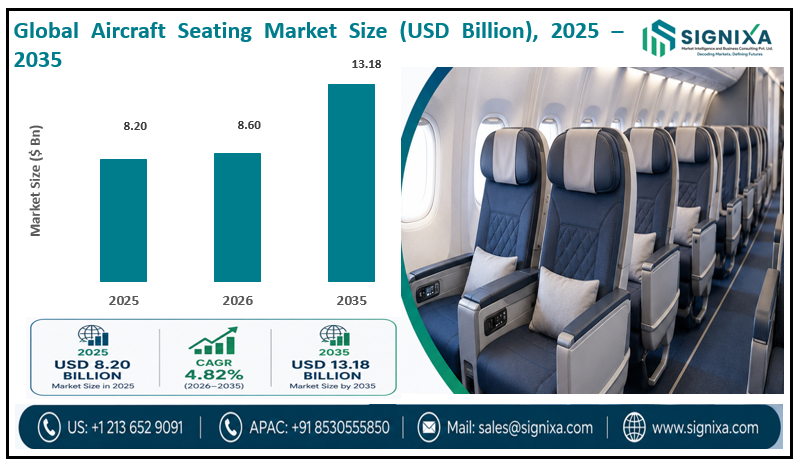
The size of the global Aircraft Seating Market was valued at approximately USD 8.20 Billion in 2025 and is projected to reach around USD 13.18 Billion by 2035, growing at a compound annual growth rate (CAGR) of 4.82% from 2026 to 2035. The report analyzes the market's drivers and restraints and evaluates opportunities throughout the projection period.
The aircraft seating market includes a wide range of seat types designed for use in commercial and military aircraft. Rising passenger traffic, increasing air travel demand, and the fleet modernization strategies of airlines are boosting market demand. As airlines prioritize passenger comfort and aircraft weight optimization, innovations in lightweight and ergonomic seating solutions are gaining traction. Increased aircraft deliveries, particularly in emerging markets, also support sustained growth in seating demand.
The aircraft seating market plays a crucial role in shaping the overall passenger experience and operational efficiency of airlines. Aircraft seats are no longer perceived as static components but as value-generating features that contribute to both comfort and revenue. Airlines are increasingly adopting modular seating designs to accommodate varying travel classes economy, premium economy, business, and first class with enhanced customizability. This trend is driven by the growing competition among carriers to differentiate through superior in-flight experience, especially on long-haul routes. Technological integration in seating such as in-flight entertainment systems, power outlets, wireless charging, and ergonomic controls has become standard across most fleet upgrades.
Lightweight composite materials are being used in seat frames and cushions to reduce aircraft weight and improve fuel efficiency without compromising durability. Moreover, seat design is now deeply influenced by cabin layout optimization, ensuring space maximization and regulatory compliance. As airlines look to optimize cost-per-seat-mile, manufacturers are tasked with producing high-strength, lighter, and thinner seats that retain comfort and safety. Regulatory standards regarding crashworthiness, flammability, and emergency evacuation are also pushing continuous innovation in design and materials. This convergence of engineering, safety, and passenger well-being makes aircraft seating a strategic focal point within the broader aerospace value chain.
Increasing demand for air travel, especially from emerging economies and low-cost carriers, has created new priorities within the aircraft seating landscape. Airlines in Asia-Pacific, the Middle East, and Africa are rapidly expanding their fleets, prompting a spike in demand for seating solutions that can serve diverse demographics and cultural preferences. For instance, wider seat pitch, lumbar support, and adjustable features are increasingly sought after in premium classes, while high-density seating remains crucial for low-cost operations. Additionally, refurbishments of aging aircraft with modernized cabin interiors are driving aftermarket demand, often requiring retrofitting of new seats compatible with legacy configurations. Environmental consciousness is also shaping the market, with airlines opting for seats made from recycled or sustainably sourced materials to reduce their carbon footprint. Moreover, with rising expectations for personal space and hygiene in the post-pandemic era, antimicrobial fabrics and privacy features like winged headrests are gaining popularity. The evolution of business and first-class seats into private suite-style layouts is further redefining luxury travel norms. These innovations reflect a broader shift where aircraft seating is no longer an afterthought in aircraft design—it is a central element aligned with customer satisfaction, operational strategy, and brand identity. As such, seat manufacturers must adapt to shifting global preferences while meeting the strict safety and certification benchmarks of aviation authorities.
Key Findings
- The global Aircraft Seating market is expected to grow at a CAGR of 4.82% during the forecast period (2026–2035).
- The market was valued at USD 8.20 Billion in 2025 and is projected to reach USD 13.18 Billion by 2035.
- The Commercial Aircraft segment dominates the market by aircraft type due to the continuous expansion of global airline fleets, rising air passenger traffic, and increasing aircraft deliveries to meet growing travel demand.
- The Economy Class segment is anticipated to command the largest market share as airlines prioritize maximizing passenger capacity while offering cost-effective seating solutions for the largest traveler segment.
- Among seat types, the 16G Seats category leads due to compliance with safety regulations, making them the industry standard for commercial aircraft and ensuring enhanced passenger protection during impact events.
- The OEM remains the leading end-use segment owing to the strong demand for factory-installed seating systems in newly manufactured aircraft delivered by major aircraft manufacturers.
- North America is projected to dominate the global aircraft seating market during the forecast period because of its well-established aerospace manufacturing ecosystem, presence of leading aircraft OEMs and seat manufacturers, and sustained investments in fleet modernization.
Aircraft Seating Market Dynamics
Rising Global Air Passenger Traffic Driving Aircraft Seating Market Growth
Growing air passenger traffic across developing and developed economies is a major driver fueling aircraft seating demand. Airlines are expanding their fleets and retrofitting older aircraft to accommodate increasing traffic. IATA reported over 4.7 billion global air travelers in 2023, and the number is expected to exceed 6.5 billion by 2035. This surge in demand is pushing aircraft manufacturers and seating solution providers to increase production capacities and develop advanced, lightweight, and comfortable seating options that optimize space and fuel efficiency.
Growing Demand for Premium and Customized Seating Solutions Enhancing Passenger Experience
The rising demand for customized and premium seating configurations, particularly in business and premium economy classes. Airlines are investing in improved passenger experience as a competitive differentiator. Luxurious seating designs with enhanced ergonomics, inflight entertainment systems, and smart technology integration are becoming essential, especially for long-haul and premium routes. Furthermore, advances in seat structures using composite materials help reduce aircraft weight and improve fuel efficiency, aligning with airline sustainability goals.
Technological Advancements and Lightweight Materials Transforming Aircraft Seating Design
The aircraft seating market is increasingly shaped by rapid advancements in materials and technology. Airlines now seek smart seats integrated with digital features like adjustable headrests, in-seat power supply, wireless charging docks, and personal touchscreens to enhance passenger comfort and entertainment. Additionally, the development of intelligent sensors embedded in seats allows real-time monitoring of passenger posture and vital signs, which is of particular interest in long-haul business and first-class cabins. Manufacturers are adopting advanced design software and 3D printing to customize seating components more efficiently, reducing lead time and enabling innovative shapes and contours for improved ergonomics. The trend toward using lightweight composite materials, such as carbon fiber-reinforced polymers, is driven by the need to reduce aircraft weight, fuel consumption, and emissions. These materials maintain high structural strength while minimizing weight, thus supporting both economic and sustainability goals. Seating systems are also being designed to be modular, allowing quicker reconfiguration of aircraft interiors during maintenance or layout changes. This level of flexibility benefits fleet operators who wish to switch between high- and low-density layouts based on seasonal demand. As digitalization deepens within the aerospace industry, the incorporation of IoT-enabled seating solutions will likely further revolutionize the passenger experience and operational data collection for airlines, solidifying seating as a critical technological touchpoint onboard.
Rising Passenger Demand for Premium Comfort and Personalized Seating Experiences
Passenger expectations have evolved dramatically, especially in premium cabins, influencing the dynamics of the aircraft seating market. Today’s travelers prioritize privacy, comfort, and customization, prompting airlines to upgrade first- and business-class seats to suite-style accommodations with lie-flat beds, sliding doors, ambient lighting, and personal storage compartments. This trend has gained momentum among full-service carriers aiming to differentiate their offerings in an intensely competitive environment. Even in economy class, the demand for enhanced seat ergonomics, increased legroom, and upgraded in-flight entertainment has led to the development of slimline seats with optimized cushioning and larger entertainment screens. The premium economy segment has also emerged as a crucial battleground, offering a mid-tier experience with recliner-style seating and improved legroom, targeting both business travelers on a budget and leisure flyers seeking extra comfort. These developments are encouraging seat manufacturers to diversify their product portfolios to cater to varied market segments. Additionally, airlines are now engaging passengers in seating design decisions through feedback and surveys, ensuring future designs align with user preferences. In this context, seating has evolved from being a fixed cost element to a revenue-generating asset. Airlines can now price differentiated seat experiences, turning comfort features into sources of ancillary income. This dynamic emphasizes the intersection of design, personalization, and monetization in the evolving aircraft seating landscape.
Stringent Aviation Safety Regulations Driving Aircraft Seating Innovation
Aircraft seating must conform to rigorous regulatory and safety standards, which play a significant role in shaping product development. Aviation authorities such as the FAA (Federal Aviation Administration) and EASA (European Union Aviation Safety Agency) mandate seat designs that meet crashworthiness, flammability, and evacuation criteria. This includes withstanding vertical and horizontal impact forces, integrating flame-retardant materials, and enabling rapid egress in emergencies. These requirements directly impact material selection, structural engineering, and installation methods. For example, seats must endure a 16g crash test to be certified for use in commercial aircraft. Moreover, in the wake of evolving safety concerns, there’s a push toward seats that incorporate integrated restraint systems, airbags, and head-impact protection mechanisms. Compliance not only adds complexity to seat development but also increases certification costs and timelines. However, these strict standards drive innovation by encouraging manufacturers to find creative solutions that meet both safety and comfort goals. Additionally, as air travel expands to new markets, international harmonization of certification processes is becoming more relevant, prompting global seat suppliers to align their designs with multiple jurisdictions. The pressure to enhance safety while maintaining lightweight design and functionality ensures that regulation remains a central force in directing the course of research, development, and innovation in the aircraft seating market.
Sustainability and Eco-Friendly Materials Shaping the Future of Aircraft Seating
Sustainability has become a defining factor in aircraft seating strategies as the aviation industry faces mounting pressure to reduce its environmental footprint. Airlines are increasingly seeking seats that not only enhance operational efficiency but also minimize their lifecycle impact. This has spurred demand for recyclable, lightweight materials that offer both structural performance and environmental responsibility. Seat manufacturers are responding by introducing components made from recycled aluminium, bio-based polymers, and eco-friendly foams. The adoption of weight-saving materials significantly reduces fuel consumption and greenhouse gas emissions per flight, aligning with airline sustainability goals. Additionally, fabric suppliers are developing upholstery made from regenerated fibers or treated with water-based, non-toxic coatings to eliminate harmful chemicals. Lifecycle assessments are also being incorporated into seating projects, evaluating the environmental costs of production, use, and disposal. Modular seating is another sustainable design approach, enabling easier repairs and part replacements, thus reducing waste. Airlines with aggressive ESG (Environmental, Social, and Governance) targets are beginning to prioritize sustainability credentials during procurement processes, influencing the competitive positioning of seat vendors. Over time, sustainability will likely become not just a value-add but a baseline requirement in aircraft seating bids. The shift to greener design not only satisfies environmental standards but also reflects growing passenger expectations for responsible air travel.
Aircraft Seating Aftermarket Expansion Driven by Fleet Retrofitting and Cabin Modernization
The aftermarket segment for aircraft seating is emerging as a significant growth driver due to increasing demand for retrofitting older aircraft with modern seating solutions. As global fleets age, many airlines are opting to upgrade interiors rather than acquire new aircraft, especially in a cost-sensitive environment. This creates opportunities for seating suppliers to offer tailored retrofit programs that enhance cabin aesthetics, seating density, and passenger comfort without extensive reengineering of aircraft interiors. Airlines may seek to replace worn-out or outdated seats with slimline, lighter, and more ergonomic alternatives, or to convert configurations to adapt to changing route demands. For instance, carriers shifting toward long-haul routes may install lie-flat business-class seats in previously all-economy layouts. Additionally, the leasing market’s growth has spurred interest in seating solutions that are modular and easily replaceable, simplifying reconfiguration between leasing cycles. This has led to increased collaboration between seating manufacturers, maintenance providers, and aircraft lessors to streamline retrofit operations. The aftermarket also includes services such as upholstery replacement, part refurbishment, and customized branding, creating a recurring revenue model beyond initial installations. As airlines continue to prioritize cost-efficiency and adaptability, the aftermarket for aircraft seating is poised to play an increasingly strategic role in maintaining fleet relevance and competitive edge.
Aircraft Seating Market Segmentation Analysis
By Aircraft Type Segment Analysis
Commercial Aircraft accounted for the largest share in 2025 due to a rise in international travel and expansion of airline fleets. Boeing and Airbus collectively delivered over 1,200 commercial aircraft in 2025, directly impacting seat demand.
By Class Segment Analysis
Economy Class dominates the segment, capturing over 60% of global share in 2025, owing to maximum passenger capacity and widespread use in commercial aviation. Premium Economy Class is growing steadily as airlines target comfort-conscious travelers at an affordable upgrade. Business Class sees robust growth, particularly on long-haul international routes where passenger comfort and in-flight services are priorities.
By Seat Type Segment Analysis
The 16G Seats led the market in 2025, comprising over 55% of total demand, driven by stringent aviation safety standards set by FAA and EASA. 9G Seats are used in military and light aircraft, primarily in niche applications. 21G Seats are an emerging category, gaining attention for enhanced safety and next-gen aircraft compatibility.
By Component Segment Analysis
Structure held the largest revenue share in 2025 due to its essential role in seat integrity and safety. Foams are crucial for passenger comfort and accounted for 20% of component revenue. Actuators and Electrical Fittings are experiencing higher demand with the integration of adjustable and smart seats. Others include tray tables, armrests, and entertainment systems that enhance passenger experience.
By End-Use Segment Analysis
OEM dominated the segment with over 70% of market share in 2025 due to large-scale deliveries of new aircraft by major manufacturers. Aftermarket demand is growing due to cabin retrofitting, maintenance, and upgrades in older aircraft fleets.
Report Attributes & Market Scope
| Report Attribute | Details |
|---|---|
| Market Size Value in 2025 | USD 8.20 Billion |
| Market Size Value in 2035 | USD 13.18 Billion |
| CAGR (2026–2035) | 4.82% |
| Base Year Used for Estimation | 2025 |
| Historic Data | 2020 - 2025 |
| Forecast Period | 2026 - 2035 |
| Segments Covered – By Aircraft Type |
|
| Segments Covered – By Class |
|
| Segments Covered – By Seat Type |
|
| Segments Covered – By Component |
|
| Segments Covered – By End-Use |
|
| Regions Covered | North America, Europe, Asia Pacific, Latin America, Middle East and Africa |
| Major Countries Covered | U.S., Canada, Mexico, Germany, UK, France, Italy, Spain, Russia, China, Japan, South Korea, India, Southeast Asia Countries, Brazil, Argentina, GCC Countries, Turkey, Iran, Israel, South Africa, Egypt, Nigeria, etc. |
| Key Companies Profiled | RECARO Aircraft Seating, Collins Aerospace, Safran Seats, Jamco Corporation, Thompson Aero Seating, Aviointeriors S.p.A., ZIM Aircraft Seating GmbH, Geven S.p.A., Expliseat, and HAECO Cabin Solutions, among others. |
Aircraft Seating Market Regional Analysis
North America led the global aircraft seating market in 2025, driven by the presence of leading aircraft OEMs like Boeing and key seating manufacturers. The region benefits from a mature aviation industry, strong regulatory frameworks, and significant investments in R&D. Europe follows closely, supported by Airbus production facilities and growing air travel across the continent. The Asia-Pacific market is expected to witness the fastest growth rate due to expanding airline networks, rising disposable income, and government initiatives to boost regional connectivity. Meanwhile, the Middle East & Africa and Latin America represent emerging markets with increasing investments in airport infrastructure and fleet expansion.
North America represents a mature yet strategically pivotal market for aircraft seating, driven by the presence of major airline operators, leading aircraft manufacturers, and robust demand for domestic and transcontinental travel. The region has witnessed steady fleet modernization initiatives by carriers such as American Airlines, Delta, and United, spurring demand for next-generation seating configurations that enhance comfort and accommodate evolving passenger preferences. The business and first-class segments remain especially lucrative, with airlines investing in premium seating upgrades like lie-flat suites, personal partitions, and integrated digital interfaces to retain high-value travelers. Additionally, the rise of low-cost carriers in the U.S. and Canada is shaping demand for cost-effective economy-class seat designs that balance weight, density, and comfort. The region's strong regulatory environment—anchored by the Federal Aviation Administration (FAA)—further drives innovation and compliance in seat design, safety, and materials. Retrofit activity is also growing, with airlines replacing aging seat systems to meet evolving customer expectations without investing in new aircraft. Moreover, the presence of key seat manufacturers, design firms, and aerospace engineering hubs in the U.S. positions North America as a center for R&D and customized seat development, reinforcing its leadership in the global aircraft seating landscape.
Recent Developments in the Aircraft Seating Market
-
2026
RECARO Aircraft Seating introduced its R4 Premium Economy seat for commercial operations with All Nippon Airways (ANA) on Boeing 787-9 aircraft. The new seat is designed to reduce weight while enhancing passenger comfort, helping airlines improve cabin efficiency and the overall travel experience.
-
2025
RECARO Aircraft Seating strengthened its collaboration with Air India by supplying premium economy and economy seats for the airline's new Boeing 787-9 aircraft. This marked the company's first line-fit seating program with Air India, supporting the carrier's ongoing fleet expansion and cabin modernization efforts.
Thompson Aero Seating expanded its premium business-class offerings by introducing advanced modular seating platforms. These solutions provide airlines with greater cabin layout flexibility while improving passenger comfort and optimizing the use of available cabin space.
Aircraft Seating Market: Competitive Landscape
Major players in the global aircraft seating market include RECARO Aircraft Seating, Collins Aerospace, Safran Seats, Jamco Corporation, Thompson Aero Seating, Aviointeriors S.p.A., ZIM Aircraft Seating GmbH, Geven S.p.A., Expliseat, and HAECO Cabin Solutions. The competitive landscape is characterized by a strong focus on lightweight design, regulatory compliance, passenger comfort, and integration of smart technologies. Leading companies are continuously investing in R&D and entering strategic partnerships with airlines and aircraft OEMs to stay ahead in the rapidly evolving market for next-generation aircraft seating solutions.
Key Companies Profiled
- RECARO Aircraft Seating
- Collins Aerospace
- Safran Seats
- Jamco Corporation
- Thompson Aero Seating
- Aviointeriors S.p.A.
- ZIM Aircraft Seating GmbH
- Geven S.p.A.
- Expliseat
- HAECO Cabin Solutions
- Acro Aircraft Seating Ltd.
- Adient Aerospace
- STELIA Aerospace
- Mirus Aircraft Seating Ltd.
- Hong Kong Aircraft Engineering Company (HAECO)
Global Aircraft Seating Market Segmentation Summary
By Aircraft Type
- Commercial
- Business Jets
- Regional Aircraft
- Transport Aircraft (Military & Commercial Aircraft)
By Class
- Economy Class
- Premium Economy Class
- Business Class
By Seat Type
- 9G Seats
- 16G Seats
- 21G Seats
By Component
- Structure
- Foams
- Actuators
- Electrical Fittings
- Others
By End Use
- OEM
- Aftermarket
By Region
- North America
- U.S.
- Canada
- Mexico
- Europe
- Germany
- France
- UK
- Spain
- Italy
- Rest of Europe
- Asia-Pacific
- China
- Japan
- India
- Australia
- South Korea
- Southeast Asia
- Rest of Asia-Pacific
- Latin America
- Brazil
- Argentina
- Rest of Latin America
- The Middle East & Africa
- GCC Countries
- South Africa
- Rest of the Middle East & Africa
Frequently Asked Questions (FAQs) About the Aircraft Seating Market
What is Aircraft Seating?
Aircraft seating refers to the seats installed in airplanes across different classes—economy, premium economy, and business—for commercial, regional, and military aircraft. These seats are designed to meet comfort, safety, weight, and regulatory standards while offering features such as reclining mechanisms, in-flight entertainment systems, and power outlets.
Which key factors will influence the Aircraft Seating Market growth over 2026–2035?
The aircraft seating market is expected to grow due to rising global air passenger traffic, increasing fleet expansion by airlines, technological advancements in lightweight and ergonomic seat designs, and a growing emphasis on passenger comfort and in-flight services.
What will be the value of the Aircraft Seating Market during 2026–2035?
The global Aircraft Seating Market accounted for around USD 8.20 Billion in 2025 and is forecast to attain a value of approximately USD 13.18 Billion by 2035.
What will be the CAGR value of the Aircraft Seating Market during 2026–2035?
The Aircraft Seating Market is projected to grow at a CAGR of 4.82% during the forecast period of 2026–2035, driven by rising global air passenger traffic, increasing commercial aircraft deliveries, and growing investments in lightweight, fuel-efficient, and passenger-centric cabin seating solutions.
Which region will contribute notably towards the Aircraft Seating Market value?
North America is projected to lead the aircraft seating market due to the presence of major aircraft manufacturers and high commercial air travel demand. Asia-Pacific is expected to grow at the fastest rate due to increasing investments in aviation infrastructure and rising passenger traffic in China, India, and Southeast Asia.
Which are the major players leveraging the Aircraft Seating Market growth?
Key companies driving the market include RECARO Aircraft Seating, Collins Aerospace, Safran Seats, Jamco Corporation, Thompson Aero Seating, Aviointeriors S.p.A., ZIM Aircraft Seating GmbH, Geven S.p.A., Expliseat, and HAECO Cabin Solutions.
What can be expected from the global Aircraft Seating Market report?
The report offers a detailed analysis of current market trends, growth drivers, restraints, and future opportunities. It includes comprehensive segmentation by aircraft type, seating class, seat type, component, and end-use, as well as regional forecasts and an overview of competitive strategies adopted by leading players in the global aircraft seating industry.