
Global Horticulture Bioplastic Market Size, Share, Growth & Forecast 2026-2035

Market Research Report  |  Base Year: 2025  |  Forecast Period: 2026-2035

Market Size (2025)
USD 2.33 Bn
Market Size (2035)
USD 6.18 Bn
CAGR (2026–2035)
10.27%
Leading Region
North America

Horticulture Bioplastic Market Overview

The global horticulture bioplastic market was valued at around USD 2.33 billion in 2025 and is projected to grow to approximately USD 6.18 billion by 2035, with a compound annual growth rate (CAGR) of 10.27% from 2026 to 2035. The report offers a comprehensive analysis of the horticulture bioplastic market’s drivers and restraints, with a focus on key growth factors and emerging opportunities that will shape the market over the coming years.

The horticulture bioplastics market includes bioplastics used in various agricultural applications, such as mulching films, seedling trays, planters, greenhouse covers, and compost bags. The market growth is attributed to the increasing demand for sustainable and eco-friendly agricultural practices, rising awareness of environmental concerns, and government initiatives promoting the use of bioplastics. These materials, often derived from renewable resources like PLA (Polylactic Acid) and PHA (Polyhydroxyalkanoates), are being adopted as alternatives to traditional plastic products in horticultural applications. The market is also driven by the need for biodegradable and compostable materials in agriculture, reducing plastic waste and its impact on the environment.

The horticulture bioplastic market is gaining strong momentum as the global agriculture sector shifts towards sustainable and eco-friendly practices. Bioplastics, derived from renewable sources such as starch, cellulose, or polylactic acid (PLA), are being increasingly adopted for applications like mulch films, plant pots, seed trays, and greenhouse coverings. These materials help reduce dependency on fossil fuels, mitigate plastic pollution, and offer biodegradability that aligns with circular economy goals. In horticulture, bioplastics enhance soil health by minimizing residue buildup, and many products degrade naturally into the soil without harming crops or microbial activity.

Government regulations and bans on conventional single-use plastics in agriculture are further propelling the adoption of bioplastic solutions. Additionally, rising awareness among farmers, horticulturists, and consumers about sustainable agricultural inputs is reinforcing market growth. Manufacturers are also focusing on developing bioplastics that can perform under diverse climatic conditions, offering comparable durability and flexibility to petroleum-based counterparts. The integration of controlled biodegradation timelines and cost-effective production processes is becoming central to product innovation. Furthermore, collaborations between bioplastic developers and horticultural product manufacturers are leading to tailored solutions that meet specific crop and regional requirements. Europe remains a major market due to strict environmental policies, while Asia-Pacific is emerging rapidly due to large-scale farming and growing environmental concerns. As demand for environmentally responsible cultivation methods rises, the horticulture bioplastic market is expected to expand steadily, supported by technological advancements, favorable policies, and increasing consumer pressure to adopt greener agricultural practices.

Key Findings

  • The global horticulture bioplastic market is estimated to grow at a CAGR of 10.27% %over the forecast period (2026-2035), reaching a market size of USD 6.18 billion by 2035 from USD 2.33 billion in 2025.
  • The market is majorly driven by applications such as mulching films and seedling trays, which continue to dominate due to their widespread use in commercial horticulture.
  • PLA and PBAT are expected to hold significant shares in the material types used, given their biodegradability and effectiveness in horticultural applications.
  • North America and Europe are expected to dominate the global horticulture bioplastic market, driven by regulatory support and consumer demand for eco-friendly products.
  • Commercial horticulture will continue to lead the end-use segment, accounting for the largest market share due to the high adoption of bioplastics in large-scale farming operations.
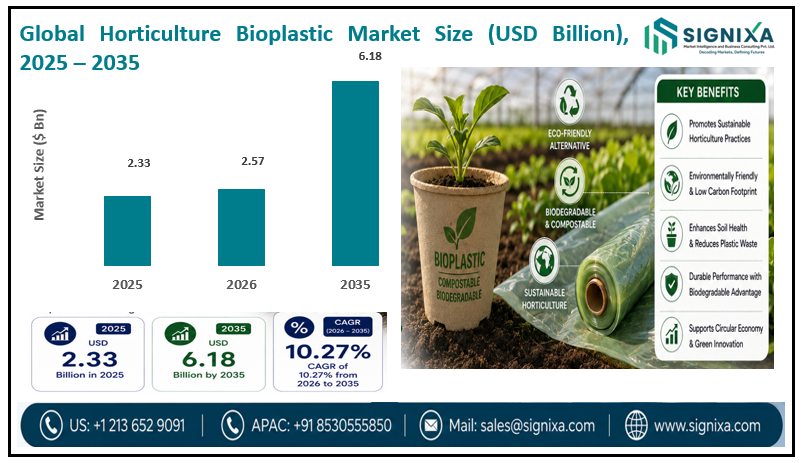
Image 1779191372

Horticulture Bioplastic Market Dynamics

A growing concern over plastic waste and its environmental impact is a major driver for the horticulture bioplastics market. Conventional plastics used in horticulture, such as plastic mulch and containers, contribute significantly to landfill waste. Bioplastics, made from renewable resources like corn and sugarcane, offer an eco-friendly alternative that decomposes naturally, reducing the carbon footprint. The adoption of bioplastics is also bolstered by increasing government support through regulations and subsidies promoting the use of biodegradable materials. As industries and consumers become more environmentally conscious, the demand for horticulture bioplastics is expected to rise substantially.

Innovation in bioplastic production technologies has improved the quality, cost-effectiveness, and availability of bioplastics in horticultural applications. For instance, the development of high-performance PLA and PBAT bioplastics, which are both biodegradable and capable of withstanding various environmental conditions, is significantly boosting their adoption in agricultural sectors. Technological improvements have also led to cost reductions, making bioplastics more competitive with traditional petroleum-based plastics. As these technologies evolve, the range of bioplastics available for horticultural applications continues to expand, fueling market growth.

Government regulations that mandate the reduction of plastic waste and promote the use of sustainable products are playing a crucial role in the growth of the horticulture bioplastics market. For instance, many countries are implementing laws that restrict the use of single-use plastics, thus encouraging the adoption of alternatives like bioplastics. Consumer preferences are also shifting towards products that align with sustainability goals, further accelerating demand. As awareness regarding the environmental impact of plastic waste increases, both businesses and consumers are increasingly turning to biodegradable solutions in agriculture.

The growing focus on sustainable agriculture is one of the primary drivers for the horticulture bioplastic market. Farmers and horticulturists are increasingly adopting biodegradable plastics to reduce environmental impact and align with eco-conscious consumer preferences. Traditional plastics used in mulch films, seed trays, and pots often accumulate in soil and pose long-term environmental hazards. In contrast, bioplastics decompose naturally, enriching soil without releasing toxins. This shift is being supported by global policy interventions aimed at banning or limiting single-use plastics, particularly in the European Union and parts of Asia. Moreover, the agricultural sector is under pressure to demonstrate responsible practices to meet export standards, especially in markets that prioritize environmental certifications. As awareness spreads regarding the benefits of bioplastics—such as enhanced soil health, reduced waste management costs, and improved crop productivity—their adoption is rising steadily. This increasing demand is compelling manufacturers to invest in R&D, leading to bioplastics that offer greater flexibility, durability, and climate resilience.

Despite their environmental benefits, the high production costs of horticulture bioplastics remain a significant barrier. Compared to petroleum-based plastics, bioplastics are often more expensive due to limited economies of scale, raw material costs, and processing complexities. Small and medium-scale farmers in developing economies may find it difficult to justify the upfront investment, especially in the absence of subsidies or financial incentives. Additionally, the performance of some bioplastic products may be compromised under extreme climatic conditions, such as high humidity or intense UV exposure, leading to premature degradation or reduced functionality. There is also a knowledge gap among end users regarding proper usage, storage, and disposal practices for bioplastics. Without adequate awareness and training, the effectiveness of these materials can be diminished. Furthermore, limited recycling infrastructure and the absence of uniform standards for biodegradability contribute to market hesitancy. Addressing these concerns through technological improvements and policy support is essential for broader market penetration.

Horticulture Bioplastic Market Segmentation Analysis

By Application Segment Analysis

Mulching films are widely used in agricultural fields to suppress weed growth, retain moisture, and regulate soil temperature. The demand for bioplastic mulching films is increasing due to the environmental benefits over traditional plastic films, which can take years to decompose. The market for bioplastic mulching films is growing as farmers seek more sustainable solutions, with an estimated market share of 35% in 2024. Seedling trays made from bioplastics help in raising plants in greenhouses or nurseries and are gaining popularity due to their environmental advantages. The growth of commercial horticulture, especially in regions such as North America and Europe, has led to an increased adoption of these eco-friendly alternatives.

Bioplastic planters are becoming increasingly popular due to their biodegradability and sustainability. Made from materials like PLA and PBAT, they provide an alternative to traditional plastic planters. With the growing trend in home gardening and commercial landscaping, the planters segment is experiencing steady growth. Bioplastic greenhouse covers, which allow for better light transmission and environmental control, are becoming more widespread. These products not only support sustainable farming practices but also reduce energy consumption in greenhouse operations. Compost bags made from biodegradable materials are increasingly replacing traditional plastic bags, especially in organic farming and gardening. These bags break down naturally, supporting the composting process, and are seeing increasing demand across both commercial and residential horticulture.

By Material Segment Analysis

PLA is the most widely used material in horticulture bioplastics due to its excellent biodegradability and ability to be produced from renewable resources like corn and sugarcane. It holds the largest market share in the material type segment, with projections showing significant growth as it is increasingly adopted in mulching films and seedling trays.

PHA is another biodegradable polymer that is gaining traction in the horticulture industry due to its higher degradation rate and environmental benefits. Although it currently holds a smaller market share compared to PLA, PHA’s unique properties are expected to drive its demand in the coming years. PBAT is widely used in bioplastics for its flexibility and excellent performance in horticulture applications such as compost bags and greenhouse covers. Its growing adoption as a biodegradable plastic alternative to conventional plastics is expected to increase its share in the market. Derived from plants, cellulose-based bioplastics are being explored for use in horticultural applications. Their natural origin and biodegradable properties make them a viable option, although their adoption is still limited compared to PLA and PBAT.

By End Use Segment Analysis

The commercial horticulture segment is expected to dominate the bioplastic market, accounting for the largest share. As large-scale farms seek sustainable solutions, the demand for biodegradable products like mulching films and seedling trays is increasing. These products help commercial farmers minimize waste and comply with environmental regulations. The growing interest in sustainable practices among home gardeners is pushing the demand for eco-friendly products, including bioplastic planters and compost bags. This segment is expanding as consumer awareness about the environmental impact of traditional plastics rises.

Research institutions are increasingly focusing on sustainable materials, including bioplastics, for agricultural experiments. This segment is driven by the need for eco-friendly solutions to study plant growth and soil health without the negative impact of plastic waste. Landscaping companies are adopting bioplastic products for more sustainable garden designs, such as biodegradable planters and mulch. The increasing demand for green spaces in urban areas is expected to boost the growth of the landscaping end-use segment.

By Distribution Channel Segment Analysis

The rise of e-commerce has made it easier for consumers and businesses to access bioplastics. Online retail accounts for a significant share of the distribution channel, as consumers seek convenient access to sustainable products. Physical retail stores, especially garden centers and hardware stores, remain key players in the distribution of horticulture bioplastics, catering to both home gardeners and commercial horticulturists.

Wholesale distributors are critical for supplying bioplastics in bulk to commercial horticulture businesses, landscapers, and agricultural enterprises. Some manufacturers and retailers opt for direct sales models to reach large-scale customers, offering them customized bioplastic products for specific horticultural needs.

Report Attributes & Market Scope

Report Attribute Details
Market Size Value in 2025 USD 2.33 Billion
Market Size Value in 2035 USD 6.18 Billion
CAGR (2026–2035) 10.27%
Base Year Used for Estimation 2025
Historic Data 2020 - 2025
Forecast Period 2026 - 2035
Segments Covered – By Application
  • Mulching Films
  • Seedling Trays
  • Planters
  • Greenhouse Covers
  • Compost Bags
Segments Covered – By Material
  • PLA
  • PHA
  • Starch Blends
  • PBAT
  • Cellulose
Segments Covered – By End Use
  • Commercial Horticulture
  • Home Gardening
  • Research Institutions
  • Landscaping
Regions Covered North America, Europe, Asia Pacific, Latin America, Middle East and Africa
Major Countries Covered U.S., Canada, Mexico, Germany, UK, France, Italy, Spain, Russia, China, Japan, South Korea, India, Southeast Asia Countries, Brazil, Argentina, GCC Countries, Turkey, Iran, Israel, South Africa, Egypt, Nigeria, etc.
Key Companies Profiled BASF, NatureWorks LLC, Total Corbion PLA, Novamont, and Biome Bioplastics among others.

Horticulture Bioplastic Market Regional Analysis

North America holds the largest market share for horticulture bioplastics due to strict regulations on plastic waste, heightened environmental awareness, and high adoption rates in both commercial horticulture and home gardening. North America holds a significant position in the horticulture bioplastic market, driven by the region’s strong emphasis on sustainable agricultural practices and regulatory support for eco-friendly materials. The U.S. and Canada have witnessed a rising shift toward biodegradable mulch films, seedling trays, and plant pots to reduce the environmental impact of conventional plastics. With increasing consumer demand for organic and sustainable produce, horticulturists and farmers are adopting bioplastics as a practical solution for soil enrichment and plastic waste reduction. The region also benefits from a well-established bioplastic manufacturing infrastructure and access to raw materials such as corn starch and PLA.

Governmental policies supporting sustainable agriculture and the banning of non-degradable plastics in several states are fueling adoption. In addition, rising public awareness, farmer education programs, and partnerships between agri-tech companies and research institutions are helping promote bioplastic usage across both commercial and small-scale horticulture operations. Companies in North America are focusing on developing high-performance bioplastics that can withstand varying weather conditions, ensuring durability throughout growing cycles. Furthermore, the integration of smart agricultural practices such as precision farming and environmentally conscious input usage complements the application of biodegradable materials. However, cost sensitivity among small farmers and limited awareness in some regions remain challenges. Despite this, continuous innovation, rising demand for sustainable food systems, and favorable policies are likely to sustain the region’s growth trajectory in the horticulture bioplastic market, making North America a key contributor to global sustainability goals in agricultural production.

Europe is expected to maintain steady growth in the horticulture bioplastics market, with a strong push toward sustainability and innovation in bioplastic materials. Government policies promoting the use of bioplastics are a key factor in the region's growth. Europe stands at the forefront of the horticulture bioplastic market, driven by its robust regulatory framework, heightened environmental awareness, and a strong commitment to circular economy principles. The European Union’s stringent bans and restrictions on single-use plastics have accelerated the shift toward biodegradable and compostable alternatives in agriculture. Countries like Germany, France, the Netherlands, and Italy have been especially proactive in integrating bioplastics into horticultural practices, including the use of mulch films, plant pots, and seed trays that break down naturally after use. These materials support soil health while minimizing pollution and the labor costs associated with plastic removal.

The region’s emphasis on organic farming and sustainable food production aligns well with the adoption of bioplastics, as they comply with EU directives and certifications for eco-friendly farming inputs. Supportive subsidies and incentive programs offered by national governments and the EU further encourage their usage, particularly among small and mid-sized farms. Moreover, Europe is home to several research institutions and industry players pioneering advancements in bioplastic formulations, improving durability and cost-efficiency. Collaborations between universities, manufacturers, and farming cooperatives are fueling innovation tailored to Europe’s diverse climatic zones.

Despite these advantages, the high cost of bioplastics relative to traditional plastics remains a hurdle for widespread adoption, especially in Eastern European countries with budget-constrained farming communities. However, growing consumer demand for sustainably grown produce and technological progress in bio-based materials are expected to bridge this gap. As a result, Europe continues to lead by example in transitioning toward greener horticultural practices powered by bioplastic solutions.

The Asia-Pacific region is witnessing rapid growth, especially in emerging markets like China and India, where commercial horticulture and large-scale farming are on the rise. The region's growing awareness of environmental issues is driving demand for bioplastics.

Recent Developments in the Horticulture Bioplastic Market

  • 2023

    BASF launched a new line of PLA-based bioplastics designed specifically for horticultural applications.

  • 2022

    NatureWorks LLC announced a partnership with leading agricultural companies to develop advanced bioplastics for use in seedling trays and compost bags.

Horticulture Bioplastic Market: Competitive Landscape

The horticulture bioplastic market is highly competitive, featuring key players such as BASF, NatureWorks LLC, Total Corbion PLA, Novamont, and Biome Bioplastics. These companies focus on product innovation, sustainability, and cost-effectiveness to gain a competitive edge in the growing market. They are investing in expanding their product offerings and production capacities to meet the rising demand for biodegradable and eco-friendly horticultural solutions. Competitive strategies include partnerships, mergers, and acquisitions, as well as investments in R&D for advanced bioplastics. As the market grows, these companies will continue to shape the industry's future with sustainable and innovative bioplastic products.

Key Companies Profiled

Global Horticulture Bioplastic Market Segmentation Summary

By Application

  • Mulching Films
  • Seedling Trays
  • Planters
  • Greenhouse Covers
  • Compost Bags

By Material

  • PLA
  • PHA
  • Starch Blends
  • PBAT
  • Cellulose

By End Use

  • Commercial Horticulture
  • Home Gardening
  • Research Institutions
  • Landscaping

By Region

  • North America (U.S., Canada, Mexico)
  • Europe (Germany, France, UK, Italy, Spain, Rest of Europe)
  • Asia Pacific (China, Japan, India, Australia, South Korea, Southeast Asia, Rest of Asia Pacific)
  • South America (Brazil, Argentina, Rest of South America)
  • Middle East and Africa (GCC Countries, South Africa, Rest of Middle East & Africa)

Frequently Asked Questions (FAQs) About the Horticulture Bioplastic Market

What is Horticulture Bioplastic?

Horticulture bioplastics are environmentally friendly plastic materials used in the horticultural industry, such as mulching films, seedling trays, planters, greenhouse covers, and compost bags. These bioplastics are made from renewable resources like PLA, PHA, starch blends, and cellulose, designed to provide sustainable alternatives to traditional petroleum-based plastics.

Which key factors will influence the Horticulture Bioplastic Market growth over 2026–2035?

The market is expected to grow due to increasing awareness about sustainability, government regulations promoting eco-friendly alternatives, rising demand for biodegradable products in agriculture, and the expansion of organic farming. Additionally, the growing popularity of bioplastics in consumer products will drive the market further.

What will be the value of the Horticulture Bioplastic Market during 2026–2035?

According to the study the global horticulture bioplastic market size was worth approximately USD 2.33 billion in 2025 and is predicted to grow to around USD 6.18 billion by 2035.

What will be the CAGR value of the Horticulture Bioplastic Market during 2026–2035?

The CAGR value of the horticulture bioplastic market is expected to be around 10.27% during 2026-2035, driven by rising demand for sustainable and biodegradable alternatives.

Which region will contribute notably towards the Horticulture Bioplastic Market value?

Europe and North America are expected to contribute significantly to the growth of the horticulture bioplastic market, driven by the increasing adoption of sustainable agricultural practices and government regulations. The Asia-Pacific region is also experiencing rapid growth, due to industrialization and the demand for sustainable solutions in agriculture.

Which are the major players leveraging the Horticulture Bioplastic Market growth?

The global horticulture bioplastic market features prominent players like BASF SE, NatureWorks LLC, Total Corbion PLA, and Novamont S.p.A., along with many regional companies providing innovative bioplastic solutions for horticulture applications.

What can be expected from the global Horticulture Bioplastic Market report?

The report will provide a comprehensive analysis of the horticulture bioplastic market, including detailed insights into market drivers, restraints, and opportunities. It will explore trends in different segments, such as application (mulching films, seedling trays, planters), material types (PLA, PHA), and distribution channels (online retail, wholesale distributors), along with a competitive analysis and regional outlook.

Global Horticulture Bioplastic Market Size, Share, Growth & Forecast 2026-2035

Market Research Report  |  Base Year: 2025  |  Forecast Period: 2026-2035

Market Size (2025)
USD 2.33 Bn
Market Size (2035)
USD 6.18 Bn
CAGR (2026–2035)
10.27%
Leading Region
North America

Horticulture Bioplastic Market Overview

The global horticulture bioplastic market was valued at around USD 2.33 billion in 2025 and is projected to grow to approximately USD 6.18 billion by 2035, with a compound annual growth rate (CAGR) of 10.27% from 2026 to 2035. The report offers a comprehensive analysis of the horticulture bioplastic market’s drivers and restraints, with a focus on key growth factors and emerging opportunities that will shape the market over the coming years.

The horticulture bioplastics market includes bioplastics used in various agricultural applications, such as mulching films, seedling trays, planters, greenhouse covers, and compost bags. The market growth is attributed to the increasing demand for sustainable and eco-friendly agricultural practices, rising awareness of environmental concerns, and government initiatives promoting the use of bioplastics. These materials, often derived from renewable resources like PLA (Polylactic Acid) and PHA (Polyhydroxyalkanoates), are being adopted as alternatives to traditional plastic products in horticultural applications. The market is also driven by the need for biodegradable and compostable materials in agriculture, reducing plastic waste and its impact on the environment.

The horticulture bioplastic market is gaining strong momentum as the global agriculture sector shifts towards sustainable and eco-friendly practices. Bioplastics, derived from renewable sources such as starch, cellulose, or polylactic acid (PLA), are being increasingly adopted for applications like mulch films, plant pots, seed trays, and greenhouse coverings. These materials help reduce dependency on fossil fuels, mitigate plastic pollution, and offer biodegradability that aligns with circular economy goals. In horticulture, bioplastics enhance soil health by minimizing residue buildup, and many products degrade naturally into the soil without harming crops or microbial activity.

Government regulations and bans on conventional single-use plastics in agriculture are further propelling the adoption of bioplastic solutions. Additionally, rising awareness among farmers, horticulturists, and consumers about sustainable agricultural inputs is reinforcing market growth. Manufacturers are also focusing on developing bioplastics that can perform under diverse climatic conditions, offering comparable durability and flexibility to petroleum-based counterparts. The integration of controlled biodegradation timelines and cost-effective production processes is becoming central to product innovation. Furthermore, collaborations between bioplastic developers and horticultural product manufacturers are leading to tailored solutions that meet specific crop and regional requirements. Europe remains a major market due to strict environmental policies, while Asia-Pacific is emerging rapidly due to large-scale farming and growing environmental concerns. As demand for environmentally responsible cultivation methods rises, the horticulture bioplastic market is expected to expand steadily, supported by technological advancements, favourable policies, and increasing consumer pressure to adopt greener agricultural practices.

Key Findings

  • The global horticulture bioplastic market is estimated to grow at a CAGR of 10.27% %over the forecast period (2026-2035), reaching a market size of USD 6.18 billion by 2035 from USD 2.33 billion in 2025.
  • The market is majorly driven by applications such as mulching films and seedling trays, which continue to dominate due to their widespread use in commercial horticulture.
  • PLA and PBAT are expected to hold significant shares in the material types used, given their biodegradability and effectiveness in horticultural applications.
  • North America and Europe are expected to dominate the global horticulture bioplastic market, driven by regulatory support and consumer demand for eco-friendly products.
  • Commercial horticulture will continue to lead the end-use segment, accounting for the largest market share due to the high adoption of bioplastics in large-scale farming operations.

 Horticulture Bioplastic Market

Horticulture Bioplastic Market Dynamics

A growing concern over plastic waste and its environmental impact is a major driver for the horticulture bioplastics market. Conventional plastics used in horticulture, such as plastic mulch and containers, contribute significantly to landfill waste. Bioplastics, made from renewable resources like corn and sugarcane, offer an eco-friendly alternative that decomposes naturally, reducing the carbon footprint. The adoption of bioplastics is also bolstered by increasing government support through regulations and subsidies promoting the use of biodegradable materials. As industries and consumers become more environmentally conscious, the demand for horticulture bioplastics is expected to rise substantially.

Innovation in bioplastic production technologies has improved the quality, cost-effectiveness, and availability of bioplastics in horticultural applications. For instance, the development of high-performance PLA and PBAT bioplastics, which are both biodegradable and capable of withstanding various environmental conditions, is significantly boosting their adoption in agricultural sectors. Technological improvements have also led to cost reductions, making bioplastics more competitive with traditional petroleum-based plastics. As these technologies evolve, the range of bioplastics available for horticultural applications continues to expand, fuelling market growth.

Government regulations that mandate the reduction of plastic waste and promote the use of sustainable products are playing a crucial role in the growth of the horticulture bioplastics market. For instance, many countries are implementing laws that restrict the use of single-use plastics, thus encouraging the adoption of alternatives like bioplastics. Consumer preferences are also shifting towards products that align with sustainability goals, further accelerating demand. As awareness regarding the environmental impact of plastic waste increases, both businesses and consumers are increasingly turning to biodegradable solutions in agriculture.

The growing focus on sustainable agriculture is one of the primary drivers for the horticulture bioplastic market. Farmers and horticulturists are increasingly adopting biodegradable plastics to reduce environmental impact and align with eco-conscious consumer preferences. Traditional plastics used in mulch films, seed trays, and pots often accumulate in soil and pose long-term environmental hazards. In contrast, bioplastics decompose naturally, enriching soil without releasing toxins. This shift is being supported by global policy interventions aimed at banning or limiting single-use plastics, particularly in the European Union and parts of Asia. Moreover, the agricultural sector is under pressure to demonstrate responsible practices to meet export standards, especially in markets that prioritize environmental certifications. As awareness spreads regarding the benefits of bioplastics—such as enhanced soil health, reduced waste management costs, and improved crop productivity—their adoption is rising steadily. This increasing demand is compelling manufacturers to invest in R&D, leading to bioplastics that offer greater flexibility, durability, and climate resilience.

Despite their environmental benefits, the high production costs of horticulture bioplastics remain a significant barrier. Compared to petroleum-based plastics, bioplastics are often more expensive due to limited economies of scale, raw material costs, and processing complexities. Small and medium-scale farmers in developing economies may find it difficult to justify the upfront investment, especially in the absence of subsidies or financial incentives. Additionally, the performance of some bioplastic products may be compromised under extreme climatic conditions, such as high humidity or intense UV exposure, leading to premature degradation or reduced functionality. There is also a knowledge gap among end users regarding proper usage, storage, and disposal practices for bioplastics. Without adequate awareness and training, the effectiveness of these materials can be diminished. Furthermore, limited recycling infrastructure and the absence of uniform standards for biodegradability contribute to market hesitancy. Addressing these concerns through technological improvements and policy support is essential for broader market penetration.

Horticulture Bioplastic Market Segmentation Analysis

By Application Segment Analysis

Mulching films are widely used in agricultural fields to suppress weed growth, retain moisture, and regulate soil temperature. The demand for bioplastic mulching films is increasing due to the environmental benefits over traditional plastic films, which can take years to decompose. The market for bioplastic mulching films is growing as farmers seek more sustainable solutions, with an estimated market share of 35% in 2024. Seedling trays made from bioplastics help in raising plants in greenhouses or nurseries and are gaining popularity due to their environmental advantages. The growth of commercial horticulture, especially in regions such as North America and Europe, has led to an increased adoption of these eco-friendly alternatives.

Bioplastic planters are becoming increasingly popular due to their biodegradability and sustainability. Made from materials like PLA and PBAT, they provide an alternative to traditional plastic planters. With the growing trend in home gardening and commercial landscaping, the planters segment is experiencing steady growth. Bioplastic greenhouse covers, which allow for better light transmission and environmental control, are becoming more widespread. These products not only support sustainable farming practices but also reduce energy consumption in greenhouse operations. Compost bags made from biodegradable materials are increasingly replacing traditional plastic bags, especially in organic farming and gardening. These bags break down naturally, supporting the composting process, and are seeing increasing demand across both commercial and residential horticulture.

PLA is the most widely used material in horticulture bioplastics due to its excellent biodegradability and ability to be produced from renewable resources like corn and sugarcane. It holds the largest market share in the material type segment, with projections showing significant growth as it is increasingly adopted in mulching films and seedling trays.

PHA is another biodegradable polymer that is gaining traction in the horticulture industry due to its higher degradation rate and environmental benefits. Although it currently holds a smaller market share compared to PLA, PHA’s unique properties are expected to drive its demand in the coming years. PBAT is widely used in bioplastics for its flexibility and excellent performance in horticulture applications such as compost bags and greenhouse covers. Its growing adoption as a biodegradable plastic alternative to conventional plastics is expected to increase its share in the market. Derived from plants, cellulose-based bioplastics are being explored for use in horticultural applications. Their natural origin and biodegradable properties make them a viable option, although their adoption is still limited compared to PLA and PBAT.

The commercial horticulture segment is expected to dominate the bioplastic market, accounting for the largest share. As large-scale farms seek sustainable solutions, the demand for biodegradable products like mulching films and seedling trays is increasing. These products help commercial farmers minimize waste and comply with environmental regulations. The growing interest in sustainable practices among home gardeners is pushing the demand for eco-friendly products, including bioplastic planters and compost bags. This segment is expanding as consumer awareness about the environmental impact of traditional plastics rises.

Research institutions are increasingly focusing on sustainable materials, including bioplastics, for agricultural experiments. This segment is driven by the need for eco-friendly solutions to study plant growth and soil health without the negative impact of plastic waste. Landscaping companies are adopting bioplastic products for more sustainable garden designs, such as biodegradable planters and mulch. The increasing demand for green spaces in urban areas is expected to boost the growth of the landscaping end-use segment.

The rise of e-commerce has made it easier for consumers and businesses to access bioplastics. Online retail accounts for a significant share of the distribution channel, as consumers seek convenient access to sustainable products. Physical retail stores, especially garden centers and hardware stores, remain key players in the distribution of horticulture bioplastics, catering to both home gardeners and commercial horticulturists.

Wholesale distributors are critical for supplying bioplastics in bulk to commercial horticulture businesses, landscapers, and agricultural enterprises. Some manufacturers and retailers opt for direct sales models to reach large-scale customers, offering them customized bioplastic products for specific horticultural needs.

Report Attributes & Market Scope

Report Attribute Details
Market Size Value in 2025 USD 2.33 Billion
Market Size Value in 2035 USD 6.18 Billion
CAGR (2026–2035) 10.27%
Base Year Used for Estimation 2025
Historic Data 2020 - 2025
Forecast Period 2026 - 2035
Segments Covered – By Application
  • Mulching Films
  • Seedling Trays
  • Planters
  • Greenhouse Covers
  • Compost Bags
Segments Covered – By Material
  • PLA
  • PHA
  • Starch Blends
  • PBAT
  • Cellulose
Segments Covered – By End Use
  • Commercial Horticulture
  • Home Gardening
  • Research Institutions
  • Landscaping
Regions Covered North America, Europe, Asia Pacific, Latin America, Middle East and Africa
Major Countries Covered U.S., Canada, Mexico, Germany, UK, France, Italy, Spain, Russia, China, Japan, South Korea, India, Southeast Asia Countries, Brazil, Argentina, GCC Countries, Turkey, Iran, Israel, South Africa, Egypt, Nigeria, etc.
Key Companies Profiled BASF, NatureWorks LLC, Total Corbion PLA, Novamont, and Biome Bioplastics among others.
 

Horticulture Bioplastic Market Regional Analysis

North America holds the largest market share for horticulture bioplastics due to strict regulations on plastic waste, heightened environmental awareness, and high adoption rates in both commercial horticulture and home gardening. North America holds a significant position in the horticulture bioplastic market, driven by the region’s strong emphasis on sustainable agricultural practices and regulatory support for eco-friendly materials. The U.S. and Canada have witnessed a rising shift toward biodegradable mulch films, seedling trays, and plant pots to reduce the environmental impact of conventional plastics. With increasing consumer demand for organic and sustainable produce, horticulturists and farmers are adopting bioplastics as a practical solution for soil enrichment and plastic waste reduction. The region also benefits from a well-established bioplastic manufacturing infrastructure and access to raw materials such as corn starch and PLA.

Governmental policies supporting sustainable agriculture and the banning of non-degradable plastics in several states are fuelling adoption. In addition, rising public awareness, farmer education programs, and partnerships between agri-tech companies and research institutions are helping promote bioplastic usage across both commercial and small-scale horticulture operations. Companies in North America are focusing on developing high-performance bioplastics that can withstand varying weather conditions, ensuring durability throughout growing cycles. Furthermore, the integration of smart agricultural practices such as precision farming and environmentally conscious input usage complements the application of biodegradable materials. However, cost sensitivity among small farmers and limited awareness in some regions remain challenges. Despite this, continuous innovation, rising demand for sustainable food systems, and favourable policies are likely to sustain the region’s growth trajectory in the horticulture bioplastic market, making North America a key contributor to global sustainability goals in agricultural production.

Europe is expected to maintain steady growth in the horticulture bioplastics market, with a strong push toward sustainability and innovation in bioplastic materials. Government policies promoting the use of bioplastics are a key factor in the region's growth. Europe stands at the forefront of the horticulture bioplastic market, driven by its robust regulatory framework, heightened environmental awareness, and a strong commitment to circular economy principles. The European Union’s stringent bans and restrictions on single-use plastics have accelerated the shift toward biodegradable and compostable alternatives in agriculture. Countries like Germany, France, the Netherlands, and Italy have been especially proactive in integrating bioplastics into horticultural practices, including the use of mulch films, plant pots, and seed trays that break down naturally after use. These materials support soil health while minimizing pollution and the labour costs associated with plastic removal.

The region’s emphasis on organic farming and sustainable food production aligns well with the adoption of bioplastics, as they comply with EU directives and certifications for eco-friendly farming inputs. Supportive subsidies and incentive programs offered by national governments and the EU further encourage their usage, particularly among small and mid-sized farms. Moreover, Europe is home to several research institutions and industry players pioneering advancements in bioplastic formulations, improving durability and cost-efficiency. Collaborations between universities, manufacturers, and farming cooperatives are fuelling innovation tailored to Europe’s diverse climatic zones.

Despite these advantages, the high cost of bioplastics relative to traditional plastics remains a hurdle for widespread adoption, especially in Eastern European countries with budget-constrained farming communities. However, growing consumer demand for sustainably grown produce and technological progress in bio-based materials are expected to bridge this gap. As a result, Europe continues to lead by example in transitioning toward greener horticultural practices powered by bioplastic solutions.

The Asia-Pacific region is witnessing rapid growth, especially in emerging markets like China and India, where commercial horticulture and large-scale farming are on the rise. The region's growing awareness of environmental issues is driving demand for bioplastics.

Recent Developments in the Horticulture Bioplastic Market

  • 2023

    BASF launched a new line of PLA-based bioplastics designed specifically for horticultural applications.

  • 2022

    NatureWorks LLC announced a partnership with leading agricultural companies to develop advanced bioplastics for use in seedling trays and compost bags.

Horticulture Bioplastic Market: Competitive Landscape

The horticulture bioplastic market is highly competitive, featuring key players such as BASF, NatureWorks LLC, Total Corbion PLA, Novamont, and Biome Bioplastics. These companies focus on product innovation, sustainability, and cost-effectiveness to gain a competitive edge in the growing market. They are investing in expanding their product offerings and production capacities to meet the rising demand for biodegradable and eco-friendly horticultural solutions. Competitive strategies include partnerships, mergers, and acquisitions, as well as investments in R&D for advanced bioplastics. As the market grows, these companies will continue to shape the industry's future with sustainable and innovative bioplastic products.

Key Companies Profiled

  • BASF SE
  • Novamont S.p.A.
  • NatureWorks LLC
  • TotalEnergies Corbion
  • Biome Bioplastics
  • FKuR Kunststoff GmbH
  • BioBag International AS
  • Taghleef Industries
  • Plastika Kritis S.A.
  • RKW Group

Global Horticulture Bioplastic Market Segmentation Summary

By Application

  • Mulching Films
  • Seedling Trays
  • Planters
  • Greenhouse Covers
  • Compost Bags

By Material

  • PLA
  • PHA
  • Starch Blends
  • PBAT
  • Cellulose

By End Use

  • Commercial Horticulture
  • Home Gardening
  • Research Institutions
  • Landscaping

By Region

  • North America (U.S., Canada, Mexico)
  • Europe (Germany, France, UK, Italy, Spain, Rest of Europe)
  • Asia Pacific (China, Japan, India, Australia, South Korea, Southeast Asia, Rest of Asia Pacific)
  • South America (Brazil, Argentina, Rest of South America)
  • Middle East and Africa (GCC Countries, South Africa, Rest of Middle East & Africa)

Frequently Asked Questions (FAQs) About the Horticulture Bioplastic Market

What is Horticulture Bioplastic?

Horticulture bioplastics are environmentally friendly plastic materials used in the horticultural industry, such as mulching films, seedling trays, planters, greenhouse covers, and compost bags. These bioplastics are made from renewable resources like PLA, PHA, starch blends, and cellulose, designed to provide sustainable alternatives to traditional petroleum-based plastics.

Which key factors will influence the Horticulture Bioplastic Market growth over 2026–2035?

The market is expected to grow due to increasing awareness about sustainability, government regulations promoting eco-friendly alternatives, rising demand for biodegradable products in agriculture, and the expansion of organic farming. Additionally, the growing popularity of bioplastics in consumer products will drive the market further.

What will be the value of the Horticulture Bioplastic Market during 2026–2035?

According to the study the global horticulture bioplastic market size was worth approximately USD 2.33 billion in 2025 and is predicted to grow to around USD 6.18 billion by 2035.

What will be the CAGR value of the Horticulture Bioplastic Market during 2026–2035?

The CAGR value of the horticulture bioplastic market is expected to be around 10.27% during 2026-2035, driven by rising demand for sustainable and biodegradable alternatives.

Which region will contribute notably towards the Horticulture Bioplastic Market value?

Europe and North America are expected to contribute significantly to the growth of the horticulture bioplastic market, driven by the increasing adoption of sustainable agricultural practices and government regulations. The Asia-Pacific region is also experiencing rapid growth, due to industrialization and the demand for sustainable solutions in agriculture.

Which are the major players leveraging the Horticulture Bioplastic Market growth?

The global horticulture bioplastic market features prominent players like BASF SE, NatureWorks LLC, Total Corbion PLA, and Novamont S.p.A., along with many regional companies providing innovative bioplastic solutions for horticulture applications.

What can be expected from the global Horticulture Bioplastic Market report?

The report will provide a comprehensive analysis of the horticulture bioplastic market, including detailed insights into market drivers, restraints, and opportunities. It will explore trends in different segments, such as application (mulching films, seedling trays, planters), material types (PLA, PHA), and distribution channels (online retail, wholesale distributors), along with a competitive analysis and regional outlook.

List of Figures

  1. Global Horticulture Bioplastic Market Revenue, Revenue (USD Million) and Volume (Kilo Tons), 2020 - 2035

  2. Competition Analysis

  3. Porter’s Five Forces Analysis

  4. Value Chain Analysis

  5. PESTEL Analysis

  6. Horticulture Bioplastic Market Attractiveness Analysis, By Region

  7. Horticulture Bioplastic Market Attractiveness Analysis, By Application

  8. Horticulture Bioplastic Market Attractiveness Analysis, By Material

  9. Horticulture Bioplastic Market Attractiveness Analysis, By End Use

  10. Company Revenue Share Analysis, 2024

  11. Horticulture Bioplastic Market – Company Revenue Market Share, 2025

  12. Horticulture Bioplastic Market – Company Volume Market Share, 2025

  13. Horticulture Bioplastic Market Revenue Share, By Application, 2025 and 2035

  14. Global Horticulture Bioplastic Market for Mulching Films, Revenue (USD Million) and Volume (Kilo Tons), 2020 - 2035

  15. Global Horticulture Bioplastic Market for Seedling Trays, Revenue (USD Million) and Volume (Kilo Tons), 2020 – 2035

  16. Global Horticulture Bioplastic Market for Planters, Revenue (USD Million) and Volume (Kilo Tons), 2020 - 2035

  17. Global Horticulture Bioplastic Market for Greenhouse Covers, Revenue (USD Million) and Volume (Kilo Tons), 2020 - 2035

  18. Global Horticulture Bioplastic Market for Compost Bags, Revenue (USD Million) and Volume (Kilo Tons), 2020 - 2035

  19. Horticulture Bioplastic Market Revenue Share, By Material, 2024 and 2035

  20. Global Horticulture Bioplastic Market for PLA, Revenue (USD Million) and Volume (Kilo Tons), 2020 - 2035

  21. Global Horticulture Bioplastic Market for PHA, Revenue (USD Million) and Volume (Kilo Tons), 2020 – 2035

  22. Global Horticulture Bioplastic Market for Starch Blends, Revenue (USD Million) and Volume (Kilo Tons), 2020 – 2035

  23. Global Horticulture Bioplastic Market for PBAT, Revenue (USD Million) and Volume (Kilo Tons), 2020 – 2035

  24. Global Horticulture Bioplastic Market for Cellulose, Revenue (USD Million) and Volume (Kilo Tons), 2020 – 2035

  25. Horticulture Bioplastic Market Revenue Share, By End Use, 2025 and 2035

  26. Global Horticulture Bioplastic Market for Commercial Horticulture, Revenue (USD Million) and Volume (Kilo Tons), 2020 - 2035

  27. Global Horticulture Bioplastic Market for Home Gardening, Revenue (USD Million) and Volume (Kilo Tons), 2020 – 2035

  28. Global Horticulture Bioplastic Market for Research Institutions, Revenue (USD Million) and Volume (Kilo Tons), 2020 – 2035

  29. Global Horticulture Bioplastic Market for Landscaping, Revenue (USD Million) and Volume (Kilo Tons), 2020 – 2035

  30. Global Horticulture Bioplastic Market Revenue Share, By Region, 2025 and 2035

  31. Global Horticulture Bioplastic Market Volume Share, By Region, 2025 and 2035

  32. North America Horticulture Bioplastic Market Revenue Share, By Country, 2025 and 2035

  33. North America Horticulture Bioplastic Market Volume Share, By Country, 2025 and 2035

  34. Europe Horticulture Bioplastic Market Revenue Share, By Country, 2025 and 2035

  35. Europe Horticulture Bioplastic Market Volume Share, By Country, 2025 and 2035

  36. Asia Pacific Horticulture Bioplastic Market Revenue Share, By Country, 2025 and 2035

  37. Asia Pacific Horticulture Bioplastic Market Volume Share, By Country, 2025 and 2035

  38. Latin America Horticulture Bioplastic Market Revenue Share, By Country, 2025 and 2035

  39. Latin America Horticulture Bioplastic Market Volume Share, By Country, 2025 and 2035

  40. Middle East Horticulture Bioplastic Market Revenue Share, By Country, 2025 and 2035

  41. Middle East Horticulture Bioplastic Market Volume Share, By Country, 2025 and 2035

  42. Africa Horticulture Bioplastic Market Revenue Share, By Country, 2025 and 2035

  43. Africa Horticulture Bioplastic Market Volume Share, By Country, 2025 and 2035

  44. Growth Strategy

  45. SWOT Analysis

  46. Research Methodology


List of Tables

  1. Global Horticulture Bioplastic Market: Snapshot

  2. Drivers for the Horticulture Bioplastic Market: Impact Analysis

  3. Restraints for the Horticulture Bioplastic Market: Impact Analysis

  4. Global Horticulture Bioplastic Market Revenue, By Region, 2020 - 2026 (USD Million)

  5. Global Horticulture Bioplastic Market Volume, By Region, 2020 - 2026 (Kilo Tons)

  6. Global Horticulture Bioplastic Market Revenue, By Region, 2027 - 2035 (USD Million)

  7. Global Horticulture Bioplastic Market Volume, By Region, 2027 - 2035 (Kilo Tons)

  8. Global Horticulture Bioplastic Market Revenue, By Application, 2020 - 2026 (USD Million

  9. Global Horticulture Bioplastic Market Volume, By Application, 2020 - 2026 (Kilo Tons)

  10. Global Horticulture Bioplastic Market Revenue, By Application, 2027 - 2035 (USD Million)

  11. Global Horticulture Bioplastic Market Volume, By Application, 2027 - 2035 (Kilo Tons)

  12. Global Horticulture Bioplastic Market Revenue, By Material, 2020 - 2026 (USD Million)

  13. Global Horticulture Bioplastic Market Volume, By Material, 2020 - 2026 (Kilo Tons)

  14. Global Horticulture Bioplastic Market Revenue, By Material, 2027 - 2035 (USD Million)

  15. Global Horticulture Bioplastic Market Volume, By Material, 2027 - 2035 (Kilo Tons)

  16. Global Horticulture Bioplastic Market Revenue, By End Use, 2020 - 2026 (USD Million)

  17. Global Horticulture Bioplastic Market Volume, By End Use, 2020 - 2026 (Kilo Tons)

  18. Global Horticulture Bioplastic Market Revenue, By End Use, 2027 - 2035 (USD Million)

  19. Global Horticulture Bioplastic Market Volume, By End Use, 2027 - 2035 (Kilo Tons)

  20. North America Horticulture Bioplastic Market Revenue, By Country, 2020 - 2026 (USD Million)

  21. North America Horticulture Bioplastic Market Volume, By Country, 2020 - 2026 (Kilo Tons)

  22. North America Horticulture Bioplastic Market Revenue, By Country, 2027 - 2035 (USD Million)

  23. North America Horticulture Bioplastic Market Volume, By Country, 2027 - 2035 (Kilo Tons)

  24. North America Horticulture Bioplastic Market Revenue, By Application, 2020 - 2026 (USD Million

  25. North America Horticulture Bioplastic Market Volume, By Application, 2020 - 2026 (Kilo Tons)

  26. North America Horticulture Bioplastic Market Revenue, By Application, 2027 - 2035 (USD Million)

  27. North America Horticulture Bioplastic Market Volume, By Application, 2027 - 2035 (Kilo Tons)

  28. North America Horticulture Bioplastic Market Revenue, By Material, 2020 - 2026 (USD Million)

  29. North America Horticulture Bioplastic Market Volume, By Material, 2020 - 2026 (Kilo Tons)

  30. North America Horticulture Bioplastic Market Revenue, By Material, 2027 - 2035 (USD Million)

  31. North America Horticulture Bioplastic Market Volume, By Material, 2027 - 2035 (Kilo Tons)

  32. North America Horticulture Bioplastic Market Revenue, By End Use, 2020 - 2026 (USD Million)

  33. North America Horticulture Bioplastic Market Volume, By End Use, 2020 - 2026 (Kilo Tons)

  34. North America Horticulture Bioplastic Market Revenue, By End Use, 2027 - 2035 (USD Million)

  35. North America Horticulture Bioplastic Market Volume, By End Use, 2027 - 2035 (Kilo Tons)

  36. Europe Horticulture Bioplastic Market Revenue, By Country, 2020 - 2026 (USD Million)

  37. Europe Horticulture Bioplastic Market Volume, By Country, 2020 - 2026 (Kilo Tons)

  38. Europe Horticulture Bioplastic Market Revenue, By Country, 2027 - 2035 (USD Million)

  39. Europe Horticulture Bioplastic Market Volume, By Country, 2027 - 2035 (Kilo Tons)

  40. Europe Horticulture Bioplastic Market Revenue, By Application, 2020 - 2026 (USD Million

  41. Europe Horticulture Bioplastic Market Volume, By Application, 2020 - 2026 (Kilo Tons)

  42. Europe Horticulture Bioplastic Market Revenue, By Application, 2027 - 2035 (USD Million)

  43. Europe Horticulture Bioplastic Market Volume, By Application, 2027 - 2035 (Kilo Tons)

  44. Europe Horticulture Bioplastic Market Revenue, By Material, 2020 - 2026 (USD Million)

  45. Europe Horticulture Bioplastic Market Volume, By Material, 2020 - 2026 (Kilo Tons)

  46. Europe Horticulture Bioplastic Market Revenue, By Material, 2027 - 2035 (USD Million)

  47. Europe Horticulture Bioplastic Market Volume, By Material, 2027 - 2035 (Kilo Tons)

  48. Europe Horticulture Bioplastic Market Revenue, By End Use, 2020 - 2026 (USD Million)

  49. Europe Horticulture Bioplastic Market Volume, By End Use, 2020 - 2026 (Kilo Tons)

  50. Europe Horticulture Bioplastic Market Revenue, By End Use, 2027 - 2035 (USD Million)

  51. Europe Horticulture Bioplastic Market Volume, By End Use, 2027 - 2035 (Kilo Tons)

  52. Asia Pacific Horticulture Bioplastic Market Revenue, By Country, 2020 - 2026 (USD Million)

  53. Asia Pacific Horticulture Bioplastic Market Volume, By Country, 2020 - 2026 (Kilo Tons)

  54. Asia Pacific Horticulture Bioplastic Market Revenue, By Country, 2027 - 2035 (USD Million)

  55. Asia Pacific Horticulture Bioplastic Market Volume, By Country, 2027 - 2035 (Kilo Tons)

  56. Asia Pacific Horticulture Bioplastic Market Revenue, By Application, 2020 - 2026 (USD Million

  57. Asia Pacific Horticulture Bioplastic Market Volume, By Application, 2020 - 2026 (Kilo Tons)

  58. Asia Pacific Horticulture Bioplastic Market Revenue, By Application, 2027 - 2035 (USD Million)

  59. Asia Pacific Horticulture Bioplastic Market Volume, By Application, 2027 - 2035 (Kilo Tons)

  60. Asia Pacific Horticulture Bioplastic Market Revenue, By Material, 2020 - 2026 (USD Million)

  61. Asia Pacific Horticulture Bioplastic Market Volume, By Material, 2020 - 2026 (Kilo Tons)

  62. Asia Pacific Horticulture Bioplastic Market Revenue, By Material, 2027 - 2035 (USD Million)

  63. Asia Pacific Horticulture Bioplastic Market Volume, By Material, 2027 - 2035 (Kilo Tons)

  64. Asia Pacific Horticulture Bioplastic Market Revenue, By End Use, 2020 - 2026 (USD Million)

  65. Asia Pacific Horticulture Bioplastic Market Volume, By End Use, 2020 - 2026 (Kilo Tons)

  66. Asia Pacific Horticulture Bioplastic Market Revenue, By End Use, 2027 - 2035 (USD Million)

  67. Asia Pacific Horticulture Bioplastic Market Volume, By End Use, 2027 - 2035 (Kilo Tons)

  68. Latin America Horticulture Bioplastic Market Revenue, By Country, 2020 - 2026 (USD Million)

  69. Latin America Horticulture Bioplastic Market Volume, By Country, 2020 - 2026 (Kilo Tons)

  70. Latin America Horticulture Bioplastic Market Revenue, By Country, 2027 - 2035 (USD Million)

  71. Latin America Horticulture Bioplastic Market Volume, By Country, 2027 - 2035 (Kilo Tons)

  72. Latin America Horticulture Bioplastic Market Revenue, By Application, 2020 - 2026 (USD Million

  73. Latin America Horticulture Bioplastic Market Volume, By Application, 2020 - 2026 (Kilo Tons)

  74. Latin America Horticulture Bioplastic Market Revenue, By Application, 2027 - 2035 (USD Million)

  75. Latin America Horticulture Bioplastic Market Volume, By Application, 2027 - 2035 (Kilo Tons)

  76. Latin America Horticulture Bioplastic Market Revenue, By Material, 2020 - 2026 (USD Million)

  77. Latin America Horticulture Bioplastic Market Volume, By Material, 2020 - 2026 (Kilo Tons)

  78. Latin America Horticulture Bioplastic Market Revenue, By Material, 2027 - 2035 (USD Million)

  79. Latin America Horticulture Bioplastic Market Volume, By Material, 2027 - 2035 (Kilo Tons)

  80. Latin America Horticulture Bioplastic Market Revenue, By End Use, 2020 - 2026 (USD Million)

  81. Latin America Horticulture Bioplastic Market Volume, By End Use, 2020 - 2026 (Kilo Tons)

  82. Latin America Horticulture Bioplastic Market Revenue, By End Use, 2027 - 2035 (USD Million)

  83. Latin America Horticulture Bioplastic Market Volume, By End Use, 2027 - 2035 (Kilo Tons)

  84. Middle East Horticulture Bioplastic Market Revenue, By Country, 2020 - 2026 (USD Million)

  85. Middle East Horticulture Bioplastic Market Volume, By Country, 2020 - 2026 (Kilo Tons)

  86. Middle East Horticulture Bioplastic Market Revenue, By Country, 2027 - 2035 (USD Million)

  87. Middle East Horticulture Bioplastic Market Volume, By Country, 2027 - 2035 (Kilo Tons)

  88. Middle East Horticulture Bioplastic Market Revenue, By Application, 2020 - 2026 (USD Million

  89. Middle East Horticulture Bioplastic Market Volume, By Application, 2020 - 2026 (Kilo Tons)

  90. Middle East Horticulture Bioplastic Market Revenue, By Application, 2027 - 2035 (USD Million)

  91. Middle East Horticulture Bioplastic Market Volume, By Application, 2027 - 2035 (Kilo Tons)

  92. Middle East Horticulture Bioplastic Market Revenue, By Material, 2020 - 2026 (USD Million)

  93. Middle East Horticulture Bioplastic Market Volume, By Material, 2020 - 2026 (Kilo Tons)

  94. Middle East Horticulture Bioplastic Market Revenue, By Material, 2027 - 2035 (USD Million)

  95. Middle East Horticulture Bioplastic Market Volume, By Material, 2027 - 2035 (Kilo Tons)

  96. Middle East Horticulture Bioplastic Market Revenue, By End Use, 2020 - 2026 (USD Million)

  97. Middle East Horticulture Bioplastic Market Volume, By End Use, 2020 - 2026 (Kilo Tons)

  98. Middle East Horticulture Bioplastic Market Revenue, By End Use, 2027 - 2035 (USD Million)

  99. Middle East Horticulture Bioplastic Market Volume, By End Use, 2027 - 2035 (Kilo Tons)

  100. Africa Horticulture Bioplastic Market Revenue, By Country, 2020 - 2026 (USD Million)

  101. Africa Horticulture Bioplastic Market Volume, By Country, 2020 - 2026 (Kilo Tons)

  102. Africa Horticulture Bioplastic Market Revenue, By Country, 2027 - 2035 (USD Million)

  103. Africa Horticulture Bioplastic Market Volume, By Country, 2027 - 2035 (Kilo Tons)

  104. Africa Horticulture Bioplastic Market Revenue, By Application, 2020 - 2026 (USD Million

  105. Africa Horticulture Bioplastic Market Volume, By Application, 2020 - 2026 (Kilo Tons)

  106. Africa Horticulture Bioplastic Market Revenue, By Application, 2027 - 2035 (USD Million)

  107. Africa Horticulture Bioplastic Market Volume, By Application, 2027 - 2035 (Kilo Tons)

  108. Africa Horticulture Bioplastic Market Revenue, By Material, 2020 - 2026 (USD Million)

  109. Africa Horticulture Bioplastic Market Volume, By Material, 2020 - 2026 (Kilo Tons)

  110. Africa Horticulture Bioplastic Market Revenue, By Material, 2027 - 2035 (USD Million)

  111. Africa Horticulture Bioplastic Market Volume, By Material, 2027 - 2035 (Kilo Tons)

  112. Africa Horticulture Bioplastic Market Revenue, By End Use, 2020 - 2026 (USD Million)

  113. Africa Horticulture Bioplastic Market Volume, By End Use, 2020 - 2026 (Kilo Tons)

  114. Africa Horticulture Bioplastic Market Revenue, By End Use, 2027 - 2035 (USD Million)

  115. Africa Horticulture Bioplastic Market Volume, By End Use, 2027 - 2035 (Kilo Tons)