

HVAC Variable Frequency Drive (VFD) Market Overview
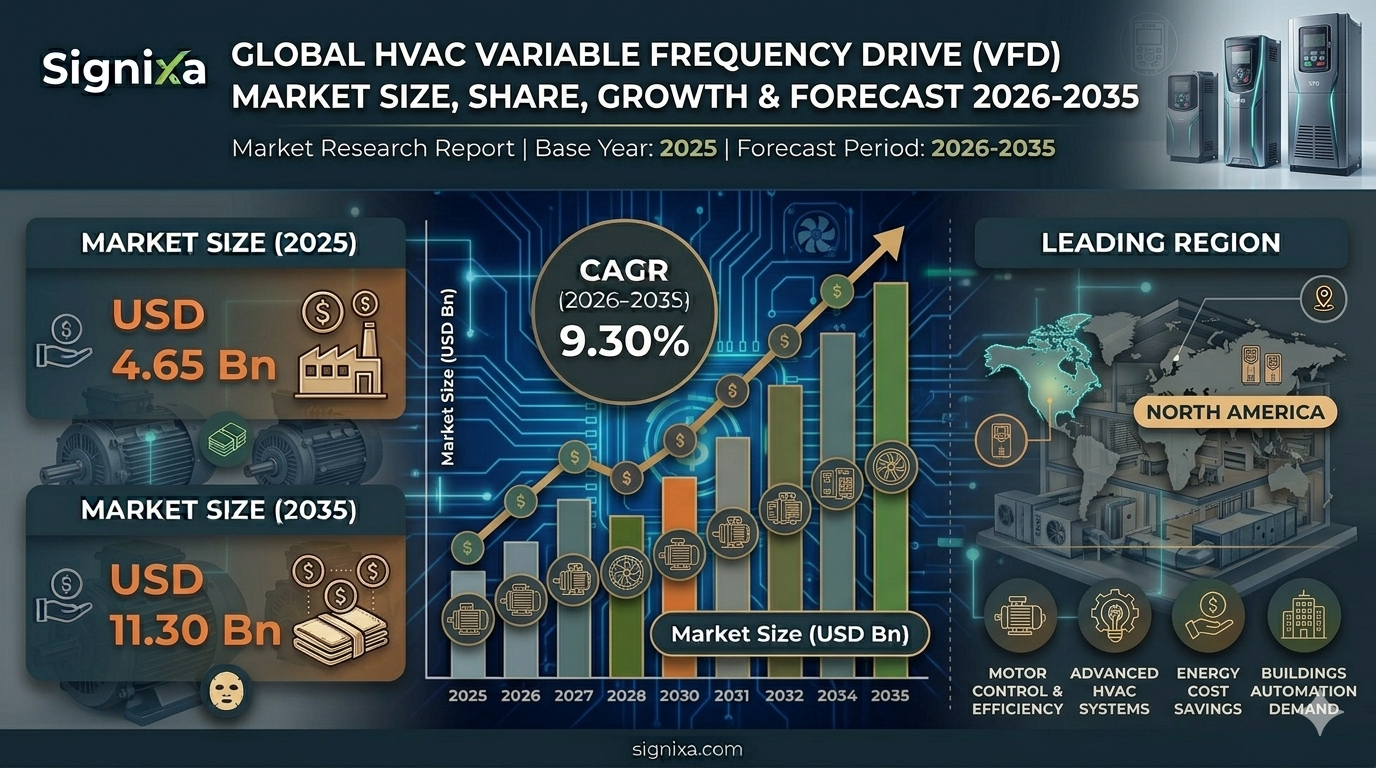
The size of the global HVAC Variable Frequency Drive (VFD) market was around USD 4.65 Billion in 2025 and is predicted to grow to around USD 11.30 Billion by 2035, with a compound annual growth rate (CAGR) of roughly 9.30% between 2026 and 2035. The report analyzes the HVAC VFD market's drivers and restraints, as well as the impact they have on demand throughout the projection period. In addition, the report examines global opportunities in the HVAC VFD market.
The HVAC Variable Frequency Drive market includes products used to control the speed and torque of HVAC motors for energy optimization and system efficiency. VFDs are electronic devices that control the speed of AC electric motors by varying the frequency and voltage of their power supply. In HVAC systems, they precisely regulate the speed of fans, pumps, and compressors, allowing these components to operate at optimal levels rather than a fixed, often excessive, speed. This capability translates into significant energy savings, reduced wear and tear on machinery, lower operational costs, and improved indoor air quality and temperature control.
The market's growth is further propelled by the rapid expansion of smart building initiatives and the increasing adoption of Building Automation Systems (BAS). As urbanization continues globally, there's a growing need for intelligent infrastructure that minimizes energy consumption and optimizes resource utilization. HVAC VFDs are integral to these smart building ecosystems, enabling remote monitoring, predictive maintenance, and seamless integration with other building management platforms. The retrofitting of older buildings with advanced HVAC systems featuring VFDs is a particularly significant trend, offering substantial energy savings for existing infrastructure.
Key Findings
- The global HVAC VFD market is expected to grow at a CAGR of around 9.30% over the forecast period (2026-2035).
- In terms of revenue, the global HVAC VFD market size was valued at around USD 4.65 Billion in 2025 and is projected to reach USD 11.30 Billion by 2035.
- Increasing demand for energy-efficient HVAC systems and rising adoption of smart buildings and building automation systems are the primary growth drivers.
- Based on Type, the AC Drives segment is projected to dominate the market due to superior compatibility with modern HVAC systems.
- By Power Range, the Medium segment is expected to hold the largest market share, driven by mid-sized commercial buildings, schools, and hospitals.
- Based on Application, the Commercial segment is anticipated to dominate the market owing to rapid urbanization and a surge in office buildings and institutional spaces.
- By Region, North America is expected to lead the global market during the forecast period.
HVAC Variable Frequency Drive (VFD) Market Dynamics
Stringent Energy Efficiency Regulations & Building Energy Codes Mandating VFD Adoption
The demand for HVAC VFDs is propelled by stringent global regulations and energy efficiency standards such as ASHRAE 90.1 and the European Union's Ecodesign Directive. These standards encourage deployment of VFDs in HVAC systems to regulate motor speeds and reduce power consumption. Commercial buildings and data centers rely on VFDs to optimize air handling units (AHUs) and chillers, ensuring compliance while lowering energy bills. HVAC systems are among the largest energy consumers in buildings, often accounting for 40–50% of a building's total energy use. VFDs directly address this challenge by allowing motors to operate at variable speeds matching actual demand, eliminating the significant energy waste associated with traditional fixed-speed motors that constantly run at full capacity, even when not required. Government building codes increasingly mandate energy-efficient solutions, driving VFD adoption as a compliance tool and a key strategy for achieving operational cost savings.
Smart Building Growth, BAS Adoption & IoT Integration Accelerating VFD Deployment
The rapid advancements in smart building technology and the proliferation of Building Automation Systems (BAS) are pivotal dynamics driving the HVAC VFD market. Modern buildings are becoming increasingly intelligent, leveraging IoT sensors, data analytics, and interconnected systems to optimize various aspects of building operation. HVAC VFDs are integral components of these smart ecosystems, enabling real-time monitoring, predictive maintenance, and seamless integration with central building management platforms. This allows facility managers to precisely control indoor climate conditions, improve air quality, and diagnose potential issues proactively, leading to enhanced occupant comfort and reduced downtime. Rising investments in infrastructure development also boost demand, as more buildings integrate automation and intelligent energy management solutions where VFDs play a central role in maintaining thermal comfort while minimizing operational costs.
Building Retrofit Wave & Urbanization Expanding Total Addressable Market
The ongoing trend of retrofitting older, less efficient buildings with modern HVAC systems incorporating VFDs presents a significant and sustained market opportunity. These upgrades offer substantial energy savings and contribute to the overall "smartification" of urban infrastructure. As urbanization continues globally — particularly in emerging economies — there's a growing pipeline of new construction requiring energy-efficient HVAC solutions from day one. The expanding stock of commercial real estate including office buildings, shopping centers, hospitals, data centers, and educational facilities creates robust recurring demand. VFDs can reduce energy use in HVAC systems by up to 50% according to U.S. Department of Energy data, making them one of the highest-ROI energy efficiency investments available to building owners and facility managers, which drives sustained procurement across both retrofit and new-build project categories.
HVAC Variable Frequency Drive (VFD) Market Segmentation Analysis
By Type Segment Analysis
The HVAC VFD market is segmented by drive type, with each configuration offering distinct motor control capabilities, voltage handling characteristics, and suitability for different HVAC applications across commercial, industrial, and residential building environments globally:
AC Drive
AC drives dominate the HVAC VFD market due to their superior compatibility with modern HVAC systems and their ability to handle high voltage applications efficiently. According to the U.S. Department of Energy, AC drives can reduce energy use in HVAC systems by up to 50%. Their extensive use in chillers, compressors, and fans in commercial HVAC systems underpins their commanding market share. AC drives are the technology of choice for new HVAC installations globally, offering benefits including soft-start capability that reduces mechanical stress, power factor correction, harmonic reduction, and seamless integration with building management systems. Their ongoing technological evolution — incorporating IoT connectivity, predictive diagnostics, and advanced control algorithms — continues to extend their performance advantages and widen their addressable application scope across all HVAC system types and building categories.
DC Drive
DC drives, though highly efficient in their operating envelope, are often used in legacy HVAC systems where existing DC motor infrastructure is already in place. While new DC drive installations for HVAC applications have declined as AC motor technology has matured, the installed base of DC-motor-equipped HVAC equipment — particularly in older commercial and industrial facilities — creates sustained demand for DC drive replacement, upgrade, and maintenance products. Their precise speed control characteristics and high starting torque make them particularly valued in specialized HVAC applications such as large industrial ventilation systems and process cooling equipment where fine-speed adjustment across a wide range is required. The segment benefits from the ongoing lifecycle management needs of existing DC-equipped building infrastructure globally.
Servo Drive
Servo drives cater to precise motor control requirements in advanced HVAC systems and specialized building automation applications. While representing a smaller share of the overall HVAC VFD market compared to AC and DC drives, servo drives are gaining adoption in high-precision HVAC applications such as variable air volume (VAV) systems, precision cooling for data centers, cleanroom HVAC, and advanced laboratory ventilation systems where exact airflow and pressure control is critical for both process integrity and occupant safety. Their ability to deliver extremely precise positioning and speed control, combined with rapid response to dynamic load changes, makes servo drives the preferred technology in HVAC applications where standard AC drive precision is insufficient to meet the exacting performance standards required by the end application.
By Power Range Segment Analysis
Medium Power Range (Largest Segment)
The medium power range segment holds the largest market share, driven by its use in mid-sized commercial buildings, schools, and hospitals. These buildings require substantial HVAC capacity without the scale of heavy industrial operations. Medium-range VFDs offer a balance between performance and cost-efficiency that is well-matched to the HVAC system scale found in the majority of commercial building types. According to BSRIA, medium-power HVAC drives account for over 40% of VFD installations globally due to their scalability and compatibility with central HVAC systems. Their compatibility with standard commercial HVAC equipment from all major manufacturers, combined with straightforward installation and commissioning requirements, makes them the default specification for mechanical engineers designing HVAC systems across the commercial building sector worldwide.
High Power Range (Fastest-Growing Segment)
High power range VFDs are used in large-scale industrial HVAC systems, district cooling plants, central utility plants, and data center cooling infrastructure where motor loads demand the highest power handling capacity. Their adoption is accelerating with the rapid expansion of hyperscale data centers, large manufacturing facilities, and mega-commercial developments that require robust, high-capacity HVAC motor control solutions. The growing construction of large hospital complexes, airport terminals, and convention centers in developing markets is further driving high-power VFD demand. High-power VFDs also benefit from the push toward electrification of industrial processes, where variable-speed motor control is a key enabler of energy management and process optimization across heavy-duty HVAC and industrial ventilation applications at the most demanding end of the power spectrum.
By Application Segment Analysis
Commercial
Commercial applications lead the HVAC VFD market owing to rapid urbanization and a surge in office buildings, shopping centers, and institutional spaces. VFDs are widely used in commercial HVAC systems to optimize ventilation and temperature control. The International Energy Agency highlights that commercial buildings account for nearly 30% of global electricity consumption, much of which is related to HVAC. VFDs help reduce energy usage by adjusting motor speeds based on actual occupancy-driven demand. Office buildings, retail complexes, hotels, hospitals, educational campuses, and data centers are all major commercial VFD consumers. The growing regulatory emphasis on building energy performance certificates and green building certifications (LEED, BREEAM) is reinforcing commercial sector VFD adoption as property developers and owners seek to demonstrate measurable energy efficiency improvements.
Industrial
Industrial HVAC applications represent a substantial segment driven by the need for precise climate and ventilation control in manufacturing, processing, warehousing, and pharmaceutical production environments. Industrial facilities require robust VFDs capable of handling demanding operating conditions including high ambient temperatures, dusty or corrosive environments, continuous-duty operation cycles, and integration with process control systems. The pharmaceutical, food and beverage, chemical, and semiconductor manufacturing sectors are particularly significant industrial VFD consumers due to their stringent requirements for cleanroom environments, temperature-controlled processes, and energy-efficient operation of large-scale industrial air handling and cooling systems. Growing industrial construction in Asia-Pacific and the Middle East is creating strong volume demand for industrial-grade HVAC VFDs through the forecast period.
Residential
Residential HVAC VFD adoption is an emerging and growing segment, driven by the increasing installation of variable-speed heat pumps, inverter-driven air conditioners, and smart home HVAC systems in premium residential markets. The proliferation of inverter-type air conditioning and heat pump systems in markets including Japan, South Korea, China, and premium residential segments globally is a primary driver of residential VFD demand. The growing consumer interest in smart home technology, combined with rising household energy costs and government incentive programs for energy-efficient appliances, is accelerating residential VFD adoption. As residential construction expands in developing economies and building energy codes are extended to cover residential HVAC performance standards, the residential segment is expected to represent an increasingly significant share of global HVAC VFD demand through the forecast period.
Report Attributes & Market Scope
| Report Attribute | Details |
|---|---|
| Market Size Value in 2025 | USD 4.65 Billion |
| Market Size Value in 2035 | USD 11.30 Billion |
| CAGR (2026–2035) | 9.30% |
| Base Year Used for Estimation | 2025 |
| Historic Data | 2020 - 2025 |
| Forecast Period | 2026 - 2035 |
| Segments Covered – By Type |
|
| Segments Covered – By Power Range |
|
| Segments Covered – By Application |
|
| Regions Covered | North America, Europe, Asia Pacific, Latin America, Middle East and Africa |
| Major Countries Covered | U.S., Canada, Mexico, Germany, UK, France, Italy, Spain, Russia, China, Japan, South Korea, India, Southeast Asia Countries, Brazil, Argentina, GCC Countries, Turkey, Iran, Israel, South Africa, Egypt, Nigeria, etc. |
| Key Companies Profiled | ABB, Siemens, Schneider Electric, Danfoss, Johnson Controls, Honeywell, Mitsubishi Electric, Fuji Electric, Yaskawa Electric, and Rockwell Automation, among others. |
HVAC Variable Frequency Drive (VFD) Market Regional Analysis
The HVAC VFD market is primarily led by North America, fuelled by stringent building energy codes, high retrofit rates, and increasing focus on energy-efficient commercial infrastructure. Asia-Pacific is the fastest-growing region, with rising construction activity in China and India. Europe follows closely, driven by the region's commitment to reducing carbon emissions and enhancing building performance through VFD adoption. The Middle East & Africa represents a significant growth opportunity driven by smart city investments and extreme climatic conditions necessitating efficient cooling solutions.
North America (Leading Region)
North America stands as a prominent market for HVAC VFDs, characterized by a mature building infrastructure and a strong emphasis on energy efficiency and smart building integration. The United States is a key driver, witnessing increasing demand for VFDs in both new commercial and residential construction, as well as significant retrofit opportunities in older buildings. Stringent energy codes and building performance standards at state and federal levels push property owners and developers towards adopting energy-saving technologies like VFDs. There's a high adoption rate of Building Automation Systems (BAS), and VFDs are integral to these systems, enabling centralized control, remote monitoring, and optimized HVAC operation. The presence of major HVAC equipment manufacturers and VFD suppliers, coupled with a developed distribution and service network, further contributes to North America's strong market position. Sectors such as healthcare, education, data centers, and retail are particularly significant VFD consumers across the region.
Asia Pacific (Fastest-Growing Region)
The Asia Pacific region is the fastest-growing and largest market for HVAC VFDs globally, primarily driven by rapid urbanization, massive infrastructure development, and burgeoning construction activities, especially in emerging economies like China and India. The rapid growth of commercial, residential, and industrial sectors is leading to a surge in demand for new HVAC installations and the need for efficient energy management. Governments across the region are increasingly implementing energy conservation policies and promoting green building standards to mitigate rising energy consumption and air pollution. The vast scale of new construction, coupled with increasing awareness of energy efficiency benefits among building owners and developers, fuels widespread VFD adoption. Local manufacturing capabilities and a competitive pricing environment further solidify Asia Pacific's dominant position as the growth engine for global HVAC VFD market expansion through the forecast period.
Europe
Europe holds a substantial share in the HVAC VFD market, heavily influenced by its ambitious decarbonization goals, stringent energy efficiency regulations, and a strong commitment to sustainable urban development. Countries like Germany, France, and the UK are at the forefront, actively implementing policies that mandate energy-efficient building operations. The European Union's directives related to building energy performance and eco-design for motors directly promote the adoption of VFDs in HVAC systems. The market also benefits from a strong tradition of engineering excellence and innovation in HVAC technology. Furthermore, the prevalence of older building stock across Europe creates substantial opportunities for retrofitting projects, where VFDs offer a clear pathway to significant energy savings and improved building efficiency, aligning with the region's green building initiatives and the EU's ambitious building renovation wave targets.
Middle East & Africa
The Middle East & Africa region represents a significant growth opportunity for the HVAC VFD market, driven by substantial investments in smart city projects, rapid urban development, and the extreme climatic conditions necessitating efficient cooling solutions. In GCC countries like the UAE and Saudi Arabia, mega-projects focused on creating futuristic, sustainable cities prioritize energy efficiency in HVAC systems due to high cooling demands, making VFDs essential for optimizing energy consumption. Governments are implementing green building codes and sustainability initiatives encouraging VFD adoption. In Africa, growing urbanization, infrastructure development, and increasing energy costs are gradually driving demand for energy-efficient HVAC solutions, especially in commercial and industrial sectors. The hot climate across much of the region ensures a sustained and critical demand for HVAC systems, with VFDs being key to optimizing their performance and energy footprint.
Latin America
Latin America is an emerging market for HVAC VFDs, with Brazil and Mexico leading regional demand driven by rapid urbanization, expanding commercial real estate development, and growing awareness of energy efficiency benefits among building owners and facility managers. Rising electricity costs across the region are making the ROI case for VFD adoption increasingly compelling for commercial building operators. Government initiatives promoting energy efficiency in buildings and green building certification programs are gradually increasing VFD specification rates in new commercial and industrial construction projects. The growing hospitality, healthcare, and retail sectors in major Latin American cities are creating consistent demand for energy-efficient commercial HVAC systems incorporating VFD technology. As regional economies strengthen and energy codes develop further, Latin America's HVAC VFD market is poised for accelerating growth through the forecast period.
Recent Developments in the HVAC VFD Market
-
2023
ABB launched a new HVAC-centric VFD line with enhanced IoT integration and energy monitoring features, expanding its smart building-ready drive portfolio and enabling facility managers to access real-time energy consumption data, predictive maintenance alerts, and seamless BAS connectivity through cloud-based platforms.
-
2022
Siemens introduced a digital twin-enabled HVAC drive system for commercial buildings to optimize performance and maintenance. The solution allows building engineers to simulate HVAC drive behavior, predict maintenance needs, and optimize energy performance across entire building HVAC systems without physical intervention, reducing downtime and operational costs.
HVAC Variable Frequency Drive (VFD) Market: Competitive Landscape
Key players in the global HVAC VFD market include ABB, Siemens, Schneider Electric, Danfoss, Johnson Controls, Honeywell, Mitsubishi Electric, Fuji Electric, Yaskawa Electric, and Rockwell Automation. These companies compete on factors such as energy efficiency, product innovation, regional presence, and intelligent control features. With the growing demand for smart HVAC systems, players are focusing on integrating connectivity, remote monitoring, and predictive diagnostics into their VFD offerings to gain market share and enhance customer satisfaction.
The competitive landscape of the HVAC VFD market is dominated by a few large, established players alongside a significant number of regional and niche specialists. These leading companies leverage their extensive global presence, strong brand recognition, and robust R&D capabilities to maintain their market share. Competition centers on technological innovation, aiming to develop VFDs with enhanced energy efficiency, higher reliability, more sophisticated control algorithms, and seamless integration with broader building automation and industrial control systems. This includes focusing on features like harmonics reduction, improved power factor, intuitive user interfaces, and remote monitoring capabilities. Their ability to cater to diverse application requirements across various power ranges — from micro to high power drives — is also a key competitive differentiator.
Beyond technological superiority, competitive strategies also heavily involve strategic partnerships, mergers and acquisitions, and localized manufacturing. Many global players are actively forming alliances with HVAC equipment manufacturers, system integrators, and building management solution providers to offer integrated solutions and expand their market reach. The rise of "smart" and "connected" VFDs, which can communicate with IoT platforms and contribute to predictive maintenance strategies, is creating a new competitive frontier. Furthermore, the ability to provide robust cybersecurity for connected VFDs and ensure data privacy is becoming an increasingly important factor as these devices become more integrated into critical building infrastructure. The intense focus on meeting evolving energy efficiency regulations and sustainability targets continues to drive a competitive push to deliver VFD solutions that demonstrate clear and measurable ROI through significant energy savings.
Key Companies Profiled
Global HVAC Variable Frequency Drive (VFD) Market Segmentation Summary
By Type
By Power Range
By Application
By Region
Frequently Asked Questions (FAQs) About the HVAC Variable Frequency Drive (VFD) Market
What is an HVAC Variable Frequency Drive (VFD)?
An HVAC Variable Frequency Drive (VFD) is an electronic device that controls the speed of motors in HVAC systems by varying the frequency and voltage of power supplied. It is widely used to optimize energy consumption and enhance performance in heating, ventilation, and air conditioning systems.
Which key factors will influence the HVAC VFD market growth over 2026–2035?
The HVAC VFD market will witness strong growth due to increasing demand for energy-efficient HVAC systems, rising adoption of smart buildings, stringent regulatory norms for energy conservation, and growing infrastructure development globally.
What will be the value of the HVAC VFD market during 2026–2035?
According to the study, the global HVAC Variable Frequency Drive (VFD) market size was worth around USD 4.65 billion in 2025 and is predicted to grow to around USD 11.30 billion by 2035.
What will be the CAGR value of the HVAC VFD market during 2026–2035?
The CAGR value of the HVAC Variable Frequency Drive (VFD) market is expected to be around 9.30% during the forecast period 2026–2035.
Which region will contribute notably towards the HVAC VFD market value?
North America is expected to contribute significantly to the HVAC VFD market due to stringent energy efficiency standards, early adoption of advanced HVAC technologies, and increasing retrofitting of older systems. Asia-Pacific will also see substantial growth due to urbanization and industrial expansion.
Which are the major players leveraging the HVAC VFD market growth?
The HVAC Variable Frequency Drive (VFD) market is led by key players including ABB, Siemens, Schneider Electric, Danfoss, Johnson Controls, Honeywell, Mitsubishi Electric, Fuji Electric, Yaskawa Electric, and Rockwell Automation.
What can be expected from the global HVAC VFD market report?
The report covers essential aspects of the HVAC VFD market, including a detailed analysis of growth drivers and restraints, segmentation by type, power range, and application, regional performance insights, and a competitive landscape profiling key market participants and strategic developments shaping the future outlook from 2026 to 2035.