
Hydrogen Fuel Cells Market Overview
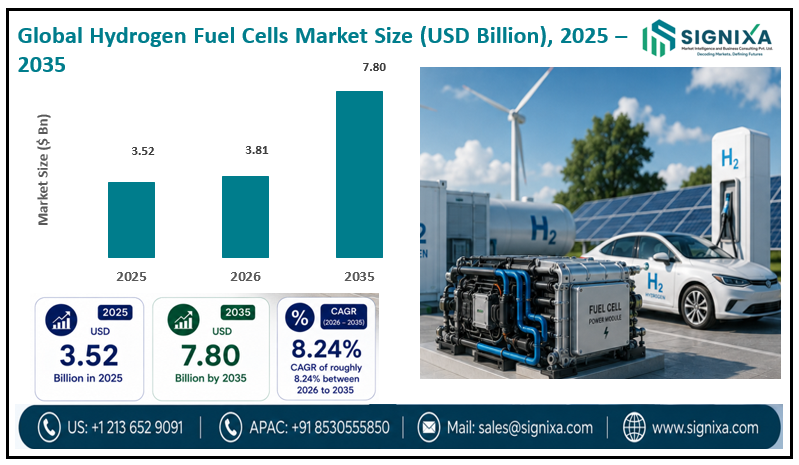
The size of the global Hydrogen Fuel Cells market was worth around USD 3.52 Billion in 2025 and is predicted to grow to around USD 7.80 Billion by 2035, with a compound annual growth rate (CAGR) of roughly 8.24% between 2026 and 2035. The report analyzes the Hydrogen Fuel Cells market's drivers and restraints, as well as the impact they have on demand throughout the projection period. In addition, the report examines global opportunities in the global Hydrogen Fuel Cells market.
Hydrogen Fuel Cells Industry Insights
The hydrogen fuel cells industry encompasses products utilized for Fuel Cell Vehicles, Defense, and Other applications. The growth in the global hydrogen fuel cells industry can be attributed to several underlying factors. First, the rising demand for clean energy solutions, stimulated by global efforts to reduce carbon emissions, is driving hydrogen fuel cells demand. Second, the development of fuel cell technologies — including advances in efficiency, cost, and energy density — are increasing the cost-competitiveness of hydrogen fuel cells in automotive, industrial, and other applications. Finally, supportive government policies and incentives to build hydrogen technologies are accelerating demand for hydrogen fuel cells, including significant capital investments in hydrogen infrastructure and R&D.
The hydrogen fuel cells market is advancing rapidly as industries seek cleaner energy alternatives for transportation, power generation, and industrial applications. Hydrogen fuel cells generate electricity through an electrochemical reaction between hydrogen and oxygen, emitting only water vapor, making them attractive for decarbonization efforts. The market is gaining traction across sectors including automotive, aerospace, maritime, and backup power systems. Notably, companies like Ballard Power Systems are supplying fuel cells for buses in Europe, while Toyota's Mirai and Hyundai's NEXO highlight adoption in passenger vehicles. In Japan and South Korea, government-backed infrastructure development for hydrogen refueling stations is accelerating uptake. Additionally, the integration of hydrogen fuel cells in forklifts by companies like Plug Power showcases growing industrial use. As green hydrogen production scales, fuel cell technologies are becoming more economically viable and widespread.
Key Findings
- As per the analysis shared by our research analyst, the global Hydrogen Fuel Cells market is estimated to grow annually at a CAGR of around 8.24% over the forecast period (2026–2035).
- In terms of revenue, the global Hydrogen Fuel Cells market size was valued at around USD3.52 Billion in 2025 and is projected to reach USD 3.52 Billion by 2035.
- The increasing demand for clean energy solutions, driven by global environmental concerns and the push to reduce carbon emissions, is a significant driver of the hydrogen fuel cells market, fostering widespread adoption.
- Based on Technology, the Proton Exchange Membrane Fuel Cells (PEMFC) segment is growing at a high rate and will continue to dominate the global market as per industry projections.
- On the basis of End Users, the Fuel Cell Vehicles (FCVs) segment is anticipated to command the largest market share.
- By Region, North America is projected to dominate the global market during the forecast period.
Hydrogen Fuel Cells Market Dynamics
The primary factor behind the growth of the global hydrogen fuel cells market is the rising demand for decarbonization and clean energy solutions. Government support in the form of favorable policies, incentives, and investments in hydrogen infrastructure is essential to the market's growth. Furthermore, the increasing adoption of fuel cell vehicles (FCVs) due to environmental concerns and the transition to sustainable transportation creates additional demand. Technological improvements which boost fuel cell efficiency and help lower costs make hydrogen fuel cells even more commercially viable. As key industries continue to focus on reducing emissions, hydrogen fuel cells offer a viable option for sustainable energy transition.
Rising Demand for Clean & Sustainable Energy
The global desire for sustainable, clean energy is a major factor driving the hydrogen fuel cell market. As countries work to eliminate greenhouse gas emissions, hydrogen fuel cells provide a credible alternative to fossil fuel energy. The quest for cleaner fuels across industries - most notably in the areas of transportation and electrical power- has hastened the use of hydrogen-based energy solutions. Given the increasing concerns for climate change, hydrogen is viewed as an essential contributor toward reaching net-zero emissions goals, thus increasing the demand and investment in hydrogen use and development throughout the world.
Government Support, Incentives & Policy Framework
Government assistance through incentives, subsidies and favorable legislation is one of the most significant drivers for the hydrogen fuel cell market. Many nations are developing hydrogen infrastructure and research to promote the use of fuel cell technologies. Policies on low carbon emissions and carbon-free positions have encouraged industry to adopt hydrogen as an alternative energy source. This institutional support, in the form of grants, tax incentives and partnerships, lowers the high associated upfront costs of hydrogen technologies, creating an increase in this emerging market.
Technological Advancements in Fuel Cell Technology
Technological developments in hydrogen fuel cell technology are important enablers of market growth. As fuel cell efficiency improves and manufacturing costs decline, hydrogen fuel cells are becoming more commercially viable. Advances in materials and manufacturing have dramatically lowered the price of fuel cells, opening up various applications, including transportation and stationary generation. These innovations also improve fuel cell durability and efficiency, facilitating wider adoption in industries and contributing to market growth.
Hydrogen Fuel Cells Market Segmentation Analysis
By Technology Segment Analysis
Proton Exchange Membrane Fuel Cells (PEMFC)
PEMFC represent one of the most common types of hydrogen fuel cells, especially for transportation and portable power. Characterized by high power density and low operating temperatures (60–100°C), they are well-suited for fuel cell vehicles (FCVs). The global PEMFC market is projected to grow at a CAGR of 17.8% from 2026 to 2035. Their quick-start ability and scalability make them attractive for manufacturers like Toyota and Honda.
Phosphoric Acid Fuel Cells (PAFC)
PAFCs are an established technology designed for stationary power generation where high reliability is required. Operating at approximately 150-200°C, they are used in backup power, combined heat and power (CHP), and large-scale commercial applications. The global PAFC market was valued at approximately USD 500 Million in 2025 and continues to grow as commercial power plant applications become more established.
Solid Oxide Fuel Cells (SOFC)
SOFCs work at high temperatures (600–1,000°C) and have excellent efficiency for stationary power generation and industrial applications. They can be used in systems ranging from 1–10 MW, delivering up to 65% efficiency, and can utilize various fuels such as natural gas and biogas.
Molten Carbonate Fuel Cells (MCFC)
MCFCs operate at 600-700°C and are primarily used for large-scale stationary power generation in industries like power plants and heavy-duty backup systems. Their ability to utilize coal-derived syngas and natural gas makes them highly versatile. The global MCFC market is anticipated to grow at a CAGR of 6.2% from 2021 to 2028.
Direct Methanol Fuel Cells (DMFC)
DMFCs use methanol as fuel directly without hydrogen reforming, operating at 60-120°C. Ideal for portable electronics, military, and consumer applications, they offer higher energy density than lithium-ion batteries. The DMFC market was valued at USD 270 Million in 2020 and is expected to reach USD 850 Million by 2027.
Others (AFC, Reversible Fuel Cells)
Alkaline Fuel Cells (AFC) have been utilized in space applications due to high efficiency and lower operational costs. Reversible fuel cells can perform both hydrogen production and fuel cell operations, acting as both an energy storage and conversion technology. Research in these niche areas continues to diversify the hydrogen fuel cell landscape, particularly for aerospace and specialized energy storage.
By End Users Segment Analysis
Fuel Cell Vehicles (FCVs)
Hydrogen fuel cell systems are primarily used in Fuel Cell Vehicles (FCVs), providing a zero-emission transportation sector. FCVs are expected to grow from USD 3.3 Billion (2021) to USD 21.9 Billion (2030). FCVs are becoming more commonplace, particularly in Japan, the U.S., and Europe. Major automobile companies -notably Toyota with the Mirai and Hyundai with the Nexo - have pioneered hydrogen fuel cell vehicles. In addition to fast refueling times, FCVs offer longer ranges compared to battery electric vehicles, contributing to their increasing appeal as an alternative fuel transportation solution.
Defense
The defense sector is another important end-user of hydrogen fuel cells, expecting growth in hydrogen use for remote power generation, mobile applications, and auxiliary power units (APUs). The military fuel cell market is expected to reach USD 2.6 Billion globally by 2025. Hydrogen fuel cells are being applied to unmanned aerial vehicles (UAVs), ground vehicles, and portable power systems for soldiers in the field — offering reduced noise, increased range, decreased logistics burden, and reliable operational performance for defense forces worldwide.
Other Applications (Stationary Power, Backup Power, Material Handling)
Hydrogen fuel cells have many other applications, including stationary power generation, backup power for data centers, and material handling equipment. The global stationary fuel cell market is expected to grow at a CAGR of 8.2% during 2026-2035 due to the demand for reliable and clean energy. Companies such as Bloom Energy are deploying fuel cells for commercial and industrial applications as a cleaner alternative to traditional backup power solutions. Niche applications include backup power for hospitals, telecom towers, and remote infrastructure.
Report Attributes & Market Scope
| Report Attribute | Details |
|---|---|
| Market Size Value in 2024 | USD 3.52 Billion |
| Market Size Value in 2032 | USD 7.80 Billion |
| CAGR (2025-2035) | 8.24% |
| Base Year Used for Estimation | 2025 |
| Historic Data | 2020-2025 |
| Forecast Period | 2026-2035 |
| Segments Covered -By Technology |
|
| Segments Covered - By End Users |
|
| Regions Covered | North America, Europe, Asia Pacific, Latin America, Middle East and Africa |
| Major Countries Covered | U.S., Canada, Mexico, Germany, UK, France, Italy, Spain, Russia, China, Japan, South Korea, India, Southeast Asia Countries, Brazil, Argentina, GCC Countries, Turkey, Iran, Israel, South Africa, Egypt, Nigeria, etc. |
| Key Companies Profiled | Intelligent Energy, SFC Energy India, Power Cell Group, Matthey, Volvo Group, Fuel Cell Energy, Plug Power, EH Group Engineering, Sainergy Fuel Cell India Pvt. Ltd, Nuvera, among others. |
Hydrogen Fuel Cells Market Regional Analysis
North America (Dominant Region)
The hydrogen fuel cell industry is primarily driven by North America due to established infrastructure, government investments, and a strong emphasis on clean technology. The U.S. and Canada are at the forefront of fuel cell vehicle adoption, supported by policies focused on incentives and subsidies. The U.S. Department of Energy (DOE) has invested significantly in hydrogen R&D to drive innovation and production, making North America the leading region throughout the forecast period.
Europe
Europe holds a pivotal position in the hydrogen fuel cell market, supported by strong policy backing, clean energy targets, and investment in hydrogen infrastructure. The European Union's Hydrogen Strategy and programs like the European Clean Hydrogen Alliance are driving large-scale adoption across transportation, industrial, and energy sectors. Germany, France, and the Netherlands lead in deploying fuel cell-powered vehicles, buses, and trains -with Alstom's Coradia iLint being a notable hydrogen-powered train operating in Germany. Major companies like Bosch, Siemens Energy, and Cummins are investing in fuel cell R&D and manufacturing capabilities across Europe. Cross-border hydrogen transport corridors - supported by Belgium, Spain, and Italy -are being developed to ensure reliable supply chains. Europe is steadily moving toward climate neutrality by 2050 through growing commercialization of green hydrogen technology.
Asia Pacific (Fastest Growing)
Asia Pacific is rapidly advancing in the hydrogen fuel cell market, led by aggressive national strategies, government subsidies, and industrial partnerships. Japan was the first to adopt a hydrogen roadmap and now operates a well-established hydrogen refueling network, with Toyota leading in fuel cell vehicles such as the Mirai. South Korea is developing a hydrogen-based economy, exemplified by Hyundai's NEXO fuel cell SUV and the Ulsan Hydrogen City project. China dominates in heavy-duty fuel cell vehicles like buses and trucks, supported by strong state funding. Australia is investing in green hydrogen export hubs and pilot projects for hydrogen-powered mining equipment. India is exploring hydrogen fuel in rail and mobility sectors through initiatives like the National Hydrogen Mission. China aims to become a global leader in hydrogen by 2030, making Asia Pacific a strong, rapidly emerging region.
Recent Developments in the Hydrogen Fuel Cells Market
-
2026
Plug Power expanded its hydrogen fuel cell deployment activities by strengthening partnerships across the transportation and logistics sectors, supporting the adoption of zero-emission power solutions for heavy-duty mobility applications.
Ballard Power Systems advanced the commercialization of its fuel cell technology through new supply agreements for buses, trucks, and rail applications, reinforcing its presence in the expanding hydrogen mobility sector.
PowerCell Group enhanced its hydrogen fuel cell portfolio with solutions designed for industrial, marine, and transportation applications, addressing growing demand for low-emission energy technologies.
FuelCell Energy broadened its clean energy offerings by progressing fuel cell projects focused on dependable, low-carbon power generation for industrial and utility customers.
EH Group Engineering introduced enhancements to its fuel cell platform aimed at improving system performance and enabling easier deployment across both mobility and stationary power applications.
Hydrogen Fuel Cells Market: Competitive Landscape
The global Hydrogen Fuel Cells market is highly competitive, with major players driving technological advancements across a range of applications. Companies are competing on factors such as product innovation, cost-efficiency, geographical reach, and sustainability — all essential for gaining market share in the growing Hydrogen Fuel Cells industry.
The competitive landscape is shaped by rapid technological innovation, increasing collaboration across industries, and growing investment in scalable solutions. Companies are focusing on enhancing fuel cell durability, lowering production costs, and improving efficiency to meet diverse application needs — from mobility to stationary power. Strategic partnerships between energy firms, research institutions, and automotive manufacturers are accelerating commercialization. Localization of fuel cell stack production and supply chain development is intensifying competition, while regulatory support is encouraging new entrants and pilot-scale advancements.
Key Companies Profiled
- Intelligent Energy
- SFC Energy AG
- PowerCell Group
- Johnson Matthey plc
- Volvo Group
- FuelCell Energy, Inc.
- Plug Power Inc.
- EH Group Engineering AG
- Sainergy Fuel Cell India Pvt. Ltd.
- Nuvera Fuel Cells, LLC
- Ballard Power Systems Inc.
- Bloom Energy Corporation
- Cummins Inc.
- Nedstack Fuel Cell Technology B.V.
- Doosan Fuel Cell Co., Ltd.
- Mitsubishi Power
- Toshiba Energy Systems & Solutions Corporation
- Panasonic Holdings Corporation
- Horizon Fuel Cell Technologies
- Hexagon Purus ASA
- Bosch Group
- Ceres Power Holdings plc
- ElringKlinger AG
- Hyundai Motor Company
- Toyota Motor Corporation
- Honda Motor Co., Ltd.
- AVL List GmbH
- Advent Technologies Holdings, Inc.
- Bloom Energy Corporation
- Siemens Energy AG
- Air Liquide S.A.
- Linde plc
- Nel ASA
- ITM Power plc
- ThyssenKrupp Nucera AG & Co. KGaA
Global Hydrogen Fuel Cells Market Segmentation Summary
By Technology Segment
- PEMFC
- PAFC
- SOFC
- MCFC
- DMFC
- Others
By End Users Segment
- Fuel Cell Vehicles
- Defense
- Others
By Region
- North America
- U.S.
- Canada
- Mexico
- Europe
- Germany
- France
- UK
- Spain
- Italy
- Rest of Europe
- Asia-Pacific
- China
- Japan
- India
- Australia
- South Korea
- Southeast Asia
- Rest of Asia-Pacific
- Latin America
- Brazil
- Argentina
- Rest of Latin America
- The Middle East & Africa
- GCC Countries
- South Africa
- Rest of the Middle East & Africa
Frequently Asked Questions (FAQs) About the Hydrogen Fuel Cells Market
What is Hydrogen Fuel Cells?
Hydrogen fuel cells are devices that convert hydrogen and oxygen into electricity, emitting only water vapor as a byproduct. They provide clean, efficient energy for various applications, including vehicles, stationary power, and portable devices.
Which key factors will influence the Hydrogen Fuel Cells market growth over 2026-2035?
Factors driving the hydrogen fuel cell market include the increasing demand for clean energy, advancements in fuel cell technology, government incentives for green solutions, growing adoption in transportation, and the push for reducing carbon emissions globally.
What will be the value of the Hydrogen Fuel Cells market during 202-2035?
According to the study, the global Hydrogen Fuel Cells market size was worth around USD 3.52 Billion in 2025 and is predicted to grow to around USD 7.80 Billion by 2035.
What will be the CAGR value of the Hydrogen Fuel Cells market during 2026-2035?
The CAGR value of the Hydrogen Fuel Cells market is expected to be around 8.24 8.24% during 2026-2035.
Which region will contribute notably towards the Hydrogen Fuel Cells market value?
North America dominates the hydrogen fuel cell market due to strong government support, investment in clean energy technologies, established infrastructure, and the presence of major players in fuel cell production, particularly in the U.S. and Canada.
Which are the major players leveraging the Hydrogen Fuel Cells market growth?
The global Hydrogen Fuel Cells market is led by players such as Intelligent Energy, SFC Energy India, Power Cell Group, Matthey, Volvo Group, Fuel Cell Energy, Plug Power, EH Group Engineering, Sainergy Fuel Cell India Pvt. Ltd, and Nuvera.
What can be expected from the global Hydrogen Fuel Cells market report?
The report explores crucial aspects of the Hydrogen Fuel Cells market, including a detailed discussion of existing growth factors and restraints while also analyzing future growth opportunities and challenges that impact the market.