
Flow Battery Market Overview
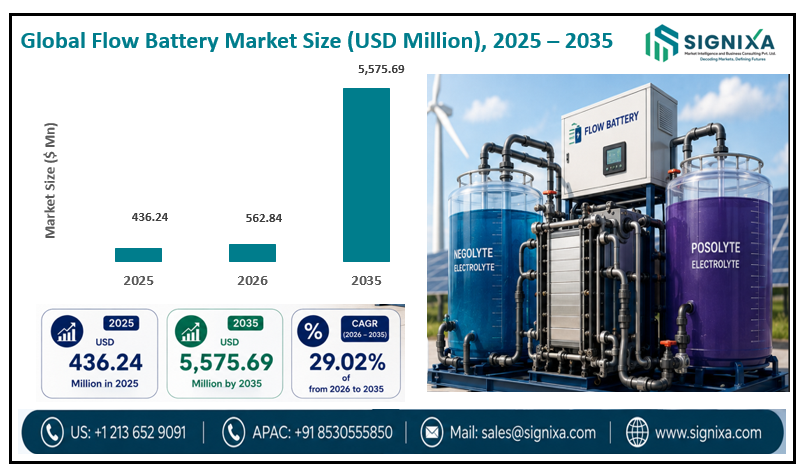
The size of the global flow battery market was valued at approximately USD 436.24 Million in 2025 and is projected to reach around USD 5,575.69 Million by 2035, growing at a compound annual growth rate (CAGR) of 29.02% from 2026 to 2035. The market is gaining momentum due to increasing demand for long-duration energy storage systems, greater integration of renewable energy sources, and the rising need for scalable, flexible, and safe grid storage technologies.
The flow battery market centers on energy storage systems that utilize liquid electrolytes for chemical energy storage. Flow batteries can be scaled to meet any demand, have long cycle life, fast-acting response times, and are non-flammable. These characteristics make flow batteries effective solutions for grid support, peak shaving, renewable energy integration, and industrial backup power. The increase of renewables coming online and the global push toward sustainable energy storage options are helping increase demand in the market. Flow batteries are being utilized to mitigate deficiencies of lithium-ion batteries, including cycling degradation and thermal runaway risks.
The flow battery market is gaining momentum due to increasing demand for reliable, large-scale energy storage solutions that support the integration of renewable energy sources like solar and wind. Unlike conventional batteries, flow batteries offer scalable energy capacity and longer cycle life, making them ideal for grid stabilization, peak shaving, and backup power applications. Their ability to decouple power and energy ratings provides flexibility to meet varying storage needs efficiently. Technological advancements in electrolyte chemistry and membrane design are improving performance, reducing costs, and enhancing durability. The adoption of flow batteries supports decarbonization goals by enabling more effective renewable energy utilization and reducing reliance on fossil fuel-based power plants.
Key Findings
- The global flow battery market is expected to grow at a CAGR of 29.02% between 2026 and 2035.
- In terms of revenue, the market value is projected to grow from USD 436.24 Million in 2025 to USD 5,575.69 Million by 2035.
- Increasing demand for long-duration, high-scale energy storage and the global push for renewable energy integration are the primary drivers shaping market expansion.
- Based on Product Type, Redox Flow Batteries dominate the global market due to higher efficiency and longer lifespan.
- By Material Type, Vanadium-based flow batteries accounted for more than 65% of the global share in 2025.
- In terms of Application, the Utility Services segment is the largest contributor, supported by increased renewable grid installations.
- By Region, Asia-Pacific is projected to be the fastest-growing regional market, with China, Japan, and South Korea investing heavily in storage technologies.
Flow Battery Market Dynamics
Explosive Demand for Long-Duration, Large-Scale Grid Energy Storage
The explosive demand for long-duration, high-scale energy storage systems is propelling the flow battery business. Flow batteries offer the flexibility of energy and power scale when compared to traditional lithium-ion batteries. As an effective grid solution, flow batteries have the capability to store renewable energy for more than 10 hours and execute 10,000 cycles, providing efficiency and reliability. The wider installation of solar and wind will keep expanding, creating non-generating hours that require storage. Flow batteries provide stability and the ability to shave peak consumption of load on the grid. Their ability to decouple power capacity from energy capacity makes them the preferred technology for utility operators managing increasingly complex renewable-heavy grid environments where traditional peaker plants are being phased out.
Government Policies, Mandates & R&D Programs Fast-Tracking Adoption
Government policies and incentives are fast-tracking flow battery adoption globally. Countries such as the United States, China, and Germany are launching energy storage requirements that favour safer, longer-duration technologies. The U.S. Department of Energy launched a Long Duration Storage Shot initiative, while the European Union's Horizon 2020 is designed to facilitate R&D and large-scale demonstrations to cost-reduce and accelerate integration of advanced storage technologies. These programs benefit developers, system integrators, and the utilities, industrial facilities, and communities deploying these systems. Regulatory mandates in California, New York, and Massachusetts are also promoting long-duration storage as part of grid stability funding, creating a policy-driven demand floor that is expected to sustain throughout the forecast period.
Renewable Microgrids, Off-Grid Applications & Emerging Market Expansion
Growing awareness around renewable microgrids and decentralized energy systems creates valuable opportunities for deployment of flow batteries. More and more, communities, islands, and remote industrial operations are building off-grid solar and wind projects. Flow battery applications are especially valuable for these scenarios, given their deep discharge capabilities, long cycle life, and high safety level. New markets in Asia, Africa, and Latin America are also considering flow batteries for rural electrification and utility flexibility. Green energy transitions led by governments, as well as decreasing renewable energy costs, are accelerating the need for storage in these markets. Companies that offer modular and scalable solutions can discover competitive advantages by serving underserved areas and aligning with global requirements for decarbonization and energy access.
Flow Battery Market Segmentation Analysis
By Product Type Segment Analysis
The flow battery market is segmented by product type, with each architecture offering distinct electrochemical configurations, scalability profiles, and commercial readiness levels for grid, industrial, and off-grid energy storage applications globally:
Redox Flow Battery
Redox flow batteries are the dominant product type, qualifying for approximately 78% of global market outlets in 2025. The ability to scale power and energy independently, coupled with their storage capabilities for grid and renewable integration, are beneficial qualities. Redox flow batteries offer extended cycle lives past 10,000 cycles and promise a 70–80% round-trip efficiency, making them preferred for large-scale applications. Countries like Germany and the United States have adopted redox systems for microgrid and utility pilot projects, including long-term energy support for reliable energy access. The technology's inherent safety profile — non-flammable electrolytes and no risk of thermal runaway — further strengthens its position for utility-scale deployments where safety certification is a regulatory requirement.
Hybrid Flow Battery
Hybrid flow batteries represented approximately 22% of total flow battery deployment in 2025 and have been gaining traction due to their cost effectiveness and greater energy density compared to pure redox systems. These batteries consist of solid electrodes and flowing electrolytes, offering the best of both solid-state and redox chemistries. While hybrid flow batteries are still being commercialized, they have strong potential for compact or mobile applications with limited space. Their higher energy density per unit volume makes them attractive for behind-the-meter commercial and industrial installations where footprint constraints are a consideration, and their falling production costs are making them increasingly competitive with both traditional redox flow and lithium-ion alternatives in mid-scale storage applications.
By Material Type Segment Analysis
Vanadium (incl. All-Vanadium)
Vanadium-based flow batteries generated 66% of total revenues in 2025. These systems employ vanadium ions that can exist in different oxidation states, thereby ensuring little cross contamination and delivering long operational lives. With lifetimes of more than 20 years and a proven record of performance in utility-scale applications, vanadium flow batteries are the dominant technology for grid energy storage. Major suppliers such as Invinity and Sumitomo Electric are installing vanadium-based systems at an accelerating pace, particularly in North America, China, and Japan to integrate wind and solar. The all-vanadium configuration, which uses the same element in both electrolyte tanks, is especially valued for its electrolyte reusability and extremely low cross-contamination risk in long-duration deployments.
Zinc–Bromine
Zinc-bromine batteries are gaining traction globally, with the advantage of lower material prices and higher volumetric energy density than vanadium alternatives. They held about 28% market share in 2025 and are growing in areas where vanadium is not a viable or cost-effective option. Zinc-bromine batteries can be used for off-grid and behind-the-meter applications, with discharge times of up to 10 hours and round-trip efficiencies of 65–75%. Companies like Redflow are making progress with zinc-bromine deployments in Australia and Southeast Asia. Their competitive cost profile and relatively mature manufacturing base make them particularly attractive for emerging market deployments where capital efficiency is a primary selection criterion for energy storage procurement.
By Storage Type Segment Analysis
Large-Scale
Large-scale flow battery installations accounted for 64% of global revenue in 2025, with applications in utility grid balancing, renewable smoothing, and load shifting. These systems offer capacities ranging from 100 kWh to several MWh, enabling reliable energy dispatch during peak demand hours. With the rising integration of solar and wind power across national grids, countries like China and the U.S. are investing in multi-megawatt flow battery systems to ensure grid stability and resilience. UK National Grid and China's State Grid are rolling out numerous large-scale systems to accommodate fluctuating renewable generation, making utility-scale large deployments the cornerstone of overall flow battery market revenue through the forecast period.
Compact
Compact flow battery systems represent approximately 36% of the entire market in 2025 and are primarily finding use in commercial buildings, telecom backup, and mobile units. They are optimal solutions in applications where space is constrained yet long-duration backup is still required. Additionally, compact flow batteries are easy to transport and install — very useful when configuring power in remote locations. The growing market demand for resilient backup in data centers and industrial sites continues to drive this segment's growth. As digital infrastructure expansion accelerates globally, the need for reliable, non-flammable, long-duration backup power in server facilities and edge computing locations is expected to sustain strong compact flow battery demand through the forecast period.
By Application Segment Analysis
Utility Services
The utilities sector accounts for more than 50% of overall global market revenue in 2025. Flow batteries can be used by grid operators to achieve load levelling, frequency regulation, and transitional renewable storage. As countries sign up for decarbonization commitments, the utilities sector must replace fossil-fuel peaking plants with clean alternatives, and flow batteries offer the long-duration storage solution required for that transition. UK National Grid and China's State Grid are rolling out numerous large-scale systems to accommodate fluctuating renewable generation. The segment is also supported by emerging grid-scale procurement frameworks and energy storage mandates in key regulatory markets that are creating structured long-term demand pipelines for utility flow battery operators.
Industrial & Commercial
Industrial and commercial applications contribute about 31% share of the flow battery market in 2025, driven by the need for backup power, peak shaving, and on-site renewable integration. Flow batteries are being adopted by factories, data centers, and commercial buildings to reduce their reliance on power from the grid and ensure operational uptime. Flow battery systems are preferred over traditional batteries in these environments because they provide consistent performance even in high-temperature or high-cycle scenarios. The growing corporate sustainability agenda and the rising cost of grid electricity in major industrial markets are accelerating commercial and industrial flow battery adoption as organizations seek to manage energy costs while improving resilience and meeting emissions reduction commitments.
Renewable Energy Integration & Others
This combined segment, which takes up approximately 12% of the market in 2025, includes renewable energy integration at smaller scales, residential, education, and microgrid use cases. Flow batteries are being tested in eco-homes, community power projects, and research bodies intending to demonstrate alternative storage technologies. Startups and incubators are developing niche systems for rural electrification and smart microgrid applications in the developing world. As solar-plus-storage project economics improve and government rural electrification programs expand in Asia, Africa, and Latin America, this segment is expected to grow significantly, driven by both commercially motivated off-grid deployments and development finance-backed clean energy access projects targeting un-electrified and under-electrified communities globally.
Military & Defense
The defense sector accounted for around 7% of the market in 2025, using flow batteries to power mobile and off-grid energy systems. Flow batteries are silent, have a significant safety record, and offer long lifetimes, which makes them well-suited for remote military bases and mobile command centers. Recent projects by the U.S. Department of Defense and NATO have been testing the suitability of redox flow batteries in mission-critical applications where reliability and ruggedness are requirements. The increasing electrification of military forward operating bases and the strategic objective of reducing fuel logistics supply chains in conflict zones are creating a growing and sustained procurement opportunity for ruggedized flow battery systems specifically designed to meet defense-grade durability and operational performance standards.
Report Attributes & Market Scope
| Report Attribute | Details |
|---|---|
| Market Size Value in 2025 | USD 436.24 Million |
| Market Size Value in 2035 | USD 5,575.69 Million |
| CAGR (2026–2035) | 29.02% |
| Base Year Used for Estimation | 2025 |
| Historic Data | 2020 - 2025 |
| Forecast Period | 2026 - 2035 |
| Segments Covered – By Product Type |
|
| Segments Covered – By Material Type |
|
| Segments Covered – By Storage Type |
|
| Segments Covered – By Application |
|
| Regions Covered | North America, Europe, Asia Pacific, Latin America, Middle East and Africa |
| Major Countries Covered | U.S., Canada, Mexico, Germany, UK, France, Italy, Spain, Russia, China, Japan, South Korea, India, Southeast Asia Countries, Brazil, Argentina, GCC Countries, Turkey, Iran, Israel, South Africa, Egypt, Nigeria, etc. |
| Key Companies Profiled | ESS Inc., Invinity Energy Systems, Sumitomo Electric Industries Ltd., Primus Power, Redflow Limited, VRB Energy, Schmid Group, UniEnergy Technologies, Lockheed Martin Corporation, and Sustainable Power Systems Inc., among others. |
Flow Battery Market Regional Analysis
The flow battery market is led by North America in terms of current market share at over 34% in 2025, driven by federal and state-level energy storage mandates. Europe follows with approximately 28% share, supported by the EU Green Deal and Horizon 2020. The Asia-Pacific region is the fastest-growing market globally with a CAGR exceeding 30% through 2035, while Latin America and the Middle East & Africa represent emerging opportunities at approximately 5% and 3% of the 2025 market respectively.
North America (Largest Market by Share)
In 2025, North America held more than 34% of the market share, fueled by energy storage mandates at the federal and state levels in the U.S. California, New York, and Massachusetts are promoting long-duration storage deployment as part of grid stability funding, creating a substantial policy-driven demand pipeline. The region is home to major players and innovators like ESS Inc. and Invinity Technologies. The U.S. Department of Energy's Long Duration Storage Shot initiative has provided significant R&D funding and growing private sector investment is accelerating technology commercialization. The region's strong regulatory framework for renewable energy integration and grid modernization investments position it as the primary revenue market for flow battery deployments across utility, industrial, and commercial applications throughout the forecast period.
Europe
In 2025, Europe accounted for almost 28% of total global market share, helped by renewable energy targets, smart grid investments, the EU's Horizon 2020 research and innovation program, and the Green Deal. Countries such as Germany, the United Kingdom, and the Netherlands are currently deploying flow batteries for grid support and community energy projects. European regulatory frameworks emphasizing battery safety and sustainability are creating a favorable environment for non-flammable flow battery technology. The region's strong industrial base and advanced grid infrastructure are enabling deployment at both utility scale and commercial scale, while growing energy sovereignty concerns following geopolitical disruptions to fossil fuel supply chains are accelerating the policy urgency around domestic long-duration energy storage capacity development.
Asia Pacific (Fastest-Growing Region)
The Asia Pacific region is experiencing rapid growth with a CAGR of over 30% from 2026 to 2035. China, Japan, South Korea, and Australia are taking significant steps to incorporate renewables into their energy storage sectors. China continues to advance vanadium battery installations at scale, while Japan is using the METI program to integrate flow battery technologies to support energy resilience and storage measures. The ability of flow batteries to decouple power and energy capacity makes them especially suitable for addressing the region's variable renewable energy generation. Government policies promoting renewable integration, smart grids, and energy security are further fueling market expansion. Technological advancements in vanadium and organic electrolyte flow batteries are improving efficiency and reducing costs, attracting increasing commercial and industrial adoption across the region.
Latin America
Latin America is emerging as a new market with approximately 5% market share in 2025, with growing interest as renewable energy projects progress in Brazil, Chile, and Argentina. These countries have been exploring the deployment of flow batteries for off-grid or hybrid solar installations in remote or industrial applications. The region's abundant solar and wind resources, combined with government-backed clean energy transition programs, are creating a growing base for long-duration energy storage demand. Brazil's expanding renewable energy capacity and Chile's world-leading solar irradiation make both countries natural fit markets for flow battery deployments in mining, agricultural, and remote community power applications. As financing costs decrease and system prices fall, Latin America's flow battery adoption is expected to accelerate significantly through the latter half of the forecast period.
Middle East & Africa
The Middle East and Africa region accounted for approximately 3% of flow batteries deployed in 2025. However, these areas are initiating pilot projects in South Africa and various GCC countries to test flow battery technologies in off-grid environments, with related applications in areas with water scarcity and high heat. Nations like the UAE, Saudi Arabia, and Oman are investing in large-scale solar and wind projects, creating demand for efficient energy storage solutions to manage intermittent power supply. Flow batteries offer advantages such as long cycle life, scalability, and safe operation in harsh climatic conditions, making them suitable for the region's environment. Despite challenges like high initial capital expenditure and limited regional awareness, partnerships between technology providers, utilities, and governments are promoting pilot projects and commercialization efforts. These regions could become significant adopters of microgrids and solar-plus-storage in coming years.
Recent Developments in the Flow Battery Market
-
2025
Invinity Energy Systems continued to expand its vanadium flow battery deployments across North America and Europe, with multiple utility-scale projects commissioned as part of grid modernization and renewable integration programs supported by government energy storage mandates.
-
2023
ESS Inc. advanced commercial deployment of its iron flow battery technology across multiple U.S. utility storage projects, benefiting from DOE Long Duration Storage Shot funding and growing utility demand for non-lithium, long-duration storage alternatives for grid balancing and renewable integration applications.
Flow Battery Market: Competitive Landscape
The flow battery industry has a combination of established businesses and new innovators coming onto the scene. The leaders in this industry include Invinity Energy Systems, ESS Inc., and Sumitomo Electric, which have established portfolios from vanadium and iron-based flow batteries. Redflow, Primus Power, and CellCube are innovators and manufacturers of zinc-bromine flow and vanadium products. Zinc8 Energy Solutions and StorEn Technologies are gaining notoriety with zinc-air and vanadium batteries. Additionally, UniEnergy Technologies and VRB Energy are expanding operations, with a particular focus on Asia. All these companies represent significant actors in creating innovations, partnerships, projects, and new solutions to the global energy storage opportunity.
The competitive landscape of the flow battery market is characterized by strong innovation and continuous technological advancements. Companies focus on improving electrolyte chemistry, membrane efficiency, and system design to enhance performance, durability, and cost-effectiveness. Customization of solutions for various applications — including grid storage, microgrids, and renewable integration — helps address diverse customer needs. Strategic collaborations with research institutions and utilities accelerate product development and market adoption. Emphasis on scalability and modularity allows flexible energy capacity expansion, appealing to large-scale users. Market players also invest in after-sales service, maintenance, and training to boost customer satisfaction and long-term relationships.
Increasing focus on sustainable and environmentally friendly materials aligns with global clean energy trends and positions flow battery manufacturers favorably versus lithium-ion competitors facing growing supply chain scrutiny around cobalt and lithium sourcing. Pricing strategies and financing options are being tailored to encourage adoption in emerging markets. Competition is also intensifying around novel electrolyte chemistries — including organic, aqueous organic, and iron-based formulations — that promise lower material costs and reduced supply chain concentration risk compared to vanadium-dependent systems. Overall, competitive dynamics are driving continuous innovation and improved solutions, ensuring steady growth and resilience in the evolving global flow battery market.
Key Companies Profiled
- ESS Inc.
- Invinity Energy Systems
- Sumitomo Electric Industries Ltd.
- Primus Power
- Redflow Limited
- VRB Energy
- Schmid Group
- UniEnergy Technologies
- Lockheed Martin Corporation
- Sustainable Power Systems Inc.
- Dalian Rongke Power
- CellCube
- Enerox
- Elestor
- Largo Clean Energy
- ViZn Energy Systems
- Jena Flow Batteries
- WattJoule Corporation
- Redox One
Global Flow Battery Market Segmentation Summary
By Product Type
- Redox Flow Battery
- Hybrid Flow Battery
By Material Type
- Vanadium
- Zinc–Bromine
- Hydrogen–Bromine
- Iron
- All-Vanadium
- Others
By Storage Type
- Compact
- Large Scale
By Application
- Utility Services
- Renewable Energy Integration
- Industrial
- Commercial
- Military
- Others
By Region
- North America
- U.S.
- Canada
- Mexico
- Europe
- Germany
- France
- UK
- Spain
- Italy
- Rest of Europe
- Asia-Pacific
- China
- Japan
- India
- Australia
- South Korea
- Southeast Asia
- Rest of Asia-Pacific
- Latin America
- Brazil
- Argentina
- Rest of Latin America
- The Middle East & Africa
- GCC Countries
- South Africa
- Rest of the Middle East & Africa
Frequently Asked Questions (FAQs) About the Flow Battery Market
What is a flow battery?
A flow battery is a type of rechargeable battery where energy is stored in liquid electrolytes contained in external tanks. These systems are known for their scalability, long cycle life, and suitability for large-scale energy storage applications like grid balancing and renewable energy integration.
Which key factors will influence the flow battery market growth over 2026–2035?
Key growth drivers include increasing demand for renewable energy integration, rising need for long-duration energy storage, favourable government policies supporting energy transition, and advancements in redox flow battery technology.
What will be the value of the flow battery market during 2026–2035?
The global flow battery market was valued at approximately USD 436.24 Million in 2025 and is projected to reach around USD 5,575.69 Million by 2035, growing at a significant pace over the forecast period.
What will be the CAGR value of the flow battery market during 2026–2035?
The flow battery market is expected to expand at a CAGR of 29.02% between 2026 and 2035, driven by technological improvements and the growing need for grid-level energy storage.
Which region will contribute notably towards the flow battery market value?
Asia-Pacific is anticipated to dominate the flow battery market in terms of growth rate, supported by rising energy storage projects in China, Japan, and South Korea. North America and Europe are also key contributors due to strong policy support and a focus on grid stability.
Which are the major players leveraging the flow battery market growth?
The leading players in the global flow battery market include ESS Inc., Invinity Energy Systems, Sumitomo Electric Industries Ltd., Primus Power, Redflow Limited, VRB Energy, Schmid Group, UniEnergy Technologies, Lockheed Martin Corporation, and Sustainable Power Systems Inc.
What can be expected from the global flow battery market report?
The report provides a comprehensive analysis of the flow battery market, including market size and forecast, key growth drivers and challenges, detailed segmentation by product type, material type, storage type, and application, regional outlook, competitive landscape, and recent developments shaping the industry from 2026 to 2035.