

Dry Yeast Market Overview
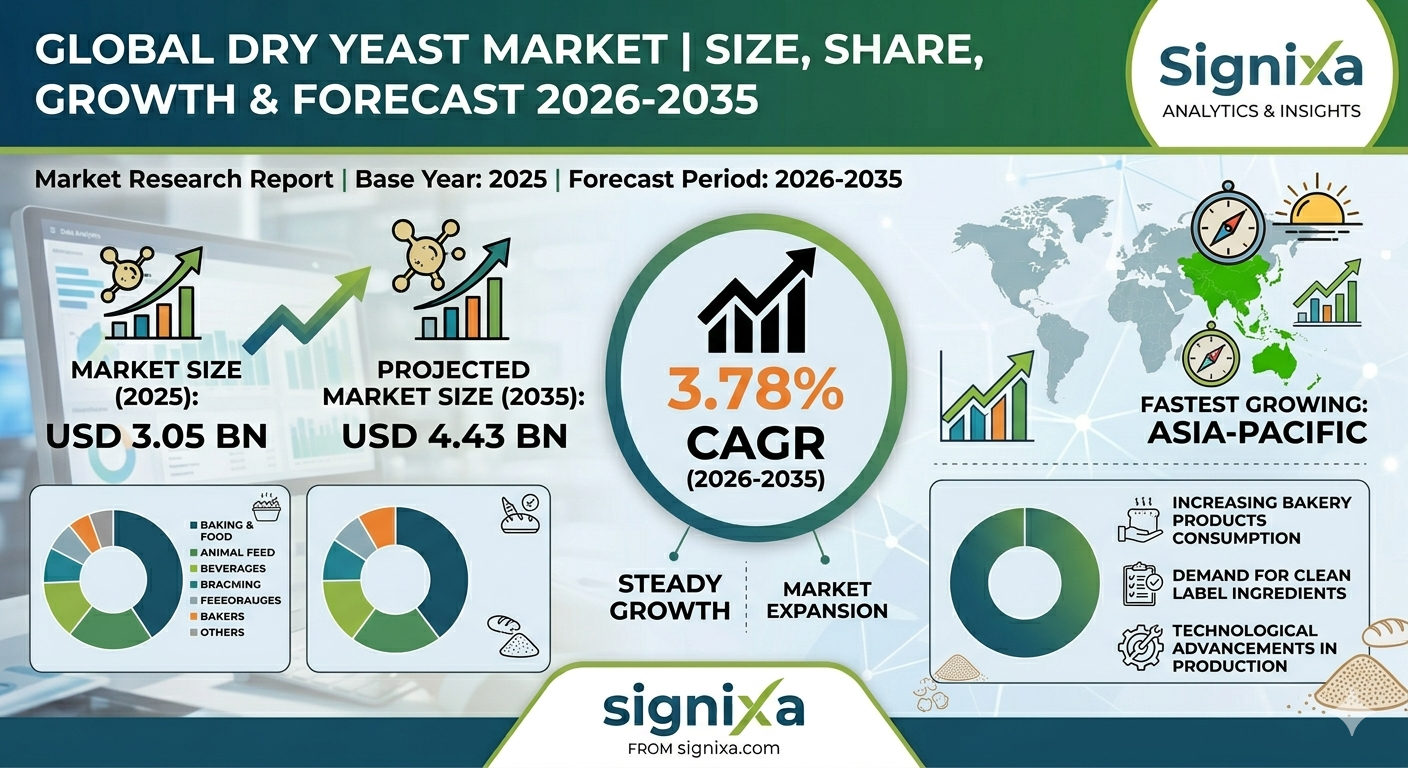
The global Dry Yeast Market was valued at approximately USD 3.05 Billion in 2025 and is projected to reach USD 4.43 Billion by 2035, growing at a compound annual growth rate (CAGR) of 3.78% from 2026 to 2035. The report provides an in-depth analysis of the key market dynamics, drivers, challenges, and opportunities influencing demand during the forecast period. It also evaluates global and regional developments shaping the dry yeast industry.
The dry yeast market encompasses many yeast products commonly used in bakery, brewing, and food processing applications. The growing demand for convenience food, increasing popularity of home baking, and advancements in food fermentation are triggering market growth. The increasing demand is also driven by consumers growing health awareness and a rise in plant-based, and non-dairy alternatives that rely on yeast-based fermentation.
The global dry yeast market is witnessing steady growth, driven by rising demand across the food, beverage, and animal feed sectors. Dry yeast, known for its longer shelf life and ease of storage compared to fresh yeast, is extensively used in baking applications for bread, pizza dough, cakes, and other baked goods. As consumer preferences shift toward ready-to-eat, convenience foods, and homemade bakery items, especially post-pandemic, dry yeast consumption has surged among both commercial and household segments.
In the beverage industry, dry yeast is widely used in brewing, winemaking, and the production of bioethanol. Its role in fermentation processes makes it vital for producing alcohol efficiently, appealing to craft brewers and distillers seeking consistent quality and enhanced fermentation control. The growing interest in home brewing and microbreweries has further contributed to market expansion.
Health-conscious trends are also supporting the use of dry yeast in nutritional supplements, given its high protein and vitamin B content. In the animal feed industry, dry yeast is being incorporated into livestock diets to enhance digestion and improve gut health.
However, the market faces challenges from fluctuating raw material prices and competition from alternative leavening agents. Despite this, innovation in product forms — such as instant and high-activity yeast — continues to broaden application potential. Moreover, expanding foodservice chains, increasing urbanization, and the rise of artisanal baking trends globally are likely to support future market growth. With its versatile usage, ease of handling, and growing demand across industries, the dry yeast market is poised for consistent long-term development.
Key Findings
- The global Dry Yeast Market is expected to grow at a CAGR of 3.78% between 2025 and 2032.
- The market size was valued at USD 3.05 Billion in 2025 and is projected to reach USD 4.43 Billion by 2035.
- The Active Dry Yeast segment is currently leading the market due to its wide usage in commercial baking.
- The Bakery segment is the dominant application, accounting for the largest share in global consumption.
- Direct Sales remains the preferred distribution channel among large-scale users.
- Bags & Sacks are the most common packaging format in the market.
- North America and Europe remain key markets, while Asia-Pacific is the fastest-growing region.
Dry Yeast Market Dynamics
Rising Demand for Baked Goods & Convenience Foods in Emerging Markets
One of the main key drivers of market growth for the dry yeast market is the rising demand for baked goods especially in emerging markets. Urbanization, shifts in lifestyles and increases in per capita income are driving consumption of convenient bakery products such as bread, pizza, cakes and pastries. As consumption of baked goods increases, demand for the various types of dry yeast increase as well, as dry yeasts provide a long shelf life for baked products, and a homogenized leavening performance for home and commercial baking.
The dry yeast market is significantly influenced by rising demand for convenience foods and bakery products. As lifestyles become increasingly fast-paced, particularly in urban settings, consumers are leaning toward ready-to-cook and easy-to-prepare food options, thereby fuelling the demand for dry yeast. The bakery industry, which accounts for a large portion of yeast usage, is undergoing rapid transformation with the introduction of healthier, high-fiber, and gluten-free baked goods, creating new avenues for yeast applications. Dry yeast's ease of storage, extended shelf life, and consistent fermentation performance make it the preferred choice over fresh yeast, especially in regions with limited cold chain infrastructure. Additionally, the surge in home baking, particularly witnessed during the COVID-19 pandemic, has introduced dry yeast to a wider consumer base, many of whom continue to bake at home as a hobby or health-conscious alternative. The foodservice industry is also experiencing a revival post-pandemic, contributing further to yeast consumption across commercial kitchens, pizzerias, and artisan bakeries. Moreover, product innovations, such as instant and fortified dry yeast, are helping manufacturers tap into niche segments. As vegan and clean-label trends grow globally, dry yeast, with its non-animal origin and additive-free profile, is increasingly gaining acceptance among ethical consumers.
Health-Conscious Consumer Behaviour & Clean-Label, Plant-Based Innovation
Another herding factor is the increase in health-conscious consumer behaviour. Dry yeast is vital in the fermentation of the whole grain, high-fiber, and gluten-free products that are trending in consumer preferences because they are seen as healthy. Yeast is also an important ingredient in dairy alternatives and many fermented products. Since food and beverage manufacturers are focused on clean-label and plant-based innovations, dry yeast will also benefit from its natural, non-GMO, and additive-free qualities.
Technological Advancements — Yeast Strain Innovation, Fermentation Efficiency & Custom Formulations
With regard to changes in technology, there have been changes in production and drying of yeast that are contributing to market growth. New developments in the yeast strain, fermentation rates and efficiencies, and custom yeast formulations have improved the functional properties of dry yeast for applications outside traditional bakery applications. Ultimately, the ability to maintain viability and enzymatic activity over a period of time is a main differentiator that continues to support usage across all end-use applications.
Brewing Industry Growth, Animal Nutrition & Expanding End-Use Applications
Beyond the food and bakery sectors, dry yeast is carving out a crucial role in brewing and animal nutrition, driving overall market dynamics. In alcoholic beverage production — particularly craft beers, wines, and spirits — dry yeast's reliability and strain-specific advantages are making it the preferred fermentation agent. The rise in microbreweries and home brewing setups is particularly notable in North America, Europe, and Asia Pacific, where consumer experimentation and demand for premium, small-batch alcohol are booming. Simultaneously, in the livestock feed industry, dry yeast is being recognized as a beneficial probiotic supplement. Its inclusion in feed enhances animal gut health, improves nutrient absorption, and boosts immunity, aligning with the global shift toward antibiotic-free animal rearing. Despite these drivers, the dry yeast market faces a few restraints. Volatility in raw material prices — especially molasses, a key fermentation substrate — can impact production costs. Also, the highly competitive landscape with the presence of regional and global players intensifies pricing pressure. Regulatory compliance regarding food safety, labelling, and yeast strain approvals can further pose challenges across markets. However, continuous R&D and the growing application scope of dry yeast in bioethanol, nutraceuticals, and dietary supplements are expected to offset these concerns, positioning the market for stable long-term expansion.
Dry Yeast Market Segmentation Analysis
By Type Segment Analysis: Active Dry, Instant Dry, Fresh & Specialized Yeast
Active Dry Yeast
The Active Dry Yeast segment held the largest market share in 2024, accounting for over 40% of global revenue. Its long shelf life and suitability for bread making and other bakery applications support consistent demand. Active dry yeast requires proofing in warm water before use, making it ideal for both commercial and experienced home baking environments.
Instant Dry Yeast
Instant Dry Yeast is gaining traction due to its faster activation and ease of use, particularly among home bakers. Unlike active dry yeast, it can be mixed directly with dry ingredients, reducing preparation time and improving convenience. Its popularity is growing strongly in the retail and e-commerce channels driven by home baking trends.
Fresh Yeast
Fresh Yeast is still prevalent in traditional bakeries, though its short shelf life limits widespread adoption. It remains the preferred choice among artisan bakers who value its distinctive fermentation characteristics and flavour contributions, particularly in European-style bread and specialty baked goods.
Specialized Yeast
Specialized Yeast, used in high-value applications such as dairy fermentation and alcoholic beverages, is growing steadily with a niche consumer base. Strain-specific yeast products developed for craft brewing, winemaking, distilling, and precision fermentation are commanding premium pricing and attracting R&D investment from leading yeast manufacturers.
By Application Segment Analysis
Bakery
Bakery applications accounted for over 55% of the dry yeast market in 2024. Bread, pastries, and pizza continue to be staple items across cultures, maintaining strong demand for dry yeast. This segment benefits from growth in both commercial food service and the home baking consumer segment, as well as innovation in healthier bakery product formulations.
Confectionery
Confectionery uses such as sweet rolls and filled pastries also contribute to market size. The growth of premium and artisanal confectionery, along with innovations in yeast-leavened confectionery products, is expanding the role of dry yeast across this application category globally.
Dairy Beverages
In the dairy beverage sector, dry yeast is increasingly used in the production of fermented drinks and non-dairy yogurts, contributing to an estimated 8.5% market share. The growing popularity of kefir, kombucha, and plant-based fermented drinks is opening new avenues for specialized dry yeast applications in this segment.
Pet Food
Pet food manufacturers are incorporating yeast for its nutritional benefits, and this segment is expected to grow steadily over the forecast period. Dry yeast's high protein content, B vitamins, and prebiotic properties make it an attractive natural supplement in premium pet food formulations for dogs, cats, and livestock.
Other Applications
Other applications include bioethanol production, nutraceuticals, dietary supplements, and pharmaceutical fermentation. The expanding use of dry yeast in sustainability-oriented industries such as biofuel and in the growing functional food market is broadening the overall application footprint of dry yeast globally.
By Distribution Channel Segment Analysis
Direct Sales
Direct Sales dominated the market in 2024 with over 35% share, driven by bulk purchases from commercial bakeries and food processors. Direct manufacturer-to-buyer relationships allow for volume pricing, custom product specifications, and technical support, making this channel the preferred procurement route for large-scale industrial users.
Distributors & Wholesalers
Distributors and wholesalers are crucial for mid-size food operations, providing regional coverage, flexible ordering quantities, and value-added services including storage and logistics support. This channel serves small to mid-size bakeries, catering companies, and food manufacturers who require regular supply without the volume commitments of direct purchasing.
Retail Stores
Retail stores serve home bakers and small businesses, offering branded dry yeast products in consumer-friendly packet sizes. Supermarkets, specialty food stores, and health food retailers carry a growing range of dry yeast varieties, including organic, non-GMO, and instant formats to meet evolving consumer preferences.
Online Sales
Online sales, in particular, are experiencing double-digit growth due to the e-commerce boom and rising home baking trends post-pandemic. Direct-to-consumer online channels, subscription services, and specialty food e-commerce platforms are making premium dry yeast products accessible to a global audience of home bakers and hobbyist brewers.
Other Distribution Channels
Other distribution channels include foodservice distributors, co-operative purchasing networks, and government procurement for institutional kitchens. These channels serve schools, hospitals, military facilities, and other institutional users that require consistent supply and quality assurance for high-volume food preparation.
By Packaging Type Segment Analysis
Bags & Sacks
Bags & Sacks remain the most popular packaging format, accounting for around 45% of market share in 2024, as they are ideal for commercial-scale storage and transport. Multi-wall paper bags, kraft sacks, and moisture-proof laminated bags are commonly used by industrial bakeries and food processors for bulk dry yeast handling.
Drums & Barrels
Drums & Barrels are used for industrial food processing applications requiring large quantities. These heavy-duty containers provide maximum protection against moisture and contamination for extended storage, making them suitable for bulk fermentation substrate handling in bioethanol, brewing, and large-scale food production facilities.
Pail Cans
Pail Cans are suitable for mid-volume usage and ensure minimal exposure to humidity. Their resealable design and ergonomic form factor make them popular with mid-size bakeries and food processors that require frequent access to dry yeast while maintaining product integrity between uses.
Other Packaging Types
Other packaging types include vacuum-sealed pouches for household use. Vacuum packaging eliminates oxygen exposure, significantly extending shelf life for retail consumers. Sachets, strip packs, and jars serve the consumer market with convenient single-use or measured portion formats tailored for home baking and cooking enthusiasts.
By End Users Segment Analysis
Commercial Bakeries
Commercial Bakeries held the dominant share in 2024 with more than 40% of the market, supported by high production volumes and consistent quality requirements. Large-scale bread manufacturers, in-store bakeries, and food service chains rely on active dry and instant yeast for reliable, high-throughput leavening performance.
Industrial Food Processors
Industrial Food Processors use dry yeast in packaged foods, sauces, and snacks, holding around 25% share. Their applications include yeast extract production, fermented condiments, savoury flavouring compounds, and yeast-derived nutritional additives used across the broader food manufacturing sector.
Home Bakers
Home Bakers represent a growing consumer segment, particularly in North America and Asia-Pacific, fuelled by hobby baking and artisanal food trends. The COVID-19 pandemic significantly accelerated home baking adoption, and this behaviour has persisted as consumers continue to embrace scratch cooking, sourdough making, and home brewing as both recreation and health-conscious lifestyle choices.
Other End Users
Other end users include breweries, distilleries, winemakers, animal feed manufacturers, nutritional supplement producers, and bioethanol facilities. These diverse end-use applications contribute to the resilience and breadth of the dry yeast market, ensuring stable demand across multiple industry verticals beyond food and bakery.
Report Attributes & Market Scope
| Report Attribute | Details |
|---|---|
| Market Size Value in 2024 | USD 2.83 Billion |
| Market Size Value in 2032 | USD 3.39 Billion |
| CAGR (2026–2035) | 3.78% |
| Base Year Used for Estimation | 2025 |
| Historic Data | 2020-2025 |
| Forecast Period | 2026-2035 |
| Segments Covered — By Type |
|
| Segments Covered — By Application |
|
| Segments Covered — By Packaging Type |
|
| Segments Covered — By End Users |
|
| Segments Covered — By Distribution Channel |
|
| Regions Covered | North America, Europe, Asia Pacific, Latin America, Middle East and Africa |
| Major Countries Covered | U.S., Canada, Mexico, Germany, UK, France, Italy, Spain, Russia, China, Japan, South Korea, India, Southeast Asia Countries, Brazil, Argentina, GCC Countries, Turkey, Iran, Israel, South Africa, Egypt, Nigeria, etc. |
| Key Companies Profiled | Lesaffre, Angel Yeast, AB Mauri, Lallemand Inc., Oriental Yeast Co., DSM, Kothari Fermentation and Biochem, Alltech Inc., Bakels Group, and Ohly, among others. |
Dry Yeast Market Regional Analysis
North America and Europe are mature markets with high per capita consumption of baked goods and strong manufacturing capabilities. The Asia-Pacific region is the fastest-growing market, with increasing bakery product demand in countries like China, India, and Japan. Latin America and the Middle East & Africa show promising growth due to urbanization and expanding food retail networks. Regional players are focusing on localized product formulations and distribution models to cater to diverse consumer preferences.
North America
The North American dry yeast market is experiencing steady growth, fueled by strong demand from the bakery, brewing, and animal feed industries. In the U.S. and Canada, the widespread consumption of bread, pizza, and other baked goods continues to drive commercial and household use of dry yeast. The rise of health-conscious consumers has led to a spike in demand for gluten-free, high-fiber, and organic bakery products — segments where dry yeast plays an integral role in fermentation. The COVID-19 pandemic also triggered a surge in home baking, a trend that persists as more people embrace scratch cooking and artisan breadmaking at home. Additionally, the growing number of microbreweries and craft beer enthusiasts across the U.S. and Canada has expanded the use of specialty yeast strains in beer and wine production.
In the animal nutrition sector, dry yeast is increasingly utilized as a feed additive to improve livestock gut health, immunity, and digestion, aligning with the region's shift toward antibiotic-free animal rearing. The region also supports innovation and research in yeast development, with companies introducing instant, fortified, and high-activity variants to meet specific end-user needs. Moreover, well-established distribution networks, cold chain infrastructure, and regulatory support for food-grade yeast production further strengthen market dynamics. However, challenges like rising molasses costs and pricing competition persist. Still, North America's mature food processing industry, evolving consumer preferences, and rising demand for high-protein yeast-based supplements are expected to keep the regional dry yeast market on a growth trajectory in the coming years.
Europe
Europe represents one of the most established markets for dry yeast, supported by a strong bakery culture, a vibrant alcoholic beverage industry, and a growing emphasis on sustainable animal nutrition. Countries like Germany, France, Italy, and the UK exhibit high per capita consumption of bread and baked goods, making them key consumers of dry yeast. The artisan and organic baking trends sweeping through Western Europe have reinforced the demand for specialty dry yeast that caters to gluten-free and clean-label products. The region's rich brewing heritage, particularly in Belgium, Germany, and the Czech Republic, has further strengthened the adoption of strain-specific dry yeasts for beer, wine, and spirits production.
Additionally, the European Union's strict regulations against antibiotic use in livestock have boosted the application of dry yeast in animal feed as a natural performance enhancer and probiotic alternative. The focus on sustainable agriculture and reduced greenhouse gas emissions has made yeast-based solutions more favourable across Europe.
Asia-Pacific (Fastest Growing)
The Asia Pacific dry yeast market is undergoing rapid expansion, supported by rising demand from the food processing, bakery, and brewing sectors across developing and developed economies. Countries such as China, India, Japan, South Korea, Indonesia, and Australia are key growth contributors due to evolving dietary preferences and a rising urban middle class. The growing consumption of baked products, including bread, cakes, and pastries, especially in urban areas, is significantly increasing the demand for dry yeast. India and China are witnessing a bakery boom, driven by changing breakfast habits, increasing exposure to Western diets, and a surge in quick-service restaurant chains and cafes.
Meanwhile, the region's robust alcoholic beverage industry — especially in Japan, China, and Vietnam — favours the use of dry yeast in beer and traditional alcohol production like sake and baijiu. The rising popularity of craft breweries is pushing demand for high-performance and specialized yeast strains. Additionally, in animal husbandry, dry yeast is being incorporated into livestock and poultry diets to improve health and productivity, aligning with the region's efforts to phase out antibiotic use in feed. The expansion of organized retail, improved cold chain infrastructure, and growing consumer awareness of home baking post-pandemic are also supporting market growth. However, price sensitivity, lack of consumer awareness in rural regions, and regulatory inconsistencies can pose challenges. Still, with strong manufacturing bases in China and India, continuous product innovation, and expanding end-use applications, Asia Pacific is positioned to become the most dynamic and high-potential region in the global dry yeast market over the coming years.
Middle East & Africa
The Middle East and Africa dry yeast market is witnessing gradual but promising growth, driven by increasing demand across bakery, brewing, and animal feed industries. In the Middle East, nations such as Saudi Arabia, the UAE, and Egypt show strong consumption of baked goods like flatbreads, pita, and pastries, which supports commercial bakery expansion and dry yeast use. Rising urbanization, Western food adoption, and expanding retail channels are further fuelling demand. In Africa, particularly in Nigeria, Kenya, and South Africa, bread remains a staple food, and industrial bakeries are scaling operations to meet population growth, increasing the uptake of dry yeast.
The region also shows growth in the brewing sector, particularly in South Africa and Ethiopia, where beer production is significant and driving the use of specialized dry yeast strains. Moreover, governments are promoting food self-sufficiency and modernizing agricultural practices, which includes using dry yeast in animal feed to improve livestock performance and reduce dependency on antibiotics. However, challenges such as limited cold chain logistics, fluctuating raw material availability, and price sensitivity in low-income regions restrain market growth. Nevertheless, with increasing investment in food processing and a growing population, the Middle East and Africa market holds long-term growth potential for dry yeast applications.
Latin America
Latin America shows promising growth in the dry yeast market due to urbanization and expanding food retail networks. Brazil and Argentina are the leading markets, supported by strong bread and bakery consumption culture, expanding food processing industries, and growing demand for convenience foods. Regional players are focusing on localized product formulations and distribution models to cater to diverse consumer preferences across the diverse geographies of Central and South America.
Recent Developments in the Dry Yeast Market
-
2023
Lesaffre launched a new instant dry yeast blend tailored for non-dairy fermented beverages in Asia-Pacific, targeting the fast-growing plant-based beverage segment with a specialized strain offering optimized fermentation performance in alternative dairy applications.
-
2022
Angel Yeast expanded its global capacity by opening a new manufacturing unit in Egypt to serve Middle East and African markets, strengthening its regional supply chain and enabling faster, more cost-effective delivery to one of the most high-potential emerging markets for dry yeast.
Dry Yeast Market: Competitive Landscape
Key players in the global dry yeast market include Lesaffre, Angel Yeast, AB Mauri, Lallemand Inc., Oriental Yeast Co., DSM, Kothari Fermentation and Biochem, Alltech Inc., Bakels Group, and Ohly. These companies focus on innovation in yeast strains, expanding manufacturing capacities, and forming distribution partnerships to gain a competitive edge. R&D investments and customized solutions for bakery, beverage, and health food applications remain central to business strategies in this moderately consolidated market.
Key Companies Profiled
Global Dry Yeast Market Segmentation Summary
By Type
By Application
By Packaging Type
By End Users
By Distribution Channel
By Region
Frequently Asked Questions (FAQs): Dry Yeast Market
What is Dry Yeast?
Dry yeast is a dehydrated form of baker's yeast, typically used in baking, brewing, and fermentation processes. It contains dormant yeast cells that become active when mixed with water, allowing it to leaven dough or ferment sugars in food and beverage production.
Which key factors will influence the Dry Yeast market growth over 2026-2035?
The global dry yeast market is expected to grow due to increasing demand for baked products, expanding applications in dairy beverages and pet food, and rising consumer interest in natural and organic food ingredients. The shift toward home baking and artisanal food trends also supports market expansion.
What will be the value of the Dry Yeast market during 2026-2035?
According to the study, the global Dry Yeast market size was worth around USD 3.05 Billion in 2025 and is predicted to grow to around USD 4.43 Billion by 2035.
What will be the CAGR value of the Dry Yeast market during 2026-2035?
The CAGR value of the Dry Yeast market is expected to be around 3.78% during 2026-2035.
Which region will contribute notably towards the Dry Yeast market value?
The global Dry Yeast market is led by North America and Europe, driven by strong demand for bakery products and robust food processing infrastructure. However, Asia-Pacific is expected to grow at the fastest rate due to rising disposable incomes and increasing urbanization.
Which are the major players leveraging the Dry Yeast market growth?
The global Dry Yeast market is led by key players such as Lesaffre, AB Mauri/Fleischmann's, Angel Yeast, Lallemand, Red Star Yeast, and others. These companies invest in fermentation technology, capacity expansion, and strategic partnerships to maintain competitive advantages.
What can be expected from the global Dry Yeast market report?
The report explores crucial aspects of the Dry Yeast market, including a detailed discussion of existing growth drivers and restraints, while also analyzing future opportunities, segment-level trends, regional growth dynamics, and challenges impacting the market.