
DNA Sequencing Market Overview
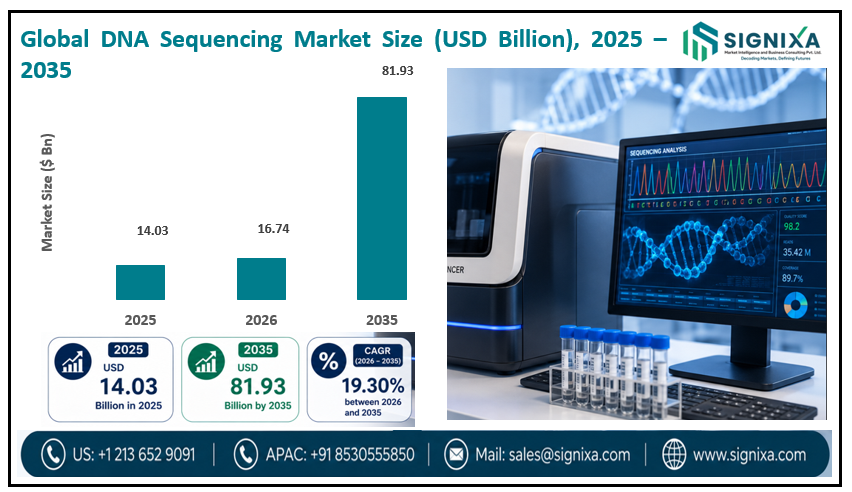
The global DNA sequencing market was valued at approximately USD 14.03 Billion in 2025 and is expected to reach USD 81.93 Billion by 2035, growing at a CAGR of 19.30% between 2026 and 2035. Market growth is primarily driven by advancements in sequencing technologies, increasing research and clinical applications, and the rising demand for personalized medicine. With significant contributions from genomic research and diagnostics, the market is witnessing broad adoption across healthcare, academic research, and pharmaceutical sectors.
The DNA sequencing market is a cornerstone of modern life sciences, enabling the determination of the precise order of nucleotides (A, T, C, G) within a DNA molecule. This fundamental information is crucial for understanding genetic variations, gene function, and the underlying mechanisms of various biological processes. The market's growth is driven by escalating demand across a multitude of applications including basic research, clinical diagnostics, drug discovery and development, personalized medicine, forensics, and agricultural biotechnology. The technological evolution from first-generation Sanger sequencing to the high-throughput capabilities of Next-Generation Sequencing (NGS) and now to Third-Generation Sequencing (TGS) has dramatically lowered costs and increased speed, making genomic data accessible to a broader range of researchers and clinicians. This continuous improvement in efficiency and affordability is a primary catalyst for the market's expansion, transforming DNA sequencing from a niche academic tool to a widely adopted and indispensable technology.
A significant dynamic within the DNA sequencing market is the relentless pursuit of higher throughput, lower cost, and longer read lengths. NGS platforms, which parallelize the sequencing process, have revolutionized genomics by enabling the simultaneous sequencing of millions of DNA fragments, drastically reducing the cost per base pair. Building on NGS, TGS technologies such as Single-Molecule Real-Time (SMRT) sequencing and Nanopore sequencing represent the latest frontier, offering significantly longer read lengths crucial for resolving complex genomic regions, identifying structural variations, and achieving more complete genome assemblies. The market's expansion is further fuelled by the burgeoning field of personalized medicine and precision diagnostics, where DNA sequencing enables comprehensive genomic tumour profiling in oncology, pharmacogenomics-guided drug dosing, and rapid diagnosis of rare genetic diseases through whole-exome or whole-genome sequencing.
Key Findings
- The global DNA sequencing market size was valued at USD 14.03 Billion in 2025 and is projected to reach USD 81.93 Billion by 2035, growing at a CAGR of 19.30%.
- Next-Generation Sequencing (NGS) dominates the market, accounting for approximately 55% of technology share in 2025, with growing adoption across clinical applications particularly in oncology and reproductive health.
- North America leads the market in terms of revenue share, driven by advanced healthcare infrastructure, strong research funding, and high adoption rates of advanced sequencing technologies.
- Consumables hold the largest product share at approximately 40% of the total market, with significant recurring demand growth across sequencing workflows.
- Oncology is the largest application segment, contributing about 30% of the total market, driven by demand for personalized cancer treatments and comprehensive genomic profiling.
- Academic Research is the largest end-user segment, contributing approximately 40% of total market share, underpinned by increased funding for genetic research and healthcare initiatives.
DNA Sequencing Market Dynamics
Continuous Technological Advancement from NGS to Third-Generation Sequencing
The DNA sequencing market is experiencing a profound evolution primarily driven by continuous advancement in sequencing technologies. The transition from Sanger sequencing to NGS and now to TGS has dramatically reduced the cost per base pair and increased data output, making genomic information more accessible than ever. NGS platforms have become a cornerstone for large-scale genomic projects, enabling whole-genome and whole-exome sequencing at unprecedented speeds. The emergence of TGS technologies — including Pacific Biosciences' SMRT sequencing and Oxford Nanopore sequencing — is pushing boundaries further by offering significantly longer read lengths and real-time data acquisition. These advancements are crucial for resolving complex genomic regions, identifying structural variations, and facilitating rapid diagnostics even at the point of care. The intense competition among technology developers to enhance accuracy, speed, and affordability is a relentless force shaping the market's trajectory and broadening the application landscape for DNA sequencing globally.
Burgeoning Clinical Applications & Personalized Medicine Demand
A significant dynamic shaping the DNA sequencing market is the burgeoning demand from clinical applications and personalized medicine. DNA sequencing is no longer solely a research tool; it is increasingly being integrated into routine clinical practice for disease diagnosis, prognosis, and guiding treatment decisions. In oncology, comprehensive genomic profiling of tumours helps identify actionable mutations that can be targeted by specific therapies, leading to more effective and personalized cancer treatments. In pharmacogenomics, sequencing data is used to predict an individual's drug response, minimizing adverse reactions and optimizing dosages. The diagnosis of rare genetic diseases is significantly accelerated by whole-exome or whole-genome sequencing, which can quickly pinpoint causative mutations that were previously undetectable. This clinical adoption is driven by growing evidence of improved patient outcomes and the long-term cost savings to healthcare systems enabled by more targeted and effective genomic interventions.
Data Management Complexity, Bioinformatics Barriers & Ethical Considerations
Despite compelling growth drivers, the DNA sequencing market faces considerable challenges related to data management, bioinformatics expertise, and ethical considerations. The immense volume of genomic data generated by high-throughput sequencers creates a significant "data tsunami," posing major hurdles in terms of storage, processing, analysis, and interpretation. Deriving meaningful biological and clinical insights from this data requires sophisticated bioinformatics tools, robust computational infrastructure, and highly skilled personnel. The shortage of specialized bio-informaticians can be a bottleneck, particularly for smaller laboratories or those in developing regions. Furthermore, the ethical implications of genetic information — including data privacy, security, potential discrimination in insurance or employment, and the responsible use of genetic data — are paramount concerns that influence market adoption and regulatory frameworks. Strict regulations such as GDPR in Europe impose significant requirements on genomic data handling. Addressing these challenges through cloud-based analysis platforms, AI-driven bioinformatics tools, and clearer ethical guidelines is crucial for sustainable market growth.
DNA Sequencing Market Segmentation Analysis
By Product & Service Segment Analysis
The DNA sequencing market is structured across three primary product and service categories, each representing distinct recurring and capital expenditure profiles within laboratory and clinical sequencing workflows:
Consumables
Consumables hold a major share of the DNA sequencing market, accounting for approximately 40% of the total market in 2025. These include reagents, chemicals, sequencing kits, library preparation kits, and flow cells used throughout the sequencing workflow. As sequencing becomes more widespread, the demand for consumables grows proportionally, with annual growth rates projected at approximately 19% — reflecting the recurring nature of consumable repurchase with every sequencing run. The high-throughput character of NGS workflows, where a single instrument may consume dozens of kits per week in an active laboratory, makes consumables the largest and most predictable revenue stream for instrument manufacturers through their reagent supply agreements and proprietary kit ecosystems.
Instruments
Instruments are integral to DNA sequencing, comprising approximately 35% of the market. The development of cost-efficient sequencers such as benchtop NGS platforms for clinical settings has been a key trend, democratizing access to high-throughput genomic analysis beyond large academic genome centers. The segment is expected to grow at a CAGR of approximately 18.5%, particularly driven by innovations in NGS and the commercialization of third-generation sequencing instruments from Pacific Biosciences and Oxford Nanopore Technologies. The introduction of more compact, affordable, and user-friendly sequencers is expanding the instrument customer base to include smaller hospitals, community laboratories, and clinical diagnostic centers that previously lacked access to genomic sequencing capabilities.
Services
Services — including sequencing-as-a-service, clinical sequencing services, and bioinformatics data analysis offered by third-party companies — contribute approximately 25% of the market. The rise of clinical sequencing services and specialized bioinformatics services is expected to expand this segment, with growth rates projected to exceed 20% by 2035. Contract research organizations (CROs) and specialized genomic service providers enable pharmaceutical companies, hospitals, and smaller research groups to access advanced sequencing capabilities without capital investment in instruments. The growing complexity of clinical variant interpretation and the demand for regulatory-compliant clinical sequencing reports are driving adoption of specialized service providers across oncology, rare disease diagnostics, and reproductive health applications.
By Technology Segment Analysis
The DNA sequencing technology landscape spans three generations, each offering distinct trade-offs between read length, throughput, cost, and application suitability across research and clinical environments:
Next-Generation Sequencing (NGS)
Next-Generation Sequencing is the market leader, accounting for 55% of the DNA sequencing market share in 2025 and growing at a CAGR of approximately 20%. The technology's applications span genetic research to clinical diagnostics, providing faster, more cost-effective sequencing than traditional methods and driving increasing adoption across multiple sectors. NGS platforms enable massively parallel sequencing — reading millions of short DNA fragments simultaneously — enabling whole-genome sequencing (WGS), whole-exome sequencing (WES), targeted gene panels, RNA sequencing, and metagenomics at throughputs and price points that have transformed genomics from a specialized research capability to a broadly accessible clinical tool. The dominant market position of Illumina's sequencing platforms within this segment underscores the proprietary ecosystem value of reagents, instruments, and bioinformatics software that characterize leading NGS providers.
Third-Generation DNA Sequencing (TGS)
Third-generation sequencing — including Pacific Biosciences' SMRT sequencing and Oxford Nanopore Technologies' nanopore-based platforms — is emerging as a transformative technology for real-time and long-read sequencing applications. This segment is expected to see a CAGR of approximately 25%, particularly in advanced genomic applications such as de novo genome assembly, structural variant detection, and direct epigenome sequencing. TGS platforms offer read lengths of tens of thousands to hundreds of thousands of base pairs — dramatically longer than NGS short reads — enabling resolution of complex repetitive genomic regions that are inaccessible to short-read sequencing. The portability of nanopore sequencers, which can operate from a laptop USB connection, opens entirely new application domains including point-of-care infectious disease surveillance, environmental metagenomics, and real-time outbreak genomics.
Sanger Sequencing
Traditional Sanger sequencing retains applications in small-scale sequencing, particularly for confirmatory sequencing of specific variants identified by NGS, targeted single-gene analysis, and specialized research applications. This technology holds approximately 15% market share and is growing at a slower pace compared to NGS. However, its high per-read accuracy, simplicity of interpretation, and well-established regulatory acceptance for clinical variant confirmation make it ideal for specialized diagnostic and research use cases where sequencing throughput requirements are modest. Sanger sequencing also remains the gold standard for orthogonal validation of NGS findings in clinical diagnostic workflows, ensuring its continued relevance as a complementary technology alongside high-throughput NGS platforms through the forecast period.
By Workflow Segment Analysis
Sequencing (Core Phase)
The sequencing phase — involving the actual reading of DNA sequences — is the core of the DNA sequencing process and dominates the workflow segment, accounting for approximately 60% of the total workflow market. Driven by the expansion of NGS technology and the growing number of samples being processed for both research and clinical applications, this segment encompasses the instrument run time, flow cell consumption, and associated software used to generate raw base call data from DNA templates. The throughput capabilities of modern NGS platforms, processing thousands of samples per year on high-end systems, make this the primary value-generating activity within sequencing workflows and the largest contributor to instrument and consumable revenue across the market.
Data Analysis (Post-Sequencing)
Post-sequencing data analysis involving the alignment, variant calling, annotation, and clinical interpretation of vast amounts of genomic data is a key challenge and the fastest-growing workflow segment, projected to grow at a CAGR of approximately 21%. This growth is driven by advancements in bioinformatics software and machine learning tools capable of handling large datasets efficiently, and by the critical need for clinically actionable interpretation of sequencing results. Commercial bioinformatics platforms, cloud-based analysis pipelines, and AI-powered variant classification tools are rapidly reducing the expertise barrier and turnaround time for genomic data interpretation, enabling broader clinical adoption. The regulatory requirement for clinically validated bioinformatics pipelines in diagnostic settings is also driving investment in certified, audit-ready analysis software solutions.
Pre-Sequencing
The pre-sequencing phase includes DNA extraction, library preparation, quality control, and sample normalization — all essential steps for ensuring high-quality samples that yield reliable sequencing data. With increasing automation and standardization of library preparation workflows, the pre-sequencing market is expected to grow at a CAGR of approximately 17%. Automated liquid handling systems and integrated library preparation platforms are reducing manual variability, improving reproducibility, and enabling higher-throughput sample processing that matches the capacity of modern NGS instruments. The quality of pre-sequencing sample preparation directly determines downstream data quality and sequencing success rates, making investments in automated, high-fidelity library preparation workflows a priority for high-volume clinical and research sequencing operations.
By Application Segment Analysis
The DNA sequencing market serves a broad and growing array of clinical, research, and consumer application segments, each driven by distinct biological questions and market dynamics:)
Oncology
Cancer genomics is one of the primary applications of DNA sequencing, contributing approximately 30% of the total market. Personalized treatment based on genetic mutations is driving demand for sequencing in oncology, particularly for early detection, comprehensive genomic profiling, and targeted therapy selection. Liquid biopsy applications — using circulating tumour DNA (ctDNA) detected in blood — are an emerging and rapidly growing sub-segment, enabling non-invasive tumour monitoring, early detection of minimal residual disease, and treatment resistance detection. The integration of NGS-based comprehensive genomic profiling into standard oncology treatment protocols in major cancer centers worldwide is creating sustained high-volume clinical demand for both instruments and sequencing consumables in this application segment.
Clinical Investigation
Clinical investigation — including diagnostic sequencing for diseases such as cystic fibrosis, muscular dystrophy, and other monogenic disorders — accounts for approximately 20% of the market. This segment is increasingly becoming an integral part of personalized medicine and is projected to grow significantly through the forecast period. Whole-exome sequencing (WES) and whole-genome sequencing (WGS) are transforming the diagnostic odyssey for patients with suspected rare genetic disorders, enabling causative variant identification in a single comprehensive test rather than sequential single-gene tests. The growing reimbursement coverage for clinical NGS-based genetic testing by health insurers across major markets is a critical catalyst for expanding clinical investigation sequencing volumes beyond specialized academic medical centers into community hospital and outpatient clinical settings.
Reproductive Health
Genetic testing in reproductive health — including non-invasive prenatal testing (NIPT), preimplantation genetic testing (PGT), and carrier screening — accounts for approximately 18% of the market. As personalized genomics for fertility and genetic disorder prevention gains traction, this segment is expected to expand rapidly at a projected CAGR of approximately 22%. NGS-based NIPT has largely replaced traditional prenatal screening methods in many markets due to its superior sensitivity and specificity for detecting chromosomal aneuploidies such as Down syndrome from maternal blood samples as early as 10 weeks of gestation. The expansion of comprehensive carrier screening panels covering hundreds of recessive genetic conditions is also driving high-volume reproductive health sequencing demand through fertility clinics, obstetric practices, and genetic counseling services.
Agrigenomics & Forensics
Use of DNA sequencing for agricultural genomics and forensic analysis is growing steadily, with market share accounting for approximately 12%. In agrigenomics, high-throughput sequencing enables crop genome sequencing for trait identification, disease resistance breeding, and development of genomic selection tools that accelerate plant and animal breeding programs. In forensics, NGS-based methods are expanding the analytical capabilities of forensic DNA profiling beyond traditional STR analysis, enabling phenotypic prediction, kinship analysis from degraded samples, and microbiome-based evidence analysis. Government investment in national food security programs and law enforcement forensic capability upgrades are both contributing to sustained growth in this diversified application segment through the forecast period.
HLA Typing / Immune System Monitoring
As immune-related diseases and organ transplantations rise globally, the HLA typing and immune system monitoring segment — contributing approximately 8% of the market — is expanding rapidly. The demand for high-resolution HLA typing for organ and stem cell transplant donor-recipient matching is increasing as transplant volumes grow and as the consequences of HLA mismatch are better understood clinically. NGS-based HLA typing offers higher resolution, broader allele coverage, and greater scalability compared to traditional sequence-based typing (SBT) methods. Additionally, immune repertoire sequencing — profiling the diversity of B-cell and T-cell receptor genes — is a growing research and clinical monitoring tool in oncology immunotherapy, autoimmune disease management, and vaccine response evaluation, expanding the addressable market for this application segment.
Consumer Genomics
The consumer genomics segment, though relatively small at approximately 5% of the market, is growing with the rising popularity of direct-to-consumer (DTC) genetic testing services such as 23andMe and Ancestry.com. The growing interest in personal health insights, ancestry mapping, pharmacogenomic wellness reports, and nutrigenomics is fuelling demand. While this segment faces ongoing regulatory scrutiny and data privacy considerations, the increasing consumer awareness of genomic health and the expanding scope of health-related insights available from DTC platforms continue to drive adoption, particularly among younger technology-savvy demographics seeking proactive health management tools. Integration with digital health platforms and electronic health records is an emerging trend that may significantly expand the clinical relevance and commercial reach of consumer genomics services.
Report Attributes & Market Scope
| Report Attribute | Details |
|---|---|
| Market Size Value in 2025 | USD 14.03 Billion |
| Market Size Value in 2035 | USD 81.93 Billion |
| CAGR (2026–2035) | 19.30% |
| Base Year Used for Estimation | 2025 |
| Historic Data | 2020 – 2025 |
| Forecast Period | 2026 – 2035 |
| Segments Covered – By Product & Service |
|
| Segments Covered – By Technology |
|
| Segments Covered – By Workflow |
|
| Segments Covered – By Application |
|
| Segments Covered – By End Use |
|
| Regions Covered | North America, Europe, Asia Pacific, Latin America, Middle East and Africa |
| Major Countries Covered | U.S., Canada, Mexico, Germany, UK, France, Italy, Spain, Russia, China, Japan, South Korea, India, Southeast Asia Countries, Brazil, Argentina, GCC Countries, Turkey, Iran, Israel, South Africa, Egypt, Nigeria, etc. |
| Key Companies Profiled | Illumina Inc., Thermo Fisher Scientific, Pacific Biosciences, Oxford Nanopore Technologies, QIAgen, and Agilent Technologies, among others. |
DNA Sequencing Market Regional Analysis
The North American market holds the largest share, contributing approximately 40% of global market revenue in 2025, attributed to well-established healthcare infrastructure, high R&D investments, and strong government support for genomics research. The Asia-Pacific region is experiencing the fastest growth with a projected CAGR of approximately 21%, driven by increasing genomic research investment, population scale, and healthcare awareness in China and India. Europe follows closely with strong government funding and increasing healthcare applications, while Latin America and MEA regions are emerging markets expected to see 18–20% CAGR due to expanding healthcare needs and infrastructure development.
North America (Dominant Region)
North America holds the largest share of the global DNA sequencing market, driven by its advanced healthcare infrastructure, the highest R&D expenditure in life sciences globally, and strong government support through initiatives such as the NIH's All of Us Research Program and the National Cancer Institute's genomic research funding. The United States is home to the leading NGS instrument manufacturers and a dense ecosystem of genomic service providers, academic medical centers, and biotech companies actively deploying sequencing at clinical and research scale. The integration of NGS-based clinical genomics panels into routine oncology protocols, the broad reimbursement coverage for molecular diagnostic testing by major US payers, and the high density of genomic research institutions collectively sustain the region's dominant market position through the forecast period.
Europe
Europe represents a mature and steadily advancing market for DNA sequencing, driven by strong government funding for research and increasing healthcare applications of clinical genomics. Large-scale national genomics initiatives — including the UK's Genomics England 100,000 Genomes Project, France's Plan France Médecine Génomique, and similar programs across Germany, the Netherlands, and Scandinavia — have established robust clinical sequencing infrastructure and demonstrated the healthcare system benefits of population-scale genomic medicine. The EU's investment in the European Health Data Space and international genomics data sharing initiatives is further supporting market growth. Europe's emphasis on ethical genomic data governance and GDPR compliance is shaping both market adoption patterns and the design of sequencing data management platforms deployed across the region.
Asia Pacific (Fastest-Growing Region)
The Asia-Pacific region is experiencing the fastest growth in the global DNA sequencing market, with a projected CAGR of approximately 21% from 2025 to 2035. China is both a dominant demand center and a major global supply hub for sequencing, with BGI Genomics operating the world's largest sequencing capacity and actively competing with Illumina on instrument and sequencing service pricing. India's healthcare modernization and government investments in biotechnology are accelerating the adoption of clinical genomics services. Japan and South Korea maintain sophisticated research genomics ecosystems with strong academic and pharmaceutical industry demand. The scale of Asia-Pacific's populations, combined with the high prevalence of specific genetic diseases, reproductive health genomics demand, and pharmacogenomics opportunity, positions the region for sustained high-growth market expansion.
Latin America
Latin America is an emerging market for DNA sequencing, with Brazil and Mexico as the primary contributors driven by growing healthcare investment, expanding pharmaceutical industry R&D activity, and increasing adoption of clinical molecular diagnostics. Brazil's national oncology programs and public health genomic initiatives are establishing clinical NGS infrastructure across major academic medical centers. The increasing prevalence of genetic diseases and the demand for non-invasive prenatal testing in the region's growing middle-class populations are driving adoption of reproductive health sequencing applications. As regional manufacturing capabilities for sequencing reagents and bioinformatics platforms expand, cost barriers to adoption are gradually declining, supporting the projected 18–20% CAGR for Latin America's DNA sequencing market through the forecast period.
Middle East & Africa
The Middle East and Africa region represents an emerging but promising market for DNA sequencing, underpinned by growing healthcare infrastructure investment, rising medical research capacity, and increasing awareness of genomic medicine's potential. GCC countries — particularly Saudi Arabia, UAE, and Qatar — are establishing genomics research centers and population genomic programs aligned with their national health transformation visions. Saudi Arabia's national genome program and the UAE's population health research initiatives are creating demand for both research-grade and clinical-grade sequencing platforms. In Africa, programs targeting infectious disease genomics — including pathogen surveillance, HIV drug resistance monitoring, and tuberculosis outbreak tracking — are driving adoption of portable nanopore sequencing platforms that operate effectively in resource-limited settings, creating a distinct and growing market segment for third-generation sequencing technology across the continent.
Recent Developments in the DNA Sequencing Market
-
2026
PacBio launched its SPRQ-Nx chemistry globally, enabling lower-cost HiFi genome sequencing and improving sequencing accuracy through AI-enhanced data analysis capabilities.
PacBio partnered with Covaris to introduce an integrated workflow for sequencing FFPE tumor samples, expanding applications in oncology and clinical research
-
2025
Illumina introduced a new NovaSeq X single-flow-cell system, along with upgraded software and sequencing kits to support multiomics and next-generation genomic research.
Oxford Nanopore Technologies continued expanding its nanopore sequencing portfolio and clinical diagnostics initiatives to strengthen its presence in genomic and healthcare applications.
Illumina launched TruSight Oncology 500 v2, an enhanced cancer research assay designed to improve comprehensive genomic profiling capabilities.
DNA Sequencing Market: Competitive Landscape
The DNA sequencing market is competitive, with several key players including Illumina Inc., Thermo Fisher Scientific, Pacific Biosciences, Oxford Nanopore Technologies, QIAgen, and Agilent Technologies, among others. These companies are focused on advancing sequencing technologies, enhancing data analysis tools, and expanding their product portfolios to capture a larger share of the rapidly growing market. With increasing investments in NGS and third-generation sequencing technologies, these players are expected to play a pivotal role in driving market expansion and technological innovation.
The competitive landscape of the DNA sequencing market is characterized by a dominant-platform dynamic, where Illumina holds the largest share of the NGS instrument and consumables market through its proprietary sequencing-by-synthesis chemistry and extensive installed base. This creates a strong recurring revenue model through reagent supply to existing instrument customers, as sequencing chemistry is not interchangeable across platforms. However, this dominance is increasingly challenged by the commercialization of third-generation long-read sequencing platforms — particularly Oxford Nanopore Technologies' GridION and PromethION instruments — which offer capabilities that complement or in some applications exceed short-read NGS, creating new competitive dynamics in the research and clinical markets.
The bioinformatics and data analysis software layer is emerging as an increasingly important competitive frontier. Companies that can provide end-to-end solutions — from sample preparation through sequencing to clinically actionable variant reports — are gaining competitive advantage in clinical market segments where workflow simplicity, regulatory compliance, and turnaround time are critical purchase criteria. Strategic acquisitions, partnerships with pharmaceutical companies for companion diagnostics co-development, and integration with electronic health record systems are all shaping the competitive positioning of leading market participants. The entry of major technology companies into genomic cloud computing and AI-powered bioinformatics is further reshaping competitive dynamics by providing powerful analysis infrastructure that enhances the clinical utility of sequencing data generated on any instrument platform.
Key Companies Profiled
- Illumina, Inc.
- Thermo Fisher Scientific Inc.
- F. Hoffmann-La Roche Ltd.
- QIAGEN N.V.
- Pacific Biosciences of California, Inc. (PacBio)
- Oxford Nanopore Technologies plc
- Agilent Technologies, Inc.
- BGI Genomics Co., Ltd.
- Bio-Rad Laboratories, Inc.
- Revvity, Inc.
- 10x Genomics, Inc.
- Eurofins Scientific SE
- Macrogen, Inc.
- MGI Tech Co., Ltd.
- Myriad Genetics, Inc.
Global DNA Sequencing Market Segmentation Summary
By Product & Service
- Consumables
- Instruments
- Services
By Technology
- Sanger Sequencing
- Next-Generation Sequencing (NGS)
- Third-Generation DNA Sequencing (TGS)
By Workflow
- Pre-Sequencing
- Sequencing
- Data Analysis
By Application
- Oncology
- Reproductive Health
- Clinical Investigation
- Agrigenomics & Forensics
- HLA Typing / Immune System Monitoring
- Metagenomics, Epidemiology & Drug Development
- Consumer Genomics
- Others
By End Use
- Academic Research
- Clinical Research
- Hospitals & Clinics
- Pharmaceutical & Biotechnology Companies
- Other Users
By Region
- North America
- U.S.
- Canada
- Mexico
- Europe
- Germany
- France
- UK
- Spain
- Italy
- Rest of Europe
- Asia-Pacific
- China
- Japan
- India
- Australia
- South Korea
- Southeast Asia
- Rest of Asia-Pacific
- Latin America
- Brazil
- Argentina
- Rest of Latin America
- The Middle East & Africa
- GCC Countries
- South Africa
- Rest of the Middle East & Africa
Frequently Asked Questions (FAQs) About the DNA Sequencing Market
What is DNA Sequencing?
DNA Sequencing refers to the process of determining the precise order of nucleotides within a DNA molecule. It plays a pivotal role in genomics research, clinical diagnostics, personalized medicine, and biological research.
Which key factors will influence the DNA Sequencing market growth over 2026–2035?
The global DNA sequencing market is expected to grow significantly due to the rising prevalence of genetic disorders, advancements in next-generation sequencing (NGS) technologies, increasing demand for precision medicine, and growing R&D investments by biotech and pharmaceutical companies.
What will be the value of the DNA Sequencing market during 2026–2035?
According to the study, the global DNA sequencing market was valued at USD 14.03 Billion in 2025 and is projected to reach USD 81.93 Billion by 2035, growing at a CAGR of 19.30%.
What will be the CAGR value of the DNA Sequencing market during 2026–2035?
The DNA sequencing market is expected to grow at a CAGR of 19.30% during the forecast period from 2026 to 2035.
Which region will contribute notably towards the DNA Sequencing market value?
North America is anticipated to dominate the global DNA sequencing market due to well-established healthcare infrastructure, high R&D spending, and early adoption of advanced sequencing technologies. Asia-Pacific is projected to register the fastest growth owing to increasing genomic research, government initiatives, and rising healthcare awareness.
Which are the major players leveraging the DNA Sequencing market growth?
Key players operating in the global DNA sequencing market include Illumina Inc., Thermo Fisher Scientific Inc., BGI Genomics Co. Ltd., Agilent Technologies Inc., Pacific Biosciences of California Inc., Oxford Nanopore Technologies Ltd., QIAGEN N.V., Roche Holding AG, PerkinElmer Inc., and Bio-Rad Laboratories Inc.
What can be expected from the global DNA Sequencing market report?
The report offers a comprehensive analysis of the global DNA sequencing market, covering current trends, growth drivers, and challenges. It includes segmentation by product, technology, application, and end user, regional insights, competitive landscape, and strategic developments. The study also provides quantitative forecasts and highlights opportunities in precision medicine and genomics research covering the forecast period 2026 to 2035.