
Aircraft Landing Gear Market Overview
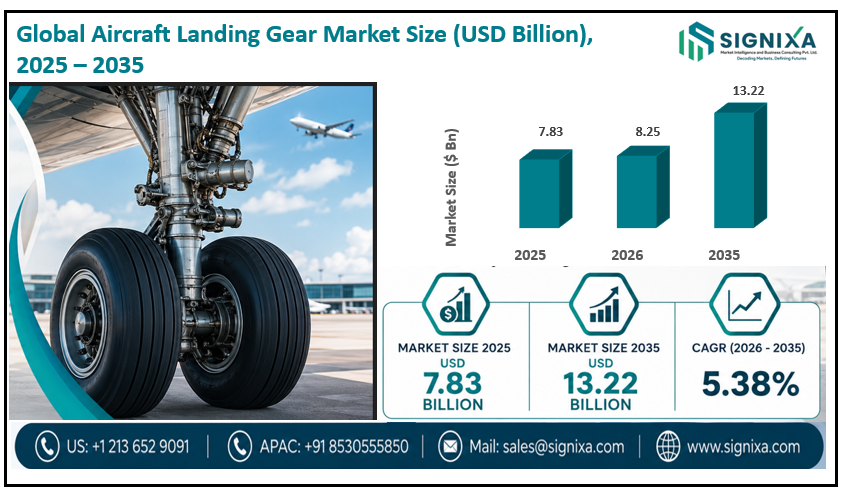
The size of the global aircraft landing gear market was worth around USD 7.83 Billion in 2025 and is predicted to grow to around USD 13.22 Billion by 2035, with a compound annual growth rate (CAGR) of roughly 5.38% between 2026 and 2035. The report analyzes the aircraft landing gear market's drivers and restraints, as well as the impact they have on demand throughout the projection period. In addition, the report examines global opportunities in the aircraft landing gear market.
The aircraft landing gear market encompasses systems designed to support aircraft during landing, takeoff, and while on the ground. Increasing air travel demand, rising military spending, and modernization of older aircraft fleets are key factors propelling market growth. Advances in lightweight materials and smart landing systems are transforming traditional designs, improving fuel efficiency and operational reliability. The trend toward electrification and innovations in retraction systems also contribute significantly to the growth of the aircraft landing gear market.
The aircraft landing gear market is a critical, highly specialized, and technologically advanced segment within the aerospace industry. Landing gear systems are far more than just wheels; they are complex assemblies comprising struts, shock absorbers, hydraulics, brakes, tires, and retraction mechanisms, all designed to support the immense weight of an aircraft during ground operations (taxiing, takeoff, landing) and absorb the massive kinetic energy of impact during touchdown. The market's stability is inherently linked to the global aviation industry's health, driven by factors such as increasing air traffic, fleet expansion by airlines, modernization programs for military aircraft, and the growing demand for business jets and general aviation. There is a continuous demand for robust, reliable, and durable landing gear systems that can withstand extreme loads and harsh environmental conditions while minimizing weight to enhance fuel efficiency and overall aircraft performance. This constant need for innovation and upgrades, across both original equipment manufacturers (OEMs) for new aircraft and the aftermarket for maintenance, repair, and overhaul (MRO) services, defines the core of this market.
A significant trend shaping the aircraft landing gear market is the relentless pursuit of weight reduction and improved fuel efficiency. With fuel costs being a major operational expense for airlines, manufacturers are constantly pressured to develop lighter landing gear systems without compromising on strength, safety, or reliability. This drives the adoption of advanced materials such as high-strength steel alloys, titanium alloys, and increasingly, composite materials like carbon fiber. These materials offer superior strength-to-weight ratios, enabling designers to create lighter components that contribute to overall aircraft weight reduction, leading to significant fuel savings and reduced emissions. Furthermore, innovations in manufacturing processes, including additive manufacturing (3D printing), are being explored to create complex, lightweight landing gear components with optimized geometries that were previously impossible to achieve with traditional methods. This focus on material science and manufacturing excellence is crucial for meeting the stringent performance demands of next-generation aircraft and aligning with the aviation industry's broader sustainability goals.
The market is also profoundly influenced by the integration of smart technologies and electrification. Traditional landing gear systems rely heavily on centralized hydraulic power, which is heavy and requires extensive piping. However, there's a clear industry shift towards more electric aircraft (MEA) concepts, leading to the development of electric and electro-hydrostatic actuation (EHA) systems for landing gear. These systems replace or supplement hydraulic power with electric motors, offering benefits such as reduced weight, lower maintenance requirements, improved reliability, and reduced noise. Beyond actuation, "smart" landing gear systems are incorporating an array of sensors and data analytics capabilities for real-time monitoring of performance, detecting wear and tear, predicting maintenance needs, and optimizing operational efficiency. This transition from reactive to predictive maintenance, enabled by IoT and AI, helps airlines reduce downtime and lower operational costs. Furthermore, concepts like electric taxiing (e-taxiing), where electric motors in the wheels allow aircraft to move on the ground without engaging their main engines, are gaining traction, promising significant reductions in fuel consumption and emissions during ground operations, further expanding the scope of innovation within the landing gear market.
Key Findings
- As per the analysis shared by our research analyst, the global aircraft landing gear market is estimated to grow annually at a CAGR of around 5.38% over the forecast period (2026-2035).
- In terms of revenue, the global aircraft landing gear market size was valued at around USD 7.83 Billion in 2025 and is projected to reach USD 13.22 Billion by 2035.
- The market is projected to grow at a steady rate due to increasing demand for modern, lightweight, and efficient landing gear systems.
- Based on Type, the Main Landing Gear segment is projected to dominate the market over the forecast period.
- On the basis of Platform, the Fixed-Wing segment is anticipated to account for the largest share.
- In terms of Arrangement, the Tri-Cycle segment is anticipated to dominate.
- By End-User, the OEM segment is expected to capture the largest market share.
- By Region, North America is projected to dominate the global market during the forecast period.
Aircraft Landing Gear Market Dynamics
Rising Commercial Aircraft Production & Growing Air Passenger Traffic
The increasing production of commercial aircraft, driven by growing air passenger traffic globally, is significantly boosting the aircraft landing gear market. As airlines expand their fleets and replace aging aircraft, there is a corresponding rise in demand for modern, efficient landing gear systems. According to the International Air Transport Association (IATA), global air travel is expected to reach 9.4 Billion passengers by 2035, encouraging aircraft manufacturers to produce more units equipped with advanced landing gear technologies, thus fueling market growth.
Advancements in Lightweight Materials & Fuel Efficiency Imperatives
Advancements in lightweight materials such as composites and titanium alloys are transforming the aircraft landing gear market. Reducing the weight of landing gear contributes directly to lower aircraft fuel consumption, aligning with the aviation industry's push toward sustainability and cost savings. Companies are investing heavily in the development of lighter yet stronger components. For instance, the introduction of carbon brakes and composite material integration in landing systems enhances aircraft efficiency and longevity, positioning these innovations as key growth drivers over the forecast period.
Fleet Modernization, Military Demand & Consistent Aftermarket Growth
The aircraft landing gear market is experiencing a significant growth trajectory driven by several key factors. Foremost among these is the sustained expansion of the global commercial aviation industry, fueled by increasing air travel demand, particularly from emerging economies. As airlines expand and modernize their fleets, there's a direct correlation with the demand for new landing gear systems as original equipment (OE) for newly manufactured aircraft. Furthermore, the imperative for airlines to enhance operational efficiency and reduce costs is driving demand for advanced landing gear that offers greater durability, reduced weight, and lower maintenance requirements. The military aviation sector also acts as a significant driver, with ongoing modernization programs and the development of new military aircraft necessitating state-of-the-art landing gear systems that can withstand extreme operational demands and harsh environments. The continuous cycle of fleet replacement and upgrades across both commercial and military sectors provides a consistent demand for both new and aftermarket landing gear components and services.
Electrification, Smart Technologies & Predictive Maintenance Integration
Another critical dynamic is the rapid pace of technological advancements, fundamentally reshaping the design, materials, and functionality of aircraft landing gear. The industry is witnessing a strong shift towards the adoption of advanced, lightweight materials such as high-strength steel alloys, titanium alloys, and increasingly, composite materials like carbon fiber. These materials offer superior strength-to-weight ratios, enabling manufacturers to design lighter yet more robust landing gear that can handle immense loads while contributing to overall aircraft fuel efficiency. Beyond materials, there's a significant trend towards electrification and smart landing gear systems. Traditional hydraulic systems are being supplemented or replaced by electro-hydrostatic actuators (EHAs) or fully electric actuation systems, which offer benefits like reduced weight, lower maintenance, and improved reliability. Furthermore, the integration of sensors for real-time monitoring of landing gear health, stress, and temperature is enabling predictive maintenance strategies, allowing airlines to anticipate and address issues before they lead to costly downtime. This shift from reactive to proactive maintenance, powered by data analytics and IoT, significantly enhances operational efficiency and safety.
Challenges: Regulatory Complexity, High Costs & Economic Sensitivity
Despite the strong growth drivers and technological advancements, the aircraft landing gear market also faces notable challenges. The stringent regulatory requirements imposed by aviation authorities globally, such as the FAA and EASA, demand exhaustive testing and certification processes for any new material, design, or technology. This lengthy and costly approval process can significantly extend product development cycles and act as a barrier to rapid innovation. The high cost of advanced materials and complex manufacturing processes for landing gear components also presents a challenge, impacting the overall cost of aircraft and spare parts. Furthermore, maintaining and repairing these highly complex systems requires specialized expertise, tools, and facilities, contributing to substantial maintenance, repair, and overhaul (MRO) costs. The market is also sensitive to global economic downturns and geopolitical instability, which can impact air travel demand, airline profitability, and defense budgets, leading to delays in aircraft deliveries or fleet modernization plans. Addressing the balance between cutting-edge technology, cost-effectiveness, and regulatory compliance remains a constant challenge for players in this critical aerospace segment.
Aircraft Landing Gear Market Segmentation Analysis
By Type Segment Analysis
The market is segmented by type, with each category exhibiting distinct performance characteristics and demand drivers:
Main Landing Gear
Main Landing Gear holds the dominant position due to its critical role in bearing the majority of the aircraft's weight during landing and takeoff. In 2025, the main landing gear segment accounted for around 65% of the market share, reflecting its indispensable role across both commercial and military aircraft. With airlines focusing on enhancing aircraft performance and load-bearing capabilities, investments in robust main landing gear systems are steadily rising, further driving segment growth through 2035.
Nose Landing Gear
The Nose Landing Gear segment plays a vital supporting role in aircraft ground operations, providing steering capability and absorbing taxiing loads. While it accounts for a smaller share compared to main landing gear, it is integral to overall aircraft ground handling and safety. Ongoing advancements in nose gear steering systems and lightweight materials are steadily improving performance and durability, ensuring consistent demand across both commercial and military aircraft platforms throughout the forecast period.
By Platform Segment Analysis
Fixed-Wing
The Fixed-Wing segment leads the aircraft landing gear market, accounting for about 72% of the global revenue in 2025. Fixed-wing aircraft, especially commercial and business jets, are witnessing strong demand due to increased air travel and global connectivity. Major manufacturers such as Airbus and Boeing are scaling up their aircraft deliveries, which in turn bolsters the need for advanced, reliable fixed-wing landing gear solutions across both OEM and aftermarket sectors.
Rotary-Wing
The Rotary-Wing segment encompasses helicopters and other rotorcraft platforms used across military, emergency services, and commercial operations. Landing gear for rotary-wing aircraft must withstand high-frequency vibrations, varied terrain landings, and demanding operational conditions. Growing military helicopter procurement, expansion of offshore operations, and increased use of helicopters in emergency medical services are supporting steady demand. Innovations in skid-type and wheeled configurations are continuously improving performance and reliability across this segment.
By Arrangement Segment Analysis
Tri-Cycle
The Tri-Cycle arrangement dominated the market in 2025, contributing to nearly 58% of the total market revenue. The tri-cycle layout offers better ground handling, improved pilot visibility during taxiing, and enhanced stability during landing and takeoff. Owing to these advantages, it remains the preferred configuration for most commercial airliners, regional jets, and even modern military aircraft, ensuring consistent demand over the forecast period.
Tail Wheel
The Tail Wheel arrangement, also known as a conventional landing gear configuration, is primarily found in older aircraft designs, agricultural aircraft, and certain specialized military platforms. While it represents a smaller share of the overall market, it continues to serve niche applications where ground clearance for propellers and simplicity of design are prioritized. Demand is supported by general aviation markets, heritage aircraft restoration, and specific utility aircraft programs.
Tandem
The Tandem arrangement features gear units aligned along the aircraft's centerline and is commonly found in high-wing military transport aircraft and certain bomber configurations. This arrangement allows for optimal weight distribution in wide-body or high-wing designs where conventional tri-cycle configurations are less practical. Growing military transport aircraft procurement and fleet modernization programs are supporting sustained demand for tandem landing gear systems across key defense-oriented markets.
By Component Segment Analysis
Retraction System
The Retraction System segment held a significant market share of around 34% in 2025. Retraction systems are crucial for reducing drag during flight and improving overall aerodynamic performance. Innovations in electro-mechanical retraction mechanisms, replacing traditional hydraulic systems, are gaining traction due to improved energy efficiency and maintenance advantages. As aircraft manufacturers seek to enhance performance and fuel economy, demand for advanced retraction systems is projected to surge steadily.
Brakes and Wheels
The Brakes and Wheels segment represents a high-value and frequently replaced component category within the aircraft landing gear market. Carbon brakes have become increasingly prevalent across commercial aviation due to their superior heat dissipation, reduced weight, and extended service life compared to steel alternatives. Growing fleet sizes and increasing landing cycles driven by higher aircraft utilization rates are ensuring robust aftermarket demand. Ongoing innovation in anti-skid braking systems and brake-by-wire technology is further enhancing segment prospects.
Steering
Steering systems are critical for nose wheel control during ground operations, enabling precise taxiing maneuvers on congested airport surfaces. The increasing size and weight of modern wide-body aircraft are driving demand for more powerful and responsive steering actuators. Electro-mechanical steering systems are increasingly replacing traditional hydraulic configurations, offering improved precision, reduced maintenance requirements, and compatibility with modern fly-by-wire architectures. Demand is consistent across both OEM and aftermarket channels globally.
Others
The Others segment encompasses a range of critical landing gear sub-components including shock absorbers, struts, sensors, position indicators, and locking mechanisms. Shock absorbers are particularly important for absorbing touchdown energy and protecting airframe structures. Growing adoption of smart sensor integration for real-time condition monitoring across all landing gear sub-components is emerging as a key trend, enabling predictive maintenance capabilities that reduce unscheduled downtime and lower overall MRO costs for airlines and defense operators.
By End User Segment Analysis
OEM
OEMs (Original Equipment Manufacturers) accounted for approximately 68% of the aircraft landing gear market revenue in 2025. Rising aircraft production rates and growing demand for next-generation aircraft from major airlines have significantly boosted the OEM segment. Major players like Airbus, Boeing, and Embraer are incorporating modern landing gear solutions in their new aircraft programs, driving the OEM demand further throughout the forecast period.
Aftermarket
The Aftermarket segment, comprising maintenance, repair, and overhaul (MRO) services and replacement components, accounted for approximately 32% of market revenue in 2025. As global aircraft fleets age and utilization rates increase, the demand for landing gear inspections, overhauls, and component replacements is growing steadily. Airlines and defense operators are increasingly turning to predictive maintenance strategies enabled by sensor data to optimize MRO scheduling. The segment is expected to grow consistently as the global installed fleet base expands through 2035.
Report Attributes & Market Scope
| Report Attribute | Details |
|---|---|
| Market Size Value in 2025 | USD 7.83 Billion |
| Market Size Value in 2035 | USD 13.22 Billion |
| CAGR (2026–2035) | 5.38 % |
| Base Year Used for Estimation | 2025 |
| Historic Data | 2020 - 2025 |
| Forecast Period | 2026 - 2035 |
| Segments Covered – By Type |
|
| Segments Covered – By Platform |
|
| Segments Covered – By Arrangement |
|
| Segments Covered – By Component |
|
| Segments Covered – By End User |
|
| Regions Covered | North America, Europe, Asia Pacific, Latin America, Middle East and Africa |
| Major Countries Covered | U.S., Canada, Mexico, Germany, UK, France, Italy, Spain, Russia, China, Japan, South Korea, India, Southeast Asia Countries, Brazil, Argentina, GCC Countries, Turkey, Iran, Israel, South Africa, Egypt, Nigeria, etc. |
| Key Companies Profiled | Safran Landing Systems, Collins Aerospace, Liebherr Group, Heroux-Devtek Inc., Triumph Group, UTC Aerospace Systems, CIRCOR Aerospace, SPP Canada Aircraft, Inc., Magellan Aerospace, and AAR Corporation, among others. |
Aircraft Landing Gear Market Regional Analysis
North America dominated the global aircraft landing gear market in 2025, accounting for around 37% of the global revenue. The region's dominance is attributed to the presence of major aircraft manufacturers, technological innovations, and high defense spending, particularly in the United States. Europe follows, driven by increasing investments in sustainable aviation and fleet modernization programs. Meanwhile, the Asia-Pacific region is expected to witness the fastest growth through 2035, fueled by rapid economic development, urbanization, and the expansion of low-cost carriers across countries like China and India.
North America (Dominant Region)
North America's aircraft landing gear market is heavily influenced by the strong presence of major aircraft manufacturers and a robust commercial aviation sector. The United States, being home to leading aerospace companies, drives significant demand for original equipment (OE) landing gear for new aircraft deliveries, particularly for commercial narrow-body and wide-body aircraft, as well as for various military platforms. The region's airlines are consistently modernizing their fleets to enhance fuel efficiency and operational performance, which fuels the aftermarket for maintenance, repair, and overhaul (MRO) services for landing gear components. There's a strong focus on incorporating advanced materials like high-strength steel and titanium alloys, alongside exploring composites, to achieve weight reduction and improve durability. Furthermore, the push towards more electric aircraft (MEA) concepts and the integration of smart sensors for predictive maintenance are key trends, positioning North America at the forefront of technological advancements in landing gear systems.
Europe
Europe's aircraft landing gear market is mature and highly sophisticated, characterized by strong domestic aerospace manufacturing capabilities and a significant demand from both commercial and military aviation sectors. European aircraft manufacturers contribute substantially to the global fleet, driving demand for OE landing gear. The region also boasts a well-established MRO infrastructure, serving a large installed base of commercial and military aircraft, which ensures a steady demand for landing gear components, repairs, and overhauls. European regulatory bodies, such as EASA, impose stringent safety and certification standards, which influence design and manufacturing processes, fostering a culture of high quality and reliability. There's a notable trend towards developing more sustainable and efficient landing gear solutions, including the adoption of electric braking and retraction systems to reduce weight and enhance fuel efficiency, aligning with Europe's broader environmental goals within the aviation industry.
Asia-Pacific
The Asia Pacific region is rapidly emerging as the fastest-growing market for aircraft landing gear, primarily driven by the exponential growth of its commercial aviation sector. Countries like China, India, and other Southeast Asian nations are witnessing a surge in air passenger traffic and significant investments in fleet expansion and modernization by airlines. This directly translates into a massive demand for new aircraft, and consequently, for original equipment landing gear. Furthermore, as the fleet size grows, the aftermarket for MRO services for landing gear is also expanding rapidly. While domestic manufacturing capabilities are increasing in some countries, the region heavily relies on imports from established global landing gear manufacturers. The focus is on robust, cost-effective solutions for a diverse fleet, ranging from narrow-body aircraft for regional connectivity to wide-body jets for international routes, all while gradually integrating more advanced and efficient landing gear technologies.
Middle East & Africa
The Middle East and Africa (MEA) region presents a growing, albeit diverse, market for aircraft landing gear. The Middle East, particularly the Gulf Cooperation Council (GCC) countries, is characterized by its rapidly expanding airlines and significant investments in new, state-of-the-art aircraft, driving demand for OE landing gear. These airlines often operate large wide-body fleets for international travel, requiring advanced and durable landing gear systems. Furthermore, the region's strong defense spending contributes to the demand for military aircraft landing gear for modernization and new acquisitions. In Africa, the market is more nascent but shows potential with increasing air travel and efforts to modernize aging fleets. However, challenges such as varying economic conditions and the need for developing local MRO capabilities mean that the region heavily relies on international suppliers and MRO providers for advanced landing gear systems and maintenance services.
Latin America
Latin America represents a developing but increasingly important market for aircraft landing gear, supported by steady growth in regional air travel and fleet expansion by key carriers in Brazil, Mexico, and Colombia. The region's aviation sector is benefiting from rising middle-class populations, improved airport infrastructure, and the continued expansion of low-cost carriers. While the market primarily relies on imported landing gear systems and MRO services from North America and Europe, gradual investments in local maintenance capabilities are being observed. Growing demand for narrow-body commercial aircraft to serve intra-regional routes is expected to sustain steady landing gear procurement across the forecast period.
Recent Developments in the Aircraft Landing Gear Market
-
2026
Liebherr has delivered its initial nose landing gear for the Airbus A350F freighter, expands Airbus partnership, with new variants for the landing-gear development
A new OEM-approved landing-gear component machining facility in Pune, India from Bharat Forge and Liebherr-Aerospace
.Jeh Aerospace has signed a long-term agreement with Liebherr-Aerospace for the production of landing-gear components to be used in commercial single-aisle planes at its Hyderabad facility.
-
2025
Safran Landing Systems and Revima renewed a spare-parts and technical-support deal for Revima's Airbus landing-gear repair facilities in France and Thailand.
Collins Aerospace announced plans to expand its factory at Tajęcina, Poland, by 4,000 square meters to boost landing-gear production for commercial aircraft and defence applications.
Héroux-Devtek acquired by Platinum Equity; provides landing-gear manufacturing platform for potential further investment and expansion without any inherent exit restrictions.
Aircraft Landing Gear Market: Competitive Landscape
The global aircraft landing gear market features major players such as Safran Landing Systems, Collins Aerospace, Liebherr Group, Heroux-Devtek Inc., Triumph Group, UTC Aerospace Systems, CIRCOR Aerospace, SPP Canada Aircraft, Inc., Magellan Aerospace, and AAR Corporation, among others. Companies are increasingly focusing on lightweight designs, advanced retraction systems, and expanding their global presence to maintain competitive advantage. With rising demand for new aircraft and growing focus on reducing operational costs, competition in the aircraft landing gear market is expected to intensify further through 2035.
The competitive landscape of the aircraft landing gear market is defined by a small number of highly specialized global suppliers with deep technical expertise, significant capital investment in R&D, and long-standing relationships with major airframe manufacturers. These established players benefit from the lengthy certification requirements associated with safety-critical aerospace components, which create substantial barriers to entry for new competitors. Their strategies revolve around securing long-term supply agreements with OEMs for new aircraft programs, investing in advanced manufacturing technologies such as additive manufacturing and precision forging, and continuously upgrading product lines to meet evolving performance, weight, and sustainability requirements.
The aftermarket segment has emerged as an increasingly strategic battleground, with established landing gear manufacturers competing alongside specialized MRO service providers. Airlines' growing focus on minimizing downtime and optimizing total cost of ownership is pushing suppliers to offer comprehensive service packages that include predictive maintenance analytics, rapid component exchange programs, and digital monitoring solutions. Consolidation through mergers and acquisitions remains an active strategy in this market, as leading players seek to broaden their capabilities, geographic reach, and customer bases. Strategic partnerships with technology companies specializing in sensors, IoT platforms, and AI-driven analytics are also becoming critical differentiators in an increasingly data-driven industry.
Key Companies Profiled
- Safran Landing Systems
- Collins Aerospace
- Liebherr Group
- Heroux-Devtek Inc.
- Triumph Group
- UTC Aerospace Systems
- CIRCOR Aerospace
- SPP Canada Aircraft, Inc.
- Magellan Aerospace
- AAR Corporation
Global Aircraft Landing Gear Market Segmentation Summary
By Type
- Nose Landing Gear
- Main Landing Gear
By Platform
- Fixed-Wing
- Rotary-Wing
By Arrangement
- Tail Wheel
- Tandem
- Tri-Cycle
By Component
- Retraction System
- Brakes and Wheels
- Steering
- Others
By End User
- OEM
- Aftermarket
By Region
- North America
- U.S.
- Canada
- Mexico
- Europe
- Germany
- France
- UK
- Spain
- Italy
- Rest of Europe
- Asia-Pacific
- China
- Japan
- India
- Australia
- South Korea
- Southeast Asia
- Rest of Asia-Pacific
- Latin America
- Brazil
- Argentina
- Rest of Latin America
- The Middle East & Africa
- GCC Countries
- South Africa
- Rest of the Middle East & Africa
Frequently Asked Questions (FAQs) About the Aircraft Landing Gear Market
What is Aircraft Landing Gear?
Aircraft landing gear is a critical component of an aircraft that supports it during landing, takeoff, and while it is on the ground. It typically includes wheels, struts, shock absorbers, brakes, and steering systems. Landing gear systems are complex assemblies designed to bear the immense weight of an aircraft and absorb the kinetic energy of impact during touchdown.
Which key factors will influence the Aircraft Landing Gear market growth over 2026-2035?
The global aircraft landing gear market is expected to grow due to increasing demand for new-generation aircraft, rising global air passenger traffic, advancements in lightweight materials such as composites and titanium alloys, the electrification of landing gear actuation systems, growing military modernization programs, and expanding aftermarket MRO services across commercial and defense aviation sectors.
What will be the value of the Aircraft Landing Gear market during 2026-2035?
According to the study, the global Aircraft Landing Gear market size was worth around USD 7.83 Billion in 2025 and is predicted to grow to around USD 13.22 Billion by 2035.
What will be the CAGR value of the Aircraft Landing Gear market during 2026-2035?
The CAGR value of the Aircraft Landing Gear market is expected to be around 5.38% during the forecast period from 2026 to 2035.
Which region will contribute notably towards the Aircraft Landing Gear market value?
The global Aircraft Landing Gear market is led by North America, driven by the presence of major aircraft manufacturers, strong defense spending, and technological advancements, particularly in the United States. Asia-Pacific is expected to register the fastest growth through 2035 owing to rapid fleet expansion and increasing air travel demand.
Which are the major players leveraging the Aircraft Landing Gear market growth?
The global Aircraft Landing Gear market is led by players such as Safran S.A., Collins Aerospace (Raytheon Technologies Corporation), Héroux-Devtek Inc., Liebherr Group, Triumph Group Inc., AAR Corp, Circor International Inc., Magellan Aerospace Corporation, SPP Canada Aircraft Inc., and GKN Aerospace Services Ltd.
What can be expected from the global Aircraft Landing Gear market report?
The report explores crucial aspects of the aircraft landing gear market, including a detailed discussion of existing growth factors and restraints while also analyzing future growth opportunities and challenges that impact the market dynamics from 2025 to 2035. It covers comprehensive segmentation by type, platform, arrangement, component, and end user, alongside regional analysis and competitive landscape profiling.