
Medical Device Connectivity Market Overview
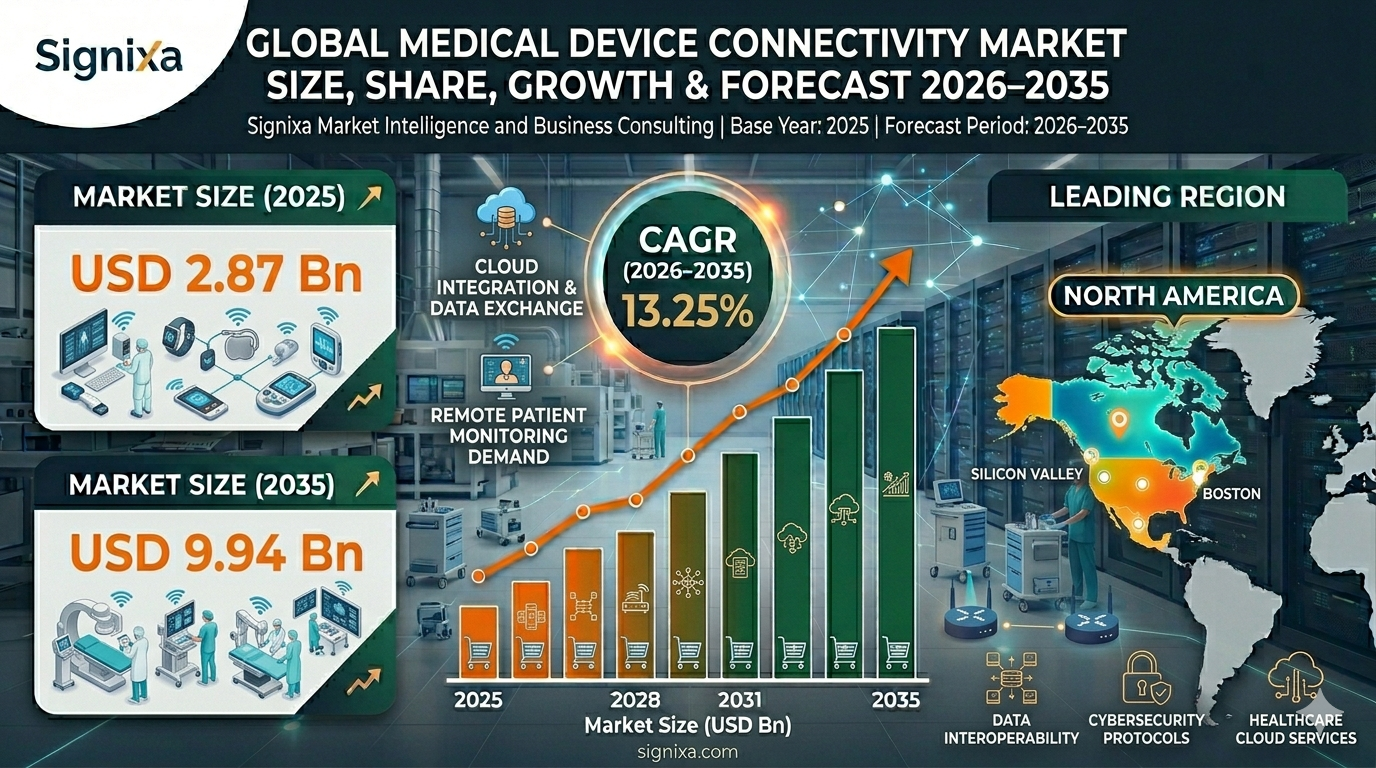
The size of the global Medical Device Connectivity market was valued at approximately USD 2.87 billion in 2025 and is projected to grow to around USD 9.94 billion by 2035, exhibiting a compound annual growth rate (CAGR) of about 13.25% during the forecast period. The report provides an in-depth analysis of market drivers and restraints, evaluating their impact on demand over the forecast period, and identifies potential global opportunities across the medical device connectivity landscape.
Medical device connectivity refers to the integration of healthcare devices with information systems to enable seamless data transfer, monitoring, and management. The rising adoption of electronic health records (EHRs), increasing demand for home healthcare, and growing investments in digital healthcare infrastructure are key drivers of market growth. Technologies that enable medical devices such as patient monitors, infusion pumps, and ventilators to share data seamlessly with hospital information systems and other digital platforms are at the core of this market. The growing emphasis on real-time patient monitoring, data-driven decision-making, and operational efficiency is driving demand for integrated connectivity solutions.
One of the primary growth drivers is the rising adoption of telehealth and remote patient monitoring, especially after the COVID-19 pandemic accelerated digital healthcare implementation. As a result, there is greater need for devices that can automatically capture, transmit, and store patient data from both in-hospital and home-based environments. Moreover, regulatory frameworks promoting interoperability, such as the U.S. 21st Century Cures Act, are pushing vendors to offer standardized connectivity solutions. As hospitals move toward value-based care and precision medicine, medical device connectivity will play a central role in transforming how healthcare is delivered, documented, and analyzed.
Key Findings
- The global medical device connectivity market is expected to grow at a CAGR of approximately 13.25% from 2026 to 2035.
- In 2025, the market size was valued at USD 2.87 billion and is forecasted to reach USD 9.94 billion by 2035.
- Increasing digitization of healthcare systems, regulatory mandates for interoperability, and the expansion of IoT in healthcare are the primary market drivers.
- Based on Components, the Wireless Hardware segment is expected to register the most significant growth due to its role in enabling mobility and reducing physical infrastructure costs.
- On the basis of End Users, the Hospital segment dominates and is anticipated to maintain its lead throughout the forecast period.
- By Region, North America is projected to remain the dominant region due to its advanced healthcare IT infrastructure and regulatory environment.
Medical Device Connectivity Market Dynamics
Value-Based Healthcare Transition, Remote Monitoring & IoT Expansion Driving Connectivity Demand
One of the major factors accelerating market expansion is the increasing focus on value-based healthcare and remote patient monitoring. Healthcare providers are transitioning from reactive to proactive care delivery models, emphasizing real-time monitoring of vital signs to detect potential health issues early. Medical device connectivity plays a central role in enabling continuous patient tracking, especially for chronic disease management in remote and home-based settings. This demand is further fuelled by the rising global prevalence of cardiovascular, respiratory, and diabetic conditions. The expansion of the Internet of Things (IoT) in healthcare is further driving innovation and deployment of connected medical solutions — IoT-enabled devices facilitate automatic data capture and transmission from patient monitoring systems to EHRs, enhancing operational efficiency and reducing administrative workload.
Regulatory Mandates for Interoperability & Data Standards Creating Compliance-Led Demand
Regulatory pressure from health authorities such as the U.S. FDA and EU MDR is pushing hospitals and care providers to implement secure and interoperable connectivity solutions. Compliance with standards such as HL7 and IEEE 11073 ensures that connected medical devices can communicate reliably with other healthcare IT systems. These regulatory frameworks aim to minimize patient risks while promoting data transparency and efficiency, making device connectivity a regulatory necessity. The U.S. 21st Century Cures Act mandates information blocking prevention and open data sharing, directly driving procurement of standardized connectivity platforms. Rising investments in digital health infrastructure, especially in developed countries, combined with the integration of wireless technologies and cloud computing, are enabling better data management, analysis, and accessibility across healthcare ecosystems.
Wireless Technology Innovation — BLE, Wi-Fi 6, 5G & Miniaturization Enabling New Use Cases
The market benefits from technological advances in wireless communication protocols like Bluetooth Low Energy (BLE), Zigbee, and Wi-Fi 6. These technologies allow low-latency, high-speed data transmission while maintaining energy efficiency, which is essential for wearable and portable medical devices. The miniaturization of sensors and chips has further contributed to developing compact, lightweight, and user-friendly devices suitable for home healthcare settings. Real-time data from connected medical devices enhances clinical decision-making, reduces human errors, and improves overall patient safety. The focus on preventive care and reducing hospital readmissions is prompting healthcare providers to adopt these technologies more aggressively, creating a self-reinforcing cycle of investment and adoption that is expected to sustain above-average market growth through the forecast period.
Medical Device Connectivity Market Segmentation Analysis
By Component Segment Analysis
The medical device connectivity market is segmented by component, with each category delivering distinct infrastructure, data management, and interoperability capabilities across clinical, home care, and ambulatory healthcare settings globally:
Wireless Hardware
Wireless hardware is a critical enabler of seamless, real-time data transfer between medical devices and information systems, and holds the fastest growth rate in 2025 due to its role in enabling mobility and reducing physical infrastructure costs. This segment includes Bluetooth modules, Wi-Fi routers, and cellular connectivity components. The widespread use of wireless patient monitoring devices in ICUs, home care, and ambulatory settings drives growth. In the healthcare environment, wireless hardware includes routers, access points, antennas, adapters, and embedded modules that facilitate the integration of medical devices into broader IT ecosystems. The rise in wearable medical devices also strengthens this segment's relevance. Integration of AI for dynamic frequency selection and edge computing capabilities is further enhancing the performance of wireless systems in demanding clinical environments.
Wired Hardware
Wired hardware comprises physical components such as cables, connectors, and hubs that enable direct data transmission between devices and systems. Although less flexible than wireless alternatives, wired solutions are preferred in critical care environments where data reliability and speed are paramount. Hospitals and large clinical centers continue to rely on wired infrastructure due to its robustness, immunity to electromagnetic interference, and uninterrupted connectivity. Compared to wireless systems, wired infrastructure offers enhanced cybersecurity, making it preferable for transmitting sensitive patient data. Recent advancements in cabling technology, such as Cat 8 and fiber optics, have increased data transfer speeds and bandwidth, reinforcing the relevance of wired solutions in high-performance clinical networking environments. While its share is gradually declining as wireless systems mature, wired hardware remains a stable, foundational component in hybrid healthcare IT architectures.
Software
Software solutions are essential for managing, interpreting, and securely transmitting the data collected from connected medical devices. This includes middleware, data integration platforms, and connectivity management applications. Software supports interoperability across multiple systems and ensures compliance with healthcare data standards. As healthcare systems shift toward cloud-based platforms, the demand for scalable and interoperable software is increasing rapidly. This segment contributes significantly to overall market value and is pivotal in enabling analytics, real-time monitoring, and remote diagnostics. Vendors are prioritizing R&D to develop solutions that comply with global interoperability standards such as HL7 and FHIR. The surge in digital health initiatives globally has increased competition for partnerships with hospitals and diagnostic centers, aiming to deliver holistic, interoperable software solutions that serve as the intelligence layer of connected medical device ecosystems.
By End Users Segment Analysis
Hospitals
Hospitals represent the largest end-user segment, accounting for the majority of global revenue in 2025. The growing emphasis on improving patient care quality, reducing medical errors, and complying with regulatory norms has prompted hospitals to integrate connected medical technologies. ICU monitoring, surgical tracking, and EHR integration are among the key applications. Large hospitals and academic medical centers are leading adopters due to their financial capabilities and strategic focus on digital transformation. Hospitals are embracing automation in inventory management, medication dispensing, and infection control. The COVID-19 pandemic further highlighted the importance of resilient hospital infrastructure, leading to increased attention on emergency preparedness and scalable ICU capacity. Globally, hospitals continue to evolve from treatment centers to digitally enabled, patient-focused institutions, and their ability to integrate connectivity technology will be key to meeting the future demands of modern healthcare delivery.
Home Healthcare
The home healthcare segment is gaining traction due to the increasing aging population and preference for at-home treatment, and is growing rapidly as of 2025 driven by the need to reduce hospital readmissions and manage long-term conditions cost-effectively. Medical device connectivity enables continuous monitoring of chronic conditions such as hypertension, diabetes, and respiratory disorders in home settings. Portable medical devices with integrated connectivity features provide real-time updates to healthcare providers, ensuring timely interventions. As telehealth and remote patient monitoring become standard care delivery components — accelerated by post-pandemic healthcare priorities and favorable reimbursement policy changes — the home healthcare segment's demand for robust, user-friendly medical device connectivity solutions is expected to accelerate significantly through the forecast period, expanding the total addressable market well beyond traditional hospital-centric deployment models.
Report Attributes & Market Scope
| Report Attribute | Details |
|---|---|
| Market Size Value in 2025 | USD 2.87 Billion |
| Market Size Value in 2035 | USD 9.94 Billion |
| CAGR (2026–2035) | 13.25% |
| Base Year Used for Estimation | 2025 |
| Historic Data | 2020 - 2025 |
| Forecast Period | 2026 - 2035 |
| Segments Covered – By Component |
|
| Segments Covered – By End Users |
|
| Regions Covered | North America, Europe, Asia Pacific, Latin America, Middle East and Africa |
| Major Countries Covered | U.S., Canada, Mexico, Germany, UK, France, Italy, Spain, Russia, China, Japan, South Korea, India, Southeast Asia Countries, Brazil, Argentina, GCC Countries, Turkey, Iran, Israel, South Africa, Egypt, Nigeria, etc. |
| Key Companies Profiled | Medtronic, GE Healthcare, Philips Healthcare, Capsule Technologies (a division of Qualcomm Life), Cerner Corporation, Stryker Corporation, Infosys BPM, Masimo Corporation, Digi International Inc., and Lantronix Inc., among others. |
Medical Device Connectivity Market Regional Analysis
The medical device connectivity market is primarily dominated by North America, owing to advanced healthcare infrastructure, strong regulatory frameworks, and high adoption of digital health solutions. Europe follows closely, with significant growth driven by telehealth adoption and GDPR-compliant data connectivity standards. The Asia-Pacific region is the fastest-growing market, led by countries like China, India, and Japan, where increasing healthcare digitization and large patient populations are accelerating demand. Latin America and the Middle East & Africa are emerging markets where improving healthcare access and infrastructure development are fostering adoption.
North America (Dominant Region)
North America dominates the global medical device connectivity market, owing to advanced healthcare infrastructure, strong regulatory frameworks, and high adoption of digital health solutions. The U.S. remains the largest contributor due to the presence of key players and government initiatives promoting EHR integration. The stringent energy codes and building performance standards at state and federal levels, combined with the U.S. 21st Century Cures Act mandating data interoperability, create robust compliance-driven demand. There's a high adoption rate of Building Automation Systems (BAS), and VFDs are integral to these systems. The high rate of digitalization and investment in AI-powered systems has supported the integration of connected medical devices with IoT platforms, enhancing automation and real-time decision-making. Partnerships between medical device manufacturers, healthcare IT companies, and cloud service providers are accelerating innovation across the region's connected healthcare ecosystem.
Europe
Europe follows closely in the medical device connectivity market, with significant growth driven by telehealth adoption and GDPR-compliant data connectivity standards. Countries like Germany, France, the UK, and the Netherlands are leading in terms of research, development, and real-world connected device applications. The European Union's EU MDR and medical device directives, combined with GDPR requirements for patient data protection, are creating strong demand for secure, interoperable connectivity solutions that meet both clinical performance and data privacy standards simultaneously. The region's strong tradition of engineering excellence in medical technology, combined with proactive government investment in digital health infrastructure through programs like the European Health Data Space, is creating a favorable environment for sustained medical device connectivity market growth throughout the forecast period.
Asia Pacific (Fastest-Growing Region)
The Asia-Pacific region is the fastest-growing market for medical device connectivity, led by countries like China, India, and Japan, where increasing healthcare digitization and large patient populations are accelerating demand. Government-backed healthcare IT modernization programs — including China's Health China 2030 initiative and India's Ayushman Bharat Digital Mission — are mandating EHR adoption and digital health interoperability across public hospital networks, creating large-scale procurement opportunities. Japan's advanced aging population is driving demand for connected home monitoring solutions. The expanding middle class and growing private healthcare sector across Southeast Asia are adding further momentum. Local manufacturing capabilities and competitive pricing environments in China and India are also enabling broader market access at price points suitable for the region's diverse healthcare infrastructure quality levels.
Middle East & Africa
The Middle East & Africa represents an emerging market for medical device connectivity, where improving healthcare access and infrastructure development are fostering adoption. GCC countries — particularly the UAE and Saudi Arabia — are investing heavily in smart hospital infrastructure, electronic health records, and connected monitoring systems as part of their national digital health transformation visions. Vision 2030 programs in Saudi Arabia and UAE healthcare authority digitalization initiatives are creating structured procurement pipelines for medical device connectivity solutions. In Africa, while the market is at an earlier development stage, growing urbanization, expanding private hospital networks, and international development finance-backed healthcare digitization programs are creating early-stage demand for connectivity infrastructure, particularly in major healthcare facilities across Nigeria, Kenya, South Africa, and Egypt.
Latin America
Latin America is an emerging market for medical device connectivity, where improving healthcare access and infrastructure development are fostering growing adoption across both public and private healthcare sectors. Brazil and Mexico are the primary regional contributors, each undertaking significant healthcare IT modernization programs that include EHR implementation, telemedicine expansion, and connected device infrastructure development. The region's large and growing patient population with high chronic disease burden — cardiovascular disease, diabetes, and respiratory conditions — creates compelling clinical and economic arguments for remote monitoring connectivity investments. As regulatory frameworks evolve and international connectivity solution vendors expand their regional presence through local partnerships and distribution arrangements, Latin America's medical device connectivity market is expected to accelerate through the latter half of the forecast period.
Recent Developments in the Medical Device Connectivity Market
-
2023
Philips announced enhancements to its IntelliVue monitoring solutions with expanded connectivity for home and ambulatory care settings, reflecting the broader industry shift toward extending hospital-grade monitoring capabilities into community and home-based care environments to support remote patient management and reduce avoidable hospitalizations.
-
2022
Medtronic introduced new cloud-based software for integrating real-time data from insulin pumps and continuous glucose monitors, demonstrating the growing convergence of implantable and wearable medical device data streams with cloud analytics platforms for automated diabetes management and remote clinical oversight.
Medical Device Connectivity Market: Competitive Landscape
The global medical device connectivity market features major players such as Medtronic, GE Healthcare, Philips Healthcare, Capsule Technologies (a division of Qualcomm Life), Cerner Corporation, Stryker Corporation, Infosys BPM, Masimo Corporation, Digi International Inc., and Lantronix Inc. These companies are focused on developing scalable, secure, and interoperable connectivity platforms. Innovation in wireless technology, software development, and strategic partnerships with healthcare providers are key competitive strategies. The market is moderately fragmented, with large players leading R&D while smaller firms offer specialized connectivity tools for niche applications.
The competitive landscape is shaped by technological advancements, strategic collaborations, and a focus on data interoperability across healthcare systems. Companies are intensifying efforts to enhance the integration capabilities of their connectivity platforms with hospital information systems, electronic medical records, and cloud infrastructure. Competition is driven by the need to offer scalable, secure, and cost-effective solutions that streamline clinical workflows and enhance patient safety. A significant trend is the integration of wireless technologies like Bluetooth, Wi-Fi, and Zigbee into medical devices, facilitating remote data transfer and real-time monitoring. Vendors are prioritizing R&D to develop solutions that comply with global interoperability standards such as HL7 and FHIR.
Security and compliance remain pivotal differentiators, with players developing encrypted data exchange protocols and secure APIs to align with data protection regulations such as HIPAA and GDPR. To remain competitive, firms are also focusing on acquiring niche connectivity solution providers and forming strategic alliances with healthcare IT companies, device manufacturers, and cloud service providers. The increasing demand for device interoperability is encouraging companies to invest in open-architecture platforms that ensure seamless communication between diverse devices and systems. As healthcare institutions modernize their infrastructure, vendors with advanced, user-friendly, and standards-compliant connectivity solutions will continue to gain market traction, strengthening their position in this rapidly evolving landscape.
Key Companies Profiled
Global Medical Device Connectivity Market Segmentation Summary
By Component
By End Users
By Region
Frequently Asked Questions (FAQs) About the Medical Device Connectivity Market
What is medical device connectivity?
Medical device connectivity refers to the integration and interoperability of medical devices with information systems to enable real-time data collection, monitoring, and analysis. It includes the hardware, software, and protocols that facilitate the seamless exchange of data between devices like monitors, ventilators, infusion pumps, and electronic health records (EHRs).
Which key factors will influence the Medical Device Connectivity market growth over 2026–2035?
The market growth is driven by increasing demand for integrated healthcare systems, rising adoption of electronic health records, and the need for accurate and real-time patient monitoring. Additionally, advancements in wireless technologies, growing telehealth services, and regulatory support for patient safety enhance market expansion.
What will be the value of the Medical Device Connectivity market during 2026–2035?
According to the study, the global Medical Device Connectivity market size was worth around USD 2.87 billion in 2025 and is projected to grow to approximately USD 9.94 billion by 2035.
What will be the CAGR value of the Medical Device Connectivity market during 2026–2035?
The Medical Device Connectivity market is expected to expand at a CAGR of 13.25% during the forecast period from 2026 to 2035.
Which region will contribute notably towards the Medical Device Connectivity market value?
North America dominates the market owing to robust healthcare infrastructure, widespread adoption of advanced technologies, and favourable government policies. Meanwhile, the Asia-Pacific region is projected to experience rapid growth due to increasing healthcare digitization, rising patient volumes, and improving hospital IT systems.
Which are the major players leveraging the Medical Device Connectivity market growth?
Key market players include Medtronic, GE Healthcare, Philips Healthcare, Capsule Technologies (a division of Qualcomm Life), Cerner Corporation, Stryker Corporation, Infosys BPM, Masimo Corporation, Digi International Inc., and Lantronix Inc., who are advancing the market through technological innovation, strategic partnerships, and product launches.
What can be expected from the global Medical Device Connectivity market report?
The report delivers a detailed analysis of market trends, growth drivers, challenges, and opportunities. It also includes competitive insights and comprehensive segmentation by component, end use, and region, offering valuable perspectives for stakeholders across the medical and healthcare IT ecosystem from 2026 to 2035.