
POS Machine Market Overview
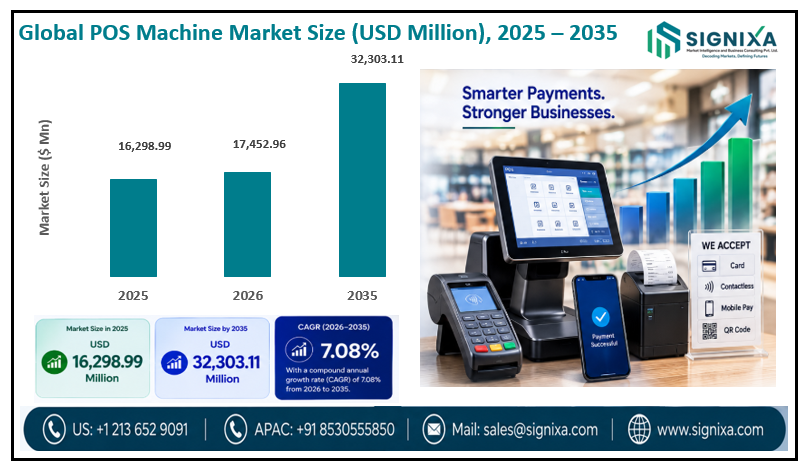
The size of the global POS machine market was worth around USD 16,298.99 Million in 2025 and is predicted to grow to around USD 32,303.11 Million by 2035, with a compound annual growth rate (CAGR) of roughly 7.08% between 2026 and 2035. The report analyzes the POS machine market's drivers and restraints, as well as the impact they have on demand throughout the projection period. In addition, the report examines global opportunities in the POS machine market.
The POS machine market consists of digital transaction appliances utilized in retail, hospitality, banking, entertainment, and healthcare. Demand for POS machines is mainly driven by the global move toward digital and contactless payments, the rise in customer experience expectations, and the inclusion of data analytics, cloud computing, and AI-based working features. POS machines are evolving as smart, multidimensional devices that process traditional card payments, as well as innovative e-wallet systems.
The Point of Sale (POS) machine market is evolving rapidly, driven by the growing demand for contactless payments, cloud integration, and mobile-enabled transaction systems. Businesses are increasingly adopting cloud-based POS platforms that allow real-time data synchronization, remote access, and seamless multi-location management. Mobile POS (mPOS) devices are gaining traction among small retailers and food vendors due to their portability, low setup cost, and compatibility with smartphones and tablets. Advanced POS systems now incorporate AI-powered features such as automated inventory updates, sales analytics, fraud detection, and customer profiling, improving operational efficiency. Meanwhile, biometric authentication, tokenization, and encryption are being embedded to strengthen payment security. Retailers, restaurants, and hospitality players are also investing in self-service kiosks and voice-enabled POS units for enhanced customer engagement.
Key Findings
- As per the analysis shared by our research analyst, the global POS machine market is estimated to grow annually at a CAGR of around 7.08% over the forecast period (2026-2035).
- In terms of revenue, the global POS machine market size was valued at around USD 16,298.99 Million in 2025 and is projected to reach USD 32,303.11 Million by 2035.
- Based on Terminal Type, the Fixed POS Terminals segment is currently dominant, but Mobile and Pocket POS segments are projected to grow rapidly.
- In terms of End Users, the Retail & Consumer Goods segment holds the largest market share.
- By Region, Asia-Pacific is projected to lead the global POS machine market during the forecast period.
POS Machine Market Dynamics
Contactless Payment Adoption & Cashless Economy Government Initiatives Driving Rapid POS Machine Deployment
The POS machine market is experiencing rapid development, primarily due to increased adoption of contactless payment technology and the growing trend of digital wallets. Governments of several countries are seeking to popularize cashless economies, thereby creating a conducive environment for POS machine utilization. More and more organizations are investing in POS systems, not just for transaction processing, but for other key business functions including inventory, customer, and loyalty program management. The surge in digital and contactless payment adoption is reshaping how POS systems function consumers now expect flexible options such as tap-to-pay, QR code payments, and mobile wallets. This trend is prompting vendors to embed security protocols like end-to-end encryption and tokenization to safeguard transactions, while regulatory requirements like PCI DSS compliance are influencing hardware and software designs to ensure secure data handling.
Mobile & Pocket POS Democratizing Payment Acceptance for SMEs & Informal Market Vendors Globally
Another major factor driving the market is the growing demand for mobile POS (mPOS) and pocket POS devices that offer portability, flexibility, and cost-effectiveness. These devices are widely adopted by small-and medium-sized enterprises (SMEs) and vendors in informal markets. Cloud-based POS systems are also gaining traction as they offer real-time data access, analytics integration, and seamless updates, making them suitable for multi-location retail chains and fast-paced environments. Subscription-based POS models are becoming popular among small businesses, offering affordable entry without heavy upfront costs. The pocket POS market is growing quickly, particularly in developing countries as smartphone usage becomes embedded and the need for low-cost payment acceptance tools rises, these small devices are attractive to merchants due to their ease of use and low upfront costs. Small vendors and gig economy workers in countries such as India and Southeast Asia see pocket POS as a way to digitize payments quickly and easily.
Cloud Integration, AI Analytics & Omnichannel Commerce Transforming POS Systems into Multi-Function Business Platforms
The POS machine market is experiencing dynamic shifts fueled by technological innovation and shifting consumer expectations. Businesses are prioritizing omnichannel retail experiences, leading to integration of POS systems with inventory management, CRM, and e-commerce platforms. These streamlining boosts operational efficiency and provides real-time insights into consumer behavior. Additionally, the demand for cloud-based solutions is on the rise, allowing merchants to scale quickly and manage operations across locations. These changes are enabling agile, data-driven decisions and fostering digital transformation across sectors. Furthermore, growing demand for eco-friendly devices and energy-efficient systems is influencing the design and materials used in POS machines. Combined, these factors are accelerating innovation and encouraging vendors to offer customized, scalable, and future-proof solutions for both brick-and-mortar and hybrid retail models. The market's evolution is increasingly marked by innovations like modular hardware designs, sustainable materials, and offline operational capabilities, ensuring adaptability across sectors.
POS Machine Market Segmentation Analysis
By POS Terminal Type Segment Analysis
The market is segmented by terminal type, with each form factor addressing distinct deployment scenarios, merchant size requirements, and payment environment characteristics across retail, hospitality, and other service sectors globally:
Fixed POS Terminals
In 2025, Fixed POS systems made up over 40% of global revenue for POS terminal types. Fixed POS systems are still the technology of choice in supermarkets, department stores, and other high-volume retail environments due to their durability, ability to integrate with printers and cash drawers, and processing capabilities. They are reliable systems and offer advanced features such as inventory management and loyalty program capabilities. The robustness of fixed terminals capable of sustaining continuous operation across millions of transaction cycles in high-traffic environments and their comprehensive peripheral integration capabilities (receipt printers, barcode scanners, cash drawers, customer displays, and weight scales) make them irreplaceable in large-format retail and grocery environments. Advanced fixed POS systems with large touchscreens, Android or Windows operating systems, and integrated payment processing are increasingly replacing legacy dedicated hardware, creating a significant technology refresh cycle that drives replacement demand through the forecast period.
Mobile POS Terminals
Mobile POS (mPOS) systems are expected to see growth of more than 9% CAGR over the forecast period. These mobile systems are changing the retail and food services sector and have enabled immediate checkout, reduced customer wait times, and improved space utilization. Smartphones and tablets used in small stores and pop-up shops as POS systems are driving this growth. Restaurant tableside ordering and payment which eliminates the traditional counter checkout model in favor of servers processing payments directly at the table is a major driver of mPOS adoption in the hospitality sector. The ability to deploy mPOS without fixed wiring or infrastructure makes it particularly attractive for temporary and event retail, trade show environments, outdoor markets, and stadium and arena concessions. Modern mPOS solutions that pair compact card readers with smartphone or tablet software provide full-featured POS functionality at dramatically lower hardware investment than fixed terminal alternatives, making them accessible to a broader range of merchant types through the forecast period.
Pocket POS Terminals
The pocket POS market is growing quickly, particularly in developing countries. As smartphone usage becomes embedded and the need for low-cost payment acceptance tools rises, these small devices are attractive to merchants due to their ease of use and low upfront costs. Small vendors and gig economy workers in countries such as India and Southeast Asia see pocket POS as a way to digitize payments quickly and easily. Pocket POS devices typically small Bluetooth-enabled card readers that connect to a smartphone app provide the most affordable entry point into digital payment acceptance, with hardware costs sometimes as low as USD 20–30 in developing markets. This price accessibility, combined with the explosive growth of smartphone-based digital payment ecosystems in India (UPI), China (WeChat Pay, Alipay), and Southeast Asia, is enabling mass-market formalization of informal commerce. Fintech companies and payment processors are subsidizing pocket POS hardware to acquire merchant relationships and transaction fee revenue, accelerating penetration in unbanked and underbanked merchant populations through the forecast period.
Others
This segment encompasses kiosk-based POS devices and unattended kiosks or terminals, typically found in parking meters, vending machines, event ticketing kiosks, or self-checkout machines. While they are niche experiences, they are becoming more utilized within higher density urban environments, particularly around transportation and entertainment environments. Unattended payment kiosks which allow consumers to complete transactions without cashier assistance are experiencing particular growth as retailers and service operators seek to reduce labor costs while maintaining or improving customer throughput. Self-checkout systems in grocery retail, fast-casual restaurant order-at-counter kiosks, and fully automated retail vending in high-footfall locations are significant demand drivers for this segment. The growing adoption of facial recognition, biometric payment authentication, and QR code payment capabilities in unattended kiosks is expanding their applicability across diverse retail and service environments through the forecast period.
By End Users Segment Analysis
Retail & Consumer Goods
The Retail & Consumer Goods segment contributed more than 35% to the market revenue in 2025. This is because POS systems can manage multiple complex inventory systems, customer transactions, and even analyze loyalty data. Another major growth factor is the increasing presence of organized retail chains across the Asia-Pacific region and the trend towards omnichannel retailing. The integration of POS systems with inventory management platforms, e-commerce channels, customer relationship management (CRM) systems, and analytics dashboards is transforming retail POS from a simple transaction processing device into a comprehensive retail management platform. The growing adoption of unified commerce platforms that manage both online and offline sales through a single POS-connected system providing real-time inventory visibility, seamless omnichannel fulfillment, and consistent customer experience across all touchpoints is a significant driver of POS upgrade cycles in the retail sector through the forecast period.
Travel & Hospitality
Hospitality and travel businesses depend on point-of-sale systems to facilitate reservations, billing, and real-time customer support. Contactless check-ins, self-order kiosks, and mobile payments are growing trends in the hospitality business, particularly in luxury hotels and quick service restaurants (QSRs). The segment is expected to grow substantially as tourism increases. Restaurant-specific POS systems that manage table reservations, kitchen order routing, tableside payment, split billing, and tip management are creating a distinct and growing market for hospitality-optimized POS solutions. The rapid expansion of QSR chains globally with their high transaction volume, speed-of-service requirements, and integration with digital ordering platforms is creating consistent high-volume POS demand from the foodservice sector. Hotel property management system (PMS) integration with POS terminals for seamless billing of restaurant, spa, and ancillary charges to room accounts is an increasingly standard feature expectation in the hospitality sector through the forecast period.
BFSI
Banks and other financial institutions are connecting their POS systems to ATMs and self-serve kiosks. In addition, POS terminals have become a critical part of payment service providers' merchant acquisition strategies. Aspects of improved fraud detection and biometric solutions have also boosted demand. The banking sector's merchant acquiring business where banks and payment processors deploy POS terminals to merchants in exchange for transaction fee revenue represents one of the largest single drivers of POS terminal deployment globally. The competitive dynamics among acquirers to offer merchants the most advanced, feature-rich terminal at the lowest cost have driven rapid technology upgrading of the global POS terminal installed base. The integration of biometric authentication (fingerprint and facial recognition) into POS terminals for identity verification in high-value transactions is a growing security enhancement trend that is creating demand for upgraded hardware across banking and financial service operator deployments through the forecast period.
Media & Entertainment
Applications in this segment range from movie theatres to theme parks to event ticketing, where POS systems can improve the customer experience through quicker ticketing and concessions purchases during peak hours. Mobility wallets and NFC integration can provide even quicker transactions than plastic cards. Entertainment venues that experience highly concentrated transaction peaks such as theme parks at opening times, concert venues during pre-show concession rushes, and stadiums during halftime benefit significantly from fast NFC and mobile wallet payment capabilities that minimize transaction processing time per customer. The adoption of stadium-wide wireless POS networks with handheld mPOS devices for seat-side food and beverage service is a growing trend in major sports arenas and entertainment venues globally. Integrated ticketing, access control, and payment platforms that use a single technology ecosystem to manage entry, concessions, merchandise, and in-venue experiences are creating demand for sophisticated, connected POS solutions in entertainment environments through the forecast period.
Manufacturing
In manufacturing, POS systems are utilized for distribution outlets, showroom control, and business-to-business customer interactions. Digital payment tracking and real-time inventory management are enabling POS systems to grow in this area of business. Manufacturing companies operating direct-to-consumer showrooms particularly in automotive, home furnishings, and specialty equipment categories are deploying advanced POS systems that integrate with ERP systems for real-time inventory, pricing, and order management. The growing adoption of digital payment acceptance in B2B commerce where manufacturing firms are offering electronic payment options for distributor and dealer transactions is expanding POS deployment beyond traditional consumer-facing contexts into trade and wholesale environments. The integration of POS systems with supply chain management and warehouse management systems is creating more sophisticated manufacturing sector use cases for real-time transaction data in production and logistics workflows through the forecast period.
Healthcare
Hospitals and clinics rely on POS for billing, insurance co-payments, and pharmacy counters. Private healthcare continues to expand, and patient demand for a fully digitized patient experience continues to increase. Hospitals and clinics are expected to increasingly deploy POS in this sector. The growing complexity of healthcare billing with multiple payment sources including insurance co-payments, self-pay amounts, and supplemental fees is creating demand for sophisticated POS systems that can integrate with healthcare billing and electronic health record (EHR) systems to provide accurate, real-time payment processing at the point of care. The expansion of telehealth and remote patient monitoring is creating demand for digital payment solutions that can process payments for virtual consultations and remote healthcare services. Healthcare-specific POS requirements including HIPAA compliance, secure handling of patient financial data, and integration with health insurance eligibility verification systems are driving demand for specialized healthcare payment solutions through the forecast period.
Others
Education, public transportation, and government sectors are also integrating POS solutions, particularly for fee payments, travel cards, and public utility services. The digitization of government service fee collection including passport fees, license renewals, utility payments, and court fees is creating new POS deployment opportunities in public sector locations. Public transportation agencies deploying open-loop contactless payment systems where passengers can tap standard bank cards or mobile wallets to pay fares rather than purchasing proprietary transit cards are integrating POS-equivalent payment acceptance infrastructure into turnstiles, validators, and fare collection points across bus, metro, and rail networks. Educational institutions implementing cashless campus payment systems for dining, printing, library services, and student fee collection are creating a growing institutional POS market segment with specific student identity management and administrative integration requirements through the forecast period.
Report Attributes & Market Scope
| Report Attribute | Details |
|---|---|
| Market Size Value in 2025 | USD 16,298.99 Million |
| Market Size Value in 2035 | USD 32,303.11 Million |
| CAGR (2026–2035) | 7.08% |
| Base Year Used for Estimation | 2025 |
| Historic Data | 2020 - 2025 |
| Forecast Period | 2026 - 2035 |
| Segments Covered – By POS Terminal Type |
|
| Segments Covered – By End Users |
|
| Regions Covered | North America, Europe, Asia Pacific, Latin America, Middle East and Africa |
| Major Countries Covered | U.S., Canada, Mexico, Germany, UK, France, Italy, Spain, Russia, China, Japan, South Korea, India, Southeast Asia Countries, Brazil, Argentina, GCC Countries, Turkey, Iran, Israel, South Africa, Egypt, Nigeria, etc. |
| Key Companies Profiled | Ingenico Group, PAX Technology Limited, Aures Group, Castles Technology, Cybernet Manufacturing Inc., NCR Corporation, Verifone Inc., Toshiba Corporation, HP Inc., and NEC Corporation, among others. |
POS Machine Market Regional Analysis
The worldwide POS machine market reports considerable momentum in the Asia-Pacific region, which accounted for the largest share in 2025, due in part to improved digital infrastructure, government initiatives to promote cashless transactions, and growing retail ecosystem. North America accounts for the second largest share, given the high adoption of cutting-edge technology and established retail chains. Europe is next, with a growing number of mPOS startups utilized in cafés, boutique merchants, and hospitality venues. Latin America and the Middle East & Africa are both emerging markets, where increasing urbanized populations and fintech market penetration are driving increased deployment of POS machines.
Asia-Pacific (Dominant Region)
The Asia-Pacific region accounted for the largest share of the global POS machine market in 2025, due in part to improved digital infrastructure, government initiatives to promote cashless transactions, and growing retail ecosystem. China's world-leading mobile payment ecosystem dominated by Alipay and WeChat Pay has created an enormous installed base of QR code and NFC-enabled POS terminals that continues to expand as merchants upgrade to accept new payment methods. India's demonetization policy in 2016 and the subsequent rapid growth of UPI-based digital payments created a massive ongoing demand for POS infrastructure as millions of merchants formalized their payment acceptance capabilities. Southeast Asian nations including Indonesia, Thailand, Vietnam, Malaysia, and the Philippines are experiencing rapid POS market growth driven by expanding organized retail, fintech investment, and government financial inclusion programs. The combination of large and growing merchant populations, rising consumer digital payment expectations, and supportive regulatory environments makes Asia-Pacific the dominant and fastest-growing regional POS market through the forecast period.
North America
North America accounts for the second largest share of the global POS machine market, given the high adoption of cutting-edge technology and established retail chains. The U.S. market is characterized by a mature and highly competitive payment processing landscape, with major card networks, processors, and merchant acquirers competing intensely on terminal technology, software features, and transaction economics. The rapid adoption of tap-to-pay contactless payments accelerated by the pandemic has driven widespread terminal upgrades to NFC-capable hardware across U.S. and Canadian merchants. The growth of software-led POS platforms like Square, Shopify POS, Clover, and Toast is transforming the competitive dynamics of the North American POS market, with integrated payment-plus-business-management software subscriptions replacing standalone payment terminal hardware as the primary value proposition for small and medium-sized merchants. The healthcare payment segment is growing particularly rapidly in North America due to high-volume patient billing requirements and the expansion of consumer-directed healthcare payment models through the forecast period.
Europe
Europe's POS machine market is witnessing steady growth driven by the region's mature retail infrastructure, growing demand for cashless transactions, and widespread adoption of digital payment technologies. Countries like Germany, the UK, France, and Italy are embracing smart POS systems that integrate contactless payments, mobile wallets, QR-based transactions, and inventory management. Government initiatives promoting digital transformation and fintech innovation such as France's Plan de Relance and the EU's Digital Finance Strategy are further encouraging businesses to adopt POS solutions. Retailers and SMEs are increasingly shifting from traditional POS to cloud-based and Android-based smart terminals to streamline operations and enhance customer experience. Regulatory compliance related to fiscal reporting in countries like Italy and Greece is driving the deployment of certified POS terminals. European consumers' strong preference for card and digital payments over cash with some Nordic countries approaching near-cashless status sustains consistent demand for POS infrastructure upgrades and new deployments through the forecast period.
Latin America
Latin America is an emerging POS market, where increasing urbanized population and fintech market penetration are driving increased deployment of POS machines. Brazil is a particularly dynamic market, with fintech companies like Stone, Cielo, and PagSeguro competing aggressively to equip the country's vast informal merchant base with affordable POS terminal solutions. Mexico's growing organized retail sector and the government's digital payment promotion programs are creating expanding POS demand across both traditional retail and informal commerce. Argentina, Colombia, Chile, and Peru are also experiencing growing POS market activity as their fintech ecosystems mature and consumer digital payment adoption increases. The Latin American market features a distinctive dynamic where fintech companies and neobanks are often the primary POS distribution channel offering integrated banking, payment processing, and POS hardware as a bundled financial services package targeted at previously unbanked micro-merchants and small businesses through the forecast period.
Middle East & Africa
The Middle East and Africa POS machine market is experiencing dynamic growth, fueled by expanding retail and hospitality sectors, increasing smartphone penetration, and evolving consumer expectations for seamless payment experiences. In urban areas across the UAE, Saudi Arabia, South Africa, and Nigeria, merchants are rapidly adopting smart POS devices that support contactless, mobile wallet, and QR code payments. Cloud-based POS solutions are also gaining traction among SMEs for their affordability, real-time inventory tracking, secure data storage, and remote management capabilities. The hospitality industry, particularly quick-service restaurants and hotel chains, is deploying self-service kiosks and mobile table-side ordering to improve guest satisfaction and operational efficiency. The shift toward omnichannel commerce is another key driver, with retailers integrating POS systems to align in-store sales with online platforms. With rising digital literacy and government policies supporting cashless economies, the Middle East and Africa POS market is poised for substantial advancement, becoming a vital foundation for future-ready, digitized commerce through the forecast period.
Recent Developments in the POS Machine Market
-
2026
Ingenico Group Introduced its next-generation AXIUM payment device family along with the Ingenico 360 cloud platform, enabling unified payment management, advanced analytics, and streamlined POS operations for global merchants.
Square (Block Inc.) Expanded its mobile POS ecosystem with enhanced handheld payment solutions and integrated commerce capabilities to support small and medium-sized businesses across retail and hospitality sectors.
Verifone Inc. Expanded its payment acceptance platform through advanced SoftPOS capabilities, biometric authentication technologies, and next-generation payment devices designed to enhance customer checkout experiences.
-
2025
Ingenico Group Launched the AXIUM CX9000 all-in-one POS solution, combining payment acceptance, inventory management, and retail operations within a single Android-based platform.
Verifone Inc. Unveiled the Verifone Victa portfolio, introducing new payment terminals, SoftPOS solutions, and biometric payment technologies aimed at modernizing digital commerce.
PAX Technology Limited Expanded its Android-based smart POS terminal offerings to support growing demand for contactless and digital payment acceptance across global markets.
Clover Network (Fiserv) Expanded cloud-connected POS solutions for small and medium-sized merchants, offering integrated payment processing and business management capabilities.
POS Machine Market: Competitive Landscape
The global POS machine market features major players such as VeriFone, Ingenico, Square, PAX Technology, Clover (Fiserv), Newland Payment, Lightspeed, Shopify POS, NCR Corporation, and Toshiba Global Commerce Solutions. These companies are focusing on enhancing product reliability, security, and ease of integration. Strategic partnerships, acquisitions, and expansions into emerging markets are key approaches to increasing market share. Vendors are also prioritizing cloud-based platforms, AI-enabled analytics, and device miniaturization to cater to evolving end-user needs across different sectors.
The competitive landscape of the POS machine market is characterized by significant divergence between traditional hardware-focused incumbents and software-led platform challengers. Established players like Ingenico, Verifone, and PAX Technology compete primarily on terminal hardware quality, payment security certifications, and global distribution reach. Software-first challengers including Square, Shopify POS, Toast, and Lightspeed compete primarily on the richness of their integrated business management software, subscription revenue models, and developer ecosystem openness. The convergence of these two approaches with hardware companies building stronger software platforms and software companies developing proprietary hardware is driving competitive consolidation and blurring traditional market boundaries. The growing importance of payment-as-a-service models, where the POS hardware is provided at low or zero cost in exchange for long-term transaction processing commitments, is reshaping merchant acquisition economics and competitive positioning across the global POS market through the forecast period.
Key Companies Profiled
- Ingenico Group
- PAX Technology Limited
- Verifone Inc.
- NCR Corporation
- Square (Block Inc.)
- Aures Group
- Castles Technology
- Toshiba Corporation
- HP Inc.
- NEC Corporation
- Diebold Nixdorf, Incorporated
- Fujitsu Limited
- Newland NPT Co., Ltd.
- SZZT Electronics Co., Ltd.
- Clover Network, LLC (Fiserv)
Global POS Machine Market Segmentation Summary
By POS Terminal Type
- Fixed POS Terminals
- Mobile POS Terminals
- Pocket POS Terminals
- Others
By End Users
- Retail & Consumer Goods
- Travel & Hospitality
- BFSI
- Media & Entertainment
- Manufacturing
- Healthcare
- Others
By Region
- North America
- U.S.
- Canada
- Mexico
- Europe
- Germany
- France
- UK
- Spain
- Italy
- Rest of Europe
- Asia-Pacific
- China
- Japan
- India
- Australia
- South Korea
- Southeast Asia
- Rest of Asia-Pacific
- Latin America
- Brazil
- Argentina
- Rest of Latin America
- The Middle East & Africa
- GCC Countries
- South Africa
- Rest of the Middle East & Africa
Frequently Asked Questions (FAQs) About the POS Machine Market
What is a POS Machine?
A POS (Point-of-Sale) machine is a digital terminal used to process card or digital payments at retail, hospitality, healthcare, and other service points. It typically integrates hardware and software to manage transactions, sales, inventory, and customer data efficiently.
Which key factors will influence the POS machines market growth over 2026–2035?
The growth of the POS machines market will be driven by increasing adoption of digital payment solutions, the rise of mobile and contactless payments, integration of advanced technologies like cloud and AI, and government initiatives promoting cashless economies.
What will be the value of the POS machines market during 2026–2035?
According to the study, the global POS machines market was valued at around USD 16,298.99 Million in 2025 and is projected to grow to approximately USD 32,303.11 Million by 2035.
What will be the CAGR value of the POS machines market during 2026–2035?
The POS machines market is expected to expand at a CAGR of approximately 7.08% between 2026 and 2035, driven by the rapid adoption of digital payment solutions, increasing penetration of cashless transactions, and growing demand for efficient retail management systems.
Which region will contribute notably towards the POS machines market value?
North America and Asia-Pacific are expected to lead the global POS machines market, supported by high technology penetration, strong digital infrastructure, and growing consumer preference for non-cash transactions.
Which are the major players leveraging the POS machines market growth?
Key players in the POS machines market include Ingenico Group, PAX Technology Limited, Aures Group, Castles Technology, Cybernet Manufacturing Inc., NCR Corporation, Verifone Inc., Toshiba Corporation, HP Inc., and NEC Corporation.
What can be expected from the global POS machines market report?
The report covers a comprehensive analysis of the global POS machines market, including market size, growth forecasts, key trends, competitive landscape, segmentation by terminal type and end-user industry, regional outlook, and strategic developments by leading companies.