
Government Cloud Market Market Overview
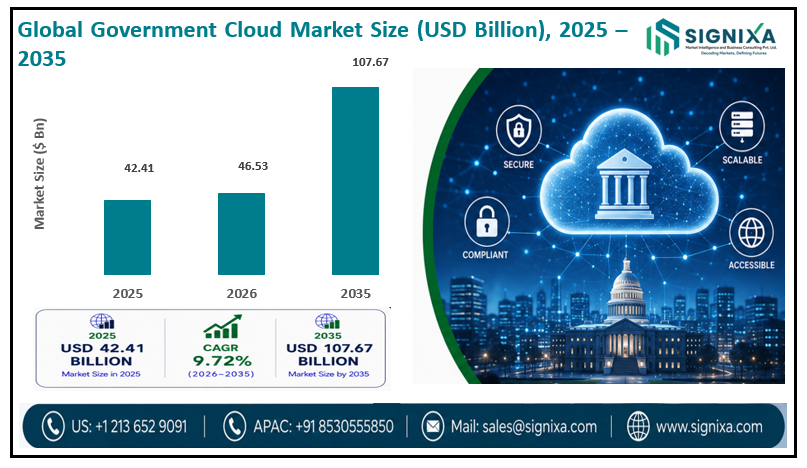
The size of the global Government Cloud Market was valued at approximately USD 42.41 Billion in 2025 and is projected to reach around USD 107.67 Billion by 2035, growing at a compound annual growth rate (CAGR) of 9.72% from 2026 to 2035. The report provides a detailed examination of market drivers, restraints, and emerging opportunities that shape the Government Cloud ecosystem globally.
The Government Cloud market encompasses cloud solutions tailored to support government agencies in securely storing, managing, and processing data. It plays a vital role in digital transformation strategies, allowing governments to enhance service delivery, reduce operational costs, and improve data security. Increasing initiatives toward cloud-first policies and smart governance are key enablers of the market. As governments modernize their IT infrastructure, they are increasingly turning to cloud solutions for scalability, disaster recovery, and efficient resource allocation.
The government cloud market is undergoing a significant transformation, driven by public sector entities worldwide increasingly recognizing the immense benefits of cloud computing for modernizing their IT infrastructure and improving citizen services. Governments are under constant pressure to enhance operational efficiency, reduce costs, and deliver more agile and responsive public services. Cloud platforms offer solutions to these challenges by providing scalable, flexible, and on-demand computing resources, eliminating the need for substantial upfront capital expenditures on physical hardware and data centres. This shift allows government agencies to move from a capital expenditure (CAPEX) to an operational expenditure (OPEX) model, enabling more flexible budget management and redirecting resources towards mission-critical initiatives. The ability to rapidly deploy new applications and services, scale resources up or down based on demand, and access advanced technologies like artificial intelligence (AI) and machine learning (ML) are key attractions for government bodies.
A major dynamic in the government cloud market is the growing emphasis on security, compliance, and data sovereignty, which influences the types of cloud deployments adopted. Government data, often highly sensitive and critical, necessitates robust security measures that go beyond standard commercial cloud offerings. This leads to a strong preference for specialized government-only cloud regions, dedicated instances, or hybrid cloud models that allow agencies to maintain sensitive data on-premises while leveraging the cloud for less critical workloads. Compliance with national and international regulations, data residency laws, and specific government security frameworks (such as FedRAMP in the U.S., or similar national certifications) is paramount. Cloud service providers are actively developing and certifying their platforms to meet these stringent requirements, offering granular access controls, encryption, and continuous monitoring to build trust and ensure regulatory adherence. This focus on trust and compliance is a fundamental differentiator in the government cloud space.
Furthermore, the market is characterized by the accelerated pace of digital transformation initiatives within public sector organizations globally. Governments are embracing cloud as a foundational element of their digital strategies, aiming to modernize legacy IT systems, automate workflows, and create seamless digital experiences for citizens. This includes moving applications like tax collection systems, public safety platforms, healthcare records, and educational services to the cloud. The demand for cloud-based collaboration tools has also surged, enabling distributed government workforces to operate efficiently, especially following global events that necessitated remote operations. The integration of cloud with emerging technologies like the Internet of Things (IoT) for smart city initiatives, data analytics for evidence-based policymaking, and AI for improved public service delivery further expands the scope and value proposition of government cloud solutions.
A persistent dynamic involves the challenges surrounding procurement processes, legacy infrastructure modernization, and the skills gap within government IT departments. Government procurement cycles are often complex, lengthy, and not traditionally aligned with the agile, consumption-based model of cloud services, creating a barrier to rapid adoption. Many agencies also contend with decades-old legacy IT systems that are expensive to maintain and difficult to migrate to the cloud, requiring significant planning and investment in modernization efforts. Furthermore, there is a recognized shortage of cloud-skilled personnel within government agencies, often necessitating reliance on external consultants and managed service providers. Overcoming these bureaucratic, technical, and human resource challenges involves fostering a "cloud-smart" mindset, investing in workforce development, and streamlining procurement mechanisms to fully leverage the transformative potential of government cloud platforms.
Key Findings
- The global Government Cloud Market is expected to grow at a CAGR of around 9.72% between 2026 and 2035.
- In terms of revenue, the market size is projected to increase from USD 42.41 Billion in 2025 to USD 107.67 Billion by 2035.
- The Public Cloud segment is anticipated to dominate the market by deployment due to its cost efficiency, scalability, and ability to support rapid digital transformation across government agencies.
- Software as a Service (SaaS) is expected to command the largest market share in the delivery mode segment owing to its ease of deployment, lower maintenance costs, and widespread adoption of cloud-based government applications.
- Security and Compliance is projected to be the leading application segment, driven by increasing cybersecurity threats, stringent regulatory requirements, and the need to protect sensitive government data.
- North America is expected to dominate the global Government Cloud Market throughout the forecast period due to robust cloud infrastructure, significant government investments in digital modernization, and the presence of leading cloud service providers.
Government Cloud Market Dynamics
Digital Governance Accelerating Government Cloud Adoption
One major driver of the Government Cloud market is the shift toward digital governance, with governments worldwide embracing cloud technologies to deliver faster, more reliable public services. Cloud adoption offers scalability, improved service agility, and cost reductions, which are highly valuable to public institutions operating under tight budget constraints. Moreover, cloud platforms facilitate inter-agency data sharing and citizen engagement tools, contributing to more integrated and transparent public sector operations.
Data Sovereignty and Cybersecurity Driving Secure Cloud Investments
Another key growth factor is the increasing concern about data sovereignty and security. Governments are investing in secure cloud infrastructures to maintain control over sensitive citizen and national data. The growing frequency of cyber threats, data breaches, and geopolitical tensions have prompted heightened investments in secure cloud environments, particularly private and hybrid models. These solutions offer better control, compliance with local data residency laws, and tailored security architectures compared to traditional IT setups.
Cloud Computing Modernizing Public Sector IT Infrastructure
The government cloud market is undergoing a significant transformation, driven by public sector entities worldwide increasingly recognizing the immense benefits of cloud computing for modernizing their IT infrastructure and improving citizen services. Governments are under constant pressure to enhance operational efficiency, reduce costs, and deliver more agile and responsive public services. Cloud platforms offer solutions to these challenges by providing scalable, flexible, and on-demand computing resources, eliminating the need for substantial upfront capital expenditures on physical hardware and data centers. This shift allows government agencies to move from a capital expenditure (CAPEX) to an operational expenditure (OPEX) model, enabling more flexible budget management and redirecting resources towards mission-critical initiatives. The ability to rapidly deploy new applications and services, scale resources up or down based on demand, and access advanced technologies like artificial intelligence (AI) and machine learning (ML) are key attractions for government bodies seeking to optimize their operations and enhance service delivery.
Security, Compliance, and Data Sovereignty Shaping Cloud Deployment Strategies
A major dynamic in the government cloud market is the growing emphasis on security, compliance, and data sovereignty, which profoundly influences the types of cloud deployments adopted. Government data, often highly sensitive and critical, necessitates robust security measures that often go beyond standard commercial cloud offerings. This leads to a strong preference for specialized government-only cloud regions, dedicated instances, or hybrid cloud models that allow agencies to maintain sensitive data on-premises while leveraging the cloud for less critical workloads. Compliance with national and international regulations, data residency laws, and specific government security frameworks (such as FedRAMP in the U.S., Canada's Protected B program, or Australia's Information Security Registered Assessors program) is paramount. Cloud service providers are actively developing and certifying their platforms to meet these stringent requirements, offering granular access controls, advanced encryption, and continuous monitoring to build trust and ensure regulatory adherence, making security a fundamental differentiator in this market.
Digital Transformation and Emerging Technologies Enhancing Public Services
The market is characterized by the accelerated pace of digital transformation initiatives within public sector organizations globally. Governments are embracing cloud as a foundational element of their digital strategies, aiming to modernize legacy IT systems, automate workflows, and create seamless digital experiences for citizens. This includes migrating critical applications like tax collection systems, public safety platforms, healthcare records, and educational services to cloud environments. The demand for cloud-based collaboration tools has also surged, enabling distributed government workforces to operate efficiently, a trend significantly accelerated by recent global events that necessitated remote operations. The integration of cloud with emerging technologies like the Internet of Things (IoT) for smart city initiatives, robust data analytics for evidence-based policymaking, and AI for improved public service delivery further expands the scope and value proposition of government cloud solutions, driving innovation in public service delivery.
Overcoming Legacy Systems, Procurement Challenges, and Workforce Skill Gaps
A persistent dynamic involves the challenges surrounding complex procurement processes, the formidable task of legacy infrastructure modernization, and the critical skills gap within government IT departments. Government procurement cycles are often rigid, lengthy, and not traditionally aligned with the agile, consumption-based model of cloud services, creating a significant barrier to rapid adoption and flexible scaling. Many agencies also contend with decades-old legacy IT systems that are expensive to maintain, difficult to integrate, and challenging to migrate to the cloud, requiring substantial planning, investment, and often phased modernization efforts. There is also a recognized shortage of cloud-skilled personnel within government agencies, making it difficult to effectively manage and leverage cloud environments. This often necessitates reliance on external consultants and managed service providers. Addressing these bureaucratic, technical, and human resource challenges involves fostering a "cloud-smart" mindset, investing significantly in workforce development programs, and streamlining procurement mechanisms to fully unlock the transformative potential of government cloud platforms.
Government Cloud Market Segmentation Analysis
By Deployment Model Segment Analysis
The Public Cloud segment accounted for over 45% of the market in 2025 and is projected to retain dominance. Governments prefer public clouds for non-sensitive applications due to scalability, lower costs, and reduced infrastructure maintenance. Vendors like AWS and Microsoft Azure are key providers. The Private Cloud representing 30% of the 2025 market share, Private Cloud is essential for managing confidential government data. It offers enhanced control, customization, and compliance with stringent regulatory standards. The Hybrid Cloud segment is anticipated to grow at a CAGR of over 11% during the forecast period. It combines the benefits of public and private clouds, making it suitable for mission-critical and public-facing services.
By Delivery Mode Segment Analysis
The IaaS held around 26% market share in 2025. It enables governments to deploy storage, servers, and networking infrastructure with minimal upfront costs, promoting flexibility. Platform as a Service (PaaS) segment captured 22% of the market in 2025. PaaS supports application development and deployment across government agencies without managing the underlying hardware or software layers. The SaaS dominated the segment with over 52% of the market in 2025. It is favored for its ease of deployment, cost-effectiveness, and compatibility with existing systems across public departments.
By Application Segment Analysis
The Server and Storage, segment represented 28% of the global market in 2025. Cloud-based server and storage solutions help agencies manage large volumes of data with better redundancy and scalability. Disaster Recovery/Data Backup estimated at 17% market share in 2025, this segment is critical for ensuring data resilience and continuity of government operations during emergencies. Security and Compliance is the largest segment, capturing 31% of the market in 2025. It is driven by increasing cyberattacks, making secure cloud solutions essential for government compliance and integrity. Analytics contributed to 14% of the market in 2025. Governments are leveraging cloud-based analytics for policy insights, predictive analysis, and real-time decision-making. Content Management held approximately 10% market share in 2025, enabling efficient digital document management, archiving, and citizen interaction platforms.
Report Attributes & Market Scope
| Report Attribute | Details |
|---|---|
| Market Size Value in 2025 | USD 42.41 Billion |
| Market Size Value in 2035 | USD 107.67 Billion |
| CAGR (2026–2035) | 9.72% |
| Base Year Used for Estimation | 2025 |
| Historic Data | 2020 - 2025 |
| Forecast Period | 2026 - 2035 |
| Segments Covered – By Deployment Model |
|
| Segments Covered – By Delivery Mode |
|
| Segments Covered – By Application |
|
| Regions Covered | North America, Europe, Asia Pacific, Latin America, Middle East and Africa |
| Major Countries Covered | U.S., Canada, Mexico, Germany, UK, France, Italy, Spain, Russia, China, Japan, South Korea, India, Southeast Asia Countries, Brazil, Argentina, GCC Countries, Turkey, Iran, Israel, South Africa, Egypt, Nigeria, etc. |
| Key Companies Profiled | Microsoft Corporation, Amazon Web Services (AWS), Oracle Corporation, Google LLC, IBM Corporation, Salesforce, Dell Technologies, Cisco Systems, VMware Inc., SAP SE, and among others. |
Government Cloud Market Regional Analysis
North America leads the Government Cloud market, fueled by advanced cloud infrastructure, federal digital initiatives, and major vendors such as AWS, Oracle, and Microsoft. Europe follows, with GDPR-compliant cloud services gaining momentum among EU public entities. Asia-Pacific is the fastest-growing region, driven by increasing digitization, public sector IT reforms, and smart city projects in countries like China, Japan, and India. Latin America, the Middle East, and Africa are emerging markets, gradually adopting cloud to address public sector challenges and improve governance transparency.
North America (Leading Region)
North America, particularly the United States and Canada, stands as the most mature and dominant region in the government cloud market. This leadership is attributed to substantial early adoption by federal, state, and local government agencies, supported by strong government-led "cloud-first" or "cloud-smart" policies. In the U.S., initiatives like FedRAMP (Federal Risk and Authorization Management Program) have established rigorous security baselines, building trust and accelerating the migration of sensitive workloads to the cloud. Agencies prioritize cloud for its ability to enhance disaster resilience, facilitate interagency collaboration, and improve digital experiences for citizens. The region benefits from a highly competitive ecosystem of major cloud service providers who have invested heavily in government-specific cloud regions and compliance offerings. The ongoing modernization of legacy IT systems across various departments, coupled with the increasing demand for advanced analytics, AI, and IoT capabilities for smart city initiatives, continues to drive robust growth in North America.
Europe
Europe's government cloud market is characterized by a strong emphasis on data sovereignty, privacy, and the development of a unified European cloud strategy, reflecting the region's stringent data protection regulations like GDPR. While adoption initially lagged compared to North America due to diverse national policies and concerns about data residency, momentum is building. European governments are increasingly recognizing cloud's potential for fiscal savings, operational efficiency, and enhancing public service delivery. Initiatives like the Gaia-X project aim to create a secure, federated European data infrastructure, promoting interoperability and reducing vendor lock-in. Countries like Germany, France, and the UK are leading cloud adoption, often favoring hybrid and sovereign cloud models that keep sensitive data within national borders or under specific governance frameworks. The drive towards digitalizing public services and modernizing outdated IT systems, alongside growing investment in cloud skills and infrastructure, is propelling the European government cloud market forward.
Middle East and Africa
The Middle East & Africa (MEA) government cloud market is in a significant growth phase, largely driven by ambitious national digital transformation agendas and economic diversification efforts. In the Middle East, countries like the UAE and Saudi Arabia are at the forefront, pouring substantial investments into building smart cities and modernizing government services as part of their national visions (e.g., Saudi Vision 2030). These nations are rapidly adopting cloud solutions to enhance public sector efficiency, create seamless citizen experiences, and attract foreign investment. The region's emphasis on data residency and sovereign cloud offerings is particularly pronounced, with major cloud providers establishing local data centers to address these concerns. The government cloud market's regional analysis reveals diverse maturity levels, strategic priorities, and regulatory environments influencing cloud adoption across different geographies.
Recent Developments in the Government Cloud Market
-
2026
Oracle Corporation & Amazon Web Services (AWS) broadened their long-standing partnership by enhancing multicloud connectivity between Oracle Cloud Infrastructure (OCI) and AWS. The expanded collaboration enables government organizations and enterprises to securely integrate workloads across both cloud platforms while improving performance, flexibility, and operational efficiency.
Amazon Web Services (AWS) expanded its OneGov initiative by welcoming additional independent software vendor (ISV) partners into the program. The expansion is designed to help government agencies accelerate cloud migration, strengthen cybersecurity capabilities, and adopt advanced digital technologies more efficiently.
Oracle Corporation strengthened its presence in the sovereign cloud market by advancing plans to support Japan's highly secure government cloud infrastructure. This expansion reinforces Oracle's commitment to delivering secure cloud environments for public sector organizations handling sensitive national data.
Google LLC completed the acquisition of cloud security company Wiz, significantly enhancing Google Cloud's cybersecurity portfolio. The acquisition strengthens the company's ability to provide advanced cloud security solutions for enterprise and government customers operating in highly regulated environments.
-
2025
Amazon Web Services (AWS) & U.S. General Services Administration (GSA) entered into agreement to support federal agencies in modernizing their IT infrastructure. The agreement focuses on accelerating cloud adoption, artificial intelligence implementation, and digital transformation while helping government organizations optimize technology spending.
Oracle Corporation & U.S. General Services Administration (GSA) signed a strategic agreement to provide federal agencies with improved access to Oracle Cloud Infrastructure, database technologies, and cloud migration services, supporting secure and cost-effective digital modernization.
Amazon Web Services (AWS) announced plans to significantly expand its cloud infrastructure and AI capabilities for U.S. government customers. The investment includes the development of additional AWS GovCloud regions and secure cloud infrastructure to meet the growing demand for mission-critical public sector applications.
Government Cloud Market: Competitive Landscape
Major players in the Government Cloud market include Microsoft Corporation, Amazon Web Services (AWS), Oracle Corporation, Google LLC, IBM Corporation, Salesforce, Dell Technologies, Cisco Systems, VMware Inc., and SAP SE. These companies are focusing on innovation, compliance, and expanding global data centers to cater to public sector clients. Strategic collaborations with governments, cybersecurity capabilities, and regional customization are key to gaining market share. As competition intensifies, vendors are expected to offer more secure, scalable, and interoperable solutions aligned with national data policies and digital transformation goals.
Key Companies Profiled
- Microsoft Corporation
- Amazon Web Services (AWS)
- Oracle Corporation
- Google LLC
- IBM Corporation
- Salesforce, Inc.
- Dell Technologies Inc.
- Cisco Systems, Inc.
- VMware LLC
- SAP SE
- Alibaba Cloud
- Tencent Cloud
- Huawei Cloud
- Rackspace Technology, Inc.
- Atos SE
- Accenture plc
- Capgemini SE
Global Government Cloud Market Segmentation Summary
By Deployment Model
- Public Cloud
- Private Cloud
- Hybrid Cloud
By Delivery Mode
- Infrastructure as a Service (IaaS)
- Platform as a Service (PaaS)
- Software as a Service (SaaS)
By Application
- Server and Storage
- Disaster Recovery / Data Backup
- Security and Compliance
- Analytics
- Content Management
By Region
- North America
- U.S.
- Canada
- Mexico
- Europe
- Germany
- France
- UK
- Spain
- Italy
- Rest of Europe
- Asia-Pacific
- China
- Japan
- India
- Australia
- South Korea
- Southeast Asia
- Rest of Asia-Pacific
- Latin America
- Brazil
- Argentina
- Rest of Latin America
- The Middle East & Africa
- GCC Countries
- South Africa
- Rest of the Middle East & Africa
Frequently Asked Questions (FAQs) About the Government Cloud Market
What is Government Cloud?
Government cloud refers to cloud computing solutions specifically designed for public sector organizations, including federal, state, and local governments. These solutions provide secure, scalable, and compliant platforms for data storage, processing, and service delivery.
Which key factors will influence the Government Cloud Market growth over 2026–2035?
The government cloud market is expected to grow due to rising digital transformation initiatives, the need for enhanced data security and sovereignty, increasing demand for cost-effective IT infrastructure, and growing adoption of hybrid cloud environments by public institutions.
What will be the value of the Government Cloud Market during 2026–2035?
The global Government Cloud Market accounted for around USD 42.41 Billion in 2025 and is forecast to attain a value of approximately USD 107.67 Billion by 2035.
What will be the CAGR value of the Government Cloud Market during 2026–2035?
The Government Cloud Market is projected to grow at a CAGR of 9.72% during the forecast period of 2026–2035, due to rising investments in cloud infrastructure, cybersecurity, and e-governance initiatives worldwide.
Which region will contribute notably towards the Government Cloud Market value?
The global government cloud market is led by North America and Europe, driven by early cloud adoption, regulatory frameworks, and strong investments in public sector digital infrastructure. The Asia-Pacific region is also emerging rapidly due to ongoing digital initiatives.
Which are the major players leveraging the Government Cloud Market growth?
The global government cloud market is led by companies such as Amazon Web Services (AWS), Microsoft Corporation, Google LLC, IBM Corporation, Oracle Corporation, Salesforce.com, Inc., SAP SE, Dell Technologies Inc., VMware, Inc., and Cisco Systems, Inc.
What can be expected from the global Government Cloud Market report?
The report explores crucial aspects of the government cloud market, including a detailed discussion of existing growth drivers and restraints, and provides insights into future opportunities and challenges affecting market expansion across deployment models, delivery modes, applications, and regions.