

Glycerol Monostearate (GMS) Market Market Overview
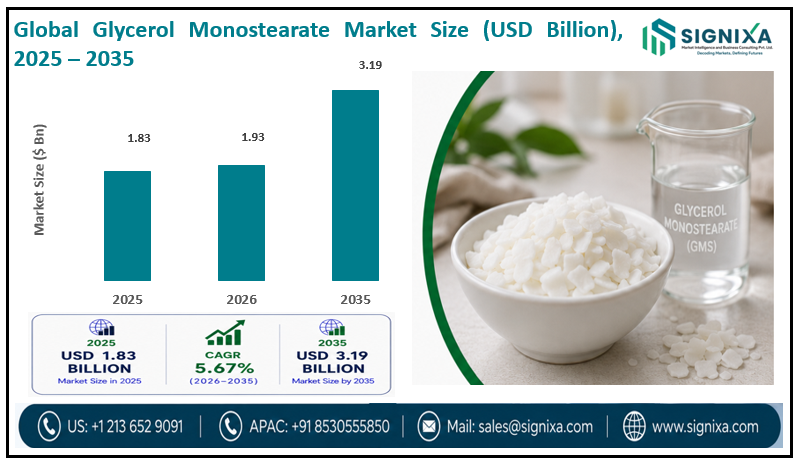
The size of the global Glycerol Monostearate (GMS) Market was valued at approximately USD 1.83 Billion in 2025 and is projected to reach around USD 3.19 Billion by 2035, growing at a compound annual growth rate (CAGR) of 5.67% from 2026 to 2035. This report examines key growth drivers, industry challenges, and regional dynamics shaping the market. It also identifies the competitive landscape and explores emerging opportunities across application sectors.
Glycerol monostearate is widely used across food, cosmetic, pharmaceutical, and industrial sectors as an emulsifier, thickener, and preservative. Its GRAS (Generally Recognized As Safe) status, combined with strong surfactant properties and compatibility with other compounds, enhances its usability across multiple formulations. The rising demand for processed food, functional skincare, and drug delivery systems is contributing significantly to market growth. Moreover, advancements in food texture and formulation science further augment the demand for high-purity GMS products globally.
This growth is primarily attributed to increasing global demand for emulsifiers and stabilizing agents in processed foods, as well as growing consumer preference for high-performance ingredients in personal care products. In addition, the rising adoption of GMS in pharmaceuticals as a solidifying agent and controlled-release component is contributing to its expanding application base. The industrial sector is also seeing increased consumption, particularly in plastic processing and construction materials, where GMS improves flow and dispersion. This multipurpose characteristic ensures stable demand across diverse industries. The market outlook remains optimistic, driven by a combination of sectoral growth, product versatility, and increasing consumer awareness around quality and functionality.
Despite its growth trajectory, the GMS market faces several challenges. Volatility in the prices of raw materials such as stearic acid and glycerol can affect production costs and profitability. Regulatory scrutiny from food and drug safety authorities (FDA, EFSA, etc.) is becoming more stringent, requiring companies to consistently meet high safety and purity standards, especially in pharmaceutical and food-grade applications. In addition, competition from alternative emulsifiers like lecithins, polysorbates, and mono/diglycerides could limit GMS penetration in some application areas. On the opportunity side, the growing trend of natural and clean-label products is encouraging R&D in bio-based and high-purity GMS derivatives, which may offer greater appeal in cosmetics and nutraceutical sectors. The increasing use of glycerol monostearate in controlled-release drug formulations, biodegradable plastics, and agricultural chemicals also presents long-term growth avenues. Companies are also focusing on expanding their geographic presence through strategic partnerships, M&A, and capacity enhancements, especially in emerging markets. With continuous innovation, improving regulatory frameworks, and rising demand from health-conscious consumers, the GMS market is poised to evolve into a more value-driven and diversified industry over the next decade.
Key Findings
- The global Glycerol Monostearate (GMS) Market is expected to grow at a CAGR of around 5.67% between 2026 and 2035.
- In terms of revenue, the market size is projected to increase from USD 1.83 Billion in 2025 to USD 3.19 Billion by 2035.
- By Purity: The >90% purity segment dominates the Glycerol Monostearate (GMS) Market due to its extensive use in premium food, pharmaceutical, and personal care formulations requiring superior quality and performance.
- By Application: Emulsifiers remain the largest application segment, driven by their widespread use in bakery products, margarine, dairy products, confectionery, and processed foods to improve texture, stability, and shelf life.
- By End Use: The Food & Beverage sector continues to lead the market owing to the growing demand for processed foods, convenience products, and functional food ingredients.
- By Region: Asia-Pacific is projected to be the fastest-growing regional market during the forecast period, supported by expanding food processing industries, increasing pharmaceutical production, and rising consumer demand across emerging economies.
Glycerol Monostearate (GMS) Market Dynamics
Growing Demand for Processed and Convenience Foods Driving the Glycerol Monostearate (GMS) Market
The global surge in consumption of processed and ready-to-eat foods is a primary growth driver for glycerol monostearate. As a widely accepted food additive, GMS enhances shelf life, improves mouthfeel, and stabilizes emulsions. With global urbanization accelerating, consumers are increasingly seeking convenience foods, especially in Asia-Pacific, where the packaged food industry is expanding rapidly. This shift drives food manufacturers to include effective emulsifiers like GMS to meet consumer demands for texture, taste, and product stability.
Rising Personal Care and Cosmetic Applications Fueling Glycerol Monostearate Market Growth
The increasing demand for multifunctional ingredients in personal care and cosmetics is also supporting GMS market growth. Glycerol monostearate acts as a thickener, opacifier, and emulsifier in lotions, creams, and sunscreens. With rising skincare awareness, especially among millennials and Gen Z, cosmetic manufacturers are formulating products that offer enhanced consistency and long-lasting stability—traits enabled by GMS. Moreover, its non-toxic, biodegradable profile makes it suitable for clean-label and natural cosmetic products, adding to its appeal in eco-conscious markets.
Expanding Pharmaceutical Applications Creating Growth Opportunities for Glycerol Monostearate
GMS is gaining traction in pharmaceutical applications as a lubricant, stabilizer, and excipient for controlled-release drug formulations. Its ability to modulate drug absorption, enhance tablet hardness, and improve shelf life is particularly valuable in solid oral dosage forms. As the global pharmaceutical industry continues to grow fueled by aging populations and increasing chronic diseases demand for safe, effective, and affordable excipients like glycerol monostearate is rising. This expanding pharmaceutical base offers significant growth opportunities for high-purity GMS producers.
Increasing Consumption of Processed Foods Accelerating Global Glycerol Monostearate Demand
The global rise in consumption of processed and convenience foods is a major driver propelling the glycerol monostearate market. GMS serves as an essential food additive with emulsifying, thickening, and anti-staling properties, making it indispensable in bakery products, dairy, confectionery, and beverages. As urbanization intensifies and dual-income households rise globally, particularly in emerging economies such as India, Brazil, and Indonesia, the demand for ready-to-eat and long-shelf-life food products has surged. GMS improves product stability, texture, and shelf life, aligning with the growing preference for packaged foods. In bread and cake production, it is used to enhance dough strength, improve crumb softness, and reduce staling directly influencing product appeal. Moreover, as food manufacturers strive to maintain consistent product quality while scaling up production, GMS’s functionality as a reliable emulsifier becomes even more critical. With global processed food consumption projected to grow significantly over the next decade, particularly in Asia-Pacific and Latin America, the use of GMS is expected to expand in tandem. Regulatory approvals by agencies such as the U.S. FDA and European Food Safety Authority for GMS as a food additive further strengthen its application scope. Additionally, the rise in demand for frozen and microwaveable foods, often requiring texture stabilizers, supports volume growth. Companies are actively developing customized GMS grades to suit the specific functional needs of food manufacturers, further fostering product demand. This convergence of industrial growth, lifestyle evolution, and innovation makes the processed food segment a strong growth pillar for the global GMS market.
Growing Adoption in Personal Care and Clean Beauty Products Driving Market Expansion
GMS is increasingly gaining traction in the personal care and cosmetic industry, driven by its multifunctional role as an emulsifier, thickener, and skin-conditioning agent. With global demand for high-performance and sensorial cosmetic products, formulators are seeking ingredients that offer texture enhancement, stability, and skin compatibility. GMS meets these needs, particularly in creams, lotions, sunscreens, and body butters, where it improves viscosity and creates a smooth, non-greasy feel. As consumer preferences shift toward clean-label and multifunctional personal care ingredients, GMS stands out for being derived from natural sources and exhibiting low toxicity, making it ideal for sensitive-skin formulations. Its ability to form stable oil-in-water emulsions supports long-term product stability critical for premium and long-lasting cosmetic lines. The Asia-Pacific region, with booming beauty markets in China, South Korea, and India, is driving a substantial portion of the GMS demand in this segment. Furthermore, rising disposable incomes and changing grooming habits are fueling product innovation across both mass-market and premium personal care brands. The clean beauty trend, emphasizing minimal, naturally derived ingredients, has placed emulsifiers like GMS in the spotlight. It is also widely used in “green” and “vegan” product formulations, further boosting its relevance. As a result, several personal care manufacturers are collaborating with ingredient suppliers to develop tailored GMS grades with enhanced purity and performance. Additionally, regulatory compliance and consumer demand for environmentally friendly production processes are leading to the adoption of bio-based GMS options. All these dynamics point to sustained, high-potential growth in the personal care and cosmetic sector for glycerol monostearate.
Rising Pharmaceutical and Nutraceutical Applications Supporting Glycerol Monostearate Market Growth
Glycerol monostearate has emerged as a key excipient in pharmaceutical and nutraceutical applications, supporting its growing role in these health-driven sectors. In the pharmaceutical industry, GMS is used for its stabilizing, solubilizing, and controlled-release capabilities. It is commonly incorporated into tablet and capsule formulations to improve the uniformity of active ingredients, enhance bioavailability, and support sustained-release drug delivery systems. This is especially relevant for treatments requiring gradual absorption, such as pain relief or cardiovascular medications. The demand for solid oral dosage forms is rising globally, especially among the aging population and in paediatric healthcare, where ease of administration and palatability matter. GMS's compatibility with both hydrophilic and lipophilic drug molecules makes it a versatile component in pharmaceutical manufacturing. In the nutraceutical space, GMS is gaining popularity in dietary supplements, protein powders, and functional foods due to its ability to enhance texture, moisture retention, and ingredient dispersion. As consumers become more health-conscious and seek preventive healthcare options, the consumption of nutraceuticals is expanding rapidly. The COVID-19 pandemic has also played a role in accelerating this trend. Pharmaceutical companies, particularly in North America and Europe, are investing in R&D to optimize GMS usage in oral solid dosage forms and topical formulations. Moreover, regulatory bodies such as the U.S. Pharmacopeia recognize GMS as safe for use in pharmaceuticals, encouraging its adoption. The drive toward efficient, scalable, and patient-compliant drug delivery mechanisms continue to present opportunities for GMS, particularly when paired with demand for clean-label and biodegradable excipients. This makes the pharmaceutical and nutraceutical sector a critical growth driver for the GMS market.
Expanding Industrial and Plastic Processing Applications Boosting Glycerol Monostearate Market Demand
Beyond its applications in food and cosmetics, GMS plays a vital role in industrial manufacturing, particularly within plastic processing, contributing to its expanding market scope. GMS acts as an internal antistatic and anti-fogging agent for polyethylene and polypropylene films used in packaging, agriculture, and consumer goods. These additives help minimize dust accumulation and enhance visibility in packaged food films, making them essential in modern packaging lines. With increasing demand for high-performance plastic films for food, pharmaceutical, and electronics packaging, GMS usage is projected to rise. Its role in enhancing the surface appearance and processing characteristics of polymer blends is gaining importance, especially as the plastic industry seeks cost-effective methods to improve product quality. GMS is also employed in the textile and paper industries as a lubricant and conditioning agent, further broadening its industrial reach. The shift toward sustainable packaging has led to a growing interest in biodegradable plastics, in which GMS can play a part by improving mechanical strength and dispersion of bio-fillers. Moreover, manufacturers in Asia-Pacific are expanding production capacities to meet the regional demand for polymer additives. The cost-efficiency and easy handling of GMS in plastic masterbatch production support its selection over synthetic alternatives. While regulatory concerns over microplastics and synthetic additives persist, the use of bio-based GMS in eco-friendly plastics offers a viable, market-aligned solution. As the global packaging and materials sectors continue to grow, particularly in regions like Southeast Asia, the Middle East, and Latin America, industrial demand for GMS is likely to remain strong and steadily contribute to the overall market expansion.
Glycerol Monostearate (GMS) Market Segmentation Analysis
By Purity Segment Analysis
The >90% purity GMS dominated the market in 2025, accounting for over 64% of global revenue due to its superior functionality in food and pharmaceutical applications. High-purity grades are preferred for applications requiring consistent performance, such as emulsification in baked goods or stabilization in tablet formulations. Meanwhile, <90% purity GMS is mainly used in non-critical applications such as industrial processing and some cosmetic formulations, where cost-efficiency is prioritized over precision.
By Application Segment Analysis
The emulsifier segment captured the largest share, contributing to nearly 58% of global consumption in 2025. GMS serves as a crucial emulsifying agent in dairy, confectionery, and bakery products to maintain ingredient uniformity and extend shelf life. The thickener segment is expanding steadily due to demand from creams and personal care items, while preservative applications are growing in relevance for processed foods and cosmetics where microbial stability is critical. Other applications include anti-static agents in plastics and coatings.
By End User Segment Analysis
The food & beverage segment remained the largest end-use sector in 2025, representing over 52% of total market share. The widespread use of GMS in baked goods, dairy, and frozen desserts underpins its stronghold. The personal care & cosmetics segment is projected to grow at a CAGR of over 6.2%, driven by rising beauty awareness and the shift toward clean-label emulsifiers. Pharmaceutical applications are expected to witness stable growth due to GMS's role as an excipient in tablets, creams, and controlled-release drugs.
Report Attributes & Market Scope
| Report Attribute | Details |
|---|---|
| Market Size Value in 2025 | USD 1.83 Billion |
| Market Size Value in 2035 | USD 3.19 Billion |
| CAGR (2026–2035) | 5.67% |
| Base Year Used for Estimation | 2025 |
| Historic Data | 2020 - 2025 |
| Forecast Period | 2026 - 2035 |
| Segments Covered – By Purity |
|
| Segments Covered – By Application |
|
| Segments Covered – By End-User |
|
| Regions Covered | North America, Europe, Asia Pacific, Latin America, Middle East and Africa |
| Major Countries Covered | U.S., Canada, Mexico, Germany, UK, France, Italy, Spain, Russia, China, Japan, South Korea, India, Southeast Asia Countries, Brazil, Argentina, GCC Countries, Turkey, Iran, Israel, South Africa, Egypt, Nigeria, etc. |
| Key Companies Profiled | BASF SE, Croda International, Kao Corporation, DuPont, Estelle Chemicals, Volkem Chemical LLP, Alpha Chemicals, Riken Vitamin Co., Ltd., Jeevika Yugchem Pvt. Ltd., among others. |
Glycerol Monostearate (GMS) Market Regional Analysis
Asia-Pacific leads the global GMS market and is projected to register the fastest CAGR during the forecast period. Rapid urbanization, evolving dietary preferences, and a booming food processing industry in China, India, and Southeast Asia are major contributors. North America holds a significant share due to its mature food and pharmaceutical sectors. Europe is witnessing stable growth, supported by stringent food safety regulations and demand for high-purity ingredients. Meanwhile, Latin America and the Middle East & Africa are emerging regions with increasing GMS demand in processed foods and personal care sectors.
North America
The North American glycerol monostearate market is experiencing steady growth, driven primarily by robust demand across food processing, pharmaceutical, and personal care industries. The United States leads the region, supported by a mature food sector that relies heavily on emulsifiers for improving texture, shelf life, and moisture retention in processed foods, bakery items, and confectionery. Additionally, the region’s well-established pharmaceutical industry leverages GMS in drug formulations, especially for its controlled-release and stabilizing properties in oral solid dosage forms. Personal care and cosmetics also contribute significantly to demand, with increasing consumer preference for clean-label and naturally derived ingredients fuelling the use of GMS in creams, lotions, and other emulsions. The presence of leading global personal care brands and pharmaceutical companies in the region further bolsters product innovation and R&D. Furthermore, regulatory clarity from agencies like the FDA facilitates wide acceptance of GMS across diverse industries. Companies are also focusing on producing higher-purity GMS to meet evolving safety and performance standards. With rising consumer health awareness, demand for functional foods, dietary supplements, and cosmetic formulations is expected to strengthen, making North America one of the most consistent and value-driven regions in the global GMS market.
Europe
Europe holds a prominent position in the global glycerol monostearate market, supported by stringent regulatory standards, high-quality food production, and innovation in personal care and pharmaceutical applications. Countries like Germany, France, the UK, and Italy are major consumers due to their developed food processing and cosmetics industries. GMS is widely accepted in the European food industry for its role in improving emulsion stability and texture in bakery, dairy, and confectionery products. The region also has a strong personal care and beauty sector, which emphasizes safety, efficacy, and natural-origin ingredients factors that favor the use of bio-based GMS in emulsions and skin-conditioning formulations. Moreover, Europe’s pharmaceutical industry is highly advanced, adopting GMS as a functional excipient in controlled-release medications. Sustainability regulations and consumer inclination toward biodegradable and non-toxic products have pushed manufacturers toward developing eco-friendly GMS grades. The European Food Safety Authority (EFSA) and REACH regulations support standardized quality, facilitating wide usage across sectors. While market maturity limits rapid volume growth, the demand for high-purity, multifunctional, and sustainable GMS variants continues to rise. As European manufacturers and brands pursue clean-label innovation and compliance with green regulations, the region remains a lucrative market for value-added GMS solutions.
Recent Developments in the Glycerol Monostearate (GMS) Market
-
2026
BASF SE expanded its portfolio of high-purity emulsifier ingredients for food, pharmaceutical, and personal care applications, reinforcing its commitment to sustainable and bio-based specialty chemicals, including glycerol monostearate (GMS) solutions.
Cargill Incorporated continued to strengthen its food ingredients business by focusing on clean-label emulsifier solutions to meet the growing global demand for processed and convenience foods, supporting wider adoption of glycerol monostearate in bakery and dairy applications.
Croda International Plc accelerated innovation in naturally derived specialty ingredients for personal care and pharmaceutical formulations, supporting increased demand for multifunctional emulsifiers such as glycerol monostearate in premium cosmetic products.
-
2025
Palsgaard A/S expanded its portfolio of plant-based food emulsifier solutions, helping food manufacturers improve texture, stability, and shelf life while addressing growing consumer demand for sustainable and clean-label ingredients.
Kerry Group plc enhanced its functional food ingredient offerings by investing in advanced emulsification technologies for bakery, dairy, and nutrition applications, supporting increased utilization of glycerol monostearate across processed food manufacturing.
Glycerol Monostearate (GMS) Market: Competitive Landscape
Key players in the global GMS market include BASF SE, Croda International, Kao Corporation, DuPont, Estelle Chemicals, Volkem Chemical LLP, Alpha Chemicals, Riken Vitamin Co., Ltd., and Jeevika Yugchem Pvt. Ltd. These companies are actively investing in R&D to develop high-performance GMS products tailored to food, cosmetic, and pharma needs. Strategic expansions and partnerships, especially in high-growth Asia-Pacific and Latin America regions, are central to enhancing their market presence and addressing growing consumer demand for quality and safe additives.
Key Companies Profiled
- BASF SE
- Croda International Plc
- Kao Corporation
- DuPont de Nemours, Inc.
- Estelle Chemicals Pvt. Ltd.
- Volkem Chemical LLP
- Alpha Chemicals Pvt. Ltd.
- Riken Vitamin Co., Ltd.
- Jeevika Yugchem Pvt. Ltd.
- Lonza Group AG
- Clariant AG
- Evonik Industries AG
- Palsgaard A/S
- Kerry Group plc
- Cargill, Incorporated
- Fine Organics Industries Limited
Global Glycerol Monostearate (GMS) Market Segmentation Summary
By Purity
- <90%
- >90%
By Application
- Emulsifier
- Thickener
- Preservative
- Others
By End-User
- Food & Beverages
- Personal Care & Cosmetics
- Pharmaceuticals
- Others
By Region
- North America
- U.S.
- Canada
- Mexico
- Europe
- Germany
- France
- UK
- Spain
- Italy
- Rest of Europe
- Asia-Pacific
- China
- Japan
- India
- Australia
- South Korea
- Southeast Asia
- Rest of Asia-Pacific
- Latin America
- Brazil
- Argentina
- Rest of Latin America
- The Middle East & Africa
- GCC Countries
- South Africa
- Rest of the Middle East & Africa
Frequently Asked Questions (FAQs) About the Glycerol Monostearate (GMS) Market
What is Glycerol Monostearate (GMS)?
Glycerol Monostearate (GMS) is an organic compound commonly used as an emulsifier, thickening agent, anti-caking agent, and preservative in food, pharmaceuticals, and cosmetics. It appears as a white, odorless, and sweet-tasting flaky powder.
Which key factors will influence the Glycerol Monostearate (GMS) Market growth over 2026–2035?
The global GMS market is expected to grow due to increasing demand for processed food products, the expansion of the cosmetic and personal care industry, and rising applications in pharmaceutical formulations and plastic processing.
What will be the value of the Glycerol Monostearate (GMS) Market during 2026–2035?
The global Glycerol Monostearate (GMS) Market accounted for around USD 1.83 Billion in 2025 and is forecast to attain a value of approximately USD 3.19 Billion by 2035.
What will be the CAGR value of the Glycerol Monostearate (GMS) Market during 2026–2035?
The Glycerol Monostearate (GMS) Market is projected to grow at a CAGR of 5.67% during the forecast period of 2026–2035, driven by increasing demand for processed foods, expanding pharmaceutical and personal care applications, and the growing adoption of multifunctional emulsifiers across industries.
Which region will contribute notably towards the Glycerol Monostearate (GMS) Market value?
The Asia-Pacific region is expected to dominate the GMS market, driven by the growth of the food processing industry, increasing cosmetic consumption, and robust pharmaceutical manufacturing in countries like China and India.
Which are the major players leveraging the Glycerol Monostearate (GMS) Market growth?
Key players in the GMS market include BASF SE, Estelle Chemicals Pvt. Ltd., Croda International Plc, Volkem Chemical LLP, Dupont, Kao Corporation, Liberty Chemicals, Alpha Chemicals Pvt. Ltd., and Fine Organics.
What can be expected from the global Glycerol Monostearate (GMS) Market report?
The report offers comprehensive insights into the GMS market, covering growth drivers, challenges, competitive dynamics, regional analysis, and segmentation by application, source, and grade, along with future trends and strategic developments.