
Wall Bed (Murphy Bed) Market Overview
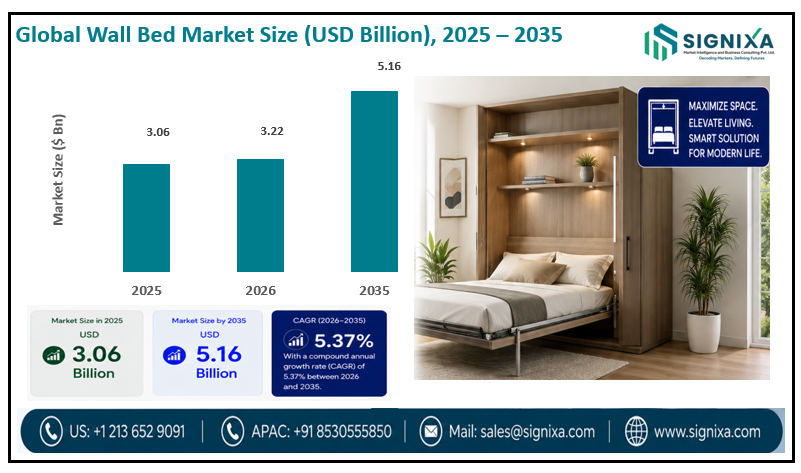
The size of the global Wall Bed market was worth around USD 3.06 Billion in 2025 and is predicted to grow to around USD 5.16 Billion by 2035, with a compound annual growth rate (CAGR) of roughly 5.37% between 2026 and 2035. A wall bed, also known as a Murphy bed, comprises a foldable bed frame, a mattress, and a cabinet or enclosure that allows it to be stored vertically against a wall or inside a closet.
Wall beds feature a space-saving design, easy folding mechanism, and are available in both manual and automated systems. Wall beds often include additional storage units like shelves or desks, making them ideal for small apartments, guest rooms, or multifunctional spaces that require flexible furniture solutions. The wall bed market is growing quickly due to rising urbanization and increasing demand for space-saving furniture wall beds fold vertically into walls, turning bedrooms into multi-use spaces, ideal for small apartments and studios.
Technological advancements like motorized and remote-controlled mechanisms enhance user convenience and appeal. North America currently leads the market, driven by high real estate costs and smaller living spaces. Meanwhile, Asia-Pacific is expected to see the fastest growth, fueled by rapid urban population growth and the need for compact furniture solutions in countries such as China and India. Manufacturers are focusing on innovative designs and smart integration to meet evolving consumer needs.
Key Findings
- The global Wall Bed market is estimated to grow annually at a CAGR of around 5.37% over the forecast period (2026–2035).
- In terms of revenue, the global Wall Bed market size was valued at around USD 3.06 Billion in 2025 and is projected to reach USD 5.16 Billion by 2035.
- Rising urbanization and shrinking living spaces are driving demand for space-saving furniture like wall beds, especially in apartments, studios, and compact residential units.
- Based on Mechanism Type, the Manual wall bed segment is growing at a high rate and will continue to dominate the global market.
- On the basis of Size, the Queen-size segment is anticipated to command the largest market share.
- In terms of Material, the Wood segment is anticipated to command the largest market share.
- In terms of Application, the Residential segment is anticipated to command the largest market share.
- By Region, North America is projected to dominate the global market during the forecast period.
Wall Bed Market Dynamics
Urban Housing Scarcity & Rising Real Estate Costs in Metropolitan Areas Compelling Residents to Maximize Floor Space Efficiency
As urban populations grow, housing availability becomes limited and expensive, leading to smaller apartments and living areas. This trend drives the demand for furniture that maximizes space efficiency. Wall beds, with their foldable design, offer a practical solution for urban dwellers who need to optimize floor space without sacrificing comfort. Particularly in cities with high real estate costs, wall beds are gaining popularity among residents seeking functionality and convenience within compact living environments. The global urban population is rising steadily, with the UN projecting 68% of the world's population will live in urban areas by 2050, creating persistent structural demand for compact living solutions. The growing phenomenon of micro-apartments units under 400 square feet in cities like New York, Tokyo, Hong Kong, and Singapore represents the most acute manifestation of this space constraint trend, making wall beds a near-essential furniture category rather than a discretionary purchase through the forecast period.
Multifunctional Living Demand: Integrated Storage, Desk & Sofa Combos Enabling Rooms to Serve Multiple Daily Purposes
Consumers today prefer furniture that offers more than one function to make the most of their limited space. Wall beds not only provide a comfortable sleeping arrangement but often include added features such as storage units, desks, or sofas. This multifunctionality appeals to users who want versatile and adaptable interior solutions. Especially in small homes, guest rooms, or studios, the ability to transform a room's purpose throughout the day enhances the wall bed's overall value. The post-pandemic normalization of remote work has further intensified this demand, many urban residents require a home office that can also function as a guest bedroom, making wall beds with integrated desk systems particularly valuable. The growing gig economy and short-term rental market through platforms like Airbnb has created additional commercial demand for wall beds that maximize the utility and appeal of rental properties, enabling hosts to market studio units as one-bedroom equivalents through the forecast period.
Home Renovation Trends & Interior Customization Culture Driving Demand for Stylish, Integrated Wall Bed Solutions
With increased interest in personalized interior design and home improvement projects, more homeowners are investing in smart, stylish furniture. Wall beds cater to this trend by offering customizable designs, finishes, and integrated features that match modern décor themes. Whether renovating a home office, guest room, or studio apartment, individuals seek innovative solutions like wall beds to elevate both aesthetics and functionality. Their discreet appearance and efficient use of space make them a preferred choice in today's renovation projects. The rise of home design content on social media platforms where consumers discover premium furniture solutions through influencer content, home tours, and interior design accounts is creating growing consumer awareness of and aspiration toward high-quality wall bed installations. The development of wall bed systems that are visually indistinguishable from standard cabinetry when closed effectively hiding the bed entirely is making wall beds aesthetically suitable for even the most design-conscious consumers through the forecast period.
Wall Bed Market: Segmentation Analysis
By Mechanism Type Segment Analysis
Manual Wall Bed
Manual wall beds are the most popular type, accounting for nearly 70% of the global market due to their affordability and simple operation. They require minimal maintenance and are cost-effective, with prices ranging from $500 to $1,500. The lack of complex mechanisms also makes them easier to install in various home settings. In North America, manual wall beds lead the market, driven by the growing need for space-saving solutions in small urban apartments and homes. Manual wall beds operate through a spring-assisted or piston-based counterbalance mechanism that makes raising and lowering a mattress of considerable weight achievable with minimal physical effort, providing functional convenience without the cost and complexity of motorized systems. The broad price range of manual wall beds from entry-level flat-pack models to custom-crafted premium installations creates accessible entry points across consumer income levels. The availability of DIY-compatible manual wall bed kits has expanded the addressable market to cost-conscious consumers comfortable with home assembly, significantly broadening distribution reach through e-commerce platforms through the forecast period.
Automatic Wall Bed
Automatic wall beds are gaining popularity, comprising approximately 30% of the market. These beds feature motorized mechanisms that allow for easy folding and unfolding with the push of a button. Although more expensive, with prices typically starting at $2,000, their convenience and modern appeal make them ideal for luxury homes and commercial spaces. As home automation trends rise, automatic wall beds are increasingly seen in high-end residential and hotel markets, where convenience and tech integration are prioritized. The integration of automatic wall beds with smart home systems enabling voice-command operation through Amazon Alexa, Google Home, and Apple HomeKit is creating a premium connected living proposition that appeals to tech-forward consumers. The commercial segment is particularly receptive to automatic wall beds, as the ability to effortlessly transform room configurations without physical effort is valuable in hotel environments where housekeeping staff regularly reset room layouts. The falling cost of electric motors and control electronics is progressively narrowing the price gap between manual and automatic models through the forecast period.
By Bed Size Segment Analysis
Queen
Queen-sized wall beds are the dominant segment in the market, accounting for 40% of sales. They balance comfort and space-saving functionality, making them perfect for couples and small families. Priced between $1,200 and $2,500, queen-sized beds are particularly popular in the United States and Europe, where apartment living is prevalent. Their popularity is driven by growing demand for versatile, high-quality furniture that accommodates two adults comfortably while fitting into smaller spaces. The queen-size format optimizes the comfort-to-footprint ratio for the largest consumer segment couples living in apartments where a full bed may feel insufficient but a king-size is impractical given space constraints. The availability of queen-size wall beds with integrated side storage, USB charging ports, and reading light fixtures creates a comprehensive bedroom-in-a-wall solution that justifies the higher price point relative to smaller sizes. Consumer preference for queen-size sleeping surfaces as the baseline comfort standard is well established in North American and European markets and is increasingly being adopted in premium Asian urban housing through the forecast period.
Single
Single wall beds are ideal for small spaces and are highly preferred in student accommodations and compact apartments. They typically account for around 20% of the market. Priced between $400 and $900, they cater to individuals who need functional sleeping solutions without taking up too much space. The demand is particularly high in regions like Asia-Pacific, where smaller living spaces are more common due to dense populations and limited real estate. Single wall beds are particularly prevalent in purpose-built student accommodation developments - where maximizing usable floor space in individual rooms while maintaining comfortable sleeping arrangements is a core design requirement. The growing trend of co-living spaces where tenants share communal areas but have private individual bedrooms also creates consistent demand for single wall beds that maximize the livability of private room footprints through the forecast period.
Double
Double wall beds are commonly used in guest rooms and studio apartments due to their ability to accommodate two people comfortably. Representing about 25% of the market, they are priced between $800 and $1,500. These beds provide ample comfort while offering space-saving advantages. Demand is particularly strong in North America and Europe, where small family homes and apartments increasingly seek practical yet spacious furniture solutions. The double wall bed serves as a practical choice for households that occasionally require guest sleeping accommodations but cannot dedicate a full room permanently to a guest bedroom allowing the space to serve as a home office or hobby room during the vast majority of time while converting to a comfortable sleeping space when needed. The popularity of double wall beds with integrated sofa systems where the bed folds down from above a seating arrangement that remains in place addresses the specific need of combined living and sleeping spaces without requiring any furniture rearrangement through the forecast period.
King
King-sized wall beds make up a smaller portion of the market at about 15%. They are typically priced from $2,000 to $3,500 and are favored for luxury homes or larger apartments. The demand for these larger models is rising in high-income urban areas where space is available, but consumers still seek space-saving solutions. King-sized wall beds are ideal for those looking for the comfort of a large bed without compromising room aesthetics or functionality. The king-size wall bed segment benefits from the growing trend of luxury condominium developers incorporating custom wall bed systems as a standard design feature offering flexible room configurations as a premium differentiator in the competitive high-end urban real estate market. The availability of king-size automated wall beds that integrate seamlessly with custom cabinetry in bespoke home design projects is expanding the addressable market among affluent consumers who prioritize premium sleeping comfort within architecturally sophisticated interiors through the forecast period.
By Material Segment Analysis
Wood
Wood is the dominant material in the wall bed market, accounting for around 60% of sales due to its aesthetic appeal and durability. Wooden wall beds are versatile, fitting into various interior designs, especially in residential spaces. Priced between $800 and $2,000, they are particularly popular in North America and Europe, where traditional and modern designs blend. The global wood wall bed market continues to grow at a CAGR of 6.5%, driven by demand for customizable and elegant furniture solutions. Wood's natural warmth and visual richness make it the preferred material for wall beds in residential environments where the aesthetic integration with existing furniture and décor is a primary purchase consideration. The availability of wood wall beds in a comprehensive range of species, stains, paint finishes, and woodgrain laminate options enables precise matching to virtually any interior design style from rustic farmhouse to contemporary minimalist. The growing consumer preference for sustainably sourced and FSC-certified wood furniture is driving manufacturers to adopt responsible supply chain practices that resonate with environmentally conscious consumers through the forecast period.
Metal
Metal wall beds hold a 40% market share, favored for their strength, lightweight nature, and modern industrial appeal. Typically priced between $600 and $1,500, they are popular in commercial settings such as hotels and hostels, where durability and ease of maintenance are crucial. The Asia-Pacific region, particularly countries like China and India, has seen increased demand due to the growing construction and furnishing industry, with metal wall beds being more affordable and resilient in high-traffic environments. Metal wall beds' superior structural rigidity relative to weight makes them particularly well-suited for wall-mounting applications where minimizing the load on the wall attachment points is important. The industrial-chic aesthetic of powder-coated steel wall beds has found a receptive audience in contemporary urban loft apartments and co-living spaces where exposed structural materials are a deliberate design element. The corrosion-resistant characteristics of stainless steel and aluminum variants make metal wall beds appropriate for humid environments including seaside properties and some climate zones in Southeast Asia where wood furniture may be susceptible to warping or degradation through the forecast period.
By Application Segment Analysis
Residential
Residential wall beds account for around 75% of the global market, driven by the increasing demand for space-saving solutions in apartments and small homes. With prices ranging from $500 to $2,500, they are popular for guest rooms, studio apartments, and multifunctional spaces. As urbanization increases, particularly in regions like North America and Europe, the demand for residential wall beds is projected to grow at a CAGR of 7% through 2030, reflecting the trend toward efficient home design. The residential wall bed market is being further stimulated by the growing population of single-person and dual-income-no-kids (DINK) households demographics that disproportionately inhabit smaller urban housing units and particularly value furniture flexibility. Real estate developers are increasingly offering custom wall bed installations as a standard feature in new apartment buildings particularly in micro-unit developments recognizing that wall beds add measurable value by making small spaces more marketable and livable. Interior designers and renovation contractors are increasingly specifying wall beds as a solution for guest room-home office hybrid spaces, driving professional installation channel growth through the forecast period.
Commercial
Commercial wall beds make up approximately 25% of the market, with strong demand from hotels, dormitories, and short-term rental accommodations. These beds range from $1,000 to $3,500, tailored for high-traffic environments where durability and easy maintenance are key. The Asia-Pacific and Europe regions are seeing rapid growth in this segment, fueled by the expansion of the hospitality industry. As commercial spaces seek cost-effective and versatile furniture, commercial wall beds are expected to grow at a CAGR of 5.5%. Hotel operators are discovering that wall beds enable a single room to be marketed as both a standard room and a suite or meeting room depending on configuration, improving revenue management flexibility. The boutique hotel sector which places a premium on maximizing the functional utility and unique design appeal of limited-square-footage rooms is an especially active adopter of premium wall bed systems with sophisticated integrated furniture solutions. The growing short-term rental market creates demand for wall beds in investment properties, where owners seek to maximize rental income potential by enabling a studio apartment to function convincingly as a one-bedroom unit through the forecast period.
Report Attributes & Market Scope
| Report Attribute | Details |
|---|---|
| Market Size Value in 2025 | USD 3.06 Billion |
| Market Size Value in 2035 | USD 5.16 Billion |
| CAGR (2026–2035) | 5.37% |
| Base Year Used for Estimation | 2025 |
| Historic Data | 2020 - 2025 |
| Forecast Period | 2026 - 2035 |
| Segments Covered – By Mechanism Type |
|
| Segments Covered – By Bed Size |
|
| Segments Covered – By Material |
|
| Segments Covered – By Application |
|
| Regions Covered | North America, Europe, Asia Pacific, Latin America, Middle East and Africa |
| Major Countries Covered | U.S., Canada, Mexico, Germany, UK, France, Italy, Spain, Russia, China, Japan, South Korea, India, Southeast Asia Countries, Brazil, Argentina, GCC Countries, Turkey, Iran, Israel, South Africa, Egypt, Nigeria, etc. |
| Key Companies Profiled | Fly Bed Home, Ribbonic, Neptueen Enterprise, Furnable, Linus Furniture, Krini Furniture, Natun Trading, Murphy Bed, Magical Nest, Inovabed, among others. |
Wall Bed Market Regional Analysis
North America is the dominant region in the wall bed market due to high urbanization, limited living space, and a strong preference for multifunctional furniture. Europe is also growing due to similar urbanization trends and a rising focus on home renovations. Asia-Pacific is emerging rapidly, driven by increasing urbanization and a growing middle class in countries like China and India.
North America (Dominant Region)
North America holds a dominant position in the wall bed market, driven by increasing urbanization, rising housing costs, and the growing trend toward compact living spaces. Cities across the United States and Canada face space constraints, making multifunctional furniture like wall beds highly desirable. Consumers value the flexibility to convert rooms quickly between sleeping and living or working spaces, especially in apartments, condos, and smaller homes. Technological innovations such as motorized and remote-controlled wall beds have further enhanced product appeal by improving ease of use and integration with smart home systems. High disposable incomes and awareness of modern interior design trends also contribute to strong market growth. The commercial sector, including hotels and student housing, increasingly adopts wall beds to maximize room utility. Environmental concerns have pushed manufacturers toward sustainable materials and eco-friendly production techniques, resonating well with conscious consumers through the forecast period.
Europe
Europe's wall bed market is steadily expanding, driven by increasing urbanization, rising housing costs, and changing lifestyle preferences favoring multifunctional living spaces. In densely populated cities like London, Paris, Berlin, and Madrid, space constraints in apartments and small homes have heightened demand for space-saving furniture solutions. European consumers value designs that combine functionality with aesthetics, prompting manufacturers to focus on stylish, customizable options. Sustainability is a major focus in Europe, with many consumers prioritizing eco-friendly materials and production processes, leading to a rise in wall beds made from recycled or responsibly sourced materials. The rise of remote work and flexible living arrangements post-pandemic has increased interest in adaptable furniture that maximizes space efficiency. The presence of strong retail networks and growing online sales channels further supports market growth through the forecast period.
Asia-Pacific (Fastest-Growing)
Asia Pacific's wall bed market is witnessing rapid growth, propelled by accelerating urbanization, rising population density, and increasing real estate costs in major countries such as China, India, Japan, and South Korea. With more people living in compact apartments and small living spaces, the demand for multifunctional, space-saving furniture like wall beds is surging. The growing middle class and rising disposable incomes further fuel adoption of premium and customizable wall bed options. Technological innovations including motorized and remote-controlled beds are increasingly popular among tech-savvy buyers who seek convenience and modern living comforts. E-commerce platforms and digital marketing play a significant role in expanding product reach to urban consumers. Manufacturers are responding to regional preferences by offering designs that cater to local tastes and cultural nuances. Asia Pacific's combination of demographic pressure, evolving consumer lifestyle, and increasing awareness makes it a key growth region through the forecast period.
Latin America & Middle East and Africa
Latin America and the Middle East & Africa represent emerging markets for wall beds, with growing adoption driven by urbanization, expanding middle-class populations, and developing hospitality sectors. In Latin America, Brazil and Mexico lead adoption, driven by growing urban apartment markets in major cities like São Paulo, Mexico City, and Bogotá, where space efficiency is increasingly valued as apartment sizes shrink and real estate values rise. The expanding hospitality and short-term rental sectors in Latin American tourism destinations are creating commercial demand for wall beds that maximize room utility and guest appeal. In the Middle East, particularly the GCC countries where ambitious urban development projects are creating significant new apartment supply, wall beds represent an opportunity for developers to differentiate premium compact living offerings. The growing young professional population in GCC cities which includes many single expatriates living in studio and one-bedroom apartments represents a receptive consumer segment for wall bed adoption through the forecast period.
Recent Developments in the Wall Bed Market
-
2026
Flybed Home expanded its premium wall bed portfolio with integrated sofa, desk, dining table, and bunk bed solutions, addressing the growing demand for multifunctional furniture in compact urban homes.
BESTAR Inc. continued expanding its modular Murphy bed collection through new space-saving designs and enhanced e-commerce availability, strengthening its position in the North American wall bed market.
BredaBeds introduced new customizable Murphy bed systems with integrated storage and home office configurations, catering to hybrid workspaces and small apartment living.
Wilding Wallbeds expanded its premium handcrafted wall bed lineup with customizable finishes and heavy-duty hardware, supporting increased demand for luxury space-saving furniture.
-
2025
Clei Srl showcased new multifunctional transforming furniture systems featuring rotating wall beds integrated with shelving and tables, reinforcing its focus on premium space-saving living solutions.
Spaceman Innovations Pte Ltd. expanded its smart space-saving furniture offerings across Asia-Pacific with new automated wall bed systems designed for urban apartments and mixed-use developments.
Wall Bed Market: Competitive Landscape
The global Wall Bed market features major players such as Fly Bed Home, Ribbonic, Neptueen Enterprise, Furnable, Linus Furniture, Krini Furniture, Natun Trading, Murphy Bed, Magical Nest, and Inovabed. The Wall Bed market is highly competitive, with companies competing on factors such as product innovation, cost-efficiency, geographical reach, and sustainability, which are all essential for gaining market share in the growing industry.
The competitive landscape is characterized by intense rivalry among manufacturers focusing on innovation, design, and technological integration. Companies are investing heavily in research and development to create advanced features such as motorized mechanisms, smart home compatibility, and improved safety functions. Customization and aesthetic versatility have become key differentiators, with brands offering a wide range of styles, finishes, and sizes. Sustainability and the use of eco-friendly materials are increasingly important as consumer awareness of environmental impact grows. Strategic partnerships with interior designers, real estate developers, and online retailers help expand market reach and visibility. Digital marketing and e-commerce platforms play a crucial role in driving sales and consumer engagement through the forecast period.
Key Companies Profiled
- Fly Bed Home
- Murphy Bed
- Inovabed
- Ribbonic
- Furnable
- Linus Furniture
- Krini Furniture
- Magical Nest
- Neptueen Enterprise
- Natun Trading
- BESTAR Inc.
- BredaBeds
- Wilding Wallbeds
- Clei Srl
- SICO Incorporated
Global Wall Bed Market Segmentation Summary
By Mechanism Type
- Manual Wall Bed
- Automatic Wall Bed
By Bed Size
- Single
- Double
- Queen
- King
By Material
- Wood
- Metal
By Application
- Residential
- Commercial
By Region
- North America
- U.S.
- Canada
- Mexico
- Europe
- Germany
- France
- UK
- Spain
- Italy
- Rest of Europe
- Asia-Pacific
- China
- Japan
- India
- Australia
- South Korea
- Southeast Asia
- Rest of Asia-Pacific
- Latin America
- Brazil
- Argentina
- Rest of Latin America
- The Middle East & Africa
- GCC Countries
- South Africa
- Rest of the Middle East & Africa
Frequently Asked Questions (FAQs) About the Wall Bed Market
What is a Wall Bed?
A wall bed, also known as a Murphy bed, is a space-saving bed that folds vertically into a wall or cabinet when not in use, transforming a room for multiple purposes, such as an office or living area.
Which key factors will influence the Wall Bed market growth over 2026–2035?
The key factor driving the growth of the wall bed market is the increasing demand for space-saving furniture in urban areas, where limited living space and multifunctional home designs require efficient and flexible solutions for residential and commercial use.
What will be the value of the Wall Bed market during 2026–2035?
According to the study, the global Wall Bed market size was worth around USD 3.06 Billion in 2025 and is predicted to grow to around USD 5.16 Billion by 2035.
What will be the CAGR value of the Wall Bed market during 2026–2035?
The CAGR value of the Wall Bed market is expected to be around 5.37% during 2026–2035, driven by increasing urbanization, shrinking residential living spaces, and the growing demand for multifunctional, space-saving furniture.
Which region will contribute notably towards the Wall Bed market value?
North America dominates the wall bed market due to high urbanization, limited living space in cities, and growing demand for multifunctional furniture. Additionally, a strong focus on home optimization and innovative design fuels the region's leadership.
Which are the major players leveraging the Wall Bed market growth?
The global Wall Bed market is led by players such as Fly Bed Home, Ribbonic, Neptueen Enterprise, Furnable, Linus Furniture, Krini Furniture, Natun Trading, Murphy Bed, Magical Nest, and Inovabed.
What can be expected from the global Wall Bed market report?
The report explores crucial aspects of the Wall Bed market, including a detailed discussion of existing growth factors and restraints while also analyzing future growth opportunities and challenges that impact the market.