
Global Field-Programmable Gate Array (FPGA) Market Size, Share, Growth & Forecast 2026-2035

Market Research Report  |  Forecast Period: 2026–2035  |  Base Year: 2025

Market Size (2025)
USD 13.35 Bn
Market Size (2035)
USD 39.17 Bn
CAGR (2026–2035)
11.32%
Leading Region
North America

Field-Programmable Gate Array (FPGA) Market Overview

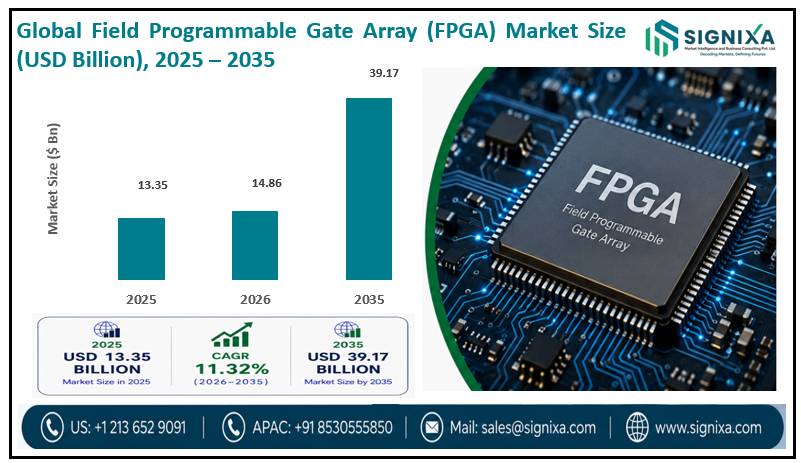
The size of the global Field-Programmable Gate Array (FPGA) market was worth around USD 13.35 Billion in 2025 and is projected to grow to approximately USD 39.17 Billion by 2035, at a CAGR of 11.32% between 2026 and 2035. This report offers a comprehensive analysis of key market dynamics, opportunities, and regional trends that are shaping the global FPGA landscape.

The Field-Programmable Gate Array (FPGA) market is experiencing notable growth due to its increasing role in flexible, high-performance computing across various sectors. FPGAs are widely adopted in applications requiring real-time processing, customizability, and parallel data execution. The shift towards edge computing, artificial intelligence (AI), and 5G deployment has significantly increased the demand for FPGAs. Moreover, the ability to reconfigure FPGAs post-manufacturing makes them valuable in prototyping, military, and rapidly evolving technology environments.

The Field-Programmable Gate Array (FPGA) market is experiencing dynamic growth driven by the increasing demand for high-performance computing, real-time data processing, and adaptable hardware solutions across a widening array of industries. Unlike Application-Specific Integrated Circuits (ASICs), which are designed for a single purpose, FPGAs can be reconfigured after manufacturing, offering unparalleled flexibility and a faster time-to-market. This inherent re-programmability makes them ideal for rapidly evolving technologies where standards are still being defined or where customized hardware acceleration is crucial. Key sectors propelling this demand include telecommunications (especially for 5G infrastructure), data centers (for acceleration of cloud computing and big data analytics), automotive (for Advanced Driver-Assistance Systems - ADAS and autonomous driving), and industrial automation. The ability of FPGAs to perform parallel processing with low latency and high throughput, while also offering energy efficiency compared to general-purpose processors like GPUs in specific workloads, makes them a compelling choice for these demanding applications.

A significant market dynamic is the transformative impact of Artificial Intelligence (AI) and Machine Learning (ML) on FPGA adoption, positioning FPGAs as crucial accelerators for AI inference at the edge and in specialized data center workloads. While GPUs dominate AI training, FPGAs excel in inference applications where low latency, power efficiency, and customizability are paramount. Their reconfigurable logic fabric is well-suited for implementing neural networks and optimizing specific AI algorithms, allowing for highly efficient processing of AI workloads closer to the data source (edge computing). This is particularly relevant in applications like real-time video analytics, industrial automation, medical imaging, and autonomous vehicles where immediate decision-making is critical. The development of higher-level synthesis (HLS) tools and AI-specific development frameworks (like AMD's Vitis AI and Intel's OpenVINO) is democratizing FPGA programming, making it more accessible to a broader range of developers, including data scientists, thus accelerating their integration into AI solutions.

However, the FPGA market also faces notable challenges, primarily related to design complexity, high development costs, and intense competition from alternative computing architectures like ASICs and GPUs. Despite advancements in design tools, FPGA programming still requires specialized expertise in hardware description languages (HDLs) and a deep understanding of hardware architecture, leading to longer development cycles and higher non-recurring engineering (NRE) costs compared to software development. While FPGAs offer flexibility, ASICs generally provide superior performance and power efficiency for high-volume, stable applications once the design is finalized, making them a preferred choice in certain mature markets. GPUs, with their broad ecosystem and established software frameworks, remain dominant for large-scale AI training. Furthermore, security concerns, such as side-channel attacks and intellectual property (IP) protection challenges for the configurable bitstreams, are ongoing issues that manufacturers are actively addressing through secure design practices and encryption techniques.

Key Findings

  • As per research analysis, the global FPGA market is projected to grow at a CAGR of approximately 11.32% during the forecast period (2026-2035).
  • In 2025, the market was valued at USD 13.35 Billion and is projected to reach USD 39.17 Billion by 2035.
  • The market is driven by rising demand in data-intensive applications and real-time processing systems.
  • Based on Configuration, the Mid-range FPGA segment is expected to register significant growth.
  • On the basis of Node Size, ≤16 nm FPGAs are expected to dominate due to their performance efficiency.
  • By Technology, SRAM remains the most widely adopted type.
  • By Vertical, Data Center & Computing is expected to command the largest share.
  • By Region, North America is anticipated to lead the global FPGA market during the forecast period.
Fpga Market

Field-Programmable Gate Array (FPGA) Market Dynamics

Rising Adoption of FPGAs in AI, 5G, and Edge Computing

The rising implementation of FPGA solutions in AI, 5G networks, and edge computing environments is a primary driver of market expansion. AI inference engines, deep learning accelerators, and intelligent vision systems are increasingly leveraging FPGAs for their customizable logic capabilities and low-latency performance. The growing need for programmable hardware platforms in dynamically changing workloads has made FPGAs the go-to solution for developers seeking to optimize speed and power consumption.

Growing Deployment of FPGAs in Data Centers and Networking Infrastructure

Another critical growth factor is the growing use of FPGAs in high-speed data centers and networking infrastructure. With the evolution of cloud-based services and the increasing volume of data generated from IoT devices, the demand for adaptable and power-efficient processing hardware has surged. FPGAs offer high parallelism and reconfigurability, making them essential in accelerating network traffic processing, encryption, and workload distribution, ultimately enhancing data center scalability and performance.

Increasing Demand for Reconfigurable Hardware Across High-Growth Industries

The Field-Programmable Gate Array (FPGA) market is experiencing dynamic growth driven by the increasing demand for highly customizable and reconfigurable hardware solutions across a widening array of high-growth industries. Unlike Application-Specific Integrated Circuits (ASICs), which are designed for a single purpose and are fixed after manufacturing, FPGAs can be programmed and reprogrammed multiple times, offering unparalleled flexibility and a significantly faster time-to-market. This inherent re-programmability is particularly critical in rapidly evolving technological landscapes where standards are still in flux or where hardware needs to adapt to new algorithms and protocols. Key sectors propelling this demand include telecommunications (especially for 5G and next-generation network infrastructure), data centers (for acceleration of cloud computing, big data analytics, and specialized workloads), automotive (for Advanced Driver-Assistance Systems - ADAS, autonomous driving, and in-car infotainment), industrial automation, and aerospace & defense. The unique ability of FPGAs to perform highly parallel processing with very low latency and high throughput, often with better power efficiency than general-purpose processors for specific tasks, makes them an increasingly compelling choice for these demanding, performance-critical applications.

Artificial Intelligence and Machine Learning Accelerating FPGA Adoption

A significant market dynamic is the transformative impact of Artificial Intelligence (AI) and Machine Learning (ML) on FPGA adoption, positioning FPGAs as crucial accelerators for AI inference at the edge and in specialized data center workloads. While Graphics Processing Units (GPUs) currently dominate the landscape for AI model training due to their massive parallel processing capabilities, FPGAs are increasingly gaining traction in AI inference. This is because inference often requires low latency, predictable performance, and high power efficiency, particularly in edge computing scenarios where real-time decision-making is critical (e.g., in autonomous vehicles, smart factories, and surveillance systems). The reconfigurable nature of FPGAs allows developers to precisely tailor the hardware architecture to the specific neural network models, optimizing performance and power consumption. Furthermore, the development of higher-level synthesis (HLS) tools and AI-specific development frameworks (such as AMD's Vitis AI and Intel's OpenVINO) is significantly lowering the entry barrier for FPGA programming. These tools enable AI developers and data scientists, who may not have extensive hardware design expertise, to deploy AI models on FPGAs more efficiently, thereby accelerating their integration into a broader range of AI-driven solutions.

Design Complexity and Competition Remain Key Market Challenges

The FPGA market also faces notable challenges that impact its broader adoption and growth, primarily related to design complexity, the high non-recurring engineering (NRE) costs associated with development, and intense competition from alternative computing architectures. Despite continuous advancements in design tools and high-level synthesis, programming FPGAs still requires specialized expertise in hardware description languages (HDLs) and a deeper understanding of hardware architecture compared to software development. This complexity can lead to longer design cycles and higher upfront development costs, making FPGAs less attractive for projects with limited budgets or short timelines. Furthermore, while FPGAs offer unparalleled flexibility, Application-Specific Integrated Circuits (ASICs) generally provide superior performance, power efficiency, and lower unit cost for high-volume, stable applications once the design is finalized. GPUs, with their mature software ecosystem and established programming models, remain formidable competitors in large-scale AI training and certain parallel computing tasks. Additionally, concerns regarding the security of intellectual property (IP) within the configurable bitstreams and vulnerabilities to side-channel attacks are ongoing challenges that manufacturers are actively addressing through advanced security features and robust design practices.

FPGA Market: Segmentation Analysis

By Configuration Segment Analysis

The Mid-range FPGAs are expected to dominate the market due to their balance between performance and cost, making them ideal for applications in automotive systems, industrial automation, and consumer electronics. In 2025, mid-range FPGAs accounted for over 42% of market share. These devices offer sufficient logic density and I/O capabilities for real-time data processing without the high power demands or cost associated with high-end configurations. Their growing use in edge AI devices and embedded systems is accelerating demand across industrial and telecommunication sectors.

By Node Size Segment Analysis

The FPGAs with node sizes of ≤16 nm are expected to dominate due to their enhanced performance, reduced power consumption, and smaller form factor. As of 2025, these FPGAs made up approximately 48% of the total FPGA production. Their higher density allows for complex computations in AI, 5G base stations, and high-speed networking applications. Companies such as Intel and AMD/Xilinx are rapidly advancing these technologies to support next-generation computing platforms, resulting in stronger adoption across high-tech industries.

By Technology Segment Analysis

The SRAM-based FPGAs lead the market due to their superior reprogrammability, lower static power usage, and widespread support across development tools. SRAM FPGAs represented nearly 65% of the global share in 2025. Their popularity stems from their ability to be reconfigured multiple times during development, enabling flexibility in prototyping and functional testing. These FPGAs are extensively used in computing, networking, and test equipment where runtime adaptability is critical.

By Size Segment Analysis

The traditional FPGA segment continues to hold the dominant share, though embedded FPGAs (eFPGAs) are gaining traction. FPGAs accounted for more than 85% of total revenues in 2025. However, eFPGAs are increasingly being integrated into SoCs and ASICs to add reconfigurable logic, particularly in custom chip designs for AI and sensor fusion. Their adoption is expected to grow in low-power applications, wearables, and automotive ECUs as chipmakers seek programmable versatility within compact systems.

By Vertical Segment Analysis

The Data Center & Computing leads all verticals, accounting for over 30% of global revenues in 2025. The need for scalable, power-efficient accelerators has driven FPGAs into cloud and enterprise environments, where they support tasks such as machine learning inference, image recognition, and encryption. Tech giants like Amazon and Microsoft are embedding FPGAs into their data centers to enable custom acceleration of workloads, resulting in stronger demand for high-throughput and reprogrammable hardware.

Report Scope & Segmentation

FPGA Market Report Attributes and Details
Report Attribute Details
Market size value in 2025 USD 13.35 Billion
Market size value in 2035 USD 39.17 Billion
CAGR (2026 – 2035) 11.32%
Base Year Used for Estimation 2025
Historic Data 2020 - 2025
Forecast Period 2026 - 2035
Segments Covered

By Configuration Segment Analysis:

  • Low-end FPGA
  • Mid-range FPGA
  • High-end FPGA

By Node Size Segment Analysis:

  • ≤16 nm
  • 20-90 nm
  • 90 nm

By Technology Segment Analysis:

  • SRAM
  • Flash
  • Antifuse

By Size Segment Analysis:

  • FPGA
  • eFPGA

By Vertical Segment Analysis:

  • Telecommunications
  • Consumer Electronics
  • Data Center & Computing
  • Military & Aerospace
  • Industrial
  • Automotive
  • Healthcare
  • Multimedia
  • Broadcasting
Regions Covered North America, Europe, Asia Pacific, Latin America, Middle East and Africa
Major Countries Covered U.S., Canada, Mexico, Germany, UK, France, Italy, Spain, Russia, China, Japan, South Korea, India, Southeast Asia Countries, Brazil, Argentina, GCC Countries, Turkey, Iran, Israel, South Africa, Egypt, Nigeria, etc.
Key Companies Profiled Intel Corporation, AMD (Xilinx), Microchip Technology Inc., Lattice Semiconductor, QuickLogic, Achronix Semiconductor, Efinix, Flex Logix Technologies, Inc., NanoXplore Inc., and Gowin Semiconductor.

FPGA Market Regional Analysis

North America leads the global FPGA market, driven by strong R&D investment, a robust semiconductor ecosystem, and early adoption of AI and 5G. The presence of tech giants such as Intel, AMD/Xilinx, and Microchip further supports regional leadership. Meanwhile, the Asia-Pacific region is rapidly growing due to industrial expansion, rising automotive electronics demand, and the proliferation of smart devices. China, Japan, South Korea, and Taiwan are key contributors due to their established manufacturing infrastructure and growing focus on next-gen computing.

North America (Leading Region)

North America stands as a leading and technologically mature market for Field-Programmable Gate Arrays (FPGAs), driven by its robust innovation ecosystem, significant investments in advanced technologies, and a strong presence of key end-use industries. The United States, in particular, is a major hub for semiconductor research and development, contributing significantly to FPGA advancements. The demand for FPGAs in this region is primarily fueled by applications in data centers (for cloud acceleration, AI inference, and network processing), telecommunications (especially for 5G infrastructure deployment and next-generation networking equipment), and aerospace & defense. The need for high-performance, low-latency, and adaptable computing solutions for complex algorithms in these sectors drives FPGA adoption. Furthermore, the burgeoning automotive industry's focus on Advanced Driver-Assistance Systems (ADAS) and autonomous driving, which require real-time sensor fusion and AI processing, presents a growing opportunity for FPGAs. The region's strong venture capital funding and focus on cutting-edge technologies ensure continuous demand for programmable logic devices.

Europe

Europe represents a significant and evolving market for Field-Programmable Gate Arrays (FPGAs), characterized by its strong industrial automation sector, growing investments in 5G infrastructure, and a robust automotive industry. Countries like Germany, the UK, and France are key contributors to FPGA demand. The widespread adoption of Industry 4.0 initiatives across Europe, emphasizing automation, smart factories, and real-time control, drives the need for FPGAs due to their ability to offer parallel processing, low latency, and reconfigurability in industrial control systems and robotics. Furthermore, the ongoing rollout of 5G networks throughout Europe necessitates FPGAs for base station processing, beamforming, and flexible network functions. The automotive sector, particularly in Germany, is also a strong driver, with FPGAs being integrated into ADAS, infotainment systems, and electric vehicle (EV) powertrains. European research collaborations and government funding for semiconductor development further support the market's growth, though slower adoption in some traditional industries compared to North America or Asia Pacific can be a factor.

Asia Pacific

The Asia Pacific region is the fastest-growing and largest market for Field-Programmable Gate Arrays (FPGAs), propelled by its massive electronics manufacturing base, rapid digitalization, and substantial investments in advanced technologies. China dominates this growth, driven by its aggressive development in 5G infrastructure, AI, and data centers, where FPGAs are crucial for acceleration and flexible hardware. Japan, South Korea, and Taiwan also hold significant market shares, being major players in the semiconductor manufacturing, automotive electronics, and consumer electronics industries. The region's demand for FPGAs stems from their use in telecommunications equipment, consumer devices (e.g., smart TVs, gaming consoles), industrial automation, and increasingly, AI inference at the edge. The presence of major FPGA foundries and a highly competitive electronics supply chain further supports the widespread adoption and innovation in FPGA technology across Asia Pacific, making it a pivotal region for future market expansion.

Middle East and Africa

The Middle East & Africa (MEA) region is a nascent but rapidly developing market for Field-Programmable Gate Arrays (FPGAs), driven by ambitious digital transformation agendas, diversification efforts away from oil economies, and growing investments in technology infrastructure. In the Middle East, particularly the UAE and Saudi Arabia, significant government-led initiatives in smart cities, defense modernization, and the build-out of advanced telecommunications networks (including 5G) are creating new opportunities for FPGA adoption. The demand is primarily emerging from sectors requiring high-performance computing, security, and specialized processing capabilities. While the market is currently smaller compared to more developed regions, the ongoing emphasis on technological self-reliance, the establishment of local manufacturing capabilities, and increasing foreign direct investment in technology sectors are expected to progressively drive the adoption of FPGAs for various applications, including defense, telecommunications, and emerging industrial automation projects. In Africa, the market is still in its early stages, but rising internet penetration and investment in digital infrastructure present long-term potential for FPGA integration in communication systems and data centers.

Recent Developments

  • 2026

    AMD expanded its Versal™ Adaptive SoC portfolio with new memory-on-package FPGA devices designed for AI inference, networking, and edge computing, improving performance while ensuring long-term product availability amid memory supply constraints.

    Altera accelerated the development of next-generation FPGA solutions for AI and robotics, introducing multiple new programmable chips and expanding production capabilities following its independence from Intel.

    Achronix Semiconductor expanded its high-performance FPGA portfolio by introducing next-generation Speedster® devices optimized for AI acceleration, high-speed networking, and data center workloads.

  • 2025

    Lattice Semiconductor expanded its low-power FPGA portfolio with new edge AI solutions targeting industrial automation, automotive systems, and embedded vision applications, strengthening its position in power-efficient programmable devices.

    Microchip Technology enhanced its PolarFire® FPGA family with advanced security, low-power operation, and real-time processing capabilities for aerospace, defense, industrial, and communications applications.

    Efinix, Inc. introduced new Titanium FPGA devices featuring enhanced AI processing capabilities, improved logic density, and higher energy efficiency for edge computing and embedded applications.

Field-Programmable Gate Array (FPGA) Market: Competitive Landscape

The global FPGA market features leading players such as Intel Corporation, AMD (Xilinx), Microchip Technology Inc., Lattice Semiconductor, QuickLogic, Achronix Semiconductor, Efinix, Flex Logix Technologies, Inc., NanoXplore Inc., and Gowin Semiconductor. The competition focuses on innovation, low-power design, enhanced performance, and integration of AI capabilities. Strategic acquisitions, R&D collaborations, and product launches are common tactics adopted by major players to secure a larger share in diverse verticals such as automotive, industrial IoT, and telecommunications.

Key Companies Profiled

  • Intel Corporation
  • AMD (Xilinx)
  • Microchip Technology Inc.
  • Lattice Semiconductor
  • QuickLogic Corporation
  • Achronix Semiconductor Corporation
  • Efinix, Inc.
  • Flex Logix Technologies, Inc.
  • NanoXplore Inc.
  • Gowin Semiconductor Corporation
  • Altera Corporation
  • Menta S.A.S.
  • Aldec, Inc.
  • BittWare (a Molex Company)
  • MicroNova AG
  • S2C Inc.
  • Aeva Technologies, Inc.

The global Field-Programmable Gate Array market is segmented as follows:

By Configuration Segment Analysis:

  • Low-end FPGA
  • Mid-range FPGA
  • High-end FPGA

By Node Size Segment Analysis:

  • ≤16 nm
  • 20-90 nm
  • 90 nm

By Technology Segment Analysis:

  • SRAM
  • Flash
  • Antifuse

By Size Segment Analysis:

  • FPGA
  • eFPGA

By Vertical Segment Analysis:

  • Telecommunications
  • Consumer Electronics
  • Data Center & Computing
  • Military & Aerospace
  • Industrial
  • Automotive
  • Healthcare
  • Multimedia
  • Broadcasting

By Region:

  • North America
    • U.S.
    • Canada
    • Mexico
  • Europe
    • Germany
    • France
    • UK
    • Spain
    • Italy
    • Rest of Europe
  • Asia-Pacific
    • China
    • Japan
    • India
    • Australia
    • South Korea
    • Southeast Asia
    • Rest of Asia-Pacific
  • Latin America
    • Brazil
    • Argentina
    • Rest of Latin America
  • The Middle East & Africa
    • GCC Countries
    • South Africa
    • Rest of the Middle East & Africa

Frequently Asked Questions (FAQs) About the Field-Programmable Gate Array (FPGA) Market

What is Field-Programmable Gate Array (FPGA)?

A Field-Programmable Gate Array (FPGA) is a type of integrated circuit that can be configured by the customer or designer after manufacturing. It is widely used in applications requiring high-speed data processing, parallel execution, and hardware reconfigurability, including telecommunications, data centers, automotive systems, and industrial automation.

Which key factors will influence the Field-Programmable Gate Array (FPGA) Market growth over 2026–2035?

The FPGA market is expected to grow due to rising demand for reconfigurable computing, growth in AI and 5G applications, expansion of data centers, and increasing adoption in automotive and industrial automation sectors.

What will be the value of the Field-Programmable Gate Array (FPGA) Market during 2026–2035?

The global Field-Programmable Gate Array (FPGA) Market accounted for around USD 13.35 Billion in 2025 and is forecast to attain a value of approximately USD 39.17 Billion by 2035.

What will be the CAGR value of the Field-Programmable Gate Array (FPGA) Market during 2026–2035?

The Field-Programmable Gate Array (FPGA) Market is projected to grow at a CAGR of 11.32% during the forecast period of 2026–2035, driven by the increasing adoption of AI, 5G infrastructure, edge computing, data center acceleration, and the growing demand for high-performance, reconfigurable semiconductor solutions.

Which region will contribute notably towards the Field-Programmable Gate Array (FPGA) Market value?

The global FPGA market is led by North America, owing to strong technological infrastructure and major semiconductor companies, followed by Asia-Pacific, driven by growth in telecommunications, automotive electronics, and consumer devices.

Which are the major players leveraging the Field-Programmable Gate Array (FPGA) Market growth?

The major players operating in the FPGA market include Intel Corporation, AMD (Xilinx), Microchip Technology Inc., Lattice Semiconductor, QuickLogic, Achronix Semiconductor, Efinix, Flex Logix Technologies, Inc., NanoXplore Inc., and Gowin Semiconductor.

What can be expected from the global Field-Programmable Gate Array (FPGA) Market report?

The report offers a comprehensive analysis of the FPGA market, covering key growth drivers, restraints, and opportunities. It provides detailed segmentation by configuration, node size, technology, size, and verticals, along with regional insights, competitive landscape, and strategic developments influencing the industry outlook from 2026 to 2035.

Table of Content

  1. Introduction
    1. Report Description
    2. Purpose of the Report
    3. USP & Key Offerings
    4. Key Benefits for Stakeholders
    5. Report Scope
  2. Executive Summary
    1. Field Programmable Gate Array (FPGA) Market Snapshot
    2. Global Field Programmable Gate Array (FPGA) Market, Revenue (USD Million), 2020 - 2035
  3. Field Programmable Gate Array (FPGA) Market – Industry Analysis
    1. Introduction
    2. Market Drivers

                                                              i.      Driving Factor 1 Analysis

                                                             ii.      Driving Factor 2 Analysis

                                                           iii.      Driving Factor 3 Analysis

    1. Market Restraints

                                                              i.      Restraining Factor 1 Analysis

                                                             ii.      Restraining Factor 2 Analysis

                                                           iii.      Restraining Factor 3 Analysis

    1. Growth Opportunities

                                                              i.      Opportunity 1

                                                             ii.      Opportunity 1

    1. Porter’s Five Forces Analysis
    2. Value Chain Analysis
    3. PESTEL Analysis
  1. Key Investment Pockets Analysis
    1. Field Programmable Gate Array (FPGA) Market Attractiveness Analysis, By Region
    2. Field Programmable Gate Array (FPGA) Market Attractiveness Analysis, By Configuration
    3. Field Programmable Gate Array (FPGA) Market Attractiveness Analysis, By Node Size
    4. Field Programmable Gate Array (FPGA) Market Attractiveness Analysis, By Technology
    5. Field Programmable Gate Array (FPGA) Market Attractiveness Analysis, By Size

f.        Field Programmable Gate Array (FPGA) Market Attractiveness Analysis, By Vertical

  1. Competitive Landscape
    1. Company Market Share Analysis – 2025
    2. Global Field Programmable Gate Array (FPGA) Market: Company Revenue Market Share, 2025
    3. Strategic Developments

                                                              i.      Acquisitions & Mergers

                                                             ii.      New Product Launch

                                                           iii.      Regional Expansion

  1. Field Programmable Gate Array (FPGA) Market – By Configuration Segment Analysis
    1. Field Programmable Gate Array (FPGA) Market Overview, by Configuration Segment
    2. Field Programmable Gate Array (FPGA) Market Revenue Share, By Configuration, 2026 and 2035

                                                              i.      Low-end FPGA

                                                             ii.      Mid-range FPGA

                                                           iii.      High-end FPGA

  1. Field Programmable Gate Array (FPGA) Market – By Node Size Segment Analysis
    1. Field Programmable Gate Array (FPGA) Market Overview, by Node Size Segment
    2. Field Programmable Gate Array (FPGA) Market Revenue Share, By Node Size, 2026 and 2035

                                                              i.      ≤16 nm

                                                             ii.      20-90 nm

                                                           iii.      90 nm

  1. Field Programmable Gate Array (FPGA) Market – By Technology Segment Analysis
    1. Field Programmable Gate Array (FPGA) Market Overview, by Technology Segment
    2. Field Programmable Gate Array (FPGA) Market Revenue Share, By Technology, 2026 and 2035

                                                              i.      SRAM

                                                             ii.      Flash

                                                           iii.      Antifuse

  1. Field Programmable Gate Array (FPGA) Market – By Size Segment Analysis
    1. Field Programmable Gate Array (FPGA) Market Overview, by Size Segment
    2. Field Programmable Gate Array (FPGA) Market Revenue Share, By Size, 2026 and 2035

                                                              i.      FPGA

                                                             ii.      eFPGA

  1. Field Programmable Gate Array (FPGA) Market – By Vertical Segment Analysis
    1. Field Programmable Gate Array (FPGA) Market Overview, by Vertical Segment
    2. Field Programmable Gate Array (FPGA) Market Revenue Share, By Vertical, 2026 and 2035

                                                              i.      Telecommunications

                                                             ii.      Consumer Electronics

                                                           iii.      Data Center & Computing

                                                           iv.      Military & Aerospace

                                                             v.      Industrial

                                                           vi.      Automotive

                                                         vii.      Healthcare

                                                       viii.      Multimedia

                                                           ix.      Broadcasting

  1. Field Programmable Gate Array (FPGA) Market – Regional Analysis
    1. Field Programmable Gate Array (FPGA) Market Overview, by Region Segment
    2. Global Field Programmable Gate Array (FPGA) Market Revenue Share, By Region, 2026 and 2035
    3. Regions

                                                              i.      Global Field Programmable Gate Array (FPGA) Market Revenue, By Region, 2020 - 2035 (USD Million)

    1. Configuration

                                                              i.      Global Field Programmable Gate Array (FPGA) Market Revenue, By Configuration, 2020 - 2035 (USD Million)

    1. Node Size

                                                              i.      Global Field Programmable Gate Array (FPGA) Market Revenue, By Node Size, 2020 - 2035 (USD Million)

    1. Technology

                                                              i.      Global Field Programmable Gate Array (FPGA) Market Revenue, By Technology, 2020 - 2035 (USD Million)

    1. Size

                                                              i.      Global Field Programmable Gate Array (FPGA) Market Revenue, By Size, 2020 - 2035 (USD Million)

    1. Vertical

                                                              i.      Global Field Programmable Gate Array (FPGA) Market Revenue, By Vertical, 2020 - 2035 (USD Million)

  1. North America Field Programmable Gate Array (FPGA) Market – Country Analysis
    1. North America Field Programmable Gate Array (FPGA) Market Overview, by Country Segment
    2. North America Field Programmable Gate Array (FPGA) Market Revenue Share, By Country, 2026 and 2035
    3. North America

                                                              i.      North America Field Programmable Gate Array (FPGA) Market Revenue, By Country, 2020 - 2035 (USD Million)

                                                             ii.      Configuration

1.      North America Field Programmable Gate Array (FPGA) Market Revenue, By Configuration, 2020 - 2035 (USD Million)

                                                           iii.      Node Size

1.      North America Field Programmable Gate Array (FPGA) Market Revenue, By Node Size, 2020 - 2035 (USD Million)

                                                           iv.      Technology

1.      North America Field Programmable Gate Array (FPGA) Market Revenue, By Technology, 2020 - 2035 (USD Million)

                                                             v.      Size

1.      North America Field Programmable Gate Array (FPGA) Market Revenue, By Size, 2020 - 2035 (USD Million)

                                                           vi.      Vertical

1.      North America Field Programmable Gate Array (FPGA) Market Revenue, By Vertical, 2020 - 2035 (USD Million)

a.      U.S.

b.      Canada

c.       Mexico

  1. Europe Field Programmable Gate Array (FPGA) Market – Country Analysis
    1. Europe Field Programmable Gate Array (FPGA) Market Overview, by Country Segment
    2. Europe Field Programmable Gate Array (FPGA) Market Revenue Share, By Country, 2026 and 2035
    3. Europe

                                                              i.      Europe Field Programmable Gate Array (FPGA) Market Revenue, By Country, 2020 - 2035 (USD Million)

                                                             ii.      Configuration

1.      Europe Field Programmable Gate Array (FPGA) Market Revenue, By Configuration, 2020 - 2035 (USD Million)

                                                           iii.      Node Size

1.      Europe Field Programmable Gate Array (FPGA) Market Revenue, By Node Size, 2020 - 2035 (USD Million)

                                                           iv.      Technology

1.      Europe Field Programmable Gate Array (FPGA) Market Revenue, By Technology, 2020 - 2035 (USD Million)

                                                             v.      Size

1.      Europe Field Programmable Gate Array (FPGA) Market Revenue, By Size, 2020 - 2035 (USD Million)

                                                           vi.      Vertical

1.      Europe Field Programmable Gate Array (FPGA) Market Revenue, By Vertical, 2020 - 2035 (USD Million)

a.      Germany

b.      France

c.       UK

d.      Italy

e.      Spain

f.        Russia

g.      Rest of Europe

  1. Asia Pacific Field Programmable Gate Array (FPGA) Market – Country Analysis
    1. Asia Pacific Field Programmable Gate Array (FPGA) Market Overview, by Country Segment
    2. Asia Pacific Field Programmable Gate Array (FPGA) Market Revenue Share, By Country, 2026 and 2035

                                                              i.      Asia Pacific

1.      Asia Pacific Field Programmable Gate Array (FPGA) Market Revenue, By Country, 2020 - 2025 (USD Million)

                                                             ii.      Configuration

1.      Asia Pacific Field Programmable Gate Array (FPGA) Market Revenue, By Configuration, 2020 - 2035 (USD Million)

                                                           iii.      Node Size

1.      Asia Pacific Field Programmable Gate Array (FPGA) Market Revenue, By Node Size, 2020 - 2035 (USD Million)

                                                           iv.      Technology

1.      Asia Pacific Field Programmable Gate Array (FPGA) Market Revenue, By Technology, 2020 - 2035 (USD Million)

                                                             v.      Size

1.      Asia Pacific Field Programmable Gate Array (FPGA) Market Revenue, By Size, 2020 - 2035 (USD Million)

                                                           vi.      Vertical

1.      Asia Pacific Field Programmable Gate Array (FPGA) Market Revenue, By Vertical, 2020 - 2035 (USD Million)

a.      China

b.      Japan

c.       South Korea

d.      India

e.      Australia

f.        Southeast Asia

g.      Rest of Asia Pacific

  1. Latin America Field Programmable Gate Array (FPGA) Market – Country Analysis
    1. Latin America Field Programmable Gate Array (FPGA) Market Overview, by Country Segment
    2. Latin America Field Programmable Gate Array (FPGA) Market Revenue Share, By Country, 2026 and 2035

                                                              i.      Latin America

1.      Latin America Field Programmable Gate Array (FPGA) Market Revenue, By Country, 2020 - 2035 (USD Million)

                                                             ii.      Configuration

1.      Latin America Field Programmable Gate Array (FPGA) Market Revenue, By Configuration, 2020 - 2035 (USD Million)

                                                           iii.      Node Size

1.      Latin America Field Programmable Gate Array (FPGA) Market Revenue, By Node Size, 2020 - 2035 (USD Million)

                                                           iv.      Technology

1.      Latin America Field Programmable Gate Array (FPGA) Market Revenue, By Technology, 2020 - 2035 (USD Million)

                                                             v.      Size

1.      Latin America Field Programmable Gate Array (FPGA) Market Revenue, By Size, 2020 - 2035 (USD Million)

                                                           vi.      Vertical

1.      Latin America Field Programmable Gate Array (FPGA) Market Revenue, By Vertical, 2020 - 2035 (USD Million)

a.      Brazil

b.      Argentina

c.       Rest of Latin America

  1. Middle East Field Programmable Gate Array (FPGA) Market – Country Analysis
    1. Middle East Field Programmable Gate Array (FPGA) Market Overview, by Country Segment
    2. Middle East Field Programmable Gate Array (FPGA) Market Revenue Share, By Country, 2026 and 2035

                                                              i.      Middle East

1.      Middle East Field Programmable Gate Array (FPGA) Market Revenue, By Country, 2020 - 2035 (USD Million)

                                                             ii.      Configuration

1.      Middle East Field Programmable Gate Array (FPGA) Market Revenue, By Configuration, 2020 - 2035 (USD Million)

                                                           iii.      Node Size

1.      Middle East Field Programmable Gate Array (FPGA) Market Revenue, By Node Size, 2020 - 2035 (USD Million)

                                                           iv.      Technology

1.      Middle East Field Programmable Gate Array (FPGA) Market Revenue, By Technology, 2020 - 2035 (USD Million)

                                                             v.      Size

1.      Middle East Field Programmable Gate Array (FPGA) Market Revenue, By Size, 2020 - 2035 (USD Million)

                                                           vi.      Vertical

1.      Middle East Field Programmable Gate Array (FPGA) Market Revenue, By Vertical, 2020 - 2035 (USD Million)

a.      GCC Countries

b.      Israel

c.       Turkey

d.      Iran

e.      Rest of Middle East

  1. Africa Field Programmable Gate Array (FPGA) Market – Country Analysis
    1. Africa Field Programmable Gate Array (FPGA) Market Overview, by Country Segment
    2. Africa Field Programmable Gate Array (FPGA) Market Revenue Share, By Country, 2026 and 2035

                                                              i.      Africa

1.      Africa Field Programmable Gate Array (FPGA) Market Revenue, By Country, 2020 - 2035 (USD Million)

                                                             ii.      Configuration

1.      Africa Field Programmable Gate Array (FPGA) Market Revenue, By Configuration, 2020 - 2035 (USD Million)

                                                           iii.      Node Size

1.      Africa Field Programmable Gate Array (FPGA) Market Revenue, By Node Size, 2020 - 2035 (USD Million)

                                                           iv.      Technology

1.      Africa Field Programmable Gate Array (FPGA) Market Revenue, By Technology, 2020 - 2035 (USD Million)

                                                             v.      Size

1.      Africa Field Programmable Gate Array (FPGA) Market Revenue, By Size, 2020 - 2035 (USD Million)

                                                           vi.      Vertical

1.      Africa Field Programmable Gate Array (FPGA) Market Revenue, By Vertical, 2020 - 2035 (USD Million)

a.      South Africa

b.      Egypt

c.       Nigeria

d.      Rest of Africa

  1. Company Profiles
    1. Intel Corporation

                                                              i.      Company Overview

                                                             ii.      Product Portfolio

                                                           iii.      Financial Overview

                                                           iv.      Recent Developments

                                                             v.      Growth Strategy

                                                           vi.      SWOT Analysis

    1. AMD (Xilinx)

                                                              i.      Company Overview

                                                             ii.      Product Portfolio

                                                           iii.      Financial Overview

                                                           iv.      Recent Developments

                                                             v.      Growth Strategy

                                                           vi.      SWOT Analysis

    1. Microchip Technology Inc.

                                                              i.      Company Overview

                                                             ii.      Product Portfolio

                                                           iii.      Financial Overview

                                                           iv.      Recent Developments

                                                             v.      Growth Strategy

                                                           vi.      SWOT Analysis

    1. Lattice Semiconductor

                                                              i.      Company Overview

                                                             ii.      Product Portfolio

                                                           iii.      Financial Overview

                                                           iv.      Recent Developments

                                                             v.      Growth Strategy

                                                           vi.      SWOT Analysis

    1. Achronix Semiconductor

                                                              i.      Company Overview

                                                             ii.      Product Portfolio

                                                           iii.      Financial Overview

                                                           iv.      Recent Developments

                                                             v.      Growth Strategy

                                                           vi.      SWOT Analysis

    1. Efinix

                                                              i.      Company Overview

                                                             ii.      Product Portfolio

                                                           iii.      Financial Overview

                                                           iv.      Recent Developments

                                                             v.      Growth Strategy

                                                           vi.      SWOT Analysis

    1. Flex Logix Technologies, Inc.

                                                              i.      Company Overview

                                                             ii.      Product Portfolio

                                                           iii.      Financial Overview

                                                           iv.      Recent Developments

                                                             v.      Growth Strategy

                                                           vi.      SWOT Analysis

    1. NanoXplore Inc.

                                                              i.      Company Overview

                                                             ii.      Product Portfolio

                                                           iii.      Financial Overview

                                                           iv.      Recent Developments

                                                             v.      Growth Strategy

                                                           vi.      SWOT Analysis

    1. Gowin Semiconductor

                                                              i.      Company Overview

                                                             ii.      Product Portfolio

                                                           iii.      Financial Overview

                                                           iv.      Recent Developments

                                                             v.      Growth Strategy

                                                           vi.      SWOT Analysis

    1. QuickLogic

                                                              i.      Company Overview

                                                             ii.      Product Portfolio

                                                           iii.      Financial Overview

                                                           iv.      Recent Developments

                                                             v.      Growth Strategy

                                                           vi.      SWOT Analysis

    1. Others

                                                              i.      Company Overview

                                                             ii.      Product Portfolio

                                                           iii.      Financial Overview

                                                           iv.      Recent Developments

                                                             v.      Growth Strategy

                                                           vi.      SWOT Analysis

List of Figures

1.                       Global Field Programmable Gate Array (FPGA) Market Revenue, Revenue (USD Million), 2020 - 2035

2.                       Competition Analysis 

3.                       Porter’s Five Forces Analysis

4.                       Value Chain Analysis

5.                       PESTEL Analysis

6.                       Field Programmable Gate Array (FPGA) Market Attractiveness Analysis, By Region

7.                       Field Programmable Gate Array (FPGA) Market Attractiveness Analysis, By Configuration

8.                       Field Programmable Gate Array (FPGA) Market Attractiveness Analysis, By Node Size

9.                       Field Programmable Gate Array (FPGA) Market Attractiveness Analysis, By Technology

10.                   Field Programmable Gate Array (FPGA) Market Attractiveness Analysis, By Size

11.                   Field Programmable Gate Array (FPGA) Market Attractiveness Analysis, By Vertical

12.                   Company Revenue Share Analysis, 2025

13.                   Field Programmable Gate Array (FPGA) Market – Company Revenue Market Share, 2025

14.                   Field Programmable Gate Array (FPGA) Market Revenue Share, By Configuration, 2026 and 2035

15.                   Global Field Programmable Gate Array (FPGA) Market for Low-end FPGA, Revenue (USD Million), 2020 - 2035

16.                   Global Field Programmable Gate Array (FPGA) Market for Mid-range FPGA, Revenue (USD Million), 2020 – 2035

17.                   Global Field Programmable Gate Array (FPGA) Market for High-end FPGA, Revenue (USD Million), 2020 – 2035

18.                   Field Programmable Gate Array (FPGA) Market Revenue Share, By Node Size, 2026 and 2035

19.                   Global Field Programmable Gate Array (FPGA) Market for ≤16 nm, Revenue (USD Million), 2020 - 2035

20.                   Global Field Programmable Gate Array (FPGA) Market for 20-90 nm, Revenue (USD Million), 2020 – 2035

21.                   Global Field Programmable Gate Array (FPGA) Market for 90 nm, Revenue (USD Million), 2020 – 2035

22.                   Field Programmable Gate Array (FPGA) Market Revenue Share, By Technology, 2026 and 2035

23.                   Global Field Programmable Gate Array (FPGA) Market for SRAM, Revenue (USD Million), 2020 - 2035

24.                   Global Field Programmable Gate Array (FPGA) Market for Flash, Revenue (USD Million), 2020 – 2035

25.                   Global Field Programmable Gate Array (FPGA) Market for Antifuse, Revenue (USD Million), 2020 - 2035

26.                   Field Programmable Gate Array (FPGA) Market Revenue Share, By Size, 2026 and 2035

27.                   Global Field Programmable Gate Array (FPGA) Market for FPGA, Revenue (USD Million), 2020 - 2035

28.                   Global Field Programmable Gate Array (FPGA) Market for eFPGA, Revenue (USD Million), 2020 – 2035

29.                   Field Programmable Gate Array (FPGA) Market Revenue Share, By Vertical, 2026 and 2035

30.                   Global Field Programmable Gate Array (FPGA) Market for Telecommunications, Revenue (USD Million), 2020 - 2035

31.                   Global Field Programmable Gate Array (FPGA) Market for Consumer Electronics, Revenue (USD Million), 2020 – 2035

32.                   Global Field Programmable Gate Array (FPGA) Market for Data Center & Computing, Revenue (USD Million), 2020 – 2035

33.                   Global Field Programmable Gate Array (FPGA) Market for Military & Aerospace, Revenue (USD Million), 2020 - 2035

34.                   Global Field Programmable Gate Array (FPGA) Market for Industrial, Revenue (USD Million), 2020 – 2035

35.                   Global Field Programmable Gate Array (FPGA) Market for Automotive, Revenue (USD Million), 2020 - 2035

36.                   Global Field Programmable Gate Array (FPGA) Market for Healthcare, Revenue (USD Million), 2020 - 2035

37.                   Global Field Programmable Gate Array (FPGA) Market for Multimedia, Revenue (USD Million), 2020 - 2035

38.                   Global Field Programmable Gate Array (FPGA) Market for Broadcasting, Revenue (USD Million), 2020 - 2035

39.                   Field Programmable Gate Array (FPGA) Market Revenue Share, By Region, 2026 and 2035

40.                   North America Field Programmable Gate Array (FPGA) Market Revenue Share, By Country, 2026 and 2035

41.                   Europe Field Programmable Gate Array (FPGA) Market Revenue Share, By Country, 2026 and 2035

42.                   Asia Pacific Field Programmable Gate Array (FPGA) Market Revenue Share, By Country, 2026 and 2035

43.                   Latin America Field Programmable Gate Array (FPGA) Market Revenue Share, By Country, 2026 and 2035

44.                   Middle East Field Programmable Gate Array (FPGA) Market Revenue Share, By Country, 2026 and 2035

45.                   Africa Field Programmable Gate Array (FPGA) Market Revenue Share, By Country, 2026 and 2035

46.                   Growth Strategy

47.                   SWOT Analysis

48.                   Research Methodology


List of Tables

  1. Global Field Programmable Gate Array (FPGA) Market: Snapshot
  2. Drivers for the Field Programmable Gate Array (FPGA) Market: Impact Analysis
  3. Restraints for the Field Programmable Gate Array (FPGA) Market: Impact Analysis
  4. Global Field Programmable Gate Array (FPGA) Market Revenue, By Region, 2020 - 2026 (USD Million)
  5. Global Field Programmable Gate Array (FPGA) Market Revenue, By Region, 2027 - 2035 (USD Million)
  6. Global Field Programmable Gate Array (FPGA) Market Revenue, By Configuration, 2020 - 2026 (USD Million)
  7. Global Field Programmable Gate Array (FPGA) Market Revenue, By Configuration, 2027 - 2035 (USD Million)
  8. Global Field Programmable Gate Array (FPGA) Market Revenue, By Node Size, 2020 - 2026 (USD Million)
  9. Global Field Programmable Gate Array (FPGA) Market Revenue, By Node Size, 2027 - 2035 (USD Million)
  10. Global Field Programmable Gate Array (FPGA) Market Revenue, By Technology, 2020 - 2026 (USD Million)
  11. Global Field Programmable Gate Array (FPGA) Market Revenue, By Technology, 2027 - 2035 (USD Million)
  12. Global Field Programmable Gate Array (FPGA) Market Revenue, By Size, 2020 - 2026 (USD Million)
  13. Global Field Programmable Gate Array (FPGA) Market Revenue, By Size, 2027 - 2035 (USD Million)
  14. Global Field Programmable Gate Array (FPGA) Market Revenue, By Vertical, 2020 - 2026 (USD Million)
  15. Global Field Programmable Gate Array (FPGA) Market Revenue, By Vertical, 2027 - 2035 (USD Million)
  16. North America Field Programmable Gate Array (FPGA) Market Revenue, By Country, 2020 - 2026 (USD Million)
  17. North America Field Programmable Gate Array (FPGA) Market Revenue, By Country, 2027 - 2035 (USD Million)
  18. North America Field Programmable Gate Array (FPGA) Market Revenue, By Configuration, 2020 - 2026 (USD Million) 
  19. North America Field Programmable Gate Array (FPGA) Market Revenue, By Configuration, 2027 - 2035 (USD Million) 
  20. North America Field Programmable Gate Array (FPGA) Market Revenue, By Node Size, 2020 - 2026 (USD Million)
  21. North America Field Programmable Gate Array (FPGA) Market Revenue, By Node Size, 2027 - 2035 (USD Million)
  22. North America Field Programmable Gate Array (FPGA) Market Revenue, By Technology, 2020 - 2026 (USD Million)
  23. North America Field Programmable Gate Array (FPGA) Market Revenue, By Technology, 2027 - 2035 (USD Million)
  24. North America Field Programmable Gate Array (FPGA) Market Revenue, By Size, 2020 - 2026 (USD Million)
  25. North America Field Programmable Gate Array (FPGA) Market Revenue, By Size, 2027 - 2035 (USD Million)
  26. North America Field Programmable Gate Array (FPGA) Market Revenue, By Vertical, 2020 - 2026 (USD Million)
  27. North America Field Programmable Gate Array (FPGA) Market Revenue, By Vertical, 2027 - 2035 (USD Million)
  28. Europe Field Programmable Gate Array (FPGA) Market Revenue, By Country, 2020 - 2026 (USD Million)
  29. Europe Field Programmable Gate Array (FPGA) Market Revenue, By Country, 2027 - 2035 (USD Million)
  30. Europe Field Programmable Gate Array (FPGA) Market Revenue, By Configuration, 2020 - 2026 (USD Million)
  31. Europe Field Programmable Gate Array (FPGA) Market Revenue, By Configuration, 2027 - 2035 (USD Million)
  32. Europe Field Programmable Gate Array (FPGA) Market Revenue, By Node Size, 2020 - 2026 (USD Million)
  33. Europe Field Programmable Gate Array (FPGA) Market Revenue, By Node Size, 2027 - 2035 (USD Million)
  34. Europe Field Programmable Gate Array (FPGA) Market Revenue, By Technology, 2020 - 2026 (USD Million)
  35. Europe Field Programmable Gate Array (FPGA) Market Revenue, By Technology, 2027 - 2035 (USD Million)
  36. Europe Field Programmable Gate Array (FPGA) Market Revenue, By Size, 2020 - 2026 (USD Million)
  37. Europe Field Programmable Gate Array (FPGA) Market Revenue, By Size, 2027 - 2035 (USD Million)
  38. Europe Field Programmable Gate Array (FPGA) Market Revenue, By Vertical, 2020 - 2026 (USD Million)
  39. Europe Field Programmable Gate Array (FPGA) Market Revenue, By Vertical, 2027 - 2035 (USD Million)
  40. Asia Pacific Field Programmable Gate Array (FPGA) Market Revenue, By Country, 2020 - 2026 (USD Million)
  41. Asia Pacific Field Programmable Gate Array (FPGA) Market Revenue, By Country, 2027 - 2035 (USD Million)
  42. Asia Pacific Field Programmable Gate Array (FPGA) Market Revenue, By Configuration, 2020 - 2026 (USD Million) 
  43. Asia Pacific Field Programmable Gate Array (FPGA) Market Revenue, By Configuration, 2027 - 2035 (USD Million) 
  44. Asia Pacific Field Programmable Gate Array (FPGA) Market Revenue, By Node Size, 2020 - 2026 (USD Million)
  45. Asia Pacific Field Programmable Gate Array (FPGA) Market Revenue, By Node Size, 2027 - 2035 (USD Million)
  46. Asia Pacific Field Programmable Gate Array (FPGA) Market Revenue, By Technology, 2020 - 2026 (USD Million)
  47. Asia Pacific Field Programmable Gate Array (FPGA) Market Revenue, By Technology, 2027 - 2035 (USD Million)
  48. Asia Pacific Field Programmable Gate Array (FPGA) Market Revenue, By Size, 2020 - 2026 (USD Million)
  49. Asia Pacific Field Programmable Gate Array (FPGA) Market Revenue, By Size, 2027 - 2035 (USD Million)
  50. Asia Pacific Field Programmable Gate Array (FPGA) Market Revenue, By Vertical, 2020 - 2026 (USD Million)
  51. Asia Pacific Field Programmable Gate Array (FPGA) Market Revenue, By Vertical, 2027 - 2035 (USD Million)
  52. Latin America Field Programmable Gate Array (FPGA) Market Revenue, By Country, 2020 - 2026 (USD Million)
  53. Latin America Field Programmable Gate Array (FPGA) Market Revenue, By Country, 2027 - 2035 (USD Million)
  54. Latin America Field Programmable Gate Array (FPGA) Market Revenue, By Configuration, 2020 - 2026 (USD Million) 
  55. Latin America Field Programmable Gate Array (FPGA) Market Revenue, By Configuration, 2027 - 2035 (USD Million) 
  56. Latin America Field Programmable Gate Array (FPGA) Market Revenue, By Node Size, 2020 - 2026 (USD Million)
  57. Latin America Field Programmable Gate Array (FPGA) Market Revenue, By Node Size, 2027 - 2035 (USD Million)
  58. Latin America Field Programmable Gate Array (FPGA) Market Revenue, By Technology, 2020 - 2026 (USD Million)
  59. Latin America Field Programmable Gate Array (FPGA) Market Revenue, By Technology, 2027 - 2035 (USD Million)
  60. Latin America Field Programmable Gate Array (FPGA) Market Revenue, By Size, 2020 - 2026 (USD Million)
  61. Latin America Field Programmable Gate Array (FPGA) Market Revenue, By Size, 2027 - 2035 (USD Million)
  62. Latin America Field Programmable Gate Array (FPGA) Market Revenue, By Vertical, 2020 - 2026 (USD Million)
  63. Latin America Field Programmable Gate Array (FPGA) Market Revenue, By Vertical, 2027 - 2035 (USD Million)
  64. Middle East Field Programmable Gate Array (FPGA) Market Revenue, By Country, 2020 - 2026 (USD Million)
  65. Middle East Field Programmable Gate Array (FPGA) Market Revenue, By Country, 2027 - 2035 (USD Million)
  66. Middle East Field Programmable Gate Array (FPGA) Market Revenue, By Configuration, 2020 - 2026 (USD Million) 
  67. Middle East Field Programmable Gate Array (FPGA) Market Revenue, By Configuration, 2027 - 2035 (USD Million) 
  68. Middle East Field Programmable Gate Array (FPGA) Market Revenue, By Node Size, 2020 - 2026 (USD Million)
  69. Middle East Field Programmable Gate Array (FPGA) Market Revenue, By Node Size, 2027 - 2035 (USD Million)
  70. Middle East Field Programmable Gate Array (FPGA) Market Revenue, By Technology, 2020 - 2026 (USD Million)
  71. Middle East Field Programmable Gate Array (FPGA) Market Revenue, By Technology, 2027 - 2035 (USD Million)
  72. Middle East Field Programmable Gate Array (FPGA) Market Revenue, By Size, 2020 - 2026 (USD Million)
  73. Middle East Field Programmable Gate Array (FPGA) Market Revenue, By Size, 2027 - 2035 (USD Million)
  74. Middle East Field Programmable Gate Array (FPGA) Market Revenue, By Vertical, 2020 - 2026 (USD Million)
  75. Middle East Field Programmable Gate Array (FPGA) Market Revenue, By Vertical, 2027 - 2035 (USD Million)
  76. Africa Field Programmable Gate Array (FPGA) Market Revenue, By Country, 2020 - 2026 (USD Million)
  77. Africa Field Programmable Gate Array (FPGA) Market Revenue, By Country, 2027 - 2035 (USD Million)
  78. Africa Field Programmable Gate Array (FPGA) Market Revenue, By Configuration, 2020 - 2026 (USD Million)
  79. Africa Field Programmable Gate Array (FPGA) Market Revenue, By Configuration, 2027 - 2035 (USD Million)
  80. Africa Field Programmable Gate Array (FPGA) Market Revenue, By Node Size, 2020 - 2026 (USD Million)
  81. Africa Field Programmable Gate Array (FPGA) Market Revenue, By Node Size, 2027 - 2035 (USD Million)
  82. Africa Field Programmable Gate Array (FPGA) Market Revenue, By Technology, 2020 - 2026 (USD Million)
  83. Africa Field Programmable Gate Array (FPGA) Market Revenue, By Technology, 2027 - 2035 (USD Million)
  84. Africa Field Programmable Gate Array (FPGA) Market Revenue, By Size, 2020 - 2026 (USD Million)
  85. Africa Field Programmable Gate Array (FPGA) Market Revenue, By Size, 2027 - 2035 (USD Million)
  86. Africa Field Programmable Gate Array (FPGA) Market Revenue, By Vertical, 2020 - 2026 (USD Million)
  87. Africa Field Programmable Gate Array (FPGA) Market Revenue, By Vertical, 2027 - 2035 (USD Million)