
External Defibrillators Market Overview
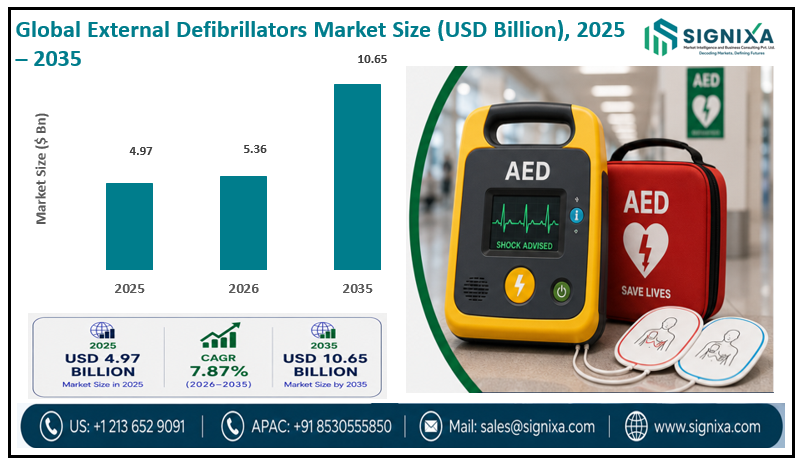
The size of the global external defibrillators market was worth around USD 4.97 Billion in 2025 and is predicted to grow to around USD 10.65 Billion by 2035, with a compound annual growth rate (CAGR) of roughly 7.87% between 2026 and 2035. The report analyzes the external defibrillators market’s drivers and restraints, as well as the impact they have on demand throughout the projection period. In addition, the report examines global opportunities in the external defibrillators market.
The external defibrillators market includes devices used to deliver therapeutic electric shocks to restore a normal heart rhythm in individuals suffering from sudden cardiac arrest (SCA). These devices are widely used in hospitals, ambulances, public spaces, and homes. Increasing awareness about cardiac health, rising prevalence of cardiovascular diseases, and growing adoption of public access defibrillation programs are major factors driving market growth. The integration of advanced technologies in defibrillator design and increased availability of wearable devices have further expanded the market’s scope.
The external defibrillators market has been experiencing consistent growth, primarily driven by the global rise in cardiovascular disorders and sudden cardiac arrest (SCA) cases. These devices are critical in restoring normal heart rhythm by delivering a therapeutic dose of electrical energy to the heart during life-threatening arrhythmias or ventricular fibrillation. Increased awareness about early cardiac arrest intervention has led to wider deployment of external defibrillators in public places, hospitals, schools, airports, and sports arenas. Automated External Defibrillators (AEDs), which can be operated by non-medical personnel, are particularly gaining popularity due to their ease of use, pre-recorded voice guidance, and minimal training requirements. Several government and non-profit initiatives are focused on increasing the availability of AEDs and training laypeople in cardiopulmonary resuscitation (CPR) and defibrillation techniques, promoting a more prepared public response. Additionally, the evolution of smart, portable, and connected defibrillator units integrated with IoT capabilities is supporting remote diagnostics and performance tracking. These smart devices are not only aiding in quicker response times but also providing valuable insights into usage data and maintenance status. The increasing emphasis on out-of-hospital cardiac care, coupled with improvements in EMS (emergency medical services) infrastructure, is further stimulating the demand for external defibrillators. As a result, defibrillation is transitioning from being a hospital-exclusive procedure to a critical public health intervention tool.
Innovation and user-centric design have become defining elements of the external defibrillators market, as manufacturers prioritize both efficacy and accessibility. With growing emphasis on preventative care and first-response readiness, modern external defibrillators are being developed with features that enhance user confidence, even in high-stress environments. These include real-time feedback on chest compression quality, automatic shock delivery algorithms, bilingual audio prompts, and visual indicators for device readiness. The design philosophy is centred around reducing hesitation and improving survival chances during the initial minutes of a cardiac event. In parallel, companies are investing in lightweight and weather-resistant models suited for deployment in diverse environments from industrial sites and schools to airplanes and cruise ships. These design considerations are important as defibrillators are increasingly embedded in broader workplace safety protocols and community health programs. Furthermore, partnerships between device manufacturers and health organizations are enabling subscription-based defibrillator programs that include device leasing, cloud-based data management, and periodic training sessions. Regulatory bodies are also updating guidelines to reflect the importance of accessible and regularly maintained defibrillation equipment in both public and private settings. With the convergence of public health awareness, technical refinement, and policy support, the external defibrillators market is poised to continue its shift toward becoming a standard component of emergency preparedness infrastructure worldwide.
Key Findings
- The global external defibrillators market is estimated to grow annually at a CAGR of around 7.87% over the forecast period (2026–2035).
- The market size was valued at around USD 4.97 Billion in 2025 and is projected to reach USD 10.65 Billion by 2035.
- The market is projected to grow steadily due to increasing cardiovascular health awareness and advancements in emergency response systems.
- Based on Product Type, the Automated External Defibrillators (AEDs) segment is projected to dominate, holding over 45% of global market share in 2025.
- Wearable Cardioverter Defibrillators (WCDs) contributed nearly 25% of the market in 2025, a rapidly growing niche.
- On the basis of End-use, the Hospital segment holds the largest market share at over 35% in 2025.
- By Region, North America is projected to lead the global market during the forecast period.
External Defibrillators Market Dynamics
Escalating SCA Prevalence & Public Access Defibrillation Program Expansion
The growing prevalence of cardiovascular diseases, particularly sudden cardiac arrest, is a major driver for the external defibrillators market. According to the American Heart Association, over 356,000 out-of-hospital cardiac arrests occur annually in the United States alone, with a survival rate of less than 12%. Early defibrillation has proven to significantly increase survival rates, thus prompting widespread adoption of defibrillators in both medical and non-medical settings. The expansion of public access defibrillation programs is also a key factor supporting market growth. Governments and non-profit organizations are increasingly placing automated external defibrillators (AEDs) in schools, airports, malls, and stadiums. These initiatives aim to empower bystanders to respond to emergencies before professional help arrives. This widespread availability, combined with user-friendly interfaces and voice prompts in AEDs, is driving adoption among the general population.
The escalating prevalence of sudden cardiac arrest (SCA) cases worldwide is one of the most significant drivers influencing the external defibrillators market. SCA can occur without prior symptoms, often in public or out-of-hospital environments, making timely defibrillation crucial to survival. External defibrillators particularly automated external defibrillators (AEDs) are designed to respond effectively in such emergencies by restoring normal cardiac rhythm within minutes. Numerous studies have confirmed that survival rates can more than double with early defibrillation, pushing public and private entities to prioritize AED installations. Governments in countries such as the United States, Japan, Germany, and Australia are implementing policies that encourage widespread AED availability in public places, including malls, schools, fitness centers, and transportation hubs. Furthermore, employer-led health and safety initiatives are incorporating AEDs into standard workplace safety equipment, especially in high-risk industries. As awareness about SCA grows through educational campaigns, both communities and individuals are taking proactive steps to make defibrillation more accessible. Social initiatives, like crowdfunding to install AEDs in rural areas, are also on the rise. In parallel, healthcare systems are reinforcing their emergency medical response capabilities by integrating defibrillator training into CPR courses. These combined factors are significantly amplifying the global reach and everyday importance of external defibrillators, making them essential tools in preventive emergency healthcare strategies.
Smart Device Technology, IoT Connectivity & Digital Transformation of Emergency Response
Technological advancement is a key dynamic shaping the external defibrillators market, with manufacturers embedding smart features into newer models to improve usability, reliability, and post-event analysis. Today’s external defibrillators are not limited to just shock delivery; they come equipped with real-time CPR feedback, heart rhythm assessment algorithms, automated prompts, and wireless data transfer systems. These upgrades enhance device performance while simultaneously increasing operator confidence particularly among non-medical personnel. Connectivity features such as Bluetooth, cloud integration, and GPS-based tracking allow centralized monitoring of AED deployment, usage history, battery status, and electrode condition. This is particularly beneficial for fleet management in corporate buildings, transportation networks, and healthcare institutions that operate multiple units across large facilities. The ability to remotely track defibrillator readiness and ensure timely maintenance is a major step toward reducing device failure risks during emergencies. Additionally, integration with emergency services and first-responder apps is improving coordination, enabling faster location-based assistance. Mobile applications that guide users through CPR and defibrillation further elevate the impact of these devices in saving lives outside clinical settings. As defibrillators become more intelligent and user-friendly, their value proposition extends beyond functionality to include operational efficiency and community empowerment. These digital transformations are helping reshape defibrillators into proactive public health solutions, rather than passive emergency tools.
Stringent Regulatory Frameworks Supporting External Defibrillator Adoption
Robust regulatory frameworks and standardized guidelines are playing a crucial role in shaping the external defibrillators market by ensuring product reliability, safety, and consistent performance. Regulatory agencies such as the U.S. Food and Drug Administration (FDA), European Medicines Agency (EMA), and Japan’s Pharmaceuticals and Medical Devices Agency (PMDA) impose strict requirements on manufacturers regarding clinical efficacy, quality control, and post-market surveillance. These regulations have prompted manufacturers to focus more on product validation, compliance, and durability during development, thereby fostering higher trust in external defibrillators. Recent updates in regulatory classifications—for instance, the FDA’s reclassification of AEDs as Class III medical devices reflect the growing recognition of their critical function in emergency medicine. Alongside these policies, global organizations such as the American Heart Association (AHA) and International Liaison Committee on Resuscitation (ILCOR) publish regularly updated resuscitation guidelines, encouraging consistency in defibrillator design and operation. Standardization of training modules and device interfaces has simplified the learning curve, making it easier for laypersons to administer defibrillation confidently. Furthermore, countries are mandating AED placement in high-traffic public zones and recommending device registration for better oversight. These legislative and policy frameworks not only drive safe innovation but also ensure that defibrillators are more uniformly accessible, user-friendly, and functionally dependable—resulting in higher deployment across varied geographies and demographics.
Public Training Initiatives Expanding External Defibrillator Adoption
Widespread education and awareness campaigns are key factors accelerating the adoption of external defibrillators, particularly among non-healthcare professionals. Governments, health organizations, and NGOs have launched numerous programs focused on training individuals in CPR and the use of AEDs, broadening the scope of first responders beyond traditional emergency personnel. These efforts are demystifying the technology, breaking down hesitation among laypersons, and reinforcing the idea that anyone can help save a life with basic guidance. Community-based first-aid initiatives, especially in developed countries, now often include AED training in school curriculums, workplace safety orientations, and public health outreach events. Online and app-based simulations also make AED training more accessible than ever before, especially in remote or underserved areas. Meanwhile, public signage and awareness posters are being used to familiarize people with AED locations and usage instructions in malls, stadiums, airports, and office buildings. This growing culture of preparedness is boosting the demand for user-friendly defibrillators that require minimal training. Manufacturers are responding with intuitive interfaces, voice-activated commands, and visual cues. As confidence in using AEDs increases among the general public, their deployment is expanding into homes and personal health kits. These awareness and education strategies are creating a more AED-literate population, ultimately improving community-wide emergency response readiness.
Cost & Logistical Barriers in LMIC Markets Constraining Universal Access
Despite the growing importance of external defibrillators, cost-related and logistical barriers continue to hinder their widespread adoption in low- and middle-income countries. The high upfront cost of AEDs and semi-automatic defibrillators, coupled with ongoing maintenance expenses such as battery and electrode replacement, can be prohibitive for healthcare facilities operating under constrained budgets. Moreover, public awareness in many emerging markets remains low, and emergency response infrastructure is often underdeveloped, reducing the perceived necessity of defibrillators in non-clinical settings. In some rural regions, a lack of electricity and trained personnel further limits usage potential. These challenges are prompting NGOs and health alliances to launch donation programs and subsidized deployment schemes to improve accessibility. Some manufacturers are also introducing cost-effective, compact models designed for resource-limited environments, focusing on battery life, durability, and simplified interfaces. Partnerships between international organizations and local governments are proving instrumental in establishing community-based AED stations and providing training to local volunteers. However, without stronger regulatory mandates and budgetary provisions, adoption in underserved regions will likely remain gradual. Bridging the affordability gap and addressing healthcare disparities will be essential for the global penetration of external defibrillators, particularly if the market is to fulfil its life-saving potential beyond urban centers and developed nations.
External Defibrillators Market Segmentation Analysis
By Product Type Segment Analysis
Manual External Defibrillators
Manual External Defibrillators are primarily used by healthcare professionals in hospitals and ambulances. These devices require clinical expertise to interpret ECG readings and determine when and how to administer a shock. Despite their limited use in public settings, manual defibrillators continue to hold a strong position in hospital emergency departments due to their reliability and precision.
Automated External Defibrillators
Automated External Defibrillators (AEDs) are the most widely used segment in public access programs due to their ease of use, portability, and cost-effectiveness. These devices guide users through the resuscitation process with visual and voice prompts. In 2025, the AED segment held over 45% of the global market share, bolstered by government mandates requiring AED installations in public venues, corporate offices, and schools.
Wearable Cardioverter Defibrillators
Wearable Cardioverter Defibrillators (WCDs) represent a growing niche in the market, particularly for patients at risk of sudden cardiac death but not eligible for an implantable defibrillator. WCDs continuously monitor the heart rhythm and automatically deliver a shock when needed. In 2025, WCDs contributed nearly 25% of the market, supported by increased use in outpatient settings and among patients with temporary cardiac risks.
By End Use Segment Analysis
The external defibrillators market is segmented across five key end-use settings, each representing a distinct deployment context and user profile for defibrillation devices globally:
Hospital
Hospitals remain the largest end-use segment in the external defibrillators market. These facilities rely on manual and automated devices for in-hospital cardiac arrest response and surgical procedures. In 2025, hospitals accounted for over 35% of the global revenue, driven by increasing emergency department visits and rising investments in critical care infrastructure.
Pre-Hospital
The Pre-Hospital segment includes ambulances and emergency response teams. This segment is essential for out-of-hospital cardiac arrest interventions, often using manual and AED units. In 2025, pre-hospital settings captured about 20% of the market, with growth supported by expanded emergency medical services and improved paramedic training.
Public Access Market
The Public Access Market is experiencing rapid growth due to widespread deployment of AEDs in public spaces. In 2025, this segment made up around 18% of total market revenue. Mandates for AED installation in airports, train stations, gyms, and schools are major contributors to this trend, along with greater community awareness.
Alternate Care Market
Alternate care market settings, such as nursing homes and urgent care centers, are increasingly adopting defibrillators for non-hospitalized patients. These facilities accounted for nearly 15% of the market in 2025, driven by the aging population and higher prevalence of cardiac events in elderly patients. Long-term care facilities and assisted living communities represent a particularly high-priority deployment target for external defibrillators given that their resident population typically older adults with multiple cardiovascular comorbidities faces substantially elevated SCA risk relative to the general population, while the response time for external emergency services in reaching residents within these facilities can be longer than the critical window for effective defibrillation without on-site device availability.
Home Healthcare
Home Healthcare is a smaller but growing segment, contributing roughly 12% to the market in 2025. Patients with known heart conditions are increasingly using AEDs and WCDs at home to ensure rapid intervention in case of cardiac emergencies. The home healthcare segment's growth is driven by the increasing recognition that many cardiac arrests in high-risk patients occur at home where average EMS response times far exceed the narrow therapeutic window for effective defibrillation creating a compelling case for home AED placement among patients with documented arrhythmia risk. Wearable cardioverter defibrillators, which automatically detect and treat life-threatening arrhythmias without requiring any user action, are particularly valuable in the home setting for patients during the highest-risk periods following acute cardiac events.
Report Attributes & Market Scope
| Report Attribute | Details |
|---|---|
| Market Size Value in 2025 | USD 4.97 Billion |
| Market Size Value in 2035 | USD 10.65 Billion |
| CAGR (2026–2035) | 7.87% |
| Base Year Used for Estimation | 2025 |
| Historic Data | 2020 - 2025 |
| Forecast Period | 2026 - 2035 |
| Segments Covered – By Product |
|
| Segments Covered – By End Use |
|
| Regions Covered | North America, Europe, Asia Pacific, Latin America, Middle East and Africa |
| Major Countries Covered | U.S., Canada, Mexico, Germany, UK, France, Italy, Spain, Russia, China, Japan, South Korea, India, Southeast Asia Countries, Brazil, Argentina, GCC Countries, Turkey, Iran, Israel, South Africa, Egypt, Nigeria, etc. |
| Key Companies Profiled | Philips Healthcare, Zoll Medical Corporation, Medtronic plc, Nihon Kohden Corporation, Schiller AG, Stryker Corporation, Cardiac Science, CU Medical Systems, Defibtech LLC, and Asahi Kasei Corporation. |
External Defibrillators Market Regional Analysis
North America dominates the global external defibrillators market due to high healthcare expenditure, advanced medical infrastructure, and widespread public access initiatives. Europe is the second-largest market, driven by strong government initiatives and robust emergency response networks. Asia-Pacific is the fastest-growing region, propelled by increasing healthcare awareness and government investments in public health infrastructure. Latin America and the Middle East & Africa represent emerging markets with gradually increasing adoption.
North America (Leading Region)
North America dominates the global external defibrillators market due to high healthcare expenditure, advanced medical infrastructure, and widespread public access initiatives. The U.S. alone accounts for the majority of the region's share, supported by favorable reimbursement policies and training programs for AED use. The 2018 FDA reclassification of AEDs as Class III medical devices reflects the growing regulatory recognition of their critical function in emergency medicine. The American Heart Association and American Red Cross maintain robust national CPR and AED training programs that have created a broad base of defibrillation-competent citizens significantly increasing the probability that an AED bystander in a cardiac arrest situation will have received at least basic defibrillation training. Federal and state-level AED placement mandates covering schools, fitness facilities, and high-occupancy buildings have created substantial recurring demand as devices reach end-of-service life and require replacement.
Europe
Europe is the second-largest market, driven by strong government initiatives and robust emergency response networks. The European Resuscitation Council provides regularly updated resuscitation guidelines that influence device standards and training approaches across the continent. The region's aging population with a higher prevalence of cardiovascular disease compared to younger demographics creates sustained underlying demand for defibrillation capability across clinical and non-clinical settings. European countries with particularly strong public access defibrillation programs notably Germany, the Netherlands, Denmark, and the UK have achieved AED density levels that rival or exceed North American standards in major urban areas. The EU Medical Devices Regulation (MDR) framework ensures rigorous device safety and performance standards, while reimbursement structures in many European healthcare systems support hospital and emergency services defibrillator procurement.
Asia-Pacific (Fastest-Growing Region)
Asia-Pacific is the fastest-growing region, propelled by increasing healthcare awareness, expanding emergency medical services, and government investments in public health infrastructure. Countries like China, Japan, and India are witnessing higher adoption rates of AEDs and WCDs. Japan stands out as a global leader in public access defibrillation with one of the world's highest AED deployment densities per capita following aggressive government-backed programs and has demonstrated impressive cardiac arrest survival rate improvements attributable to widespread AED availability. China's large and growing middle class, rapidly expanding healthcare system, and government emphasis on improving cardiac emergency response are creating substantial demand growth. India represents a longer-term opportunity as healthcare infrastructure investment accelerates and awareness of cardiac emergency preparedness grows among both institutional purchasers and the general public.
Middle East & Africa
Latin America and the Middle East & Africa represent emerging markets, where adoption is gradually increasing due to improved healthcare infrastructure and international support for cardiac care programs. In the Middle East, GCC countries' significant healthcare investment programs and the high concentration of large international venues airports, sports stadiums, shopping malls with stringent safety requirements are driving AED deployment. Africa faces greater challenges due to healthcare resource constraints and limited emergency medical services infrastructure in many markets, but international health organization programs and partnerships are gradually establishing community-based AED programs in higher-population urban centers. As healthcare budgets expand and awareness of cardiac emergency preparedness grows through international public health campaigns, the region's adoption trajectory is expected to accelerate through the forecast period.
Latin America
Latin America represents an emerging market where adoption is gradually increasing due to improved healthcare infrastructure and international support for cardiac care programs. Brazil and Mexico lead regional demand, driven by their large populations, significant healthcare system investment, and growing awareness of cardiac emergency preparedness among both healthcare institutions and the general public. Brazil's expanding network of urgent care centers and growing emphasis on workplace safety are creating demand for AEDs in non-hospital settings. Several Latin American countries are developing AED placement regulations modeled on North American and European frameworks, which will provide a systematic commercial impetus for market growth as compliance deadlines approach and the regulatory environment for AED deployment becomes more clearly defined across the region's major healthcare markets.
Recent Developments in the External Defibrillators Market
-
2026
Stryker Corporation expanded its emergency cardiac care portfolio by enhancing connectivity features in its automated external defibrillators (AEDs), enabling faster device monitoring and improved emergency response readiness.
Philips Healthcare strengthened its resuscitation portfolio by expanding smart defibrillation technologies focused on improving ease of use, remote device management, and emergency preparedness.
Medtronic plc expanded its cardiac rhythm management innovations by integrating advanced digital technologies that support more effective emergency cardiac care and post-resuscitation monitoring.
-
2025
Shenzhen Mindray Bio-Medical Electronics Co., Ltd. expanded its AED portfolio with next-generation external defibrillators featuring simplified operation, faster shock delivery, and enhanced connectivity for public access and healthcare facilities.
ZOLL Medical Corporation introduced advanced AED solutions with upgraded real-time CPR feedback and cloud-based device management capabilities to improve survival outcomes in sudden cardiac arrest cases.
Nihon Kohden Corporation enhanced its external defibrillator product lineup with improved portability, intuitive operation, and advanced patient monitoring features for hospitals and emergency medical services.
External Defibrillators Market: Competitive Landscape
The global external defibrillators market features major players such as Philips Healthcare, Zoll Medical Corporation, Medtronic plc, Nihon Kohden Corporation, Schiller AG, Stryker Corporation, Cardiac Science, CU Medical Systems, Defibtech LLC, and Asahi Kasei Corporation. These companies compete on technological innovation, user-friendly design, product reliability, and geographic reach. As the demand for accessible and portable life-saving devices continues to grow, market participants are investing in R&D to offer improved models with better usability, connectivity, and patient safety features.
The competitive landscape is shaped by a combination of clinical credibility, regulatory compliance capability, geographic distribution reach, and software-enabled service differentiation. The shift toward connected AEDs with cloud-based fleet management platforms is creating new subscription revenue streams and long-term customer relationships that extend beyond the initial device sale transforming the competitive dynamic from a transactional equipment sale to an ongoing service relationship. Companies offering comprehensive programs that bundle device provision, maintenance monitoring, electrode and battery replacement, software updates, and regular CPR/AED training refreshers are achieving stronger customer retention and recurring revenue than competitors focused purely on device hardware sales. The increasing availability of lower-cost AED models from Asian manufacturers particularly from Chinese and Korean companies including Mindray and CU Medical is creating pricing pressure in the standard AED segment while premium manufacturers differentiate through advanced connectivity features, clinical validation data, and service program comprehensiveness.
Key Companies Profiled
- Philips Healthcare
- ZOLL Medical Corporation
- Medtronic plc
- Nihon Kohden Corporation
- Schiller AG
- Stryker Corporation
- Cardiac Science
- CU Medical Systems
- Defibtech LLC
- Asahi Kasei Corporation
- Baxter International Inc.
- BPL Medical Technologies
- AMI Italia S.r.l.
- Metsis Medikal
- Progetti S.r.l.
- Shenzhen Mindray Bio-Medical Electronics Co., Ltd.
- Instramed Indústria Médico Hospitalar Ltda.
Global External Defibrillators Market Segmentation Summary
By Product
- Manual External Defibrillators
- Automated External Defibrillators (AEDs)
- Wearable Cardioverter Defibrillators (WCDs)
By End Use
- Hospital
- Pre-Hospital (Ambulance & EMS)
- Public Access Market
- Alternate Care Market
- Home Healthcare
By Region
- North America
- U.S.
- Canada
- Mexico
- Europe
- Germany
- France
- UK
- Spain
- Italy
- Rest of Europe
- Asia-Pacific
- China
- Japan
- India
- Australia
- South Korea
- Southeast Asia
- Rest of Asia-Pacific
- Latin America
- Brazil
- Argentina
- Rest of Latin America
- The Middle East & Africa
- GCC Countries
- South Africa
- Rest of the Middle East & Africa
Frequently Asked Questions (FAQs) About the External Defibrillators Market
What is an External Defibrillator?
An external defibrillator is a life-saving medical device designed to deliver an electric shock to the heart during sudden cardiac arrest (SCA) to restore normal rhythm. It includes types such as manual defibrillators, automated external defibrillators (AEDs), and wearable cardioverter defibrillators (WCDs), and is used in hospitals, public areas, and home settings.
Which key factors will influence the External Defibrillators market growth over 2026–2035?
The global external defibrillators market is expected to grow due to the increasing prevalence of cardiovascular diseases, growing awareness about emergency cardiac care, advancements in defibrillator technology, and the expansion of public access defibrillation programs.
What will be the value of the External Defibrillators market during 2026–2035?
According to the study, the global external defibrillators market size was worth around USD 4.97 Billion in 2025 and is predicted to grow to around USD 10.65 Billion by 2035.
What will be the CAGR value of the External Defibrillators market during 2026–2035?
The CAGR value of the external defibrillators market is expected to be around 7.87% during 2026–2035, driven by the increasing prevalence of cardiac emergencies, expanding deployment of automated external defibrillators (AEDs).
Which region will contribute notably towards the External Defibrillators market value?
The global external defibrillators market is led by North America, due to high awareness, supportive policies, and healthcare infrastructure, followed by Asia-Pacific, where rapid healthcare development and increasing cardiac incidences drive market adoption.
Which are the major players leveraging the External Defibrillators market growth?
The global external defibrillators market is led by players such as Medtronic plc, Philips Healthcare, Stryker Corporation, ZOLL Medical Corporation, Nihon Kohden Corporation, Asahi Kasei Corporation, Boston Scientific Corporation, LivaNova PLC, CU Medical Systems, and Shenzhen Mindray Bio-Medical Electronics Co., Ltd.
What can be expected from the global External Defibrillators market report?
The report explores crucial aspects of the external defibrillators market, including a detailed discussion of current growth drivers and restraints, while also analyzing future opportunities, regulatory influences, and technological innovations shaping the market outlook through 2035.