

EV Platform Market Overview
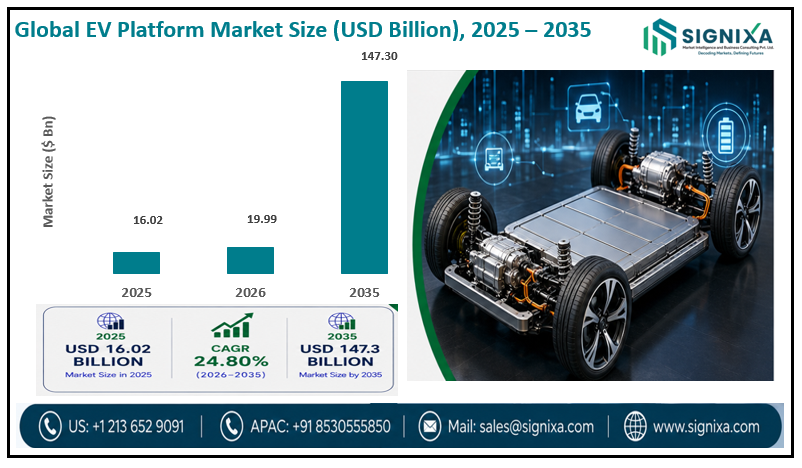
The global EV platform market was valued at USD 16.02 Billion in 2025 and is projected to grow to approximately USD 147.3 Billion by 2035, registering a compound annual growth rate (CAGR) of 24.80% from 2026 to 2035. The report analyzes the drivers, restraints, and impacts of the EV platform market's demand throughout the forecast period and provides insights into global opportunities.
The EV platform market includes specialized platforms designed for electric vehicles (EVs), which are essential in the development of next-generation EVs across various categories, including passenger vehicles, commercial vehicles, two-wheelers, and buses. These platforms are designed to integrate key components such as batteries, electric powertrains, and other EV-specific technologies, enabling automakers to streamline production processes. The rapid shift towards electric mobility, government incentives, and advancements in battery technology are driving the adoption of dedicated, flexible, and modular EV platforms, boosting the overall market growth.
The EV platform market is a foundational and rapidly expanding segment within the automotive industry, undergoing a significant transformation driven by the accelerating global shift towards electric vehicles and the inherent advantages of dedicated EV architectures over modified internal combustion engine (ICE) platforms. An EV platform is essentially the base structure of an electric vehicle, comprising the chassis, battery pack, electric motors, power electronics, and control systems. Unlike traditional ICE vehicles where the powertrain dictates much of the design, dedicated EV platforms (often referred to as "skateboard" platforms) are designed from the ground up to optimize for electric propulsion. This allows for superior battery packaging, leading to greater energy density, longer range, and a lower center of gravity for improved handling. The modularity and scalability inherent in these platforms enable automakers to develop multiple vehicle models from sedans and SUVs to trucks using a common foundation, significantly reducing R&D costs and accelerating time-to-market. This strategic shift is crucial for automakers aiming to scale EV production efficiently and profitably.
A significant market dynamic shaping the EV platform landscape is the intense focus on cost reduction through economies of scale and advanced manufacturing techniques. Building a dedicated EV platform requires substantial upfront investment, but the ability to share components and engineering across a wide range of models allows manufacturers to achieve significant cost savings in the long run. This is a critical factor for achieving price parity with ICE vehicles and driving mass-market adoption of EVs. Trends like "gigacasting" large-scale die-casting to produce fewer, larger body parts are emerging as ways to simplify manufacturing processes, reduce assembly time, and lower production costs. Furthermore, there's a growing emphasis on optimizing battery integration within the platform, not just for energy density but also for structural integrity and thermal management, which directly impacts safety and performance. The drive to reduce weight through innovative material science (e.g., lightweight alloys, composites) while maintaining structural rigidity and crashworthiness is another key aspect of platform development, aiming to maximize range and efficiency.
However, the EV platform market also faces notable challenges, primarily related to the immense capital investment required, the complexity of managing global supply chains, and the rapid evolution of battery technology. Developing a new dedicated EV platform is a multi-billion-dollar endeavor, representing a significant financial commitment for automakers. This high barrier to entry can make it difficult for smaller players to compete without strategic partnerships or substantial external funding. Moreover, the increasing demand for critical raw materials for batteries (like lithium, cobalt, nickel) and advanced semiconductors puts pressure on global supply chains, leading to potential shortages and price volatility. Automakers must carefully navigate these complexities to ensure a stable and cost-effective supply. Lastly, the rapid advancements in battery chemistries and energy storage solutions mean that platforms must be designed with a degree of future-proofing to accommodate new battery technologies without requiring a complete overhaul. Balancing long-term flexibility with current technological capabilities is a constant challenge for platform developers.
Key Findings
- The global EV platform market is projected to expand at a CAGR of 24.80%, reaching USD 147.3 Billion by 2035, up from USD 16.02 Billion in 2025.
- Dedicated EV platforms are expected to lead the market due to their optimized design for electric drivetrains and batteries.
- Passenger vehicles will dominate the vehicle segment, as the shift to EVs continues to gain momentum in personal transportation.
- Lithium-Ion batteries are the most common battery type used, driving the market for EV platforms.
EV Platform Market Dynamics
Growing Demand for Electric Vehicles
The growing demand for electric vehicles is a key driver for the EV platform market, driven by the global push for sustainable transportation solutions. Governments worldwide are offering incentives to promote EV adoption, and manufacturers are increasingly focusing on electric mobility to meet stricter environmental regulations. The market for EV platforms is also influenced by the continuous improvement in battery technologies, particularly in energy density and charging speeds, which enhances EV performance and reduces costs.
Shift Toward Versatile, Flexible & Modular Platforms
Another dynamic shaping the market is the shift towards more versatile EV platforms, such as flexible and modular platforms. These platforms enable manufacturers to produce various vehicle types on a single platform, reducing production costs and lead times. Modular platforms, in particular, offer the flexibility to accommodate different body types and vehicle classes, allowing manufacturers to efficiently scale production based on market demand. Technological advancements, such as solid-state batteries, also promise to enhance the energy efficiency and safety of EVs, further driving the adoption of dedicated and flexible EV platforms.
Dedicated EV Architectures Reshape Automotive Design
The EV platform market is a foundational and rapidly expanding segment within the automotive industry, undergoing a significant transformation driven by the accelerating global shift towards electric vehicles and the inherent advantages of dedicated EV architectures over modified internal combustion engine (ICE) platforms. An EV platform is essentially the base structure of an electric vehicle, comprising the chassis, battery pack, electric motors, power electronics, and control systems. Unlike traditional ICE vehicles where the powertrain dictates much of the design, dedicated EV platforms (often referred to as "skateboard" platforms) are designed from the ground up to optimize for electric propulsion. This allows for superior battery packaging, leading to greater energy density, longer range, and a lower centre of gravity for improved handling and safety. The modularity and scalability inherent in these platforms enable automakers to develop multiple vehicle models from sedans and SUVs to trucks and commercial vehicles using a common foundation. This significantly reduces R&D costs, accelerates time-to-market for new models, and is crucial for automakers aiming to scale EV production efficiently and profitably in a highly competitive landscape.
Cost Reduction Through Economies of Scale & Advanced Manufacturing
A significant market dynamic shaping the EV platform landscape is the intense focus on cost reduction through economies of scale, shared architectures, and advanced manufacturing techniques. Building a dedicated EV platform requires substantial upfront investment, but the ability to share components and engineering across a wide range of models allows manufacturers to achieve significant cost savings in the long run. This platform-sharing strategy is critical for achieving price parity with ICE vehicles and driving mass-market adoption of EVs. Advanced manufacturing processes, such as "gigacasting" large-scale die-casting to produce fewer, larger body parts are emerging as ways to simplify manufacturing processes, reduce assembly time, and lower production costs per vehicle. Furthermore, there's a relentless drive to optimize battery integration within the platform, not just for energy density and range but also for structural integrity (e.g., cell-to-pack, cell-to-chassis designs) and thermal management, which directly impacts safety, charging speed, and overall performance. The continuous innovation in lightweight materials and structural design is also a key aspect, aiming to maximize range and efficiency while maintaining rigidity and crashworthiness.
Capital Investment, Supply Chain & Technology Evolution Challenges
The EV platform market also faces notable challenges, primarily related to the immense capital investment required, the complexity of managing global supply chains, and the rapid evolution of battery and software technologies. Developing a new dedicated EV platform is a multi-billion-dollar endeavor, representing a significant financial commitment for automakers, which can be a high barrier to entry for smaller players without strategic partnerships. The increasing global demand for critical raw materials for batteries (like lithium, cobalt, nickel) and advanced semiconductors creates pressure on supply chains, leading to potential shortages and price volatility that directly impact platform production costs. Moreover, the rapid advancements in battery chemistries (e.g., solid-state batteries, LFP) and energy storage solutions mean that platforms must be designed with a degree of future-proofing to accommodate new battery technologies without requiring a complete overhaul. The increasing shift towards "software-defined vehicles" also means EV platforms must be designed with robust electrical/electronic architectures to support advanced driver-assistance systems (ADAS), autonomous driving capabilities, and over-the-air (OTA) updates, adding another layer of complexity and cost to platform development.
EV Platform Market Segmentation Analysis
By Platform Type Segment Analysis
Dedicated EV Platform
Dedicated EV Platform is designed specifically for electric vehicles, with all components (battery pack, electric motor, etc.) optimized for EV performance. These platforms are expected to dominate the market due to their efficiency and long-term benefits in EV production. Dedicated platforms ensure a higher degree of integration, leading to better vehicle performance and range. As per recent data, dedicated platforms will hold a market share of over 55% by 2035.
Flexible Platform
Flexible platforms allow manufacturers to design both electric and internal combustion engine (ICE) vehicles using the same platform. The flexibility in design makes them a popular choice for manufacturers transitioning to electric vehicles. This platform type is growing steadily, contributing to around 25% of the EV platform market in 2025.
Modular Platform
Modular platforms provide flexibility to produce various types of vehicles, including sedans, SUVs, and crossovers, with different powertrains. These platforms offer cost-efficiency in production by sharing core components while allowing for customization of different body types. Modular platforms are expected to capture around 20% of the EV platform market by 2035.
By Vehicle Type Segment Analysis
Passenger Vehicles
Passenger vehicles will remain the largest segment of the EV platform market, driven by increased consumer demand for electric cars. The global passenger EV market is expected to account for over 60% of the total vehicle market share by 2035, fueled by factors such as rising environmental concerns, government policies, and the growing availability of EV models.
Commercial Vehicles
The demand for electric commercial vehicles, including trucks and delivery vans, is expected to grow as companies transition to electric fleets to reduce carbon footprints and lower operating costs. This segment is predicted to grow at a CAGR of 8% during the forecast period.Electric buses are being adopted worldwide for public transportation, driven by the need for eco-friendly and cost-effective solutions. This segment is forecasted to grow significantly, with electric buses making up a large portion of the commercial vehicle market.
Two-Wheelers
Electric two-wheelers, including motorcycles and scooters, are gaining popularity in markets like Asia-Pacific due to their lower cost of ownership and suitability for urban environments. The two-wheeler segment is projected to capture around 10% of the EV platform market by 2035.
By Battery Type Segment Analysis
Lithium-Ion Battery
Lithium-ion batteries remain the most widely used battery technology for electric vehicles, due to their high energy density, reliability, and relatively lower cost. This battery type is expected to hold the largest market share throughout the forecast period, contributing to over 80% of the EV platform market.
Solid State Battery
Solid-state batteries promise higher energy density, enhanced safety, and faster charging times compared to lithium-ion batteries. While still in the early stages of commercial adoption, this technology is expected to become a key player in the future EV platform market, accounting for around 10% of the market share by 2035.
Nickel Metal Hydride Battery
Nickel-metal hydride batteries are less common in newer EV platforms but are still used in some hybrid and electric vehicles due to their higher stability in extreme temperatures. This segment is expected to see slow growth, maintaining a smaller market share of about 5%.
By Charging Type Segment Analysis
Home Charging
Home charging solutions are the most convenient and affordable option for EV owners, and the demand for home charging infrastructure is growing, driven by increasing EV adoption. This segment is expected to hold a significant share of the charging market, growing at a CAGR of 7% over the forecast period.
Public Charging
The expansion of public charging networks is crucial for the widespread adoption of electric vehicles. Public charging stations will see rapid growth, particularly in urban areas, as governments and private companies invest in charging infrastructure to meet the demand for EVs.
Fast Charging
Fast charging solutions are essential for long-distance EV travel and are becoming increasingly important. With advancements in charging technology, fast-charging stations are expected to grow in number and adoption, making up about 15% of the total charging market by 2035.
Report Attributes & Market Scope
| Report Attribute | Details |
|---|---|
| Market Size Value in 2025 | USD 16.02 Billion |
| Market Size Value in 2035 | USD 147.34 Billion |
| CAGR (2026–2035) | 24.80% |
| Base Year Used for Estimation | 2025 |
| Historic Data | 2020 - 2025 |
| Forecast Period | 2026 - 2035 |
| Segments Covered – By Platform Type |
|
| Segments Covered – By Vehicle Type |
|
| Segments Covered – By Battery Type |
|
| Segments Covered – By Charging Type |
|
| Regions Covered | North America, Europe, Asia Pacific, Latin America, Middle East and Africa |
| Major Countries Covered | U.S., Canada, Mexico, Germany, UK, France, Italy, Spain, Russia, China, Japan, South Korea, India, Southeast Asia Countries, Brazil, Argentina, GCC Countries, Turkey, Iran, Israel, South Africa, Egypt, Nigeria, etc. |
| Key Companies Profiled | Tesla, Inc., BYD Company Limited, Volkswagen AG, Hyundai Motor Group, Rivian Automotive, Inc., General Motors Company, Ford Motor Company, Nissan Motor Corporation, Toyota Motor Corporation, and REE Automotive Ltd., among others. |
EV Platform Market Regional Analysis
The global EV platform market is experiencing growth across all regions. North America and Europe lead in terms of adoption due to strong regulatory frameworks supporting EV infrastructure and policies promoting sustainable transportation. The Asia-Pacific region is the fastest-growing market, driven by the increasing demand for electric vehicles in countries like China, India, and Japan. Latin America and the Middle East & Africa are emerging markets where EV platform adoption is gaining traction due to urbanization, infrastructure development, and the global shift toward sustainable energy solutions.
Asia-Pacific (Dominant Region)
The Asia Pacific region leads the global EV platform market in terms of sheer volume and rapid development, primarily driven by China's dominant position in EV manufacturing and sales. Chinese automakers like BYD are vertically integrated, often developing their own battery and platform technologies (e.g., e-Platform 3.0) to achieve unparalleled cost control and rapid deployment of diverse EV models. The region is characterized by a strong emphasis on scalable and cost-effective platforms to cater to the immense demand for affordable EVs across various segments, including compact cars, SUVs, and a booming electric two- and three-wheeler market. Countries like South Korea (with Hyundai's E-GMP platform) and Japan are also major players, focusing on high-performance platforms and advanced battery technologies. There's a significant trend towards "cell-to-pack" and "cell-to-chassis" battery integration, maximizing space utilization and structural integrity. Governments in the region are actively promoting EV adoption through subsidies and infrastructure development, which in turn fuels investment in advanced EV platform development and manufacturing capabilities, including novel production techniques like battery swapping systems.
North America
North America is a pivotal region in the global EV platform market, characterized by significant investment from established automotive giants and a dynamic ecosystem of EV startups. The transition to dedicated EV platforms is a strategic imperative for manufacturers like General Motors (GM) with its Ultium platform, Ford with its GE platform, and Tesla's integrated approach. These companies are heavily investing in developing highly modular and scalable architectures to underpin a diverse range of electric vehicles, from passenger cars to commercial trucks. The focus in North America is on achieving economies of scale, reducing manufacturing complexity through innovations like gigacasting, and localizing supply chains, especially for battery production, to qualify for government incentives like those offered under the Inflation Reduction Act in the U.S. Consumer demand in the region is increasingly diversifying beyond luxury EVs to more affordable and practical electric sedans, SUVs, and trucks, driving manufacturers to optimize platform costs while maintaining performance. The robust R&D landscape and the presence of tech companies also push for advanced software-defined vehicle capabilities deeply integrated into the platform architecture.
Europe
Europe's EV platform market is driven by stringent emission regulations, ambitious electrification targets set by the European Union, and a strong push for sustainable mobility. Traditional European automakers like Volkswagen (with its MEB and PPE platforms), Mercedes-Benz (with MMA and EVA platforms), and Stellantis (with STLA platforms) are rapidly transitioning their portfolios to dedicated EV architectures. The focus in Europe is heavily on modularity and scalability to support a wide array of vehicle segments, ensuring flexibility for diverse market demands. There's a significant emphasis on battery integration and thermal management within the platform design, driven by the need for long-range capabilities and fast charging. Regulatory frameworks, such as the EU's battery regulation, are also influencing platform development by mandating higher recycling efficiencies and promoting localized material sourcing and production. While the transition to EVs faces some short-term market speedbumps related to affordability and infrastructure, the long-term commitment to decarbonization ensures sustained investment in advanced EV platforms, particularly those designed for mass-market adoption and efficient production.
Middle East & Africa
The Middle East & Africa (MEA) EV platform market is in its nascent stages but is poised for significant growth, driven by ambitious economic diversification plans, growing environmental consciousness, and increasing investments in electric mobility. Countries in the Middle East, particularly the UAE and Saudi Arabia, are actively seeking to reduce their reliance on fossil fuels and are investing heavily in building new automotive manufacturing capabilities, including EV production plants. These initiatives often involve partnerships with international EV manufacturers and technology providers, leading to the adoption of established global EV platforms. For example, Saudi Arabia's Public Investment Fund is investing in Lucid Motors, which has its own EV platform. In Africa, while the market is less developed, there's a growing interest in EV assembly and component manufacturing, often focusing on more cost-effective or modular platforms suitable for diverse local conditions. Challenges include the relatively high upfront cost of EVs and the need for significant infrastructure development. However, as governments across the MEA region roll out supportive policies and incentives for EV adoption, the demand for underlying EV platform technologies is expected to accelerate, often through technology transfer or the establishment of local assembly lines.
Recent Developments in the EV Platform Market
-
2026
Volkswagen Group advanced its next-generation EV platform strategy through its joint venture with Rivian, accelerating the development of scalable software-defined vehicle platforms for future electric vehicles.
Rivian began production of its R2 electric SUV built on its midsize EV platform, supporting the company's expansion into more affordable electric vehicles while leveraging its next-generation platform architecture.
Ford Motor Company unveiled its Universal EV Platform, designed to support a new generation of affordable electric pickups, SUVs, hatchbacks, and commercial vehicles with simplified manufacturing and lower production costs.
BMW Group accelerated the rollout of its Neue Klasse EV platform, focusing on improved battery efficiency, software integration, and lightweight vehicle architecture for upcoming electric models.
-
2025
General Motors continued expanding its Ultium EV platform across multiple Chevrolet, GMC, Cadillac, and Buick electric models, strengthening its scalable architecture for high-volume EV production.
Hyundai Motor Group expanded vehicles based on its Electric-Global Modular Platform (E-GMP), enhancing fast-charging capabilities, driving range, and production efficiency for next-generation electric vehicles.
EV Platform Market: Competitive Landscape
The EV platform market is highly competitive, with key players such as Tesla, General Motors, Volkswagen Group, BYD, and Hyundai Motor Group leading the way in platform development. Companies are focusing on platform innovation, cost-reduction strategies, and expanding their EV offerings to capture a larger share of the growing market. Additionally, the market sees increasing investments in charging infrastructure, battery technologies, and platform modularity to meet the evolving needs of electric vehicle manufacturers and consumers.
Key Companies Profiled
- Tesla, Inc.
- BYD Company Limited
- Volkswagen AG
- Hyundai Motor Group
- Rivian Automotive, Inc.
- General Motors Company
- Ford Motor Company
- Nissan Motor Corporation
- Toyota Motor Corporation
- REE Automotive Ltd.
- Mercedes-Benz Group AG
- BMW AG
- Stellantis N.V.
- Honda Motor Co., Ltd.
- Geely Holding Group
- XPENG Inc.
- Lucid Group, Inc.
Global EV Platform Market Segmentation Summary
By Platform Type
- Dedicated EV Platform
- Flexible Platform
- Modular Platform
By Vehicle Type
- Passenger Vehicles
- Commercial Vehicles
- Two-Wheelers
By Battery Type
- Lithium-Ion Battery
- Solid-State Battery
- Nickel Metal Hydride Battery
By Charging Type
- Home Charging
- Public Charging
- Fast Charging
By Region
- North America
- U.S.
- Canada
- Mexico
- Europe
- Germany
- France
- UK
- Spain
- Italy
- Rest of Europe
- Asia-Pacific
- China
- Japan
- India
- Australia
- South Korea
- Southeast Asia
- Rest of Asia-Pacific
- Latin America
- Brazil
- Argentina
- Rest of Latin America
- The Middle East & Africa
- GCC Countries
- South Africa
- Rest of the Middle East & Africa
Frequently Asked Questions (FAQs) About the EV Platform Market
What is an EV Platform?
An EV platform is a standardized and modular chassis structure specifically designed to accommodate electric vehicles. It integrates components such as batteries, electric motors, and suspension systems into a unified architecture, enabling scalability, manufacturing efficiency, and flexibility across different vehicle models and brands.
Which key factors will influence the EV Platform market growth over 2026–2035?
Growth in the EV platform market will be driven by rising electric vehicle adoption, government incentives for EV production, cost efficiencies achieved through modular platforms, and automakers' strategic shift towards dedicated EV architectures to optimize performance, range, and design flexibility.
What will be the value of the EV Platform market during 2026–2035?
According to the study, the global EV Platform market size was valued at around USD 16.02 Billion in 2025 and is projected to reach approximately USD 147.3 Billion by 2035, reflecting significant industry transformation and investment.
What will be the CAGR value of the EV Platform market during 2026–2035?
The global EV Platform market is anticipated to expand at a compound annual growth rate (CAGR) of approximately 24.80% between 2026 and 2035, driven by rising electric vehicle adoption, increasing investments in dedicated EV architectures, and growing demand for scalable, lightweight vehicle platforms.
Which region will contribute notably towards the EV Platform market value?
Asia-Pacific is expected to dominate the EV Platform market, driven by strong production and sales in China, South Korea, and Japan. Europe and North America are also key contributors due to high EV penetration rates, strict emission norms, and major OEM activities.
Which are the major players leveraging the EV Platform market growth?
Key players in the global EV Platform market include Hyundai Motor Company, Volkswagen Group, Tesla Inc., BYD Company Ltd., Toyota Motor Corporation, Ford Motor Company, General Motors, and Rivian Automotive Inc.
What can be expected from the global EV Platform market report?
The report provides an in-depth analysis of the EV Platform market, covering major trends, platform designs (skateboard, modular, etc.), propulsion types, end-use vehicle categories, technological developments, regional insights, regulatory landscape, and strategic initiatives by leading manufacturers.