Global Electronic Grade Polysilicon Market Size, Share, Growth & Forecast 2026-2035

Market Research Report  |  Base Year: 2025  |  Forecast Period: 2026-2035

Market Size (2025)
USD 2.73 Bn
Market Size (2035)
USD 5.68 Bn
CAGR (2026–2035)
5.34%
Leading Region
Asia Pacific

Electronic Grade Polysilicon Market Overview

The size of the global Electronic Grade Polysilicon Market was valued at approximately USD 2.73 Billion in 2025 and is projected to reach around USD 5.68 Billion by 2035, growing at a compound annual growth rate (CAGR) of 5.34% from 2026 to 2035. The report analyzes the drivers and restraints influencing demand for high-purity polysilicon, particularly in the semiconductor and photovoltaic industries, and provides insights into future opportunities across major regions.

The electronic grade polysilicon market comprises ultra-high purity silicon used in manufacturing semiconductors, solar cells, and other electronics. Rising investments in semiconductor fabrication, growing demand for clean energy, and continued advancements in electronics are propelling market growth. This material plays a vital role in integrated circuit manufacturing and high-efficiency photovoltaic panels. Increased demand for 5G, IoT, and AI devices has made electronic-grade polysilicon essential to global supply chains.

The electronic grade polysilicon market is witnessing strong growth, driven primarily by increasing demand for high-performance semiconductors and the expansion of the global electronics and photovoltaic industries. Electronic grade polysilicon—characterized by its ultra-high purity (typically 99.9999999% or 9N)—serves as a critical raw material in the manufacture of semiconductor wafers used in microchips, transistors, memory devices, and integrated circuits. As data centres, smartphones, electric vehicles, and artificial intelligence systems proliferate, the need for faster, more energy-efficient chips are fuelling consumption of this specialty material. The U.S., China, South Korea, Japan, and Germany are key regions where major semiconductor manufacturers are ramping up capacity, creating robust demand for electronic grade polysilicon. Technological advancements in chemical vapour deposition (CVD) processes and purification techniques have helped improve production efficiency and yield. Strategic investments by leading players in expanding capacity and backward integration are reshaping the competitive landscape. Additionally, government support through subsidies and policies to localize semiconductor supply chains is further boosting market prospects.

Supply chain dynamics and purity standards play a crucial role in shaping the electronic grade polysilicon market. The material’s production is highly capital-intensive and concentrated among a few global players due to the complexity involved in maintaining ultra-high purity levels. Any contamination can compromise the performance of the semiconductor, making quality assurance and consistency vital. Market growth is also influenced by cyclical demand patterns in the semiconductor industry and geopolitical tensions affecting raw material trade. While China has rapidly expanded its domestic production capacity, trade restrictions and reliance on Western purification technologies pose constraints. At the same time, the U.S. and EU are pushing for semiconductor independence by investing in local polysilicon manufacturing capabilities. The transition toward advanced nodes in chip manufacturing (e.g., 5nm, 3nm) is further intensifying the requirement for extremely pure polysilicon. As industries such as automotive, healthcare, and telecommunications digitize rapidly, the electronic grade polysilicon market is expected to remain integral to the global tech ecosystem, supported by stable demand, strategic alliances, and continuous innovation in production technologies.

Key Findings

  • The global Electronic Grade Polysilicon market is expected to grow at a CAGR of 5.34% during the forecast period (2026–2035).
  • The market was valued at USD 2.73 Billion in 2025 and is projected to reach USD 5.68 Billion by 2035.
  • Monocrystalline silicon dominates the market due to its superior purity, exceptional electrical performance, and widespread use in advanced semiconductor manufacturing.
  • Semiconductor device manufacturing represents the leading application segment, driven by the rising demand for high-performance integrated circuits, memory chips, and consumer electronics.
  • Asia-Pacific holds the largest share of the global market, supported by extensive semiconductor fabrication capacity, strong government initiatives, and expanding solar photovoltaic production.
  • Consumer electronics continue to drive market growth owing to increasing demand for smartphones, laptops, AI-enabled devices, and IoT applications.
  • High-purity electronic-grade polysilicon is witnessing increasing demand as chip manufacturers transition toward smaller process nodes and advanced semiconductor technologies.
  • Investments in domestic semiconductor manufacturing across the U.S., China, South Korea, Japan, and Europe are accelerating the demand for electronic-grade polysilicon.
  • Technological advancements in wafer fabrication and growing adoption of AI, 5G, electric vehicles, and data centers are creating significant growth opportunities for the market.
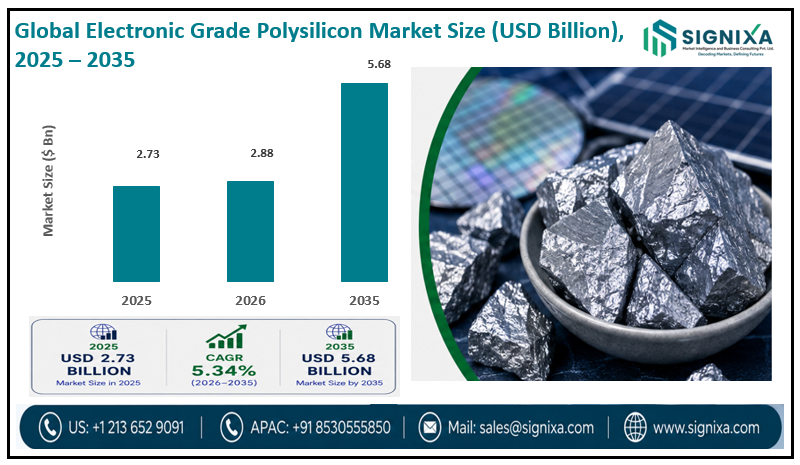
Image 1784124174

Electronic Grade Polysilicon Market Dynamics

Rising Demand from Semiconductor and Advanced Electronics Industry

The surge in demand for semiconductors across diverse industries such as consumer electronics, automotive, aerospace, and telecommunications is a fundamental driver for the electronic grade polysilicon market. This ultra-pure material is essential for fabricating semiconductor wafers used in microprocessors, memory chips, and integrated circuits. As global reliance on digital technologies intensifies—spanning cloud computing, AI, IoT devices, and autonomous systems—semiconductor consumption is rising sharply. Additionally, the growing sophistication of devices and the shift toward high-performance, energy-efficient chips require greater wafer precision and purity. Electronic grade polysilicon enables the production of wafers with minimal defects, ensuring reliability and durability in critical applications. The expansion of 5G infrastructure, wearable electronics, and high-speed computing is placing additional pressure on the supply of semiconductor-grade materials. Moreover, emerging trends like edge computing and machine learning are accelerating fab utilization rates, further increasing demand for polysilicon. Major foundries in the U.S., Taiwan, South Korea, and China are expanding their capacity, requiring consistent supplies of electronic grade polysilicon. With end-use sectors continuing to diversify, the need for high-purity feedstock will remain strong, securing the material’s relevance and growth within the semiconductor supply chain.

Growing Solar Photovoltaic Deployment Driving Polysilicon Consumption

The electronic grade polysilicon market is expanding steadily as semiconductors become more integral to global industries. The rollout of 5G networks, AI-based technologies, and edge computing has driven a surge in semiconductor device production. Electronic-grade polysilicon, with its superior purity, is a foundational material in wafer manufacturing. The miniaturization of components and demand for high-speed performance require materials that meet stringent quality standards, making electronic-grade polysilicon increasingly valuable. As nations accelerate renewable energy deployment, demand for high-purity silicon for monocrystalline solar cells is rising. Monocrystalline panels, which offer higher efficiency and performance in low-light conditions, heavily rely on electronic-grade polysilicon. Countries like China, India, and the U.S. are investing in solar capacity additions, increasing the consumption of electronic-grade polysilicon in solar cell production, particularly for utility-scale solar farms.

Technological Advancements in High-Purity Polysilicon Manufacturing

Significant strides in purification technologies are enhancing the quality and production efficiency of electronic grade polysilicon. Traditional processes such as Siemens deposition remain dominant but are now being complemented with innovations like fluidized bed reactors (FBRs), advanced distillation techniques, and closed-loop recycling of by-products. These advancements are enabling manufacturers to produce 9N or higher purity polysilicon with lower energy consumption and reduced emissions. Improved process control and automation are reducing contamination risks, which is critical given the stringent purity thresholds required for semiconductor-grade applications. Technological improvements are also allowing for better scalability and higher yields, which help stabilize pricing and meet the growing global demand. Furthermore, new developments in crystal growth and wafer slicing techniques are minimizing material loss, improving the overall value chain efficiency. Leading producers are investing in proprietary purification systems that offer a competitive edge in product consistency and cost-effectiveness. As chip manufacturers transition to smaller nodes (e.g., 5nm, 3nm), the requirement for defect-free silicon with ultra-low trace metals and dopants is intensifying. These technical standards are pushing polysilicon manufacturers to innovate continuously, making technological progression one of the most dynamic forces shaping the market’s long-term evolution.

Geopolitical Shifts and Supply Chain Regionalization Reshaping the Market

Geopolitical factors and trade tensions are reshaping the global supply chain for electronic grade polysilicon. Over the past decade, China has emerged as a significant producer, rapidly building capacity to reduce dependence on imports. However, Western countries—particularly the United States, Germany, and Japan—are now revaluating their supply strategies in light of increasing concerns over semiconductor self-sufficiency and national security. The U.S. CHIPS and Science Act, along with Europe’s semiconductor initiatives, are encouraging domestic production of critical raw materials, including polysilicon. This regionalization trend is creating a bifurcated market where supply chains are being localized to reduce vulnerability to trade restrictions, tariffs, and export controls. Moreover, countries are investing in vertically integrated facilities that cover raw material processing through to wafer production, strengthening end-to-end resilience. While regional competition increases, so does the opportunity for local players to enter the high-purity polysilicon space, especially in markets where policy and subsidies support infrastructure development. These supply chain shifts are also improving transparency, traceability, and quality control, all crucial factors in the semiconductor manufacturing process. Overall, the move toward regional self-reliance is shaping both the competitive landscape and the growth trajectory of the electronic grade polysilicon market.

High Capital Investment and Market Consolidation Pose Industry Challenges

Producing electronic grade polysilicon is highly capital-intensive, requiring advanced technology, cleanroom infrastructure, and stringent quality control systems. The high cost of entry limits competition, concentrating market power among a few global players with the technical expertise and financial strength to sustain operations. This has led to a consolidated market structure where companies like Hemlock Semiconductor, Wacker Chemie, and OCI dominate global supply. Smaller or new entrants often struggle to meet the ultra-high purity standards required for semiconductor-grade materials, creating high barriers to entry. Furthermore, the cyclical nature of the semiconductor industry adds financial risk, requiring manufacturers to balance capacity planning with demand fluctuations. Consolidation also allows major players to benefit from economies of scale and long-term supply agreements with leading wafer and chip manufacturers. This strategic integration provides price stability and ensures uninterrupted delivery, both of which are essential in high-precision manufacturing environments. However, market concentration poses challenges in terms of pricing power and supply chain flexibility. While consolidation supports technological leadership, it also necessitates regulatory oversight to avoid monopolistic practices. The capital intensity of the industry ensures that any disruption or expansion has ripple effects across the semiconductor ecosystem.

Sustainability Initiatives and Green Manufacturing Transforming the Industry

The electronic grade polysilicon market is increasingly influenced by environmental sustainability concerns. The traditional Siemens process, while effective in producing high-purity material, is energy-intensive and generates hazardous by-products such as silicon tetrachloride. With mounting pressure from governments, investors, and downstream clients to reduce carbon footprints, manufacturers are focusing on greener production techniques. Adoption of closed-loop recycling systems, renewable energy sources, and energy-efficient purification technologies is gaining traction across top producers. Companies are also pursuing sustainability certifications and lifecycle assessments to assure stakeholders of their environmental commitment. Additionally, semiconductor manufacturers—who form the primary customer base—are themselves under pressure to meet ESG goals, driving demand for responsibly produced raw materials. Innovations such as FBR-based polysilicon production offer a more sustainable alternative by reducing energy use and waste generation. Regulations related to carbon emissions, energy efficiency, and industrial waste management are likely to tighten in coming years, compelling the industry to adapt rapidly. These environmental pressures are not only risks but also opportunities for differentiation. Companies that align their operations with sustainability trends are more likely to attract long-term partnerships and investment, ensuring relevance in a market increasingly shaped by green mandates and responsible sourcing.

Electronic Grade Polysilicon Market Segmentation Analysis

By Type Segment Analysis

Monocrystalline silicon accounted for a significant share in 2025 and is expected to dominate through 2035 due to its use in high-performance electronics and solar panels. Monocrystalline silicon offers superior electrical properties and fewer defects, making it ideal for microprocessors and ICs. According to SEMI, global semiconductor wafer shipments reached 14,165 million square inches in 2023, up 5.2% year-on-year, reflecting rising demand for high-purity silicon.

Polysilicon, though less pure than monocrystalline, is widely used in less advanced electronics and solar PV applications. Its lower cost makes it suitable for applications where ultra-high purity is not critical. In 2023, global polysilicon production for electronics and solar reached approximately 950,000 metric tons, according to Bernreuter Research, with a growing portion dedicated to electronic-grade uses.

By Application Segment Analysis

Semiconductor devices represent the largest application segment in the electronic grade polysilicon market, driven by ongoing innovations in chips and ICs. High-purity polysilicon is essential for creating defect-free wafers used in consumer electronics, automotive systems, and industrial control units. According to IC Insights, the global semiconductor market surpassed USD 550 billion in 2023, indicating sustained demand for core materials like electronic-grade polysilicon.

Electronic products such as smartphones, laptops, and wearables also contribute significantly to polysilicon consumption. With over 1.3 billion smartphones shipped globally in 2023 (IDC), the need for reliable, high-performance materials in logic chips and displays supports market expansion. Furthermore, the solar cells segment is growing rapidly due to global decarbonization efforts. In 2023, over 300 GW of new solar capacity was added worldwide, as per IEA, with monocrystalline PV cells—largely dependent on electronic-grade polysilicon—being the dominant technology.

Report Attributes & Market Scope

Report Attribute Details
Market Size Value in 2025 USD 2.73 Billion
Market Size Value in 2035 USD 5.68 Billion
CAGR (2026–2035) 5.34%
Base Year Used for Estimation 2025
Historic Data 2020 - 2025
Forecast Period 2026 - 2035
Segments Covered – By Type
  • Monocrystalline Silicon
  • Polysilicon
Segments Covered – By Application
  • Semiconductor Devices
  • Electronic Products
  • Solar Cells
  • Others
Regions Covered North America, Europe, Asia Pacific, Latin America, Middle East and Africa
Major Countries Covered U.S., Canada, Mexico, Germany, UK, France, Italy, Spain, Russia, China, Japan, South Korea, India, Southeast Asia Countries, Brazil, Argentina, GCC Countries, Turkey, Iran, Israel, South Africa, Egypt, Nigeria, etc.
Key Companies Profiled Wacker Chemie AG, Hemlock Semiconductor, REC Silicon, Tokuyama Corporation, OCI Company Ltd., Mitsubishi Materials Corporation, GCL-Poly Energy Holdings Ltd., and Xinte Energy Co. Ltd, among others.

Electronic Grade Polysilicon Market Regional Analysis

Asia-Pacific dominates the global electronic grade polysilicon market due to the presence of major semiconductor fabrication hubs in China, South Korea, Taiwan, and Japan. China alone accounted for more than 50% of global polysilicon production capacity in 2023. Government subsidies and the push for domestic semiconductor capabilities further support market growth in the region. North America remains a significant market, driven by the U.S. CHIPS Act and ongoing investments in domestic semiconductor manufacturing. Europe follows closely, with companies like Wacker Chemie AG investing in high-purity silicon production for solar and semiconductor applications.

Asia Pacific (Leading Region)

Asia Pacific dominates the global electronic grade polysilicon market in terms of both production and consumption. Countries such as China, South Korea, Japan, and Taiwan are home to some of the world’s largest semiconductor manufacturing hubs, making the region a critical centre for polysilicon demand. China, in particular, has aggressively scaled up domestic polysilicon capacity to support its national semiconductor agenda, reducing reliance on imports and gaining cost advantages. However, high-purity electronic-grade production remains concentrated among a few advanced players, especially in Japan and South Korea, where quality and consistency are critical. Taiwan’s growing foundry dominance, led by firms like TSMC, further boosts regional consumption. Governments across Asia Pacific are investing heavily in semiconductor ecosystems, offering subsidies and tax incentives for upstream materials such as polysilicon. Moreover, a highly integrated supply chain, skilled labour, and technological expertise give the region a significant competitive edge. With continued investments in AI chips, consumer electronics, and 5G infrastructure, the demand for reliable, ultra-pure electronic grade polysilicon is expected to grow exponentially. Asia Pacific will likely remain the global centre of gravity for both innovation and volume production in this segment for years to come.

Europe

Europe’s electronic grade polysilicon market is anchored by a strong base of specialty chemical firms and semiconductor wafer producers focused on quality, sustainability, and innovation. Countries like Germany and Norway play a central role in the region’s production landscape, with well-established manufacturing capabilities that meet ultra-high purity standards. European Union strategies for technological sovereignty have placed semiconductors and their raw materials under priority consideration, leading to increased funding for domestic polysilicon production. Leading players in the region are also investing in carbon-neutral manufacturing processes, aligning with the EU Green Deal. Europe's chip demand is further fuelled by its expanding automotive electronics and industrial automation sectors, which require highly reliable microchips and sensors. Additionally, collaborations between semiconductor fabs and polysilicon suppliers are strengthening internal supply chains. The region’s emphasis on research and quality certification ensures that its electronic grade polysilicon meets the stringent requirements of advanced node chip production. While not as large as Asia in terms of volume, Europe distinguishes itself through precision, reliability, and environmental leadership. As the continent pushes to reduce reliance on imports, its electronic grade polysilicon market is set for steady, innovation-led expansion over the next decade.

North America

North America remains a vital market for electronic grade polysilicon, driven by its robust semiconductor industry, strategic policy interventions, and established high-purity materials infrastructure. The United States, in particular, hosts major semiconductor manufacturers and wafer fabrication facilities that depend on a reliable domestic supply of ultra-pure polysilicon. Legislative support, including the CHIPS and Science Act, is aimed at revitalizing the domestic semiconductor supply chain, spurring investments in localized polysilicon production. Key producers in the region are upgrading capacity and embracing cleaner, energy-efficient production methods to meet both demand and environmental standards. The U.S. government is also tightening controls on exports of high-end chip-making materials to manage geopolitical risks, making domestic production even more crucial. Additionally, collaborations between polysilicon manufacturers and chip foundries are strengthening long-term supply agreements. As the region invests in advanced node chip production and AI hardware, the need for 9N and higher-grade polysilicon will grow substantially. With strong R&D capabilities, favourable policy environment, and a mature semiconductor ecosystem, North America is expected to witness stable, long-term demand growth for electronic grade polysilicon, while also positioning itself as a strategic counterweight to Asia’s manufacturing dominance.

Middle East and Africa

The Middle East & Africa (MEA) region is still in the nascent stage of developing its electronic grade polysilicon capabilities but holds significant long-term potential due to strategic investments and access to low-cost energy resources. Countries like Saudi Arabia and the United Arab Emirates are diversifying their economies by investing in advanced materials and semiconductor sectors as part of their Vision 2030 and industrialization initiatives. While current demand for electronic grade polysilicon is limited due to the absence of large-scale chip fabrication units, the region is making efforts to attract foreign direct investment in high-tech industries, including semiconductor manufacturing. The availability of abundant solar energy also provides a sustainable foundation for energy-intensive polysilicon production, especially as the industry shifts toward cleaner methods. Africa’s role is more indirect at this stage, focusing on supplying key raw materials like quartz and metals used in chip production. However, with digital transformation accelerating in emerging African economies, demand for semiconductors—and, by extension, polysilicon—is likely to rise gradually. While MEA currently plays a minor role in the global electronic grade polysilicon market, targeted industrial policy, energy advantages, and strategic alliances may position it as an emerging player in the future.

Recent Developments in the Electronic Grade Polysilicon Market

  • 2026

    SUMCO Corporation: Expanded investments in ultra-high-purity silicon wafer technologies to meet increasing requirements from AI, automotive, and high-performance computing applications.

    Shin-Etsu Chemical Co., Ltd.: Increased production capabilities for semiconductor-grade silicon materials to support next-generation chip manufacturing and advanced electronics.

    Hemlock Semiconductor: Continued modernization of its manufacturing facilities to improve production efficiency and strengthen the global supply of electronic-grade polysilicon.

  • 2025

    Wacker Chemie AG: Expanded its semiconductor-grade polysilicon purification capacity to support rising demand from advanced semiconductor manufacturing and AI-driven chip production.

    Tokuyama Corporation: Enhanced its electronic-grade polysilicon manufacturing process through advanced purification technologies, improving production efficiency and product quality for semiconductor applications.

    REC Silicon: Strengthened its supply of high-purity silicon materials to support the growing global demand for semiconductor wafers and advanced electronic devices.

Electronic Grade Polysilicon Market: Competitive Landscape

Leading companies in the electronic grade polysilicon market include Wacker Chemie AG, Hemlock Semiconductor, REC Silicon, Tokuyama Corporation, OCI Company Ltd., Mitsubishi Materials Corporation, GCL-Poly Energy Holdings Ltd., and Xinte Energy Co. Ltd. Competition centers around purity levels, pricing, supply chain integration, and capacity expansions. Companies are investing in process optimization and recycling technologies to reduce costs and environmental impact while enhancing silicon quality. As global demand for advanced electronics and renewable energy rises, market players are expanding production capacities and forming strategic partnerships to strengthen their position.

Key Companies Profiled

  • Wacker Chemie AG
  • Hemlock Semiconductor
  • REC Silicon
  • Tokuyama Corporation
  • OCI Company Ltd.
  • Mitsubishi Materials Corporation
  • GCL-Poly Energy Holdings Ltd.
  • Xinte Energy Co. Ltd.
  • Shin-Etsu Chemical Co., Ltd.
  • SUMCO Corporation
  • Asia Silicon (Qinghai) Co., Ltd.
  • Daqo New Energy Corp.
  • Yongxiang Co., Ltd. (Tongwei Group)
  • Hoshine Silicon Industry Co., Ltd.
  • Siltronic AG

Global Electronic Grade Polysilicon Market Segmentation Summary

By Type

  • Monocrystalline Silicon
  • Polysilicon

By Application

  • Semiconductor Devices
  • Electronic Products
  • Solar Cells
  • Others

By Region

  • North America
    • U.S.
    • Canada
    • Mexico
  • Europe
    • Germany
    • France
    • UK
    • Spain
    • Italy
    • Rest of Europe
  • Asia-Pacific
    • China
    • Japan
    • India
    • Australia
    • South Korea
    • Southeast Asia
    • Rest of Asia-Pacific
  • Latin America
    • Brazil
    • Argentina
    • Rest of Latin America
  • The Middle East & Africa
    • GCC Countries
    • South Africa
    • Rest of the Middle East & Africa

Frequently Asked Questions (FAQs) About the Electronic Grade Polysilicon Market

What is Electronic Grade Polysilicon?

Electronic grade polysilicon is an ultra-high-purity form of silicon used in manufacturing semiconductors and photovoltaic cells. It plays a crucial role in producing microchips, integrated circuits, and solar cells due to its superior electrical and structural properties.

Which key factors will influence the Electronic Grade Polysilicon Market growth over 2026–2035?

The global electronic grade polysilicon market is expected to grow due to increasing demand for high-performance semiconductors, expansion of the solar photovoltaic industry, advancements in electronics manufacturing, and rising investments in renewable energy infrastructure.

What will be the value of the Electronic Grade Polysilicon Market during 2026–2035?

The global Electronic Grade Polysilicon Market accounted for around USD 2.73 Billion in 2025 and is forecast to attain a value of approximately USD 5.68 Billion by 2035.

What will be the CAGR value of the Electronic Grade Polysilicon Market during 2026–2035?

The Electronic Grade Polysilicon Market is projected to grow at a CAGR of 5.34% during the forecast period of 2026–2035, driven by increasing semiconductor production, rising demand for AI and 5G technologies, and expanding investments in advanced chip manufacturing.

Which region will contribute notably towards the Electronic Grade Polysilicon Market value?

The global electronic grade polysilicon market is led by the Asia-Pacific region, followed by North America and Europe, due to strong semiconductor manufacturing bases, rising adoption of solar energy, and supportive government policies.

Which are the major players leveraging the Electronic Grade Polysilicon Market growth?

The global electronic grade polysilicon market is driven by major players such as Wacker Chemie AG, Hemlock Semiconductor, REC Silicon, Tokuyama Corporation, OCI Company Ltd., Mitsubishi Materials Corporation, GCL-Poly Energy Holdings Ltd., and Xinte Energy Co. Ltd.

What can be expected from the global Electronic Grade Polysilicon Market report?

The report provides an in-depth analysis of the electronic grade polysilicon market, including market trends, drivers, restraints, segment-wise performance, regional insights, recent developments, and the competitive landscape. It offers valuable insights for stakeholders to understand growth opportunities and strategic developments from 2026 to 2035.

Table of Content

1.      Introduction

a.      Report Description

b.      Purpose of the Report

c.       USP & Key Offerings

d.      Key Benefits for Stakeholders

e.      Report Scope

2.      Executive Summary

a.      Electronic Grade Polysilicon Market Snapshot

b.      Global Electronic Grade Polysilicon Market, Revenue (USD Million) and Volume (Kilo Tons), 2020 - 2035

3.      Electronic Grade Polysilicon Market – Industry Analysis

a.      Introduction

b.      Market Drivers

                                                              i.      Driving Factor 1 Analysis

                                                             ii.      Driving Factor 2 Analysis

                                                           iii.      Driving Factor 3 Analysis

c.       Market Restraints

                                                              i.      Restraining Factor 1 Analysis

                                                             ii.      Restraining Factor 2 Analysis

                                                           iii.      Restraining Factor 3 Analysis

d.      Growth Opportunities

                                                              i.      Opportunity 1

                                                             ii.      Opportunity 1

e.      Porter’s Five Forces Analysis

f.        Value Chain Analysis

g.      PESTEL Analysis

4.      Key Investment Pockets Analysis

a.      Electronic Grade Polysilicon Market Attractiveness Analysis, By Region

b.      Electronic Grade Polysilicon Market Attractiveness Analysis, By Type

c.       Electronic Grade Polysilicon Market Attractiveness Analysis, By Application

5.      Competitive Landscape

a.      Company Market Share Analysis – 2025

b.      Global Electronic Grade Polysilicon Market: Company Revenue Market Share, 2025

c.       Global Electronic Grade Polysilicon Market: Company Volume Market Share, 2025

d.      Strategic Developments

                                                              i.      Acquisitions & Mergers

                                                             ii.      New Product Launch

                                                           iii.      Regional Expansion

6.      Electronic Grade Polysilicon Market – By Type Segment Analysis

a.      Electronic Grade Polysilicon Market Overview, by Type Segment

b.      Electronic Grade Polysilicon Market Revenue Share, By Type, 2025 and 2035

c.       Electronic Grade Polysilicon Market Volume Share, By Type, 2025 and 2035

                                                              i.      Monocrystalline Silicon

                                                             ii.      Polysilicon

7.      Electronic Grade Polysilicon Market – By Application Segment Analysis

a.      Electronic Grade Polysilicon Market Overview, by Application Segment

b.      Electronic Grade Polysilicon Market Revenue Share, By Application, 2025 and 2035

c.       Electronic Grade Polysilicon Market Volume Share, By Application, 2025 and 2035

                                                              i.      Semiconductor Devices

                                                             ii.      Electronic Products

                                                           iii.      Solar Cells

                                                           iv.      Others

8.      Electronic Grade Polysilicon Market – Regional Analysis

a.      Electronic Grade Polysilicon Market Overview, by Region Segment

b.      Global Electronic Grade Polysilicon Market Revenue Share, By Region, 2025 and 2035

c.       Global Electronic Grade Polysilicon Market Volume Share, By Region, 2025 and 2035

d.      Regions

                                                              i.      Global Electronic Grade Polysilicon Market Revenue, By Region, 2020 - 2035 (USD Million)

                                                             ii.      Global Electronic Grade Polysilicon Market Volume, By Region, 2020 - 2035 (Kilo Tons)

e.      Type

                                                              i.      Global Electronic Grade Polysilicon Market Revenue, By Type, 2020 - 2035 (USD Million)

                                                             ii.      Global Electronic Grade Polysilicon Market Volume, By Type, 2020 - 2035 (Kilo Tons)

f.        Application

                                                              i.      Global Electronic Grade Polysilicon Market Revenue, By Application, 2020 - 2035 (USD Million)

                                                             ii.      Global Electronic Grade Polysilicon Market Volume, By Application, 2020 - 2035 (Kilo Tons)

9.      North America Electronic Grade Polysilicon Market – Country Analysis

a.      North America Electronic Grade Polysilicon Market Overview, by Country Segment

b.      North America Electronic Grade Polysilicon Market Revenue Share, By Country, 2025 and 2035

c.       North America Electronic Grade Polysilicon Market Volume Share, By Country, 2025 and 2035

d.      North America

                                                              i.      North America Electronic Grade Polysilicon Market Revenue, By Country, 2020 - 2035 (USD Million)

                                                             ii.      North America Electronic Grade Polysilicon Market Volume, By Country, 2020 - 2035 (Kilo Tons)

                                                           iii.      Type

1.      North America Electronic Grade Polysilicon Market Revenue, By Type, 2020 - 2035 (USD Million)

2.      North America Electronic Grade Polysilicon Market Volume, By Type, 2020 - 2035 (Kilo Tons)

                                                           iv.      Application

1.      North America Electronic Grade Polysilicon Market Revenue, By Application, 2020 - 2035 (USD Million)

2.      North America Electronic Grade Polysilicon Market Volume, By Application, 2020 - 2035 (Kilo Tons)

a.      U.S.

b.      Canada

c.       Mexico

10.  Europe Electronic Grade Polysilicon Market – Country Analysis

a.      Europe Electronic Grade Polysilicon Market Overview, by Country Segment

b.      Europe Electronic Grade Polysilicon Market Revenue Share, By Country, 2025 and 2035

c.       Europe

                                                              i.      Europe Electronic Grade Polysilicon Market Revenue, By Country, 2020 - 2035 (USD Million)

                                                             ii.      Europe Electronic Grade Polysilicon Market Volume, By Country, 2020 - 2035 (Kilo Tons)

                                                           iii.      Type

1.      Europe Electronic Grade Polysilicon Market Revenue, By Type, 2020 - 2035 (USD Million)

2.      Europe Electronic Grade Polysilicon Market Volume, By Type, 2020 - 2035 (Kilo Tons)

                                                           iv.      Application

1.      Europe Electronic Grade Polysilicon Market Revenue, By Application, 2020 - 2035 (USD Million)

2.      Europe Electronic Grade Polysilicon Market Volume, By Application, 2020 - 2035 (Kilo Tons)

a.      Germany

b.      France

c.       UK

d.      Italy

e.      Spain

f.        Russia

g.      Rest of Europe

11.  Asia Pacific Electronic Grade Polysilicon Market – Country Analysis

a.      Asia Pacific Electronic Grade Polysilicon Market Overview, by Country Segment

b.      Asia Pacific Electronic Grade Polysilicon Market Revenue Share, By Country, 2025 and 2035

c.       Asia Pacific

                                                              i.      Asia Pacific Electronic Grade Polysilicon Market Revenue, By Country, 2020 - 2035 (USD Million)

                                                             ii.      Asia Pacific Electronic Grade Polysilicon Market Volume, By Country, 2020 - 2035 (Kilo Tons)

                                                           iii.      Type

1.      Asia Pacific Electronic Grade Polysilicon Market Revenue, By Type, 2020 - 2035 (USD Million)

2.      Asia Pacific Electronic Grade Polysilicon Market Volume, By Type, 2020 - 2035 (Kilo Tons)

                                                           iv.      Application

1.      Asia Pacific Electronic Grade Polysilicon Market Revenue, By Application, 2020 - 2035 (USD Million)

2.      Asia Pacific Electronic Grade Polysilicon Market Volume, By Application, 2020 - 2035 (Kilo Tons)

a.      China

b.      Japan

c.       South Korea

d.      India

e.      Australia

f.        Southeast Asia

g.      Rest of Asia Pacific

12.  Latin America Electronic Grade Polysilicon Market – Country Analysis

a.      Latin America Electronic Grade Polysilicon Market Overview, by Country Segment

b.      Latin America Electronic Grade Polysilicon Market Revenue Share, By Country, 2025 and 2035

c.       Latin America

                                                              i.      Latin America Electronic Grade Polysilicon Market Revenue, By Country, 2020 - 2035 (USD Million)

                                                             ii.      Latin America Electronic Grade Polysilicon Market Volume, By Country, 2020 - 2035 (Kilo Tons)

                                                           iii.      Type

1.      Latin America Electronic Grade Polysilicon Market Revenue, By Type, 2020 - 2035 (USD Million)

2.      Latin America Electronic Grade Polysilicon Market Volume, By Type, 2020 - 2035 (Kilo Tons)

                                                           iv.      Application

1.      Latin America Electronic Grade Polysilicon Market Revenue, By Application, 2020 - 2035 (USD Million)

2.      Latin America Electronic Grade Polysilicon Market Volume, By Application, 2020 - 2035 (Kilo Tons)

a.      Brazil

b.      Argentina

c.       Rest of Latin America

13.  Middle East Electronic Grade Polysilicon Market – Country Analysis

a.      Middle East Electronic Grade Polysilicon Market Overview, by Country Segment

b.      Middle East Electronic Grade Polysilicon Market Revenue Share, By Country, 2025 and 2035

c.       Middle East

                                                              i.      Middle East Electronic Grade Polysilicon Market Revenue, By Country, 2020 - 2035 (USD Million)

                                                             ii.      Middle East Electronic Grade Polysilicon Market Volume, By Country, 2020 - 2035 (Kilo Tons)

                                                           iii.      Type

1.      Middle East Electronic Grade Polysilicon Market Revenue, By Type, 2020 - 2035 (USD Million)

2.      Middle East Electronic Grade Polysilicon Market Volume, By Type, 2020 - 2035 (Kilo Tons)

                                                           iv.      Application

1.      Middle East Electronic Grade Polysilicon Market Revenue, By Application, 2020 - 2035 (USD Million)

2.      Middle East Electronic Grade Polysilicon Market Volume, By Application, 2020 - 2035 (Kilo Tons)

a.      GCC Countries

b.      Israel

c.       Turkey

d.      Iran

e.      Rest of Middle East

14.  Africa Electronic Grade Polysilicon Market – Country Analysis

a.      Africa Electronic Grade Polysilicon Market Overview, by Country Segment

b.      Africa Electronic Grade Polysilicon Market Revenue Share, By Country, 2025 and 2035

c.       Africa

                                                              i.      Africa Electronic Grade Polysilicon Market Revenue, By Country, 2020 - 2035 (USD Million)

                                                             ii.      Africa Electronic Grade Polysilicon Market Volume, By Country, 2020 - 2035 (Kilo Tons)

                                                           iii.      Type

1.      Africa Electronic Grade Polysilicon Market Revenue, By Type, 2020 - 2035 (USD Million)

2.      Africa Electronic Grade Polysilicon Market Volume, By Type, 2020 - 2035 (Kilo Tons)

                                                           iv.      Application

1.      Africa Electronic Grade Polysilicon Market Revenue, By Application, 2020 - 2035 (USD Million)

2.      Africa Electronic Grade Polysilicon Market Volume, By Application, 2020 - 2035 (Kilo Tons)

a.      South Africa

b.      Egypt

c.       Nigeria

d.      Rest of Africa

15.  Company Profiles

a.      Wacker Chemie AG

                                                              i.      Company Overview

                                                             ii.      Product Portfolio

                                                           iii.      Financial Overview

                                                           iv.      Recent Developments

                                                             v.      Growth Strategy

                                                           vi.      SWOT Analysis

b.      Hemlock Semiconductor

                                                              i.      Company Overview

                                                             ii.      Product Portfolio

                                                           iii.      Financial Overview

                                                           iv.      Recent Developments

                                                             v.      Growth Strategy

                                                           vi.      SWOT Analysis

c.       REC Silicon

                                                              i.      Company Overview

                                                             ii.      Product Portfolio

                                                           iii.      Financial Overview

                                                           iv.      Recent Developments

                                                             v.      Growth Strategy

                                                           vi.      SWOT Analysis

d.      Tokuyama Corporation

                                                              i.      Company Overview

                                                             ii.      Product Portfolio

                                                           iii.      Financial Overview

                                                           iv.      Recent Developments

                                                             v.      Growth Strategy

                                                           vi.      SWOT Analysis

e.      OCI Company Ltd.

                                                              i.      Company Overview

                                                             ii.      Product Portfolio

                                                           iii.      Financial Overview

                                                           iv.      Recent Developments

                                                             v.      Growth Strategy

                                                           vi.      SWOT Analysis

f.        Mitsubishi Materials Corporation

                                                              i.      Company Overview

                                                             ii.      Product Portfolio

                                                           iii.      Financial Overview

                                                           iv.      Recent Developments

                                                             v.      Growth Strategy

                                                           vi.      SWOT Analysis

g.      GCL-Poly Energy Holdings Ltd.

                                                              i.      Company Overview

                                                             ii.      Product Portfolio

                                                           iii.      Financial Overview

                                                           iv.      Recent Developments

                                                             v.      Growth Strategy

                                                           vi.      SWOT Analysis

h.      Xinte Energy Co. Ltd

                                                              i.      Company Overview

                                                             ii.      Product Portfolio

                                                           iii.      Financial Overview

                                                           iv.      Recent Developments

                                                             v.      Growth Strategy

                                                           vi.      SWOT Analysis

i.        Others

                                                              i.      Company Overview

                                                             ii.      Product Portfolio

                                                           iii.      Financial Overview

                                                           iv.      Recent Developments

                                                             v.      Growth Strategy

                                                           vi.      SWOT Analysis

List of Figures

1.      Global Electronic Grade Polysilicon Market Revenue, Revenue (USD Million) and Volume (Kilo Tons), 2020 - 2035

2.      Competition Analysis 

3.      Porter’s Five Forces Analysis

4.      Value Chain Analysis

5.      PESTEL Analysis

6.      Electronic Grade Polysilicon Market Attractiveness Analysis, By Region

7.      Electronic Grade Polysilicon Market Attractiveness Analysis, By Type

8.      Electronic Grade Polysilicon Market Attractiveness Analysis, By Application           

9.      Company Revenue Share Analysis, 2025

10.  Electronic Grade Polysilicon Market – Company Revenue Market Share, 2025

11.  Electronic Grade Polysilicon Market – Company Volume Market Share, 2025

12.  Electronic Grade Polysilicon Market Revenue Share, By Type, 2025 and 2035

13.  Global Electronic Grade Polysilicon Market for Monocrystalline Silicon, Revenue (USD Million) and Volume (Kilo Tons), 2020 - 2035

14.  Global Electronic Grade Polysilicon Market for Polysilicon, Revenue (USD Million) and Volume (Kilo Tons), 2020 – 2035

15.  Electronic Grade Polysilicon Market Revenue Share, By Application, 2025 and 2035

16.  Global Electronic Grade Polysilicon Market for Semiconductor Devices, Revenue (USD Million) and Volume (Kilo Tons), 2020 - 2035

17.  Global Electronic Grade Polysilicon Market for Electronic Products, Revenue (USD Million) and Volume (Kilo Tons), 2020 – 2035

18.  Global Electronic Grade Polysilicon Market for Solar Cells, Revenue (USD Million) and Volume (Kilo Tons), 2020 – 2035

19.  Global Electronic Grade Polysilicon Market for Others, Revenue (USD Million) and Volume (Kilo Tons), 2020 – 2035

20.  Global Electronic Grade Polysilicon Market Revenue Share, By Region, 2025 and 2035

21.  Global Electronic Grade Polysilicon Market Volume Share, By Region, 2025 and 2035

22.  North America Electronic Grade Polysilicon Market Revenue Share, By Country, 2025 and 2035

23.  North America Electronic Grade Polysilicon Market Volume Share, By Country, 2025 and 2035

24.  Europe Electronic Grade Polysilicon Market Revenue Share, By Country, 2025 and 2035

25.  Europe Electronic Grade Polysilicon Market Volume Share, By Country, 2025 and 2035

26.  Asia Pacific Electronic Grade Polysilicon Market Revenue Share, By Country, 2025 and 2035

27.  Asia Pacific Electronic Grade Polysilicon Market Volume Share, By Country, 2025 and 2035

28.  Latin America Electronic Grade Polysilicon Market Revenue Share, By Country, 2025 and 2035

29.  Latin America Electronic Grade Polysilicon Market Volume Share, By Country, 2025 and 2035

30.  Middle East Electronic Grade Polysilicon Market Revenue Share, By Country, 2025 and 2035

31.  Middle East Electronic Grade Polysilicon Market Volume Share, By Country, 2025 and 2035

32.  Africa Electronic Grade Polysilicon Market Revenue Share, By Country, 2025 and 2035

33.  Africa Electronic Grade Polysilicon Market Volume Share, By Country, 2025 and 2035

34.  Growth Strategy

35.  SWOT Analysis

36.  Research Methodology


List of Tables

1.      Global Electronic Grade Polysilicon Market: Snapshot

2.      Drivers for the Electronic Grade Polysilicon Market: Impact Analysis

3.      Restraints for the Electronic Grade Polysilicon Market: Impact Analysis

4.      Global Electronic Grade Polysilicon Market Revenue, By Region, 2020 - 2026 (USD Million)

5.      Global Electronic Grade Polysilicon Market Volume, By Region, 2020 - 2026 (Kilo Tons)

6.      Global Electronic Grade Polysilicon Market Revenue, By Region, 2027 - 2035 (USD Million)

7.      Global Electronic Grade Polysilicon Market Volume, By Region, 2027 - 2035 (Kilo Tons)

8.      Global Electronic Grade Polysilicon Market Revenue, By Type, 2020 - 2026 (USD Million)

9.      Global Electronic Grade Polysilicon Market Volume, By Type, 2020 - 2026 (Kilo Tons)

10.  Global Electronic Grade Polysilicon Market Revenue, By Type, 2027 - 2035 (USD Million)

11.  Global Electronic Grade Polysilicon Market Volume, By Type, 2027 - 2035 (Kilo Tons)

12.  Global Electronic Grade Polysilicon Market Revenue, By Application, 2020 - 2026 (USD Million)

13.  Global Electronic Grade Polysilicon Market Volume, By Application, 2020 - 2026 (Kilo Tons)

14.  Global Electronic Grade Polysilicon Market Revenue, By Application, 2027 - 2035 (USD Million)

15.  Global Electronic Grade Polysilicon Market Volume, By Application, 2027 - 2035 (Kilo Tons)

16.  North America Electronic Grade Polysilicon Market Revenue, By Country, 2020 - 2026 (USD Million)

17.  North America Electronic Grade Polysilicon Market Volume, By Country, 2020 - 2026 (Kilo Tons)

18.  North America Electronic Grade Polysilicon Market Revenue, By Country, 2027 - 2035 (USD Million)

19.  North America Electronic Grade Polysilicon Market Volume, By Country, 2027 - 2035 (Kilo Tons)

20.  North America Electronic Grade Polysilicon Market Revenue, By Type, 2020 - 2026 (USD Million)

21.  North America Electronic Grade Polysilicon Market Volume, By Type, 2020 - 2026 (Kilo Tons)

22.  North America Electronic Grade Polysilicon Market Revenue, By Type, 2027 - 2035 (USD Million)

23.  North America Electronic Grade Polysilicon Market Volume, By Type, 2027 - 2035 (Kilo Tons)

24.  North America Electronic Grade Polysilicon Market Revenue, By Application, 2020 - 2026 (USD Million)

25.  North America Electronic Grade Polysilicon Market Volume, By Application, 2020 - 2026 (Kilo Tons)

26.  North America Electronic Grade Polysilicon Market Revenue, By Application, 2027 - 2035 (USD Million)

27.  North America Electronic Grade Polysilicon Market Volume, By Application, 2027 - 2035 (Kilo Tons)

28.  Europe Electronic Grade Polysilicon Market Revenue, By Country, 2020 - 2026 (USD Million)

29.  Europe Electronic Grade Polysilicon Market Volume, By Country, 2020 - 2026 (Kilo Tons)

30.  Europe Electronic Grade Polysilicon Market Revenue, By Country, 2027 - 2035 (USD Million)

31.  Europe Electronic Grade Polysilicon Market Volume, By Country, 2027 - 2035 (Kilo Tons)

32.  Europe Electronic Grade Polysilicon Market Revenue, By Type, 2020 - 2026 (USD Million)

33.  Europe Electronic Grade Polysilicon Market Volume, By Type, 2020 - 2026 (Kilo Tons)

34.  Europe Electronic Grade Polysilicon Market Revenue, By Type, 2027 - 2035 (USD Million)

35.  Europe Electronic Grade Polysilicon Market Volume, By Type, 2027 - 2035 (Kilo Tons)

36.  Europe Electronic Grade Polysilicon Market Revenue, By Application, 2020 - 2026 (USD Million)

37.  Europe Electronic Grade Polysilicon Market Volume, By Application, 2020 - 2026 (Kilo Tons)

38.  Europe Electronic Grade Polysilicon Market Revenue, By Application, 2027 - 2035 (USD Million)

39.  Europe Electronic Grade Polysilicon Market Volume, By Application, 2027 - 2035 (Kilo Tons)

40.  Asia Pacific Electronic Grade Polysilicon Market Revenue, By Country, 2020 - 2026 (USD Million)

41.  Asia Pacific Electronic Grade Polysilicon Market Volume, By Country, 2020 - 2026 (Kilo Tons)

42.  Asia Pacific Electronic Grade Polysilicon Market Revenue, By Country, 2027 - 2035 (USD Million)

43.  Asia Pacific Electronic Grade Polysilicon Market Volume, By Country, 2027 - 2035 (Kilo Tons)

44.  Asia Pacific Electronic Grade Polysilicon Market Revenue, By Type, 2020 - 2026 (USD Million)

45.  Asia Pacific Electronic Grade Polysilicon Market Volume, By Type, 2020 - 2026 (Kilo Tons)

46.  Asia Pacific Electronic Grade Polysilicon Market Revenue, By Type, 2027 - 2035 (USD Million)

47.  Asia Pacific Electronic Grade Polysilicon Market Volume, By Type, 2027 - 2035 (Kilo Tons)

48.  Asia Pacific Electronic Grade Polysilicon Market Revenue, By Application, 2020 - 2026 (USD Million)

49.  Asia Pacific Electronic Grade Polysilicon Market Volume, By Application, 2020 - 2026 (Kilo Tons)

50.  Asia Pacific Electronic Grade Polysilicon Market Revenue, By Application, 2027 - 2035 (USD Million)

51.  Asia Pacific Electronic Grade Polysilicon Market Volume, By Application, 2027 - 2035 (Kilo Tons)

52.  Latin America Electronic Grade Polysilicon Market Revenue, By Country, 2020 - 2026 (USD Million)

53.  Latin America Electronic Grade Polysilicon Market Volume, By Country, 2020 - 2026 (Kilo Tons)

54.  Latin America Electronic Grade Polysilicon Market Revenue, By Country, 2027 - 2035 (USD Million)

55.  Latin America Electronic Grade Polysilicon Market Volume, By Country, 2027 - 2035 (Kilo Tons)

56.  Latin America Electronic Grade Polysilicon Market Revenue, By Type, 2020 - 2026 (USD Million)

57.  Latin America Electronic Grade Polysilicon Market Volume, By Type, 2020 - 2026 (Kilo Tons)

58.  Latin America Electronic Grade Polysilicon Market Revenue, By Type, 2027 - 2035 (USD Million)

59.  Latin America Electronic Grade Polysilicon Market Volume, By Type, 2027 - 2035 (Kilo Tons)

60.  Latin America Electronic Grade Polysilicon Market Revenue, By Application, 2020 - 2026 (USD Million)

61.  Latin America Electronic Grade Polysilicon Market Volume, By Application, 2020 - 2026 (Kilo Tons)

62.  Latin America Electronic Grade Polysilicon Market Revenue, By Application, 2027 - 2035 (USD Million)

63.  Latin America Electronic Grade Polysilicon Market Volume, By Application, 2027 - 2035 (Kilo Tons)

64.  Middle East Electronic Grade Polysilicon Market Revenue, By Country, 2020 - 2026 (USD Million)

65.  Middle East Electronic Grade Polysilicon Market Volume, By Country, 2020 - 2026 (Kilo Tons)

66.  Middle East Electronic Grade Polysilicon Market Revenue, By Country, 2027 - 2035 (USD Million)

67.  Middle East Electronic Grade Polysilicon Market Volume, By Country, 2027 - 2035 (Kilo Tons)

68.  Middle East Electronic Grade Polysilicon Market Revenue, By Type, 2020 - 2026 (USD Million)

69.  Middle East Electronic Grade Polysilicon Market Volume, By Type, 2020 - 2026 (Kilo Tons)

70.  Middle East Electronic Grade Polysilicon Market Revenue, By Type, 2027 - 2035 (USD Million)

71.  Middle East Electronic Grade Polysilicon Market Volume, By Type, 2027 - 2035 (Kilo Tons)

72.  Middle East Electronic Grade Polysilicon Market Revenue, By Application, 2020 - 2026 (USD Million)

73.  Middle East Electronic Grade Polysilicon Market Volume, By Application, 2020 - 2026 (Kilo Tons)

74.  Middle East Electronic Grade Polysilicon Market Revenue, By Application, 2027 - 2035 (USD Million)

75.  Middle East Electronic Grade Polysilicon Market Volume, By Application, 2027 - 2035 (Kilo Tons)

76.  Africa Electronic Grade Polysilicon Market Revenue, By Country, 2020 - 2026 (USD Million)

77.  Africa Electronic Grade Polysilicon Market Volume, By Country, 2020 - 2026 (Kilo Tons)

78.  Africa Electronic Grade Polysilicon Market Revenue, By Country, 2027 - 2035 (USD Million)

79.  Africa Electronic Grade Polysilicon Market Volume, By Country, 2027 - 2035 (Kilo Tons)

80.  Africa Electronic Grade Polysilicon Market Revenue, By Type, 2020 - 2026 (USD Million)

81.  Africa Electronic Grade Polysilicon Market Volume, By Type, 2020 - 2026 (Kilo Tons)

82.  Africa Electronic Grade Polysilicon Market Revenue, By Type, 2027 - 2035 (USD Million)

83.  Africa Electronic Grade Polysilicon Market Volume, By Type, 2027 - 2035 (Kilo Tons)

84.  Africa Electronic Grade Polysilicon Market Revenue, By Application, 2020 - 2026 (USD Million)

85.  Africa Electronic Grade Polysilicon Market Volume, By Application, 2020 - 2026 (Kilo Tons)

86.  Africa Electronic Grade Polysilicon Market Revenue, By Application, 2027 - 2035 (USD Million)

87.  Africa Electronic Grade Polysilicon Market Volume, By Application, 2027 - 2035 (Kilo Tons)