

EV Grid Integration Solutions Market Overview
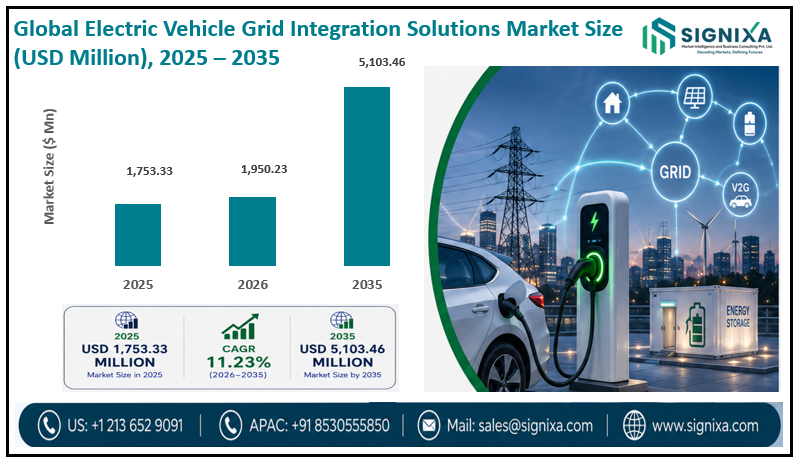
The size of the global Electric Vehicle (EV) Grid Integration Solutions market was worth around USD 1,753.33 Million in 2025 and is predicted to grow to around USD 5,103.46 Million by 2035, with a compound annual growth rate (CAGR) of roughly 11.23% between 2026 and 2035. The report analyzes the EV grid integration market's key drivers and challenges, while examining global opportunities across different solution types and user segments.
The EV Grid Integration Solutions market includes technologies and systems designed to integrate electric vehicles into the power grid effectively. This includes V2G (Vehicle-to-Grid) systems, smart charging, energy management tools, and advanced connectivity platforms. Growth is driven by the rising adoption of EVs globally and the need to balance grid stability and energy efficiency. With governments pushing for sustainable energy and transport systems, these solutions are becoming critical components in smart grid development.
The Electric Vehicle (EV) grid integration market is a rapidly expanding sector at the intersection of the automotive and energy industries, driven primarily by the accelerating global adoption of electric vehicles and the imperative to modernize existing electricity grids. As millions of EVs are deployed, they represent a significant new load on the grid, demanding intelligent management to prevent strain, particularly during peak charging times. Grid integration, therefore, refers to the suite of technologies, policies, and strategies that enable EVs to interact beneficially with the power system, optimizing charging and potentially even discharging energy back to the grid (Vehicle-to-Grid or V2G). This dynamic interaction is crucial for ensuring grid stability, reliability, and efficiency. Governments worldwide are providing significant policy support and incentives for EV adoption and smart grid development, further accelerating market growth.
A key dynamic shaping the EV grid integration market is the rapid evolution of smart charging and Vehicle-to-Grid (V2G) technologies. Smart charging solutions allow for the optimization of EV charging based on various factors such as electricity prices, grid conditions, and user preferences. This helps to shift demand away from peak hours, reducing stress on the grid and potentially lowering charging costs for EV owners. V2G technology represents an even more transformative aspect, enabling bidirectional energy flow where EVs can not only draw power from the grid but also supply excess energy back to it. This turns EVs into mobile energy storage units, capable of providing valuable grid services like peak shaving, load balancing, and frequency regulation. The development of advanced communication protocols (e.g., ISO 15118), sophisticated energy management software, and bidirectional chargers are critical enablers of V2G functionality.
However, the EV grid integration market faces several significant challenges that require concerted efforts from various stakeholders. One major hurdle is the need for substantial infrastructure upgrades to accommodate the increased and potentially volatile electricity demand from EV charging. Existing grid infrastructure, particularly at the distribution level, may not be designed to handle concentrated EV charging loads, leading to potential issues like voltage instability, transformer overloading, and power quality degradation. Another challenge is the complexity of developing harmonized regulatory frameworks, market mechanisms, and interoperability standards that can facilitate seamless EV-grid interaction across different regions and utility providers.
Key Findings
- The global EV Grid Integration Solutions market is projected to grow at a CAGR of 11.23% from 2026 to 2035.
- In 2025, the market size was valued at USD 1,753.33 Million and is anticipated to reach USD 5,103.46 Million by 2035.
- Demand for smart, sustainable charging infrastructure is accelerating market growth.
- Vehicle-to-Grid (V2G) Systems are emerging as the most transformative technology segment.
- Utility Companies and Fleet Operators are key end-users expected to dominate market share.
- Cloud-Based Connectivity is projected to grow significantly, driven by advancements in IoT and remote energy management.
- North America and Europe are leading regions, with Asia-Pacific showing the fastest growth rate.
EV Grid Integration Market Dynamics
Smart Grid Technology and EV Mandates Drive Market Growth
The market is being propelled by the rising demand for smart grid technology and electric vehicles. Governments globally are introducing mandates and incentives to promote EV adoption, which necessitates efficient charging and energy distribution systems. These solutions not only facilitate real-time monitoring and control but also ensure grid resilience by balancing loads during peak demand. As power grids modernize, the synergy between EVs and the grid is becoming essential.
Integrated Systems Combining Storage, Demand Response & IoT
Additionally, technological advancements are driving the adoption of integrated systems that combine energy storage, demand response, and IoT connectivity. The development of V2G and smart charging technologies is enabling two-way energy flow, improving load management, and helping utilities optimize energy distribution. As urban centers transition to smart cities, EV grid integration is expected to play a pivotal role in reducing emissions and achieving energy sustainability goals.
Accelerating EV Adoption and Renewable Energy Integration
The Electric Vehicle (EV) grid integration solution market is a burgeoning sector driven by the urgent need to manage the growing number of EVs and the imperative to modernize electricity grids for a sustainable future. The primary market dynamic is the accelerating global adoption of electric vehicles coupled with the increasing integration of renewable energy sources into the grid. As millions of EVs come online, they represent a significant, yet potentially flexible, new load on the power system. Without intelligent management, concentrated EV charging can strain existing grid infrastructure, particularly during peak hours, leading to potential instability, overloads, and power quality issues. Grid integration solutions, such as smart charging and Vehicle-to-Grid (V2G) technologies, are crucial for mitigating these challenges. They enable optimized charging schedules, allowing EVs to charge when renewable energy is abundant or electricity prices are low. Furthermore, V2G allows EVs to act as distributed energy storage, feeding power back to the grid during high demand or outages, thereby enhancing grid resilience and supporting the transition to a cleaner energy system.
Advances in Bidirectional Charging, Communication Protocols & AI
A second critical market dynamic is the rapid technological advancements in bidirectional charging infrastructure, communication protocols, and energy management software. The shift from basic unidirectional charging to sophisticated bidirectional capabilities is transforming EVs into active participants in the energy ecosystem. This involves the development of advanced power electronics within chargers and vehicles, capable of managing two-way energy flow. Communication standards, such as ISO 15118, are vital for enabling seamless data exchange between EVs, charging stations, and grid operators, allowing for real-time monitoring and control of charging and discharging processes. Furthermore, the integration of Artificial Intelligence (AI) and machine learning algorithms in energy management software is revolutionizing how EV charging is optimized, predicting charging demand, analyzing grid conditions, and dynamically adjusting charging/discharging schedules to maximize benefits for both EV owners and grid operators.
Regulatory Fragmentation, Infrastructure Investment & Consumer Acceptance
However, the EV grid integration solution market also faces significant challenges that impact its widespread deployment. One major hurdle is the complex and often fragmented regulatory landscape, alongside the need for substantial investment in grid infrastructure upgrades. The absence of harmonized policies and clear market mechanisms across different regions and utility jurisdictions can create uncertainty for solution providers and EV owners alike. For V2G specifically, the lack of standardized interconnection agreements, clear tariff structures that incentivize energy sharing, and regulatory frameworks for revenue generation from grid services are significant barriers. Another crucial challenge is consumer acceptance and addressing concerns about battery degradation. EV owners need compelling incentives and reassurance that participating in smart charging or V2G programs will not negatively impact their vehicle's battery health or range availability.
EV Grid Integration Solutions Market Segmentation Analysis
By Technology Segment Analysis
Vehicle-to-Grid (V2G) Systems are gaining traction due to their ability to send power from EVs back to the grid. According to NREL, integrating V2G can reduce peak grid load by up to 20% in EV-dense areas. Smart Charging Systems allow dynamic load management, and IEA data shows they can cut energy consumption per vehicle by up to 15%. Demand Response Solutions support utilities in balancing demand during peak hours, with GridWise Alliance estimating a 10-12% reduction in grid stress.
By End User Segment Analysis
Residential Users benefit from cost savings and grid services via home energy management integration. Report highlights that 40% of EV users are expected to adopt home-based grid solutions by 2035. Commercial Users, like malls and office complexes, install EV integration systems to manage energy consumption and peak-hour loads. Industrial Users use integration for cost-effective operations and enhanced power reliability. Utility Companies are the largest users of EV grid integration solutions, leveraging them for grid balancing and decentralized energy control. Fleet Operators are also major adopters; a 2023 Navigant report noted that 62% of commercial fleets are planning to implement V2G-compatible solutions by 2028.
By Connectivity Segment Analysis
Wired Connectivity ensures stable communication between EVs and the grid, commonly used in urban installations. Wireless Connectivity is gaining pace for ease of deployment and user convenience, especially in residential settings. Internet of Things (IoT) Solutions play a crucial role in enabling remote monitoring and real-time analytics; IoT-enabled charging stations are expected to grow at 14.7% CAGR through 2035. Cloud-Based Connectivity allows centralized control, scalability, and data integration across locations.
By Service Segment Analysis
Consulting Services help clients assess technical feasibility and ROI for grid integration projects. Installation Services are essential in deploying hardware and infrastructure, often supported by public-private partnerships. Maintenance Services ensure long-term operational efficiency, with predictive maintenance reducing system downtime by up to 30%, per GE Digital. Managed Services provide end-to-end solutions, allowing utilities and operators to outsource grid operations. Training and Support Services are vital to educating stakeholders, with utility companies investing in workforce training to handle EV-grid tech transitions.
By Charging Infrastructure Segment Analysis
Level 1 Charging Stations are basic residential units, primarily for overnight charging. Level 2 Charging Stations are widely used in public and commercial settings, enabling faster charging times. According to EVgo, Level 2 stations account for nearly 60% of public charging networks in North America. Fast Charging Stations provide rapid recharging and are essential for long-distance travel; they are growing at over 12% CAGR. Wireless Charging Stations offer convenience and are emerging in premium vehicle markets. Public Charging Stations are vital to large-scale EV adoption, with the Global EV Outlook reporting over 2 million new public chargers installed globally in 2023.
Report Attributes & Market Scope
| Report Attribute | Details |
|---|---|
| Market Size Value in 2025 | USD 1,753.33 Million |
| Market Size Value in 2035 | USD 5,103.46 Million |
| CAGR (2026–2035) | 11.23% |
| Base Year Used for Estimation | 2025 |
| Historic Data | 2020 - 2025 |
| Forecast Period | 2026 - 2035 |
| Segments Covered – By Technology |
|
| Segments Covered – By End User |
|
| Segments Covered – By Connectivity |
|
| Segments Covered – By Service |
|
| Segments Covered – By Charging Infrastructure |
|
| Regions Covered | North America, Europe, Asia Pacific, Latin America, Middle East and Africa |
| Major Countries Covered | U.S., Canada, Mexico, Germany, UK, France, Italy, Spain, Russia, China, Japan, South Korea, India, Southeast Asia Countries, Brazil, Argentina, GCC Countries, Turkey, Iran, Israel, South Africa, Egypt, Nigeria, etc. |
| Key Companies Profiled | Siemens AG, ABB Ltd., Schneider Electric, General Electric, Nuvve Holding Corp., Enel X, Eaton Corporation, AutoGrid Systems, The Mobility House, and Fermata Energy. |
EV Grid Integration Market Regional Analysis
North America is a dominant market due to federal and state-level EV mandates, strong utility investments, and advanced infrastructure. Europe follows closely, driven by sustainability targets, government incentives, and rising EV sales. The Asia-Pacific region is projected to grow the fastest, led by China, Japan, and South Korea, where public infrastructure and smart grid integration are rapidly expanding. Latin America and the Middle East & Africa are emerging markets, supported by growing urbanization, green energy policies, and pilot EV-grid projects.
North America (Dominant Region)
North America is a significant and rapidly growing market for EV grid integration solutions, propelled by aggressive EV adoption targets, substantial government incentives, and a strong emphasis on modernizing aging grid infrastructure. The United States, in particular, has seen significant federal support through initiatives like the Bipartisan Infrastructure Law, which allocates billions for EV charging infrastructure, including smart charging capabilities. State-level policies, such as California's mandates for zero-emission vehicles and managed charging programs, further drive innovation. The market is characterized by a strong push for Vehicle-to-Grid (V2G) pilot projects and commercial deployments, with utilities and technology companies collaborating to explore how EVs can provide grid services like peak shaving, frequency regulation, and demand response. The prevalence of distributed energy resources (DERs) like solar PV in residential and commercial sectors also creates a strong synergy with EV integration, as intelligent charging can optimize self-consumption and reduce reliance on grid imports. Challenges include varying regulatory frameworks across states and the need for significant upgrades to local distribution grids, but the overall momentum is robust.
Europe
Europe is at the forefront of EV grid integration, driven by ambitious decarbonization targets, comprehensive EU-level directives, and a strong focus on renewable energy integration. The European Union's Green Deal and specific directives on alternative fuels infrastructure are pushing member states to accelerate EV adoption and develop smart charging ecosystems. Countries like Norway, Germany, the UK, and the Netherlands are leading in EV penetration and are actively investing in V2G pilot projects and commercial deployments. The European market prioritizes interoperability and standardization (e.g., ISO 15118 for communication protocols) to ensure seamless communication between EVs, charging infrastructure, and the grid. Utilities in Europe are increasingly exploring dynamic pricing models and demand response programs to incentivize off-peak charging and enable EVs to participate in electricity markets. The integration of EVs with decentralized renewable energy sources, such as rooftop solar and wind farms, is a key focus, leveraging EVs as flexible storage to balance intermittent renewable generation. Despite progress, fragmented national regulations and the need for extensive grid modernization efforts remain key challenges, but the political will and technological advancements position Europe as a leader in EV grid integration.
Recent Developments in the EV Grid Integration Solutions Market
-
2026
Siemens AG expanded its eMobility portfolio by advancing smart charging and digital energy management solutions designed to optimize EV charging infrastructure and support grid integration for commercial fleets.
Nuvve Holding Corp. highlighted the growing role of vehicle-to-grid (V2G) platforms by expanding energy management solutions that aggregate EV batteries for grid balancing and distributed energy services.
The Mobility House showcased its expanding V2G ecosystem through collaborations with utilities, charging providers, and vehicle manufacturers to accelerate commercial deployment of bidirectional charging solutions.
-
2025
Enel X continued expanding its smart charging, demand response, and energy management offerings, supporting greater integration of EV charging infrastructure with modern power grids.
ABB Ltd. continued strengthening its EV charging and grid integration capabilities through investments in power electronics and energy management technologies to support next-generation smart charging infrastructure.
EV Grid Integration Solutions Market: Competitive Landscape
The competitive landscape includes leading technology providers such as ABB, Siemens, Schneider Electric, Enel X, Tesla, Nuvve, ChargePoint, General Electric, Hitachi Energy, and Leviton. These companies are advancing EV-grid integration through innovations in V2G technology, smart charging, and cloud-based energy platforms. Key players are focusing on expanding their global footprint, enhancing software capabilities, and forming strategic partnerships with utilities and governments to strengthen their positions in the evolving market landscape.
Key Companies Profiled
- Siemens AG
- ABB Ltd.
- Schneider Electric
- General Electric
- Nuvve Holding Corp.
- Enel X
- Eaton Corporation
- AutoGrid Systems
- The Mobility House
- Fermata Energy
- Hitachi Energy Ltd.
- ChargePoint Holdings, Inc.
- Wallbox N.V.
- EVBox
- Delta Electronics, Inc.
- Driivz Ltd.
- Ampcontrol
Global EV Grid Integration Solutions Market Segmentation Summary
By Technology
- Vehicle-to-Grid (V2G) Systems
- Smart Charging Systems
- Demand Response Solutions
- Energy Management Systems
- Battery Storage Solutions
By End User
- Residential Users
- Commercial Users
- Industrial Users
- Utility Companies
- Fleet Operators
By Connectivity
- Wired Connectivity
- Wireless Connectivity
- Internet of Things (IoT) Solutions
- Cloud-Based Connectivity
By Service
- Consulting Services
- Installation Services
- Maintenance Services
- Managed Services
- Training and Support Services
By Charging Infrastructure
- Level 1 Charging Stations
- Level 2 Charging Stations
- Fast Charging Stations
- Wireless Charging Stations
- Public Charging Stations
By Region
- North America
- U.S.
- Canada
- Mexico
- Europe
- Germany
- France
- UK
- Spain
- Italy
- Rest of Europe
- Asia-Pacific
- China
- Japan
- India
- Australia
- South Korea
- Southeast Asia
- Rest of Asia-Pacific
- Latin America
- Brazil
- Argentina
- Rest of Latin America
- The Middle East & Africa
- GCC Countries
- South Africa
- Rest of the Middle East & Africa
Frequently Asked Questions (FAQs) About the EV Grid Integration Solutions Market
What is Electric Vehicle Grid Integration?
Electric Vehicle Grid Integration (EVGI) refers to technologies and solutions that enable electric vehicles (EVs) to interact intelligently with the electric power grid. These solutions include bidirectional charging (V2G), smart charging, load management, and energy storage services to improve grid stability and energy efficiency.
Which key factors will influence the Electric Vehicle Grid Integration Solutions market growth over 2026–2035?
The market is expected to grow due to increasing EV adoption, rising demand for grid resilience, favourable government policies, and advancements in smart grid and energy management technologies. The push for decentralized energy systems also supports long-term growth.
What will be the value of the Electric Vehicle Grid Integration Solutions market during 2026–2035?
According to the study, the global Electric Vehicle Grid Integration Solutions market size was worth around USD 1,753.33 Million in 2025 and is predicted to grow to around USD 5,103.46 Million by 2035.
What will be the CAGR value of the Electric Vehicle Grid Integration Solutions market during 2026–2035?
The CAGR value of the Electric Vehicle Grid Integration Solutions market is expected to be around 11.23% during 2026–2035, driven by the increasing deployment of vehicle-to-grid (V2G) technologies for efficient energy management.
Which region will contribute notably towards the Electric Vehicle Grid Integration Solutions market value?
The market is led by North America and Europe, driven by stringent emission regulations, advanced EV infrastructure, and active government investments in grid modernization and renewable integration.
Which are the major players leveraging the Electric Vehicle Grid Integration Solutions market growth?
Key players in the global market include Siemens AG, ABB Ltd., Schneider Electric, General Electric, Nuvve Holding Corp., Enel X, Eaton Corporation, AutoGrid Systems, The Mobility House, and Fermata Energy.
What can be expected from the global Electric Vehicle Grid Integration Solutions market report?
The report offers an in-depth analysis of the EVGI market, covering key trends, market drivers and restraints, technological developments, regional performance, and competitive dynamics. It also evaluates future opportunities and investment potential through 2035.