
Bonded NdFeB Magnet Market Overview
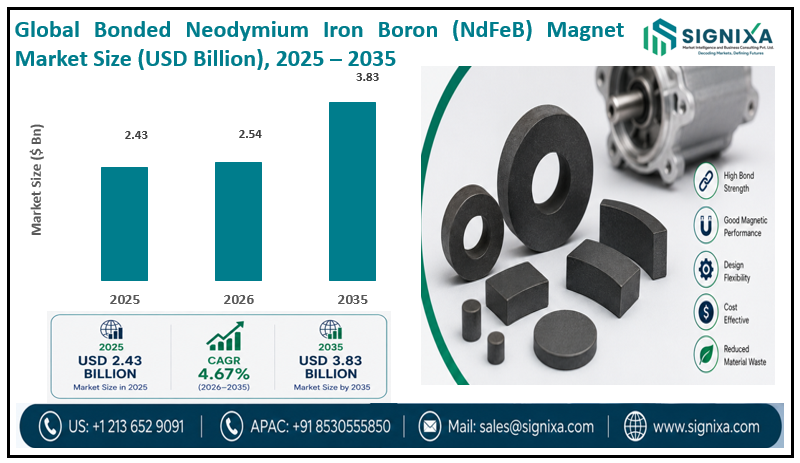
The global Bonded Neodymium Iron Boron (NdFeB) magnet market was valued at approximately USD 2.43 Billion in 2025 and is projected to reach around USD 3.83 Billion by 2035, registering a CAGR of 4.67% during the forecast period from 2026 to 2035. Bonded NdFeB magnets are composite permanent magnets that offer high magnetic strength, design flexibility, and excellent mechanical integrity, widely used in compact, high-performance applications across industries such as automotive, electronics, and home appliances.
The Bonded NdFeB magnet market has gained substantial traction due to the unique combination of high magnetic strength and design flexibility these materials offer. Unlike sintered magnets, bonded NdFeB magnets are formed by binding magnetic powders with polymer or epoxy resins, allowing them to be moulded into complex shapes and multi-polar configurations with minimal machining. This flexibility makes them ideal for compact and lightweight applications in automotive, consumer electronics, office automation, and medical devices. Their corrosion resistance and isotropic nature make them suitable for applications where uniform magnetic properties are required. Advancements in injection moulding technologies are enhancing product consistency and throughput, catering to industries that demand high-volume, precision magnet production.
On the technological front, the demand for precision control in applications such as power steering motors, cooling fans, pumps, and sensors continues to support the growth of bonded NdFeB magnets. Moreover, the trend toward electric and hybrid vehicles is leading to increased demand for cost-effective magnets that can be produced in high volumes. While bonded NdFeB magnets generally have lower magnetic strength than their sintered counterparts, their ability to be integrated directly into component designs without secondary machining makes them highly economical in automated production lines. As industries seek more efficient, high-performance, and cost-conscious alternatives, bonded NdFeB magnets are positioned as a vital component in the evolving landscape of electromechanical and mechatronic devices.
Key Findings
- The global bonded NdFeB magnet market is growing at a CAGR of 4.67% over the forecast period (2026–2035).
- The market size is expected to grow from USD 2.43 Billion in 2025 to USD 3.83 Billion by 2035.
- Ring-shaped magnets are expected to gain traction due to increased use in compact electric motors.
- Injection moulding dominates the process segment, contributing over 60% of global revenue, due to its suitability for mass production and design flexibility.
- Office automation equipment and micro motors are major application segments due to rising automation and miniaturization.
- Automotive and electronic & electrical industries are leading end-use sectors; automotive held nearly 35% market share in 2025.
- Asia-Pacific remains the largest consumer and manufacturer, accounting for over 55% of global demand in 2025, driven by China, Japan, and South Korea.
Bonded NdFeB Magnet Market Dynamics
Miniaturization Megatrend Driving Demand for Injection-Mouldable Complex-Geometry Magnets in Compact Electronic & Medical Devices
The increasing miniaturization of electronic devices has significantly driven the demand for bonded NdFeB magnets. These magnets offer flexibility in shape, isotropic magnetic properties, and high precision in moulding, which supports the design of smaller, lighter, and more complex components without sacrificing performance. Unlike sintered magnets, bonded versions allow integration directly into assemblies, reducing the number of parts and simplifying production. This is particularly beneficial for compact consumer electronics such as smartphones, wearables, hard drives, and printers, where space and weight constraints are critical. As industrial automation grows, motors and sensors are being developed with a focus on reduced size and higher efficiency, boosting the adoption of bonded NdFeB magnets. Their low eddy current losses and design flexibility make them a favoured choice in high-speed motors and power tools. The market continues to gain from this trend, especially as product designers seek magnets that can be directly integrated into plastic housings, offering a strong blend of performance, cost-effectiveness, and ease of assembly through the forecast period.
EV/HEV Electrification Accelerating Demand for Net-Shape-Mouldable BLDC Motor Magnets in Automotive Auxiliary & Sensor Systems
The automotive industry has emerged as one of the key growth drivers for bonded NdFeB magnets, fueled by the growing use of electric and hybrid vehicles (EVs/HEVs), as well as smart automotive components. Bonded magnets are used extensively in brushless DC motors (BLDCs) for applications such as fuel pumps, sensors, seat motors, mirror adjusters, HVAC actuators, and steering systems. Their ability to be moulded into complex shapes allows automotive engineers to create compact, efficient motors with high torque-to-weight ratios. Bonded NdFeB magnets offer low magnetic loss and excellent dimensional stability, making them suitable for high-performance automotive environments. As vehicle electrification accelerates, the demand for reliable, cost-effective magnetic components has grown. Bonded magnets, being less brittle and easier to assemble than sintered counterparts, reduce manufacturing complexity and improve design freedom. While sintered NdFeB still dominates in high-strength traction motor requirements, bonded variants are carving a niche in auxiliary systems and sensors, with the transition toward more electronic features in vehicles expected to solidify the position of bonded magnets in long-term automotive strategies through the forecast period.
Hybrid Binder Systems, Additive Manufacturing & Optimized Rare Earth Powder Coatings Expanding Bonded Magnet Performance Envelope
Continuous advancements in manufacturing technologies and material science have reshaped the bonded NdFeB magnet market. Developments in injection moulding and compression bonding techniques now allow manufacturers to produce magnets with tighter tolerances, improved surface finish, and enhanced magnetic performance. Hybrid bonding materials combining NdFeB powders with thermoplastics or resins balance strength, durability, and processing ease. The integration of 3D printing and additive manufacturing processes is being explored to produce highly customized magnetic components without the limitations of traditional mold designs, supporting small batch and prototype production for industries with fast-paced product development cycles. The use of rare earth powders with optimized particle size and coating technology also helps improve the oxidation resistance and thermal stability of bonded magnets. Research into alternate rare-earth formulations and hybrid magnet composites may also help mitigate risks associated with raw material volatility, particularly for dysprosium and neodymium. The increasing investment in R&D is pushing performance boundaries and expanding the range of bonded magnet applications through the forecast period.
Rare Earth Supply Chain Geopolitical Concentration & China's Dominant Neodymium/Dysprosium Production Posing Strategic Sourcing Risks
The bonded NdFeB magnet market faces supply chain risks primarily due to its reliance on rare earth elements, which are geopolitically concentrated. China accounts for a dominant share of the global neodymium and dysprosium production, making the supply chain vulnerable to export restrictions, political decisions, or trade conflicts. Any disruption can significantly affect material availability and pricing, raising cost pressures for manufacturers and end-users. This has led to a growing focus on recycling rare earth magnets and optimizing raw material use during production. Companies are also exploring alternate sourcing strategies, including domestic rare earth extraction projects or strategic stockpiling. Environmental regulations surrounding mining and processing of rare earths further complicate sourcing and production. These dynamics compel manufacturers to explore hybrid magnet formulations with reduced rare earth content, or enhanced performance through better coating and stabilization techniques. The ability of the market to manage these risks will play a critical role in determining long-term growth and stability through the forecast period.
Bonded NdFeB Magnet Market: Segmentation Analysis
By Shape Segment Analysis
Ring
Ring-shaped magnets accounted for the largest market share in 2025, driven by their extensive use in brushless DC motors, which are prevalent in automotive and consumer electronics. Their symmetrical geometry ensures uniform magnetic flux, making them suitable for high-efficiency motor designs. The rising use of ring magnets in cooling fans, robotic drives, and industrial actuators will continue to support segment growth, particularly as the demand for automation and robotics accelerates. Ring magnets are the foundational magnet geometry for rotary electric machines the circular form factor enables the creation of multi-pole magnetic fields that are essential for efficient BLDC motor operation. The trend toward higher pole-count motors which improve efficiency and torque density at the cost of requiring more precisely dimensioned magnetic segments is driving demand for ring magnets with tighter dimensional tolerances than bonded processes can routinely achieve through injection moulding. The growing adoption of BLDC motors in home appliances including dishwashers, washing machines, and HVAC systems is creating a large and growing volume demand for ring-shaped bonded NdFeB magnets through the forecast period.
Rectangular
Rectangular bonded NdFeB magnets are widely used in applications requiring a defined magnetic pole face geometry and directional field orientation. Their flat, elongated form makes them suitable for linear actuator arrays, magnetic encoder assemblies, holding systems, and sensor applications where the magnet must fit within a constrained planar space. Rectangular bonded magnets are also extensively used in reed switch actuators, where the precise control of magnetic field distance and direction is critical for reliable switch operation. The growing adoption of magnetic position sensing in industrial automation and robotics — where rectangular magnet arrays create the periodic magnetic fields detected by linear encoder sensors is supporting demand for high-precision rectangular bonded NdFeB magnets. Their ability to be moulded with consistent dimensions and magnetic properties in high-volume injection moulding processes makes rectangular bonded magnets a reliable and cost-effective component in automated assembly operations through the forecast period.
Square
Square bonded NdFeB magnets serve niche applications where a symmetrical square footprint is geometrically advantageous for component integration. Their equal-dimension faces enable symmetric magnetic field profiles that simplify sensor calibration and assembly alignment. Square bonded magnets are used in compact sensor targets, magnetic latch and closure mechanisms, and as individual pole pieces in multi-pole magnetic assemblies. The growing wearable electronics segment including smartwatches, fitness trackers, and medical monitoring devices is creating demand for miniaturized square bonded magnets that can be embedded in compact charging interfaces, haptic feedback actuators, and magnetic attachment systems. The ability to injection-mould square bonded magnets with integrated overmold features such as plastic mounting bosses, retention clips, or protective enclosures enables their direct integration into compact device assemblies without requiring secondary mechanical fixturing through the forecast period.
Others
The Others category encompasses specialized bonded NdFeB magnet geometries including arc segments, discs, cylinders, trapezoids, and fully custom profiles that cannot be classified under the standard ring, rectangular, or square categories. Arc segment magnets used as individual poles in the stator or rotor assemblies of brushless motors represent a significant sub-category, enabling motor designers to achieve higher power density and optimized magnetic field distribution relative to simple ring configurations. Disc and cylindrical magnets are widely used in sensors, reed switches, and holding applications. The growing use of additive manufacturing and advanced injection moulding techniques is progressively expanding the commercial viability of truly custom magnet geometries that precisely conform to the available space and field requirements of each specific application enabling product designers to specify bespoke magnet profiles without the cost penalties that previously made custom geometries impractical for anything but the highest-volume applications through the forecast period.
By Process Segment Analysis
Injection Molding
Injection molding dominated the bonded NdFeB magnet market in 2025, contributing over 60% of global revenue. The process enables the mass production of complex-shaped magnets with tight tolerances and minimal post-processing. As it supports high throughput and repeatability, injection moulding is widely adopted in the automotive and electronics sectors for fabricating micro-motor components and sensors. Its capability to integrate magnetic material with plastic parts in a single step reduces production cost and assembly complexity. Injection-moulded bonded NdFeB magnets where magnetic powder is dispersed within a thermoplastic binder at typical loadings of 62% by weight achieve densities and magnetic properties that, while below sintered magnets, are more than adequate for the micro-motor, sensor, and office automation applications that represent the largest volume market. The process's ability to incorporate inserts, overmoulding, and multi-cavity tooling enables highly automated, high-volume production with minimal human intervention, meeting the cost and consistency requirements of automotive and electronics OEMs through the forecast period.
Compression Molding
Compression molding represents a significant process alternative to injection molding in the bonded NdFeB magnet market, offering advantages in magnetic loading fraction and output magnetic properties. The compression bonding process where NdFeB powder is mixed with a thermosetting epoxy binder, pressed to shape under high pressure in a die, and then cured achieves higher magnetic powder loading than injection molding, resulting in higher remanent magnetic flux and coercive force. This makes compression-bonded magnets attractive for applications where higher magnetic performance is required while retaining the design flexibility advantages of bonded magnets over sintered alternatives. Compression-bonded magnets also demonstrate superior corrosion resistance, as the dense epoxy matrix provides more complete encapsulation of the magnetic powder particles. The process is well-suited for larger magnet cross-sections and simpler geometries particularly disc, ring, and block shapes where the uniaxial pressing direction doesn't limit achievable complexity. Growing demand for higher-performance bonded magnets in precision automotive sensors and medical device applications is supporting compression bonding adoption through the forecast period.
Others
The Others process category includes calendering, extrusion, and emerging additive manufacturing techniques that produce bonded NdFeB magnets in forms and geometries not achievable through conventional injection or compression molding. Calendering where magnetic compound is processed through heated rollers to form thin, flexible magnet sheets enables the production of flexible bonded NdFeB magnets used in magnetic refrigerator seals, promotional printing, and magnetic tape applications. Extrusion produces continuous profiles of bonded magnet material in fixed cross-sectional shapes, which are then cut to length, enabling efficient production of high-volume standardized geometries like tubes and rods. Additive manufacturing including magnetic material 3D printing using loaded filament or binder jetting with NdFeB powder is the most rapidly developing emerging process, enabling truly arbitrary magnet geometries and magnetic field distribution patterns without tooling costs or minimum order quantities, making it particularly valuable for prototyping and custom small-batch applications. As additive manufacturing techniques mature and magnetic loading fractions improve, this process is expected to carve out increasing share in the others category through the forecast period.
By Application Segment Analysis
Office Automation Equipment
Office automation equipment, including printers, copiers, and scanners, accounted for a substantial share of over 30% in 2025 due to continuous demand from SMEs and corporate setups. Bonded NdFeB magnets are essential for smooth motor function in such equipment. Office automation equipment deploys bonded NdFeB magnets in a diverse array of sub-systems including paper feed roller drive motors, print head positioning actuators, document sensing systems, and toner cartridge motors where the compact size, precise dimensional tolerance, and ability to be directly integrated into plastic housings of injection-moulded bonded magnets are particularly valuable. The global installed base of office automation equipment represents a consistent replacement market, while the growing deployment of network-connected multifunction devices in emerging market corporate offices is creating incremental new demand. The trend toward more compact and energy-efficient office automation products particularly portable and wireless printers and scanners is sustaining demand for miniaturized bonded NdFeB magnets with improved performance-per-gram through the forecast period.
Micro Motors
The micro motors segment is projected to grow rapidly, supported by rising usage in medical devices and wearable electronics. Micro motors are the fundamental electromechanical component in an enormous range of consumer, medical, and industrial products from the vibration motors in smartphones and smartwatches to the precision drives in surgical tools, dental drills, and laboratory automation equipment. Bonded NdFeB magnets are particularly well-suited for micro motor applications because their injection-mouldable nature allows the magnet to be formed as an integral part of the rotor assembly, eliminating the need for adhesive bonding or mechanical retention of separately manufactured magnet pieces. The growing miniaturization of medical devices — particularly implantable and wearable devices that require small, efficient, and biocompatible motors is creating demand for the smallest and most precisely dimensioned bonded NdFeB magnets that manufacturing technology can produce. The expansion of industrial robotics into collaborative robot (cobot) applications where many small, lightweight joint actuators replace fewer large motors is also supporting micro motor magnet demand through the forecast period.
Metering Machinery
Metering machinery represents a well-established application for bonded NdFeB magnets, encompassing gas meters, water meters, electricity meters, and various industrial flow measurement and process control instruments. Bonded NdFeB magnets in metering applications are typically used as rotating magnetic elements in impeller-based flow meters, as sensor targets in reed switch counters, and as magnetic coupling elements in magnetically coupled meter drives that enable isolated measurement without mechanical seals. The global rollout of smart metering infrastructure where conventional mechanical meters are replaced with electronic smart meters capable of remote reading and two-way communication is creating demand for high-precision bonded magnets in reed switch assemblies and Hall effect sensor targets. The growing adoption of advanced water management systems in water-stressed regions is driving smart water meter deployments that require reliable, corrosion-resistant bonded NdFeB magnets for long service life in demanding environmental conditions through the forecast period.
Electric Generators
Electric generators are witnessing increased demand for bonded magnets due to the global push toward renewable energy and decentralized power systems. While sintered NdFeB dominates in high-power wind turbine generators, bonded NdFeB magnets are finding growing application in small-scale and micro-generators including portable generators, micro-hydro generators, small wind turbines, and energy harvesting devices where their net-shape production, isotropic magnetic properties, and ease of assembly in smaller rotor diameters provide practical advantages. The growing use of energy harvesting technology which captures ambient mechanical energy from vibration, fluid flow, or rotation to power wireless sensors and IoT devices is creating demand for small, customized bonded NdFeB magnets that can be integrated into the compact harvester mechanical assemblies. The expansion of off-grid electrification programs in developing regions which often deploy small wind and micro-hydro systems is also creating market opportunity for bonded magnets in decentralized generator applications through the forecast period.
Others
The Others application category encompasses the diverse range of bonded NdFeB magnet uses beyond the primary segments, including consumer electronics mini-motors, speakers, vibration actuators, disk drives, camera autofocus systems, and home automation actuators. In consumer electronics, bonded NdFeB magnets power the vibration units in smartphones and tablets, the speaker and microphone assemblies in headphones and earbuds, and the autofocus motor drives in camera modules. The growing smart home market where door locks, window blinds, thermostatic radiator valves, and various appliance automation systems require compact, reliable actuators is creating growing application opportunities for bonded NdFeB magnets. The development of miniaturized wearable health monitoring devices including biosensors, drug delivery systems, and neural interface devices is creating emerging specialty demand for bonded magnets with precisely controlled field profiles and biocompatible coatings. These evolving applications collectively represent a significant and growing fraction of overall bonded NdFeB magnet consumption through the forecast period.
By End Use Industry Segment Analysis
Automotive
The automotive industry held the largest share in 2025, contributing nearly 35% of the market, owing to the rising integration of magnetic actuators, sensors, and motors in vehicles. Electric powertrains and intelligent safety systems heavily rely on compact magnets. Bonded NdFeB magnets serve automotive applications spanning the full vehicle architecture from powertrain-adjacent systems (fuel pumps, oil pumps, cooling system fans) to chassis systems (ABS sensors, power steering motors, suspension actuators) to body and comfort systems (seat motors, mirror adjusters, window lift motors, HVAC blower fans) to infotainment and instrumentation. Each modern vehicle can contain dozens to hundreds of individual bonded NdFeB magnets distributed across these systems. As vehicle electrification increases the number of electric motor-driven auxiliary systems per vehicle, the per-vehicle bonded magnet content is rising accordingly, making the automotive segment the primary volume growth driver. The industry's emphasis on weight reduction for EV range optimization further favors bonded magnets, which eliminate machining waste and secondary operations relative to sintered alternatives through the forecast period.
Electronic and Electrical
The electronic and electrical segment follows closely after automotive, benefiting from the expansion of the consumer electronics industry and increased production of smart devices, HVAC systems, and energy-efficient appliances, all of which utilize bonded NdFeB magnets. This segment encompasses the entire spectrum of electronic device sub-systems that require compact magnetic components from the mini-speakers and vibration motors in smartphones to the fan motors in laptops and gaming consoles to the actuators in smart home devices and building automation systems. The ongoing global transition to inverter-driven, variable-speed HVAC systems which offer significantly improved energy efficiency over fixed-speed alternatives is creating growing demand for high-quality BLDC motor magnets in air conditioning and heat pump applications. The trend toward higher integration of electronic controls and sensing in home appliances creating "smart" washing machines, refrigerators, and cooking equipment with more motor-driven functions is also supporting volume growth in electronic and electrical sector bonded magnet demand through the forecast period.
Energy & Power
The Energy & Power end use industry segment encompasses bonded NdFeB magnet applications in power generation, transmission, distribution, and metering infrastructure. The global shift toward renewable energy sources particularly distributed solar and wind power is creating demand for bonded magnets in small-scale generators, energy storage systems, and smart grid sensor applications. Bonded NdFeB magnets are used in the magnetic components of smart power meters, current transformers, protection relays, and circuit breaker actuators that form the control and monitoring infrastructure of modern electricity grids. The growing deployment of smart grid technology which adds sensing, communication, and automated control capabilities to existing power infrastructure is creating incremental demand for the compact, reliable magnetic sensing elements enabled by bonded NdFeB magnets. The energy transition's demand for backup power systems, including residential battery storage and fuel cell systems with auxiliary motors, is also expanding the end-use footprint for bonded magnets in the energy sector through the forecast period.
Medical
The medical end-use segment represents a high-value and growing market for bonded NdFeB magnets, driven by the increasing miniaturization and electrification of medical devices. Bonded NdFeB magnets are used in surgical power tools, dental drills, hearing aids, cochlear implant components, infusion pump motors, and miniaturized diagnostic instruments. Their corrosion resistance, low eddy current losses, and precision dimensional tolerancing make them particularly suitable for regulated medical environments where consistent performance and biocompatibility are critical. The growing wearable medical monitoring market including continuous glucose monitors, cardiac monitors, and drug delivery devices is creating demand for the smallest bonded NdFeB magnets that can be produced at commercial scale. The increasing use of robotic surgical systems which deploy many miniaturized actuators within the surgical instruments is creating growing demand for precision bonded magnets in hospital environments. Healthcare's broad adoption of portable and point-of-care diagnostic equipment is also expanding the medical sector magnet demand through the forecast period.
Home Appliance
The home appliance end-use segment is expanding, driven by the global transition to higher-efficiency, inverter-driven appliances and the increasing integration of smart home technologies. Bonded NdFeB magnets serve the motor sub-systems in washing machines, dishwashers, refrigerator compressors, fans, vacuum cleaners, and cooking appliances. The regulatory trend toward mandatory energy efficiency standards for home appliances including the EU's Ecodesign regulations and similar frameworks in North America and Asia-Pacific is accelerating the replacement of conventional fixed-speed motors with inverter-driven BLDC alternatives, which typically utilize bonded NdFeB magnets in the rotor assembly. The growing adoption of robotic vacuum cleaners and other autonomous home appliances which require multiple compact drive motors and sensor systems is creating additional volume demand for bonded NdFeB magnets in premium household product categories through the forecast period.
Others
The Others end-use segment encompasses bonded NdFeB magnet applications in industrial robotics, aerospace subsystems, defense electronics, and various specialty industrial and commercial applications. Industrial robotics particularly collaborative robots deployed in flexible manufacturing environments use bonded NdFeB magnets in the compact joint actuator motors and position sensor assemblies that enable precise, lightweight robot arm designs. Aerospace and defense applications leverage bonded magnets' low mass, corrosion resistance, and form factor flexibility in guidance system actuators, aircraft seat adjustment motors, and UAV flight control servos. The growing use of magnetic coupling in industrial pump and mixer applications where magnetic drive couples transmit torque through a containment shell to eliminate shaft seals creates demand for bonded NdFeB magnets in containment coupling assemblies. Specialty industrial sensing applications, including conveyor belt speed sensors, industrial flow meters, and position transducers, represent additional consistent demand for bonded NdFeB magnets through the forecast period.
Report Attributes & Market Scope
| Report Attribute | Details |
|---|---|
| Market Size Value in 2025 | USD 2.43 Billion |
| Market Size Value in 2035 | USD 3.83 Billion |
| CAGR (2026–2035) | 4.67% |
| Base Year Used for Estimation | 2025 |
| Historic Data | 2020 - 2025 |
| Forecast Period | 2026 - 2035 |
| Segments Covered – By Shape |
|
| Segments Covered – By Process |
|
| Segments Covered – By Application |
|
| Segments Covered – By End Use Industry |
|
| Regions Covered | North America, Europe, Asia Pacific, Latin America, Middle East and Africa |
| Major Countries Covered | U.S., Canada, Mexico, Germany, UK, France, Italy, Spain, Russia, China, Japan, South Korea, India, Southeast Asia Countries, Brazil, Argentina, GCC Countries, Turkey, Iran, Israel, South Africa, Egypt, Nigeria, etc. |
| Key Companies Profiled | TDK Corporation, Arnold Magnetic Technologies, Vacuumschmelze GmbH, Daido Steel Co. Ltd., Hitachi Metals Ltd., Ningbo Yunsheng Co. Ltd., Magnequench, Galaxy Magnets, and SDM Magnetics, among others. |
Bonded NdFeB Magnet Market Regional Analysis
The Asia-Pacific region is the dominant market, accounting for over 55% of global demand in 2025. North America and Europe are mature markets with high adoption in automotive and medical sectors. Latin America and the Middle East & Africa are emerging as potential growth areas due to industrialization and infrastructure expansion.
Asia-Pacific (Dominant Region)
The Asia-Pacific region is the dominant market for bonded NdFeB magnets, accounting for over 55% of global demand in 2025. China leads the regional market due to its extensive manufacturing base and government focus on electric mobility and renewable energy. Japan and South Korea also contribute significantly through innovations in consumer electronics and robotics. Asia Pacific dominates bonded NdFeB magnet production due to extensive raw material availability, particularly in China, and large-scale manufacturing of consumer electronics, electric motors, and home appliances. Government support for EVs and electronics manufacturing, especially under initiatives like "Made in China 2026," strengthens regional growth. Asia Pacific remains the global supply center, with vertically integrated value chains ensuring rapid production and competitive pricing. The concentration of both rare earth raw material supply and major end-market manufacturing in the Asia-Pacific region creates a structural advantage that is expected to sustain regional leadership through the forecast period.
North America
North America's bonded NdFeB magnet market is driven by robust demand in automotive, aerospace, and consumer electronics sectors. The U.S. is witnessing growing integration of bonded magnets in electric vehicle motors, sensor systems, and miniaturized electronics. Technological innovation and localized manufacturing capabilities support domestic production, while emphasis on energy-efficient devices drives magnet adoption. Strong R&D in defense and healthcare technologies fuels niche applications. As industries move toward automation and sustainability, bonded NdFeB magnets are favored for their flexibility, corrosion resistance, and reduced manufacturing complexity, positioning North America as a critical innovation hub for advanced magnet solutions. The growing policy focus on domestic rare earth processing and magnet manufacturing driven by supply chain security concerns is creating investment in North American bonded magnet production capacity that may progressively reduce import dependency through the forecast period.
Europe
Europe represents a mature market for bonded NdFeB magnets with high-quality demand concentrated in automotive, industrial, and medical applications. Germany's dominant automotive manufacturing sector home to major OEMs and Tier 1 suppliers investing heavily in electrification is the primary driver of European bonded magnet demand. The EU's ambitious vehicle electrification targets are accelerating EV and HEV production and creating growing demand for the BLDC motor magnets used in auxiliary automotive systems. Europe's strong focus on sustainable manufacturing and supply chain resilience is driving investment in domestic rare earth processing and magnet manufacturing capabilities, reducing dependency on Asian suppliers. The region's sophisticated medical device manufacturing base particularly in Germany, Switzerland, and the Netherlands creates demand for high-precision bonded NdFeB magnets in surgical instruments, diagnostic equipment, and wearable medical devices. Stringent energy efficiency regulations for home appliances and industrial motors are also supporting transition to BLDC motor designs that utilize bonded NdFeB magnets through the forecast period.
Latin America & Middle East and Africa
Latin America and the Middle East & Africa are emerging as potential growth areas for bonded NdFeB magnets due to industrialization and infrastructure expansion. In Latin America, Brazil and Mexico lead adoption, driven primarily by their roles as manufacturing bases for automotive and consumer electronics supply chains. Mexico's deep integration into North American automotive production particularly in Tier 1 and Tier 2 automotive component manufacturing creates demand for bonded magnets used in the sensor and actuator assemblies produced for OEM assembly plants across the region. The growing electrification of vehicle fleets and expansion of electronics manufacturing in Brazil is creating incremental domestic demand for bonded magnets. In the Middle East & Africa, GCC countries' industrial diversification programs and infrastructure development are creating growing demand for the motors, sensors, and control systems that utilize bonded NdFeB magnets. Africa's expanding manufacturing sector particularly in automotive assembly is progressively integrating into global bonded magnet supply chains through the forecast period.
Recent Developments in the Bonded NdFeB Magnet Market
-
2025
Hitachi Metals Ltd. announced the development of a new high-temperature NdFeB magnet line designed to improve thermal stability and performance in demanding applications such as electric vehicle traction motors and industrial automation systems.
-
2025
Magnequench International LLC announced the acquisition of Advanced Magnet Source to expand its bonded NdFeB magnet production capabilities and strengthen its global supply network for automotive and industrial applications.
-
2024
TDK Corporation introduced hybrid bonded NdFeB magnets for electric vehicle motor applications, designed to increase motor efficiency and thermal performance while supporting compact motor designs required in advanced mobility platforms.
-
2024
Arnold Magnetic Technologies launched a new series of bonded NdFeB magnets engineered for high-temperature environments, targeting aerospace, automotive, and industrial motor applications that require improved magnetic stability and durability.
-
2023
Hitachi Metals Ltd. expanded its NdFeB magnet manufacturing facility in Japan to increase production capacity and meet growing demand from electric vehicle and renewable energy sectors.
Bonded NdFeB Magnet Market: Competitive Landscape
Key players in the bonded NdFeB magnet market include TDK Corporation, Arnold Magnetic Technologies, Vacuumschmelze GmbH, Daido Steel Co. Ltd., Hitachi Metals Ltd., Ningbo Yunsheng Co. Ltd., Magnequench, Galaxy Magnets, and SDM Magnetics. These companies are focusing on advanced manufacturing processes, sustainable sourcing of rare earth materials, and expanding production capacity. Strategic alliances, R&D investments, and technology licensing are also common among leading players aiming to strengthen their market positions and address the rising demand from high-growth industries.
Key Companies Profiled
- TDK Corporation
- Hitachi Metals Ltd.
- Arnold Magnetic Technologies
- Magnequench
- Vacuumschmelze GmbH
- Ningbo Yunsheng Co. Ltd.
- Daido Steel Co. Ltd.
- Galaxy Magnets
- SDM Magnetics
- Shin-Etsu Chemical Co., Ltd.
- Yantai Shougang Magnetic Materials Inc.
- Zhejiang Innuovo Magnetics Co., Ltd.
- Hangzhou Permanent Magnet Group
- Bunting Magnetics Co.
- Electron Energy Corporation
Global Bonded NdFeB Magnet Market Segmentation Summary
By Shape
- Ring
- Rectangular
- Square
- Others
By Process
- Compression Molding
- Injection Molding
- Others
By Application
- Office Automation Equipment
- Micro Motors
- Metering Machinery
- Electric Generators
- Others
By End Use Industry
- Automotive
- Energy & Power
- Electronic and Electrical
- Medical
- Home Appliance
- Others
By Region
- North America
- U.S.
- Canada
- Mexico
- Europe
- Germany
- France
- UK
- Spain
- Italy
- Rest of Europe
- Asia-Pacific
- China
- Japan
- India
- Australia
- South Korea
- Southeast Asia
- Rest of Asia-Pacific
- Latin America
- Brazil
- Argentina
- Rest of Latin America
- The Middle East & Africa
- GCC Countries
- South Africa
- Rest of the Middle East & Africa
Frequently Asked Questions (FAQs) About the Bonded NdFeB Magnet Market
What is a bonded NdFeB magnet?
A bonded NdFeB (Neodymium-Iron-Boron) magnet is a type of rare earth permanent magnet made by combining NdFeB magnetic powder with resin or polymer binders through compression or injection molding. These magnets offer design flexibility, corrosion resistance, and are widely used in automotive, consumer electronics, medical, and industrial applications.
Which key factors will influence the bonded NdFeB magnet market growth over 2026–2035?
The global bonded NdFeB magnet market is expected to grow due to the rising demand for lightweight and high-performance magnetic components, increased use in electric motors and sensors, and expanding adoption in automotive and electronic devices.
What will be the value of the bonded NdFeB magnet market during 2026–2035?
According to the study, the global bonded NdFeB magnet market size was worth around USD 2.43 Billion in 2025 and is projected to reach around USD 3.83 Billion by 2035.
What will be the CAGR value of the bonded NdFeB magnet market during 2026–2035?
The CAGR value of the bonded NdFeB magnet market is estimated to be around 4.67% during the forecast period from 2026 to 2035.
Which region will contribute notably towards the bonded NdFeB magnet market value?
Asia-Pacific is expected to dominate the bonded NdFeB magnet market due to strong manufacturing infrastructure, growing demand from automotive and consumer electronics sectors, and the presence of key magnet producers in China, Japan, and South Korea.
Which are the major players leveraging the bonded NdFeB magnet market growth?
Key players in the global bonded NdFeB magnet market include Hitachi Metals Ltd., Arnold Magnetic Technologies, Vacuumschmelze GmbH, Ningbo Yunsheng Co. Ltd., Magnequench International, TDK Corporation, Earth-Panda Advance Magnetic Material Co. Ltd., Daido Steel Co. Ltd., Galaxy Magnets, and Bunting Magnetics Co.
What can be expected from the global bonded NdFeB magnet market report?
The report provides an in-depth analysis of the bonded NdFeB magnet market, including a thorough evaluation of market drivers, restraints, and opportunities, along with detailed segmentation, competitive landscape, regional insights, and future forecasts up to 2035.