
Wireless Smart Lighting Control System Market Overview
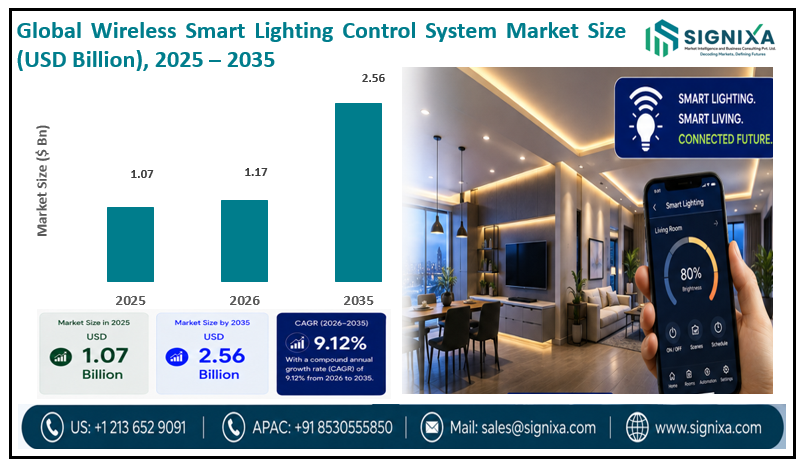
The size of the global Wireless Smart Lighting Control System market was around USD 1.07 Billion in 2025 and is projected to grow to USD 2.56 Billion by 2035, at a CAGR of 9.12% from 2026 to 2035. This report analyzes key drivers, restraints, and opportunities influencing demand trends across major regions while outlining future growth potential.
The Wireless Smart Lighting Control System market involves digitally managed lighting solutions connected through wireless protocols including Wi-Fi, Bluetooth, Zigbee, and Z-Wave, enabling seamless integration with smart home and building automation ecosystems. These systems enhance energy efficiency, user convenience, and automation across residential, commercial, and public environments. Market growth is supported by rising smart home adoption, urban development initiatives, and government support for energy-efficient infrastructure, while integration with IoT platforms and mobile-based apps makes these lighting systems increasingly scalable and adaptable to real-time operational needs.
Smart cities development is a significant catalyst, as municipal authorities deploy wireless smart lighting to optimize energy use, enhance public safety, and gather real-time environmental data. In commercial spaces, these systems enable occupancy-based lighting and daylight harvesting that contribute toward LEED certifications and green building standards. Residential consumers are adopting these technologies for personalization, remote access, and voice assistant compatibility. The rise of retrofitting projects is also fuelling demand, as wireless solutions offer minimal disruption and reduced installation costs compared to wired systems — and despite ongoing concerns around cybersecurity and interoperability, advancements in IoT standards and encryption technologies are helping mitigate adoption risks across both developed and emerging markets.
Key Findings
- The global Wireless Smart Lighting Control System market is forecasted to grow at a CAGR of 9.12% between 2026 and 2035, with revenue rising from USD 1.07 Billion in 2025 to USD 2.56 Billion by 2035.
- Zigbee protocol is projected to dominate the market, owing to its widespread integration in smart devices, low power consumption, and reliable mesh networking capabilities across smart home and commercial applications.
- The Residential application segment will witness the highest growth, driven by the rapid adoption of smart home solutions and rising consumer demand for personalized, voice-controlled lighting environments.
- North America is anticipated to maintain market dominance through the forecast period, supported by advanced infrastructure, strong consumer awareness, and an early-adopter smart home technology base.
- Integration of wireless lighting with AI-driven automation, motion detection, and cloud-based analytics is emerging as a key technology trend reshaping competitive dynamics and product development priorities across the industry.
Wireless Smart Lighting Control System Market Dynamics
Rising Smart Home and Building Adoption Driving Demand
The demand for wireless smart lighting control systems is significantly driven by the increasing adoption of smart homes and buildings. Consumers are increasingly seeking connected living environments, leading to higher installations of smart lighting solutions that offer automation, remote access, and customization. These systems reduce energy usage by integrating sensors, timers, and mobile controls capabilities that are essential in residential and commercial spaces aiming for higher energy efficiency alongside greater day-to-day convenience. Government initiatives promoting sustainable infrastructure and smart city projects are further fostering demand, as energy regulations and incentive programs encourage the shift toward LED and smart lighting systems. Integration of lighting systems with IoT platforms, voice control assistants, and AI-enabled analytics is expanding use cases across both urban public infrastructure and private commercial buildings seeking to optimize operational costs and improve occupant comfort.
Energy Efficiency Mandates, Sustainability Goals & Retrofit-Friendly Deployment
The wireless smart lighting control system market is driven by growing demand for energy-efficient technologies and sustainability initiatives across the globe. As energy consumption and environmental concerns rise, governments and private institutions are prioritizing solutions that reduce power usage without compromising functionality wireless smart lighting allows users to schedule operations, control intensity, and remotely turn lights on or off, minimizing unnecessary usage and lowering energy bills while facilitating compliance with green building certifications such as LEED and BREEAM. The scalability and flexibility of wireless systems make them particularly well-suited for retrofitting existing structures, especially in commercial and industrial sectors where traditional rewiring may be impractical or prohibitively costly. Rising emphasis on decarbonization, ESG commitments, and broader smart infrastructure adoption is positively reinforcing these market dynamics across both developed and emerging economies.
Cybersecurity Concerns, Upfront Costs & Cross-Platform Interoperability Challenges
Despite positive growth factors, market expansion faces challenges related to cybersecurity, initial costs, and system interoperability. Security concerns are particularly significant, as wireless systems are vulnerable to hacking and data breaches if not adequately protected, leaving users concerned about privacy issues and unauthorized access to networked devices. Higher upfront costs and inconsistent compatibility across devices from different manufacturers deter some potential adopters, especially in price-sensitive regions, while integration across legacy infrastructure can be complex and may require skilled technicians limiting adoption among small businesses or residential users with constrained budgets. However, rising awareness, industry education campaigns, and innovations in plug-and-play system design are gradually reducing these adoption barriers. As industry stakeholders continue investing in encryption technologies and standardized communication protocols, trust in wireless smart lighting solutions is improving, paving the way for broader market penetration across both developed and emerging economies.
Wireless Smart Lighting Control System Market Segmentation Analysis
By Type Segment Analysis
The market is served by multiple wireless communication protocols, each offering distinct performance, power consumption, and connectivity advantages suited to different deployment scales and application contexts:
Zigbee
Zigbee-based lighting control systems accounted for over 35% of the market share in 2025, due to their low power consumption and reliable mesh networking capabilities. These systems are ideal for smart homes and commercial applications where multiple lighting fixtures must be interconnected across a building or facility, since mesh topology allows devices to relay signals to one another and extend network range without requiring a central wired backbone. Zigbee's open-standard nature and broad compatibility with major home automation platforms including Amazon Alexa and Google Home make it a preferred choice for residential and small commercial setups where consumers and integrators value cross-vendor device interoperability and a mature, well-supported ecosystem of compatible smart lighting products.
WiFi
WiFi-enabled lighting control systems hold a substantial market share, accounting for nearly 28% of market revenue in 2025, owing to their easy integration with existing home and office network infrastructure without requiring a separate hub or bridge device. These systems are favored in residential and light commercial spaces where users demand seamless control through mobile apps connected directly to their existing WiFi network. The increasing penetration of home WiFi networks and the development of energy-efficient WiFi chips optimized for low-power IoT applications have contributed to broader adoption, particularly among consumers seeking the simplest possible setup experience for smart lighting control.
Bluetooth
Bluetooth technology, particularly Bluetooth Low Energy (BLE), is gaining traction due to its low power usage and direct peer-to-peer connectivity, recording nearly 18% market penetration in 2025. It is commonly used in smaller residential or office environments where direct device-to-device communication is sufficient and the overhead of establishing a dedicated mesh network or hub infrastructure is unnecessary. Bluetooth-based systems are valued for their easy installation process and native compatibility with smartphones, making them particularly appealing for consumers seeking a straightforward, app-controlled lighting solution for individual rooms or smaller-scale deployments.
Others (Z-Wave, EnOcean & Proprietary RF)
Other wireless communication protocols including Z-Wave, EnOcean, and proprietary RF systems are used in specialized applications, particularly in industrial settings or large-scale public installations, and represented about 19% of the total market in 2025. These systems offer extended communication range, low interference characteristics in dense radio frequency environments, and advanced security features that are particularly valued in mission-critical or large-scale deployment contexts including industrial facilities, large public infrastructure projects, and security-sensitive commercial installations. Though a relatively niche segment compared to Zigbee and WiFi, this category is expected to grow as customization needs increase across specialized verticals requiring tailored wireless connectivity solutions beyond the mainstream consumer-oriented protocols.
By Application Segment Analysis
Residential
The residential segment dominated the market in 2025, contributing nearly 42% of total revenue. The growing adoption of smart home ecosystems, along with rising consumer awareness about energy efficiency, is driving demand within this segment. Smart lighting in homes enhances ambiance through customizable scenes and color temperature control, improves security through automated on/off schedules that simulate occupancy, and reduces electricity bills through usage-based automation — collectively making residential wireless lighting control an increasingly mainstream consumer technology rather than a premium or niche product category.
Commercial
Commercial applications including offices, retail stores, and the hospitality sector are increasingly deploying wireless smart lighting to reduce operational costs and improve lighting quality, representing about 36% of the total market in 2025. These systems help enable demand-based lighting and centralized monitoring through unified control platforms that allow facility managers to adjust lighting across multiple zones, floors, or properties from a single interface. The segment is expected to grow further due to the increasing importance of green building certifications and ESG compliance trends, which are pushing commercial property owners and operators to adopt energy-efficient lighting infrastructure as part of broader sustainability commitments and tenant attraction strategies.
Public
Public sector installations including street lighting, transportation hubs, and government buildings held around 22% of market revenue in 2025 and are forecasted to witness strong growth through 2035. Adoption is driven by smart city initiatives, where municipalities are replacing traditional lighting systems with sensor-enabled smart lighting that reduces energy usage and enables adaptive lighting based on pedestrian or vehicle movement detection. This application segment is particularly significant in flagship smart city development projects, where wireless lighting infrastructure often serves as a foundational layer for broader urban sensor networks that also support traffic management, public safety, and environmental monitoring functions beyond illumination alone.
Report Attributes & Market Scope
| Report Attribute | Details |
|---|---|
| Market Size Value in 2025 | USD 1.07 Billion |
| Market Size Value in 2035 | USD 2.56 Billion |
| CAGR (2026–2035) | 9.12% |
| Base Year Used for Estimation | 2025 |
| Historic Data | 2020 – 2025 |
| Forecast Period | 2026 – 2035 |
| Segments Covered – By Type |
|
| Segments Covered – By Application |
|
| Regions Covered | North America, Europe, Asia Pacific, Latin America, Middle East and Africa |
| Major Countries Covered | U.S., Canada, Mexico, Germany, UK, France, Italy, Spain, Russia, China, Japan, South Korea, India, Southeast Asia Countries, Brazil, Argentina, GCC Countries, Turkey, Iran, Israel, South Africa, Egypt, Nigeria, etc. |
| Key Companies Profiled | Signify (Philips Lighting), Legrand, Acuity Brands, Lutron Electronics, Hubbell, Honeywell, Cree Lighting, OSRAM, Eaton Corporation, and Schneider Electric, among others. |
Wireless Smart Lighting Control System Market Regional Analysis
North America leads the global market due to early adoption of smart home technology and supportive regulatory frameworks. Europe follows closely, particularly in Germany and the UK, where energy efficiency mandates promote adoption. Asia-Pacific is the fastest-growing region, driven by rapid urbanization and large-scale deployment in China, Japan, and India. Latin America and the Middle East & Africa are emerging markets where infrastructure development and urbanization will fuel growth through the forecast period.
North America (Dominant Region)
North America dominates the wireless smart lighting control system market, driven by early adoption of smart home technologies, advanced infrastructure, and strong consumer awareness regarding energy efficiency. The U.S. leads the region due to rapid integration of smart devices into households and businesses, bolstered by government initiatives promoting energy conservation and sustainable construction. Increasing demand for home automation and green buildings, especially in urban areas, is spurring uptake of wireless lighting systems across both residential and commercial sectors, supported by a strong presence of technology providers and widespread access to high-speed internet that enables seamless deployment of wireless solutions. Commercial real estate, retail chains, and corporate offices are increasingly using occupancy-based lighting and centralized wireless controls to optimize operational efficiency, while in Canada, energy-efficiency standards and climate-conscious policies are fostering adoption particularly in public infrastructure. North America's mature IoT ecosystem and compatibility with smart assistants like Alexa and Google Home enhance consumer convenience, positioning wireless lighting as an increasingly standard feature in new residential and commercial construction.
Europe
Europe is a prominent region in the wireless smart lighting control system market, supported by stringent energy regulations and widespread sustainability initiatives. The European Union's commitment to climate-neutral goals by 2050 is encouraging adoption of smart lighting systems that help reduce electricity usage across both public and private sectors. Countries including Germany, the UK, and the Netherlands are leading in integrating smart lighting with building automation systems to meet energy efficiency standards, with wireless technologies increasingly used in retrofitting historic and older buildings since they minimize invasive installation procedures. The growing popularity of smart cities is also influencing demand, as municipalities deploy intelligent lighting systems to reduce costs and monitor energy consumption, while in the commercial sector, office buildings and retail centers are adopting smart lighting to lower overhead expenses and achieve green certifications. Manufacturers in Europe are focusing on innovation and user-friendly designs to improve cross-platform compatibility, and while data security and high installation costs remain areas of concern, advancements in wireless communication standards and regulatory incentives are expected to enhance the region's adoption trajectory.
Asia Pacific (Fastest-Growing Region)
Asia Pacific is emerging as a high-growth region in the wireless smart lighting control system market due to rapid urban development, infrastructure expansion, and increasing adoption of smart technologies. Countries including China, Japan, South Korea, and India are witnessing a surge in demand, driven by rising energy costs, environmental concerns, and smart city initiatives, with governments across the region investing heavily in urban modernization where smart lighting forms a critical component of energy-efficient infrastructure. China is at the forefront due to its strong manufacturing ecosystem and aggressive smart city push, while India is seeing increased demand in residential and commercial segments due to urbanization and growing smartphone penetration. The commercial sector including shopping malls, airports, hotels, and IT parks is integrating wireless controls to automate lighting based on occupancy, schedules, and daylight availability, while residential uptake is growing on the back of rising popularity of app-based and voice-controlled devices compatible with platforms like Alexa and Google Assistant. Despite challenges including inconsistent rural internet infrastructure and a fragmented vendor landscape, declining wireless component costs and the entry of global players with localized offerings are expected to drive robust market expansion across the region.
Middle East & Africa
The Middle East and Africa region is witnessing steady growth in the wireless smart lighting control system market, driven by ambitious urban development projects, rising energy demand, and growing emphasis on sustainable infrastructure. Countries including the UAE, Saudi Arabia, and Qatar are leading adoption through government-backed smart city initiatives aimed at enhancing energy efficiency and environmental responsibility flagship projects including NEOM in Saudi Arabia and Dubai Smart City are integrating wireless lighting systems to optimize public space illumination, reduce energy waste, and improve overall city management. In commercial spaces including hotels, airports, and malls, wireless lighting systems are being deployed to reduce operating costs and create intelligent ambiance control, with the hospitality sector in particular leveraging these technologies to offer personalized guest experiences alongside lower power consumption. In Africa, market development is comparatively nascent but gradually gaining pace in urban areas, supported by increasing internet penetration and growing interest in mobile-based automation, though limited awareness in less developed markets, cybersecurity concerns, and a shortage of skilled technical personnel remain key adoption challenges across the broader MEA region.
Recent Developments in the Wireless Smart Lighting Control System Market
-
2026
Signify: Expanded its Interact connected lighting platform with enhanced cloud-based controls and analytics, enabling improved remote monitoring, energy management, and operational efficiency for commercial buildings.
Schneider Electric: Enhanced its EcoStruxure smart building platform by integrating advanced wireless lighting controls, helping building operators optimize energy usage and support sustainability goals.
-
2025
Acuity Brands: Introduced new wireless lighting control solutions featuring occupancy sensing and daylight harvesting to improve energy performance in commercial and educational buildings.
Lutron Electronics: Expanded its wireless lighting and shading control portfolio with enhanced mobile app capabilities and broader integration with smart home and building automation platforms.
Wireless Smart Lighting Control System Market: Competitive Landscape
Key players in the Wireless Smart Lighting Control System market include Signify (Philips Lighting), Legrand, Acuity Brands, Lutron Electronics, Hubbell, Honeywell, Cree Lighting, OSRAM, Eaton Corporation, and Schneider Electric. These companies are actively investing in R&D, product innovations, and strategic collaborations. Market competition is shaped by factors including interoperability, scalability, energy savings, and user experience, with players also enhancing their global presence through partnerships with construction firms, smart city planners, and IoT ecosystem providers to expand market reach and capture emerging opportunities.
The competitive landscape reflects a blend of established lighting fixture manufacturers with deep channel relationships in construction and electrical distribution including Acuity Brands, Hubbell, and Eaton and technology-forward connected lighting specialists such as Signify and Lutron that have built strong brand recognition in the smart home and premium commercial lighting control segments. Competitive differentiation increasingly centers on software platform capability, cloud analytics sophistication, and the breadth of third-party ecosystem integrations supported by each manufacturer's control platform, rather than purely on luminaire hardware specifications. As cybersecurity becomes a more prominent purchase consideration, vendors that can demonstrate robust encryption, secure firmware update mechanisms, and compliance with emerging IoT security standards are gaining a meaningful competitive edge, particularly in large-scale commercial, institutional, and government deployment contexts where data security due diligence is a formal procurement requirement.
Key Companies Profiled
- Signify (Philips Lighting)
- Legrand
- Acuity Brands
- Lutron Electronics
- Hubbell
- Honeywell
- Cree Lighting
- OSRAM
- Eaton Corporation
- Schneider Electric
- Siemens
- Leviton Manufacturing Co., Inc.
- Casambi Technologies
- Current Lighting Solutions (Current)
- Zumtobel Group
Global Wireless Smart Lighting Control System Market Segmentation Summary
By Type
- Zigbee
- WiFi
- Bluetooth
- Others
By Application
- Residential
- Commercial
- Public
By Region
- North America
- U.S.
- Canada
- Mexico
- Europe
- Germany
- France
- UK
- Spain
- Italy
- Rest of Europe
- Asia-Pacific
- China
- Japan
- India
- Australia
- South Korea
- Southeast Asia
- Rest of Asia-Pacific
- Latin America
- Brazil
- Argentina
- Rest of Latin America
- The Middle East & Africa
- GCC Countries
- South Africa
- Rest of the Middle East & Africa
Frequently Asked Questions (FAQs) About the Wireless Smart Lighting Control System Market
What is a Wireless Smart Lighting Control System?
A Wireless Smart Lighting Control System is a network-based solution that enables remote or automated control of lighting using wireless communication protocols like Wi-Fi, Zigbee, Z-Wave, or Bluetooth. These systems enhance energy efficiency, user comfort, and operational flexibility in residential, commercial, and industrial settings.
Which key factors will influence the Wireless Smart Lighting Control System market growth over 2026–2035?
The market is projected to grow due to rising demand for energy-efficient lighting, rapid urbanization, increasing adoption of smart home technologies, and government initiatives promoting sustainable infrastructure and smart cities.
What will be the value of the Wireless Smart Lighting Control System market during 2026–2035?
According to the study, the global Wireless Smart Lighting Control System market was valued at around USD 1.07 Billion in 2025 and is anticipated to reach approximately USD 2.56 Billion by 2035.
What will be the CAGR value of the Wireless Smart Lighting Control System market during 2026–2035?
The Wireless Smart Lighting Control System market is expected to grow at a CAGR of around 9.12% during the forecast period from 2026 to 2035, driven by the increasing adoption of smart homes and smart buildings, rising demand for energy-efficient lighting solutions, and the rapid integration of IoT, wireless communication technologies, and building automation systems.
Which region will contribute notably towards the Wireless Smart Lighting Control System market value?
The market is significantly led by North America and Europe, owing to widespread smart home adoption, high awareness of energy conservation, and robust infrastructure supporting IoT-based lighting systems. Asia-Pacific is the fastest-growing region.
Which are the major players leveraging the Wireless Smart Lighting Control System market growth?
Key players driving the market include Signify (Philips Lighting), Lutron Electronics, Acuity Brands, Legrand, Hubbell Incorporated, OSRAM GmbH, Cree Lighting, Schneider Electric, Eaton Corporation, and GE Lighting (a Savant company).
What can be expected from the global Wireless Smart Lighting Control System market report?
The report provides in-depth analysis of the Wireless Smart Lighting Control System market, focusing on current growth drivers and limitations, along with future opportunities, evolving technology trends, and competitive dynamics shaping the market landscape through 2035.