
Logistics Services (3PL & 4PL) Market Overview
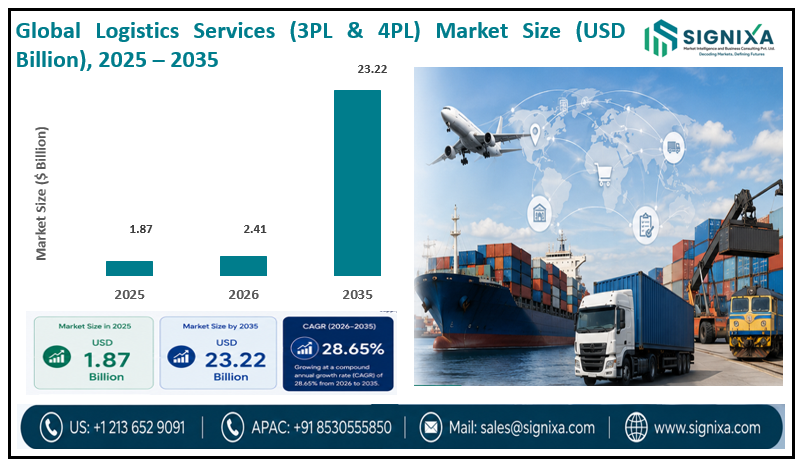
The size of the global Logistics Services (3PL & 4PL) Market was valued at approximately USD 1.87 Billion in 2025 and is projected to reach around USD 23.22 Billion by 2035, growing at a compound annual growth rate (CAGR) of 28.65% from 2026 to 2035. This rapid growth is driven by increased demand for efficient supply chain management and digitalization in logistics services. Companies are increasingly adopting cloud-based solutions and integrating advanced technologies to enhance service delivery in key industries like retail, pharmaceuticals, and automotive.
The logistics services market plays a crucial role in global trade by enabling the efficient movement, storage, and management of goods across supply chains. Increasing globalization and e-commerce expansion have heightened demand for comprehensive logistics solutions, including transportation, warehousing, freight forwarding, and inventory management. Advances in technology, such as automation, AI, and blockchain, are transforming logistics operations by improving tracking accuracy, reducing delivery times, and enhancing transparency. Customer expectations for faster and more reliable deliveries are pushing companies to adopt omnichannel strategies and integrated logistics platforms. Sustainability is also influencing the market, with providers focusing on eco-friendly transportation methods and green warehousing practices to reduce carbon footprints. Challenges like geopolitical tensions, regulatory changes, and infrastructure constraints remain, but ongoing innovation and strategic partnerships are helping companies navigate complexities effectively.
The market’s growth is further driven by diversification in service offerings, catering to various industries like retail, manufacturing, pharmaceuticals, and automotive. Last-mile delivery has gained significant attention, with logistics providers investing in drones, autonomous vehicles, and local distribution centers to meet urban demand efficiently. Risk management, including supply chain resilience and cybersecurity, is becoming a top priority as companies face disruptions from pandemics and natural disasters. Moreover, the rise of data analytics and IoT devices enable real-time decision-making, optimizing routes and reducing costs. Overall, the logistics services market is evolving rapidly, embracing digital transformation to meet increasing complexity and customer-centric demands worldwide.
Key Findings
- The global Logistics Services (3PL & 4PL) market is expected to grow at a CAGR of 28.65% during the forecast period (2026–2035).
- The market was valued at USD 1.87 Billion in 2025 and is projected to reach USD 23.22 Billion by 2035.
- Based on Service Type, the Third-Party Logistics (3PL) segment is expected to witness strong growth due to increasing demand for outsourced transportation, warehousing, inventory management, and value-added logistics services across multiple industries.
- By End-Use Industry, the E-commerce segment is expected to dominate the market owing to rising online shopping activities, growing cross-border trade, and the need for efficient fulfilment and last-mile delivery solutions.
- In terms of Mode of Transport, the Roadways segment is anticipated to command the largest market share due to its flexibility, cost-effectiveness, extensive connectivity, and ability to support domestic and regional freight movement.
- Regionally, Asia Pacific is projected to lead the global market, supported by rapid industrialization, expanding manufacturing activities, booming e-commerce sectors, and increasing investments in logistics infrastructure and supply chain modernization.
Logistics Services (3PL & 4PL) Market Dynamics
The Logistics Services market is undergoing significant transformation, driven by the rising demand for efficient and cost-effective transportation and warehousing solutions. As e-commerce continues to grow globally, the need for reliable third-party logistics (3PL) providers is increasing. Retailers and manufacturers are seeking optimized solutions for inventory management, last-mile delivery, and customer satisfaction. The shift towards cloud-based deployment in logistics services allows real-time tracking, greater visibility, and streamlined operations. This is pushing 3PL and 4PL services to the forefront as businesses increasingly rely on digital platforms for supply chain management.
Furthermore, automation and technology integration are key drivers of growth in the logistics market. With advancements in AI, IoT, and data analytics, logistics providers are able to optimize their networks, reducing operational costs while enhancing service quality. This trend is evident in the rise of automated warehouses and robotic delivery solutions, which help improve delivery speed and accuracy. Additionally, advanced tracking solutions are enabling companies to better manage inventory, streamline workflows, and improve efficiency across various transportation modes.
Finally, sustainability initiatives are shaping the future of the logistics industry. Companies are increasingly adopting green logistics practices to reduce their carbon footprint. As a result, there is an increasing focus on eco-friendly transportation modes such as electric vehicles and railways. The rise in demand for sustainable supply chain management is encouraging logistics companies to adopt environmentally friendly practices and green technologies to meet the rising consumer expectations and regulatory pressures for sustainability.
The logistics services market dynamics are increasingly shaped by rapid technological advancements and shifting consumer behaviors. One major driver is the surge in e-commerce, which demands faster, more flexible delivery options, pushing logistics companies to innovate with last-mile solutions like crowd-sourced deliveries and micro-fulfilment centers. Additionally, the integration of AI and machine learning enhances demand forecasting and route optimization, reducing costs and improving service reliability. Sustainability is becoming a key factor, with growing pressure on providers to adopt electric vehicles and optimize packaging to reduce environmental impact. On the supply side, labor shortages and rising fuel prices challenge operational efficiency, prompting investments in automation and alternative energy sources. Regulatory changes, especially those related to cross-border trade and customs, add complexity but also encourage modernization and transparency through blockchain and digital documentation. Furthermore, global disruptions such as pandemics and geopolitical conflicts have highlighted the need for resilient, agile supply chains, driving companies to diversify supplier bases and localize inventory. This evolving landscape requires logistics providers to continuously adapt, balancing innovation with sustainability and resilience to maintain competitive advantage and meet evolving customer expectations.
Logistics Services (3PL & 4PL) Market Segmentation Analysis
By Deployment Type Segment Analysis
Deployment Type, On-premises deployment is widely used by large corporations requiring full control over their supply chain operations. It is preferred by companies in regulated industries such as pharmaceuticals and automotives, which require strict security measures. On-premises deployment offers customization, but it comes with higher upfront costs. However, it provides businesses with a high level of control, offering flexibility in adapting to changing logistics needs.
The cloud-based segment is expected to experience the highest growth rate, driven by the increasing demand for scalability, flexibility, and cost-efficiency. Cloud-based logistics solutions enable real-time tracking, predictive analytics, and greater visibility across supply chains, making them essential for industries like retail and electronics. With the adoption of cloud computing, logistics services are becoming more accessible to small and medium-sized enterprises (SMEs).
By Mode of Transport Segment Analysis
Mode of transport wise, the airways segment holds a significant market share, driven by the demand for faster delivery in industries like electronics and pharmaceuticals. It is particularly prominent in global supply chains where time-sensitive shipments are essential. The air freight market benefits from technological advancements, such as automated cargo handling, reducing transit times and improving overall efficiency.
The railways segment is expected to grow as a more sustainable and cost-effective alternative to air transport. Rail freight is used for bulk goods such as agricultural products and building materials, and the segment is benefiting from the adoption of intermodal transportation systems. The integration of AI-powered logistics is further streamlining rail operations, making it a viable option for long-distance freight.
Road transport remains the dominant mode of logistics, driven by the need for last-mile delivery services in urban areas. This segment benefits from the increasing use of electric vehicles and autonomous delivery systems, which are improving operational efficiency while reducing costs. Road transport is essential for industries like apparel, electronics, and pharmaceuticals, where speed and reliability are crucial.
Waterways are pivotal for international trade, particularly for transporting bulk goods like petrochemicals and machinery. This segment is expected to experience steady growth, particularly in regions with extensive coastline infrastructure. The growing demand for green shipping practices is also driving innovation in the sector, with companies adopting eco-friendly vessels and technology to reduce emissions.
By End Use Segment Analysis
End Use wise, the apparel and footwear segment relies heavily on logistics services for efficient supply chain management. With the growing trend of fast fashion, companies need rapid delivery solutions to meet consumer demand. Logistics companies are adopting innovative solutions to enhance inventory management, reduce lead times, and support global distribution networks.
Retailers are increasingly outsourcing logistics services to third-party providers to streamline their operations and focus on core activities. E-commerce growth is fueling demand for efficient logistics solutions, particularly in last-mile delivery. Retail logistics involves managing a high volume of returns, which logistics service providers are helping to optimize with real-time tracking and predictive analytics.
The automotive industry relies on just-in-time delivery for components and parts. Logistics companies are helping auto manufacturers manage complex supply chains by providing real-time inventory management and automated systems. The rise of electric vehicles and autonomous cars also creates new logistics opportunities.
The electronics industry requires precise logistics services due to the delicate nature of products and the need for timely delivery. Logistics providers in this sector offer specialized services such as temperature-controlled transport and secure warehousing to protect high-value electronics.
The pharmaceutical industry demands highly specialized logistics services to maintain the integrity of drugs during transportation. Providers are focusing on cold-chain logistics, ensuring drugs are transported at the right temperature to avoid spoilage.
Report Attributes & Market Scope
| Report Attribute | Details |
|---|---|
| Market Size Value in 2025 | USD 1.87 Billion |
| Market Size Value in 2035 | USD 23.22 Billion |
| CAGR (2026–2035) | 28.65% |
| Base Year Used for Estimation | 2025 |
| Historic Data | 2020 - 2025 |
| Forecast Period | 2026 - 2035 |
| Segments Covered – By Deployment Type |
|
| Segments Covered – By Mode of Transportation |
|
| Segments Covered – By End Use |
|
| Regions Covered | North America, Europe, Asia Pacific, Latin America, Middle East and Africa |
| Major Countries Covered | U.S., Canada, Mexico, Germany, UK, France, Italy, Spain, Russia, China, Japan, South Korea, India, Southeast Asia Countries, Brazil, Argentina, GCC Countries, Turkey, Iran, Israel, South Africa, Egypt, Nigeria, etc. |
| Key Companies Profiled | ESS Inc., Invinity Energy Systems. Sumitomo Electric Industries Ltd., Primus Power, Redflow Limited, VRB Energy, Schmid Group, UniEnergy Technologies, Lockheed Martin Corporation, Sustainable Power Systems Inc., among others. |
Logistics Services (3PL & 4PL) Market Regional Analysis
North America (Dominant Region)
North America dominates the global 3PL & 4PL market, benefiting from robust infrastructure, high levels of industrialization, and advanced technology adoption in logistics services. The region’s increasing emphasis on sustainability and green logistics also drives market growth. Meanwhile, the Asia-Pacific region is anticipated to see the highest growth due to its rapidly expanding industrial base, increasing demand for efficient logistics services, and improving infrastructure. The market is experiencing rapid industrialization, particularly in China and India, where infrastructure development and e-commerce expansion are major contributors to growth. Europe remains a strong market with a focus on sustainable logistics practices.
Europe
Europe’s cold chain logistics market is evolving rapidly due to advances in technology and growing consumer expectations for fresh and safe products. The use of Internet of Things (IoT) sensors and real-time monitoring systems has improved the control of temperature-sensitive shipments, minimized spoilage and ensuring regulatory compliance. Data analytics plays a crucial role in optimizing routes and storage conditions, enhancing overall supply chain efficiency. Sustainability is also a major focus, with an increasing shift toward electric vehicles and renewable energy-powered refrigeration units to reduce carbon footprints in line with European environmental goals. The pharmaceutical industry significantly drives demand, as the need for reliable transport of vaccines, biologics, and other temperature-sensitive medicines rises. Additionally, the expansion of e-commerce, especially in grocery delivery, fuels the requirement for robust cold chain solutions across urban and rural areas. Countries like Germany, France, and the UK lead this growth with well-established logistics infrastructure and consumer demand. However, challenges such as fluctuating energy prices and inconsistent infrastructure in some regions could impact seamless cold chain operations. Despite these obstacles, continued innovation and investment are expected to strengthen the market’s resilience and sustainability.
Asia Pacific
The Asia-Pacific cold chain logistics market is growing swiftly, driven by rising demand for fresh food, pharmaceuticals, and e-commerce expansion. Increasing consumer preference for perishable and temperature-sensitive products is pushing companies to invest in advanced cold storage facilities and transportation solutions. Technologies such as IoT sensors and real-time tracking improve the monitoring of product conditions, reducing spoilage and ensuring compliance with safety standards. The pharmaceutical sector significantly contributes to this growth, with increasing production and distribution of vaccines and biologics requiring stringent temperature control. Countries like China, India, Japan, and Australia lead market development due to their large populations and improving infrastructure. However, challenges such as fragmented logistics networks, inconsistent cold storage availability in rural areas, and high energy costs persist. Efforts to upgrade infrastructure, integrate renewable energy sources, and enhance workforce training are underway to address these hurdles. Additionally, government initiatives promoting food safety and pharmaceutical quality standards help strengthen cold chain adoption. Sustainability is becoming a priority, with companies adopting greener practices like electric refrigerated trucks and eco-friendly packaging. Overall, Asia-Pacific’s cold chain logistics market is poised for substantial growth, driven by innovation, increasing health awareness, and the region’s expanding consumer base.
Middle East & Africa
The Middle East and Africa cold chain logistics market is experiencing steady growth driven by rising urbanization, increased demand for fresh and frozen foods, and expanding pharmaceutical distribution. Urban populations in countries like Saudi Arabia, UAE, South Africa, and Nigeria are fueling demand for perishable products that require reliable temperature-controlled storage and transport. The pharmaceutical sector is also a key growth driver, with the distribution of vaccines and biologics necessitating strict temperature control and regulatory compliance. Advanced technologies such as IoT sensors, real-time tracking, and data analytics are being adopted to enhance visibility, reduce spoilage, and ensure product integrity throughout the supply chain. Despite these advances, the region faces significant challenges including limited cold storage infrastructure in rural areas, high operational and energy costs, and inconsistent regulations across countries. These obstacles create gaps in the cold chain, affecting product quality and market growth potential. Additionally, poor road networks and logistical inefficiencies in some parts of Africa increase delivery times and risks of temperature excursions. To address these issues, investments are being made to upgrade infrastructure, introduce renewable energy solutions to reduce costs, and improve workforce training. Policy reforms and harmonization of standards are also underway to facilitate smoother cross-border cold chain operations. Overall, the Middle East and Africa cold chain logistics market is evolving towards greater efficiency and sustainability, driven by technological innovation and growing demand for temperature-sensitive products.
Recent Developments in the Logistics Services (3PL & 4PL) Market
-
2026
-
2025
CEVA Logistics expanded its warehousing and distribution operations in several high-growth regions to address increasing demand from industries such as e-commerce, automotive, healthcare, and consumer goods. The expansion is intended to strengthen service capacity and improve supply chain responsiveness.
GXO Logistics advanced its fulfilment operations by implementing additional automation technologies, including robotics, AI-powered warehouse management systems, and data-driven analytics tools. These enhancements help improve productivity, order accuracy, and overall warehouse performance.
Maersk Logistics & Services continued to strengthen its integrated logistics portfolio by bringing together ocean transportation, warehousing, customs services, and inland logistics solutions. This approach enables customers to access comprehensive end-to-end supply chain services through a single provider.
DHL Supply Chain continued to expand the use of automation technologies across its warehousing network by investing in robotics, intelligent inventory management systems, and advanced fulfilment solutions. These initiatives are aimed at improving operational efficiency and supporting the growing volume of e-commerce orders worldwide.
Kuehne+Nagel enhanced its digital logistics capabilities through upgrades to its supply chain visibility platform. The improvements provide customers with greater transparency into shipment movements, helping businesses make informed decisions and optimize transportation planning across international supply chains.
Logistics Services (3PL & 4PL) Market: Competitive Landscape
The Logistics Services (3PL & 4PL) market is highly competitive, with both large global players and regional providers vying for market share. Major players in the logistics services market include DHL Supply Chain, XPO Logistics, C.H. Robinson, Kuehne + Nagel, and UPS Supply Chain Solutions. These companies are focusing on innovation, such as integrating AI, IoT, and robotics to improve supply chain operations. In addition, mergers and acquisitions are prominent as companies strive to increase their global reach and operational capabilities. With the shift towards cloud-based logistics, companies are also investing heavily in digital solutions to provide scalable, cost-efficient services to their customers.
The competitive landscape of the Middle East and Africa cold chain logistics market is characterized by a growing emphasis on technological integration, infrastructure expansion, and service diversification to meet increasing demand for temperature-sensitive products. Companies in this region are focusing on adopting advanced technologies such as IoT-enabled temperature monitoring, real-time data analytics, and blockchain for enhanced transparency and traceability throughout the supply chain. These innovations help reduce product spoilage, ensure compliance with international quality standards, and improve operational efficiency. Additionally, there is a strong push towards expanding cold storage capacity and refrigerated transportation networks, especially in underserved rural and remote areas, to bridge existing infrastructure gaps.
Service providers are also enhancing their offerings by integrating end-to-end logistics solutions that cover storage, transportation, packaging, and last-mile delivery, addressing the complex needs of sectors such as pharmaceuticals, food and beverages, and agriculture. Sustainability is gaining importance, with increasing investments in energy-efficient technologies, renewable energy-powered cold storage facilities, and green logistics practices to reduce the environmental impact and operational costs. Strategic collaborations and partnerships among logistics providers, technology firms, and government agencies are becoming more common to foster innovation and regulatory compliance. However, challenges such as regulatory fragmentation, high capital expenditure, and skilled labor shortages continue to impact market dynamics. To stay competitive, companies are prioritizing agility, digital transformation, and customer-centric solutions, positioning themselves to capitalize on the region’s expanding cold chain logistics demand.
Key Companies Profiled
- DHL Supply Chain
- XPO Logistics
- C.H. Robinson Worldwide, Inc.
- Kuehne + Nagel International AG
- UPS Supply Chain Solutions
- DSV A/S
- CEVA Logistics
- GXO Logistics, Inc.
- DB Schenker
- A.P. Moller – Maersk (Logistics & Services)
- FedEx Logistics
- Nippon Express Holdings, Inc.
- GEODIS
- Ryder System, Inc.
- Expeditors International of Washington, Inc.
- Hellmann Worldwide Logistics
Global Logistics Services (3PL & 4PL) Market Segmentation Summary
By Deployment Type
- On-Premises
- Cloud-Based
By Mode of Transportation
- Airways
- Railways
- Roadways
- Waterways
By End Use
- Apparel & Footwear
- Retail
- Automobiles
- Electronics
- Agriculture
- Building Materials
- Pharmaceutical Products
- Aircraft/Ships/Railways
- Petrochemicals
- Machinery
- Others
By Region
- North America
- U.S.
- Canada
- Mexico
- Europe
- Germany
- France
- UK
- Spain
- Italy
- Rest of Europe
- Asia-Pacific
- China
- Japan
- India
- Australia
- South Korea
- Southeast Asia
- Rest of Asia-Pacific
- Latin America
- Brazil
- Argentina
- Rest of Latin America
- The Middle East & Africa
- GCC Countries
- South Africa
- Rest of the Middle East & Africa
Frequently Asked Questions (FAQs) About the Logistics Services (3PL & 4PL) Market
What is a Logistics Services (3PL & 4PL)?
3PL (Third-Party Logistics) services involve outsourcing logistics operations such as warehousing, transportation, and inventory management to external providers. 4PL (Fourth-Party Logistics) extends this concept by acting as a single integrator that manages the entire supply chain, often coordinating multiple 3PLs and leveraging technology for optimization.
Which key factors will influence the Logistics Services (3PL & 4PL) Market growth over 2026–2035?
Key drivers include the rising complexity of global supply chains, increasing e-commerce demand, digitalization of logistics operations, growing emphasis on real-time visibility, and a shift toward asset-light models among manufacturers and retailers.
What will be the value of the Logistics Services (3PL & 4PL) Market during 2026–2035?
The global Logistics Services (3PL & 4PL) Market accounted for around USD 1.87 Billion in 2025 and is forecast to attain a value of approximately USD 23.22 Billion by 2035, reflecting rising adoption across industries.
What will be the CAGR value of the Logistics Services (3PL & 4PL) Market during 2026–2035?
The Logistics Services (3PL & 4PL) Market is projected to grow at a CAGR of 28.65% during the forecast period of 2026–2035. This growth is driven by the rapid expansion of e-commerce, increasing globalization of supply chains, rising demand for outsourced logistics solutions, and growing adoption of digital technologies such as AI, IoT, automation, and real-time shipment tracking. Additionally, businesses are increasingly relying on 3PL and 4PL providers to improve operational efficiency, reduce transportation costs, and enhance end-to-end supply chain visibility.
Which region will contribute notably towards the Logistics Services (3PL & 4PL) Market value?
North America and Asia-Pacific are expected to dominate the market due to the presence of major logistics hubs, expanding e-commerce sectors, rapid infrastructure development, and strong governmental support for logistics modernization.
Which are the major players leveraging the Logistics Services (3PL & 4PL) Market growth?
Leading companies include DHL Supply Chain, Kuehne+Nagel, XPO Logistics, DB Schenker, Nippon Express, CEVA Logistics, Ryder System Inc., GEODIS, UPS Supply Chain Solutions, and FedEx Logistics, all offering extensive global logistics networks and digital integration.
What can be expected from the global Logistics Services (3PL & 4PL) Market report?
The report provides an in-depth analysis of market trends, growth drivers, challenges, and technological advancements. It also includes segmentation by service type, industry vertical, and region, with competitive profiling and recent strategic developments of key market players.