
KNX Product Market Overview
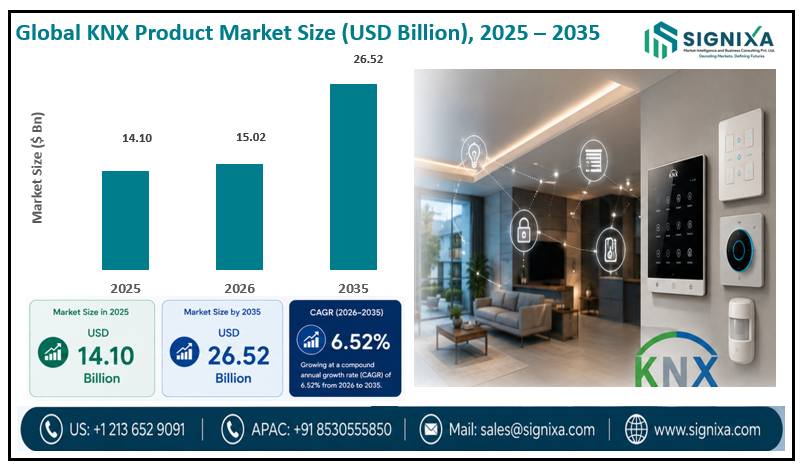
The size of the global KNX Product Market was valued at approximately USD 14.10 Billion in 2025 and is projected to reach around USD 26.52 Billion by 2035, growing at a compound annual growth rate (CAGR) of 6.52% from 2026 to 2035. The report examines the drivers and restraints affecting the KNX product market and explores opportunities that could propel growth globally.
The KNX product market includes intelligent solutions for building automation, including sensors, actuators, and system components. These products are increasingly integrated into residential, commercial, and industrial spaces to enable centralized and remote control of lighting, heating, security, and other building systems. Rising demand for smart building infrastructure, energy efficiency, and convenience is boosting global market adoption.
The KNX Products market revolves around devices, components, and systems that adhere to the KNX standard, a globally recognized open protocol for smart home and building automation. This standard enables seamless communication and interoperability between various building functions, including lighting, HVAC (heating, ventilation, and air conditioning), security systems, energy management, blinds/shutters, and audio/video control. The market is driven by the increasing demand for intelligent building solutions that enhance comfort, convenience, and, critically, energy efficiency. KNX products, such as sensors (e.g., presence detectors, temperature sensors), actuators (e.g., dimming units, heating valves), system devices (e.g., power supplies, couplers), and user interfaces (e.g., touch panels, switches), form the backbone of these integrated systems. Their ability to connect devices from different manufacturers into a unified, intelligent network distinguishes KNX from many proprietary automation systems, offering flexibility and future-proofing for building owners and developers. The market's growth is further propelled by the rising awareness of climate change and the imperative for sustainable building practices, with KNX systems demonstrably contributing to significant energy savings.
A key factor shaping the KNX products market is the growing emphasis on energy efficiency and sustainability in both new construction and retrofitting projects. As energy costs continue to rise and governments worldwide implement stricter regulations and incentives for green buildings, the adoption of KNX systems becomes increasingly attractive. KNX's ability to provide granular control over various building functions allows for optimized energy consumption, such as daylight harvesting in lighting, occupancy-based climate control, and automated shading based on external weather conditions. This not only translates into substantial operational cost savings for building owners but also contributes to reduced carbon footprints and helps achieve environmental certifications. Beyond energy management, the market is also influenced by the desire for enhanced user comfort and convenience. KNX systems offer centralized control through intuitive interfaces like wall panels, smartphones, and tablets, allowing occupants to effortlessly manage their environment. This includes creating personalized scenes for lighting and climate, automating daily routines, and integrating security features for peace of mind.
Furthermore, the KNX products market is heavily influenced by technological advancements and the increasing integration with other smart technologies. The convergence of KNX with the Internet of Things (IoT), Artificial Intelligence (AI), and cloud computing is opening up new possibilities for smarter, more adaptive building environments. This integration enables features such as predictive maintenance, intelligent energy consumption optimization based on real-time data, and highly personalized indoor experiences. For instance, KNX systems can now be seamlessly integrated with voice assistants like Alexa and Google Home for intuitive voice control. The market is also seeing innovation in product design, with manufacturers developing more compact, aesthetically pleasing devices and exploring wireless KNX (KNX RF) solutions for easier installation and retrofitting, particularly in existing buildings where extensive wiring might be challenging. The ongoing global promotion by the KNX Association, which fosters a robust ecosystem of certified manufacturers, system integrators, and training centers, ensures the standard's continued development and widespread adoption, reinforcing its position as a leading open protocol in building automation.
Key Findings
- The global KNX Product market is expected to grow at a CAGR of 6.52% during the forecast period (2026–2035).
- The market was valued at USD 14.10 Billion in 2025 and is projected to reach USD 26.52 Billion by 2035.
- Based on Type, the Sensor segment is expected to witness strong growth due to increasing demand for real-time environmental monitoring, occupancy detection, and energy management applications in smart buildings.
- By Application, the Residential Buildings segment is expected to dominate the market owing to the growing adoption of smart home technologies, connected devices, and automated building control systems.
- In terms of Sales Channel, the Distribution Channel segment is anticipated to command the largest market share due to its extensive network, wider product availability, and strong relationships with system integrators and installers.
- Regionally, Europe is projected to lead the global market, supported by favorable government initiatives, stringent energy-efficiency regulations, and increasing investments in smart and sustainable building infrastructure.
KNX Product Market Dynamics
Growing adoption of smart home and smart building technologies is one of the leading drivers of the KNX product market. As of 2024, over 300 Million smart homes are in operation worldwide, reflecting the increasing preference for automated systems that enhance comfort and energy efficiency. KNX-based devices allow seamless integration of systems like lighting, HVAC, and security, making them integral to modern building automation.
Supportive regulatory frameworks and environmental policies in regions like Europe and North America are further boosting demand for KNX systems. EU directives promoting energy performance in buildings and mandates for low-carbon construction encourage the integration of KNX components. For example, the Energy Performance of Buildings Directive (EPBD) calls for automation in all new non-residential buildings by 2026, enhancing KNX adoption across the continent.
The demand for energy-efficient and scalable automation solutions in commercial infrastructure is another crucial factor. According to the International Energy Agency (IEA), buildings consume nearly 30% of global energy, driving businesses to invest in smart technologies. KNX-based systems reduce energy use by enabling precise control over lighting and HVAC, helping companies meet sustainability targets and reduce operational costs.
Rising investments in smart city projects across Asia-Pacific and the Middle East are unlocking new opportunities. Governments are investing heavily in building infrastructure equipped with advanced automation. For instance, India's Smart Cities Mission has prioritized intelligent building systems, including KNX-compatible products, to promote safety, convenience, and sustainability. Such initiatives are likely to accelerate market growth in emerging regions.
The KNX Products market is experiencing robust growth driven by a confluence of factors, primarily the escalating global demand for smart home and building automation. As societies become more digitized and energy costs continue to rise, there's an increasing imperative to create intelligent environments that offer enhanced comfort, convenience, and crucially, significant energy savings. KNX, as a globally recognized open standard, is perfectly positioned to address these needs due to its inherent interoperability and vendor-neutral approach, allowing seamless communication between devices from over 500 manufacturers. This open ecosystem fosters flexibility and future-proofing, attracting developers and building owners who seek integrated solutions for lighting, HVAC, security, and energy management. Furthermore, stringent energy efficiency regulations implemented by governments worldwide, coupled with a growing focus on sustainability and green building certifications, and are powerful accelerators for KNX adoption. The tangible benefits of reduced operational costs and a lower carbon footprint are compelling incentives for both new construction projects and the extensive retrofitting of existing buildings, ensuring sustained demand for KNX products.
Despite its strong drivers, the KNX Products market faces certain challenges that can impede its broader adoption. A significant restraint is the relatively high initial cost of installation compared to traditional electrical systems or some proprietary smart home solutions. While KNX promises long-term energy savings and enhanced functionality, the upfront investment in specialized hardware, certified components, and the requirement for highly skilled professionals for design, installation, and commissioning can be a barrier, particularly for price-sensitive consumers or smaller commercial projects. This complexity also leads to a lack of widespread awareness among general consumers and even some segments of the construction industry about the full benefits and capabilities of KNX. The need for specialized training for system integrators and installers, while ensuring quality, also contributes to a perceived skills gap, which can slow down deployment in certain regions. Moreover, while KNX is an open standard, ensuring seamless interoperability across every single device from every manufacturer can still present minor integration complexities, especially when combining with non-KNX smart home ecosystems or legacy building management systems. Addressing these cost, awareness, and complexity concerns through simplified solutions and enhanced training programs is crucial for overcoming these hurdles.
KNX Product Market Segmentation Analysis
By Type Segment Analysis
By Type Wise, Sensors are essential for detecting temperature, light, occupancy, and air quality in smart environments. They enable automated control responses in real-time, improving energy efficiency and user comfort. Increasing installation of multifunctional sensors in smart homes and offices is expected to drive segment growth. They account for more than 35% market share. Actuators, these devices receive commands from controllers and sensors to operate physical mechanisms like window blinds, valves, or lighting systems. The expansion of HVAC automation and lighting control systems is fostering actuator demand in both new construction and retrofits. System Components includes gateways, power supplies, programming tools, and controllers that ensure system interoperability. Rising complexity in smart buildings is increasing the requirement for robust backbone components, reinforcing growth in this segment.
By Application Segment Analysis
By application wise, residential buildings, growing urbanization, increasing awareness of energy conservation, and demand for home automation are driving the adoption of KNX solutions in the residential segment. Integration of lighting, climate control, and security systems enhances convenience, security, and energy savings. Commercial Buildings, KNX technology is widely used in office buildings, shopping malls, hotels, and hospitals for managing energy and facilities. Enhanced operational efficiency and reduced energy bills make KNX a preferred solution. Others includes applications in industrial and government buildings, where automation is essential for monitoring and managing diverse operational needs.
Report Attributes & Market Scope
| Report Attribute | Details |
|---|---|
| Market Size Value in 2025 | USD 14.10 Billion |
| Market Size Value in 2035 | USD 26.52 Billion |
| CAGR (2026–2035) | 6.52% |
| Base Year Used for Estimation | 2025 |
| Historic Data | 2020 - 2025 |
| Forecast Period | 2026 - 2035 |
| Segments Covered – By Type |
|
| Segments Covered – By Application |
|
| Segments Covered – By Sales Channel |
|
| Regions Covered | North America, Europe, Asia Pacific, Latin America, Middle East and Africa |
| Major Countries Covered | U.S., Canada, Mexico, Germany, UK, France, Italy, Spain, Russia, China, Japan, South Korea, India, Southeast Asia Countries, Brazil, Argentina, GCC Countries, Turkey, Iran, Israel, South Africa, Egypt, Nigeria, etc. |
| Key Companies Profiled | Siemens AG, ABB Ltd., Schneider Electric, Hager Group, Gira, Theben AG, Jung, Legrand, MDT Technologies, and Zennio Avance y Tecnología, among others. |
KNX Product Market Regional Analysis
Europe remains the largest regional market for KNX products, driven by robust regulatory frameworks, high awareness of sustainable building practices, and widespread adoption of automation standards. Germany, France, and the UK are key countries leading implementation. The Asia-Pacific market is growing fastest due to rapid urbanization, infrastructure investment, and government-led smart building initiatives in China, Japan, and India. North America is experiencing steady growth driven by commercial retrofitting and energy-efficiency mandates. Latin America and the Middle East & Africa are emerging markets with increasing smart infrastructure development and public-private partnerships supporting automation deployment.
North America
North America's KNX Products market is experiencing substantial growth, driven by a burgeoning demand for smart building technologies and a strong emphasis on energy efficiency. The United States, in particular, leads the adoption due to increasing urbanization, tightening energy efficiency regulations, and a growing consumer interest in smart homes and commercial automation. While KNX has historically been more prevalent in Europe, North America is rapidly catching up, with increasing awareness among developers, architects, and system integrators about the benefits of an open, interoperable standard. The market sees demand from both the residential sector for integrated home automation (lighting, HVAC, security) and the commercial sector for advanced building management systems that optimize energy consumption and operational efficiencies. Strategic partnerships between KNX manufacturers and local system integrators, along with increasing training initiatives, are crucial for overcoming initial installation costs and promoting wider adoption in this highly competitive region where KNX also faces competition from other proprietary and open protocols like Z-Wave and Zigbee.
Europe (Dominant Region)
Europe remains the largest and most mature market for KNX Products globally, primarily due to its early standardization and strong commitment to energy efficiency and sustainability in building regulations. Countries like Germany, Belgium, and the Netherlands have a deeply embedded culture of KNX adoption, often mandated in new constructions for energy-efficient systems. Initiatives such as the European Union's Energy Efficiency Directive and the broader European Green Deal, which aim for climate neutrality, have significantly accelerated the integration of KNX systems, especially in commercial buildings and public infrastructure. The market is characterized by a high number of certified system integrators, a robust supply chain from numerous KNX manufacturers, and a strong focus on technical expertise and reliability. European consumers and businesses prioritize long-term cost savings through optimized energy consumption, enhanced comfort, and the future-proofing capabilities offered by KNX's open standard, ensuring its continued dominance in the region.
Asia Pacific
The Asia Pacific region is rapidly emerging as a high-growth market for KNX Products, fueled by unprecedented urbanization, significant investments in smart city initiatives, and a burgeoning construction sector, particularly in China, Japan, South Korea, and India. As these economies develop, there's a strong drive to adopt advanced building automation solutions that improve energy efficiency, enhance security, and provide greater comfort in both residential and commercial spaces. While awareness and adoption levels vary across countries, there's a clear trajectory towards the integration of intelligent building systems. The scalability and interoperability of KNX are appealing to large-scale development projects and smart city frameworks. Local manufacturing capabilities are also increasing, making KNX products more accessible and competitive. However, the market still faces challenges related to the initial investment cost and the need for more specialized training for installers, though these are being addressed by the increasing presence and promotional efforts of global KNX manufacturers and associations in the region.
Middle East & Africa
The Middle East and Africa (MEA) region represents an evolving market for KNX Products, driven primarily by ambitious infrastructure development projects, rapid urbanization, and a growing emphasis on creating sustainable and smart buildings, particularly in the Gulf Cooperation Council (GCC) countries. Nations like the UAE, Saudi Arabia, and Qatar are investing heavily in iconic smart cities and large commercial developments, where integrated building automation systems are a key component. The demand for KNX stems from the desire for energy optimization, enhanced luxury, and sophisticated control over various building functions in both high-end residential and commercial properties. While the market is still developing in many parts of Africa, there's a gradual increase in interest as economies grow and awareness of smart building technologies expands. Key challenges include the initial capital expenditure for KNX systems and the availability of skilled integrators, but significant government support for smart initiatives and an increasing number of international manufacturers entering the region are fostering continuous growth.
Recent Developments in the KNX Product Market
-
2026
KNX Association Expanded the adoption of KNX IoT technologies, promoting seamless interoperability between smart building systems and IoT-enabled devices to support enhanced automation and energy management capabilities.
Siemens AG Expanded its KNX-compatible building automation portfolio with integrated solutions for smart commercial buildings, focusing on energy optimization, operational efficiency, and centralized building control.
-
2025
KNX Association Launched KNX Standard Version 3.0.4, introducing updates related to energy management, product certification, testing procedures, and interoperability requirements across KNX-enabled devices.
Schneider Electric Expanded its KNX home and building automation portfolio with advanced solutions for lighting control, HVAC management, and energy monitoring across residential and commercial applications.
Legrand SA Introduced new KNX-enabled smart building products designed to improve occupant comfort, energy efficiency, and intelligent control capabilities within modern building environments.
KNX Product Market: Competitive Landscape
The KNX product market is characterized by strong competition among global players such as ABB, Siemens, Schneider Electric, Hager Group, and Gira. These companies focus on product innovation, integration with IoT, and user-friendly interfaces to strengthen their market positions. Regional players are also gaining traction through customized solutions and competitive pricing. Strategic partnerships with system integrators and increasing investment in R&D are key trends. Europe leads in vendor presence due to early adoption, while Asia-Pacific is witnessing rising activity from emerging manufacturers.
The competitive landscape of the KNX Products market is largely shaped by the standard's open protocol nature, which fosters a unique ecosystem of collaboration and competition. Unlike proprietary systems where a single vendor controls the entire chain, KNX thrives on interoperability between products from numerous manufacturers. This means that while individual manufacturers compete on product design, features, quality, and price for specific components (e.g., sensors, actuators, touch panels), the overall competitiveness of the KNX ecosystem relies on the seamless integration and functionality of these diverse products. This structure benefits system integrators and end-users, as it avoids vendor lock-in and allows for "best-of-breed" solutions to be assembled from various suppliers. Major electrical and building technology giants, with their extensive R&D budgets and global distribution networks, form the core of the manufacturing base, producing a wide range of KNX certified devices. Their competitive strategies often involve offering comprehensive solutions, expanding their product portfolios, and investing in training and certification programs for installers to ensure widespread adoption and proper implementation of their components within KNX systems.
Despite the collaborative nature of the KNX standard, intense competition exists at various levels of the value chain. Manufacturers compete on innovation, introducing new product functionalities like wireless KNX (KNX RF) for easier retrofitting, smarter sensors with AI capabilities, and more intuitive user interfaces. Aesthetic design is also a significant differentiator, particularly in residential and high-end commercial projects where seamlessly integrated and visually appealing devices are crucial. Beyond manufacturing, the competitive landscape extends to system integrators, who differentiate themselves through their expertise, project experience, customer service, and ability to deliver complex, customized KNX solutions. The growth of smart home and building automation has also brought KNX into competition with other communication protocols and ecosystems (e.g., Z-Wave, Zigbee, BACnet, Modbus). While KNX's robustness, scalability, and long-standing presence make it a preferred choice for large-scale commercial and high-end residential projects, these alternatives often compete in simpler, more cost-sensitive applications. The ongoing competition ultimately drives innovation and the continuous enhancement of KNX products and services to meet evolving market demands for smarter, more energy-efficient, and user-friendly building automation solutions.
Key Companies Profiled
- Schneider Electric
- Siemens AG
- ABB Ltd.
- Legrand SA
- Hager Group
- Jung GmbH
- Gira Giersiepen GmbH & Co. KG
- Theben AG
- MDT Technologies GmbH
- Zennio Avance y Tecnología
- Basalte
- Loxone Electronics GmbH
- Berker GmbH
- Busch-Jaeger (ABB)
- Control4 Corporation
- Steinel GmbH
- Ekinex S.p.A.
- Tense BVBA
- Tapko Technologies GmbH
- Weinzierl Engineering GmbH
Global KNX Product Market Segmentation Summary
By Type
- Sensors
- Actuators
- System Components
By Application
- Residential Buildings
- Commercial Buildings
- Others
By Sales Channel
- Direct Channel
- Distribution Channel
By Region
- North America
- U.S.
- Canada
- Mexico
- Europe
- Germany
- France
- UK
- Spain
- Italy
- Rest of Europe
- Asia-Pacific
- China
- Japan
- India
- Australia
- South Korea
- Southeast Asia
- Rest of Asia-Pacific
- Latin America
- Brazil
- Argentina
- Rest of Latin America
- The Middle East & Africa
- GCC Countries
- South Africa
- Rest of the Middle East & Africa
Frequently Asked Questions (FAQs) About the KNX Product Market
What is an KNX Product?
KNX products are smart building automation devices based on the KNX standard, enabling centralized and remote control of systems such as lighting, HVAC, shading, and security. These include sensors, actuators, and control components used in residential, commercial, and industrial buildings.
Which key factors will influence the KNX Product Market growth over 2026–2035?
The KNX product market is expected to grow due to rising adoption of smart buildings, energy-efficiency regulations, urbanization, and demand for integrated home and building automation solutions.
What will be the value of the KNX Product Market during 2026–2035?
The global KNX Product Market accounted for around USD 14.10 Billion in 2025 and is forecast to attain a value of approximately USD 26.52 Billion by 2035, reflecting significant growth throughout the forecast period.
What will be the CAGR value of the KNX Product Market during 2026–2035?
The KNX Product Market is projected to grow at a CAGR of 6.52% during the forecast period of 2026–2035. The market growth is driven by the increasing adoption of smart homes and smart buildings, rising demand for energy-efficient automation systems, and growing investments in intelligent building management solutions.
Which region will contribute notably towards the KNX Product Market value?
Europe will lead the global KNX product market due to government mandates on energy-efficient buildings, strong adoption of automation standards, and mature infrastructure in countries such as Germany, France, and the UK.
Which are the major players leveraging the KNX Product Market growth?
The global KNX product market is driven by companies such as Siemens AG, ABB Ltd., Schneider Electric, Hager Group, Gira, Theben AG, Jung, Legrand, MDT Technologies, and Zennio Avance y Tecnología.
What can be expected from the global KNX Product Market report?
The report provides an in-depth overview of the KNX product market, analyzing key growth drivers, regulatory trends, competitive dynamics, and market forecasts, while evaluating opportunities and challenges across various regions and application sectors.