

Industrial Logistics Robot Market Overview
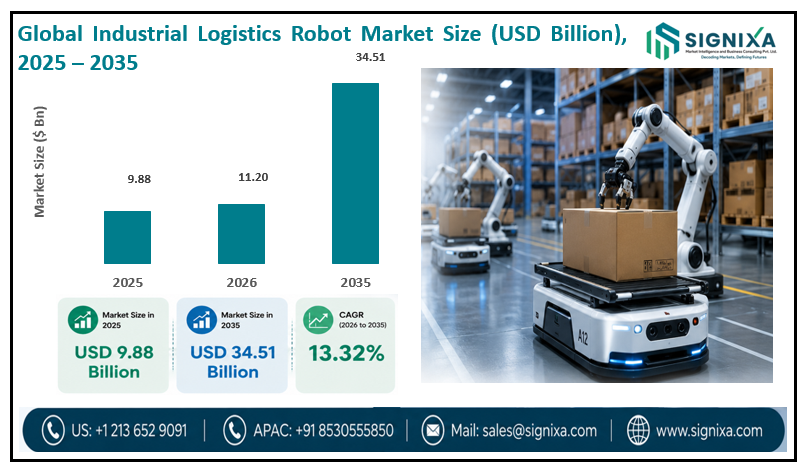
The size of the global Industrial Logistics Robot Market was valued at approximately USD 9.88 Billion in 2025 and is projected to reach around USD 34.51 Billion by 2035, growing at a compound annual growth rate (CAGR) of 13.32% from 2026 to 2035. This growth is driven by increasing demand for automation in logistics operations, advancements in robotics technology, and the need for efficient material handling solutions.
The industrial logistics robot market encompasses robotic systems designed to automate various logistics operations, including material handling, palletizing, transportation, and order fulfilment. The adoption of these robots enhances operational efficiency, reduces labor costs, and improves accuracy in logistics processes. The market is witnessing significant growth due to the rising e-commerce sector, labor shortages, and the need for faster and more reliable logistics solutions. The industrial logistics robot market is experiencing rapid expansion, reflecting a fundamental shift in how goods are moved, stored, and managed across various industries. This market, encompassing technologies like Automated Guided Vehicles (AGVs), Autonomous Mobile Robots (AMRs), robotic arms, and automated storage and retrieval systems (AS/RS), is projected to reach significant valuations in the coming years.
The primary driver behind this growth is the increasing demand for operational efficiency and cost reduction in warehousing, distribution centers, and manufacturing facilities. As companies strive to optimize their supply chains, reduce manual handling errors, and accelerate order fulfilment, industrial logistics robots offer a compelling solution by automating repetitive, labor-intensive, and often ergonomically challenging tasks, leading to higher throughput, improved accuracy, and reduced labor costs. Furthermore, the explosive growth of e-commerce and the increasing consumer expectation for faster delivery times (e.g., same-day or next-day delivery) have created immense pressure on logistics operations. Industrial logistics robots are critical to meeting these demands by streamlining processes such as picking, packing, sorting, and material transportation within warehouses and fulfilment centers. The integration of advanced technologies like Artificial Intelligence (AI), Machine Learning (ML), and the Internet of Things (IoT) is further enhancing the capabilities of these robots, enabling them to navigate complex environments autonomously, optimize routes, and make real-time decisions. This technological evolution allows for greater flexibility and adaptability in logistics operations, crucial for handling diverse product portfolios and fluctuating demand volumes, thereby solidifying the market's robust growth trajectory.
Despite the promising outlook, the industrial logistics robot market faces several significant challenges that can influence its adoption rate and development. The most prominent hurdle is the high upfront capital investment required for purchasing, installing, and integrating these sophisticated robotic systems. This substantial financial outlay can be a significant barrier for small and medium-sized enterprises (SMEs), limiting their ability to leverage automation and remain competitive with larger, more automated players. Beyond the initial cost, the complexity of integrating new robotic systems with existing legacy infrastructure and warehouse management systems (WMS) can also be challenging, often requiring specialized expertise and significant customization, which adds to the overall cost and implementation time. Moreover, the successful deployment of industrial logistics robots necessitates a skilled workforce capable of programming, operating, and maintaining these advanced machines. A shortage of such skilled personnel can impede adoption, as companies struggle to find and train employees who can effectively manage automated systems. While robots reduce manual labor for repetitive tasks, they create a demand for new skill sets related to robotics and automation technology. Additionally, ensuring the safety of human-robot collaboration, particularly with the rise of collaborative robots (cobots), requires careful planning, robust safety protocols, and adherence to evolving industry standards. Addressing these challenges related to cost, integration complexity, and talent development will be crucial for the widespread and sustained adoption of industrial logistics robots across various industries.
Key Findings
- The global Industrial Logistics Robot market is expected to grow at a CAGR of 13.32% during the forecast period (2026–2035).
- The market was valued at USD 9.88 Billion in 2025 and is projected to reach USD 34.51 Billion by 2035.
- Automated Guided Vehicles (AGVs) and Autonomous Mobile Robots (AMRs) are anticipated to dominate the market due to their versatility and efficiency in logistics operations.
- The transportation segment is expected to hold the largest market share among applications, driven by the need for efficient movement of goods within warehouses and distribution centers.
- Asia-Pacific is projected to lead the market growth, attributed to rapid industrialization, expansion of the e-commerce sector, and increasing investments in automation technologies.
Industrial Logistics Robot Market Dynamics
The industrial logistics robot market is experiencing robust growth, propelled by the increasing need for automation in logistics and supply chain operations. The surge in e-commerce activities has led to a higher demand for efficient order fulfilment and inventory management, which robots can effectively address. Additionally, labor shortages and rising labor costs are encouraging companies to adopt robotic solutions to maintain productivity and competitiveness. Technological advancements in robotics, such as improved sensors, artificial intelligence, and machine learning, have enhanced the capabilities of logistics robots, making them more adaptable and efficient. These innovations enable robots to operate in dynamic environments, collaborate with human workers, and perform complex tasks with greater precision. As a result, businesses are increasingly integrating robotics into their logistics operations to optimize performance and reduce operational costs.
The industrial logistics robot market's dynamics are profoundly shaped by the escalating pressures on global supply chains and the continuous evolution of consumer behavior. A primary driving force is the explosive growth of e-commerce and omnichannel retail. Consumers' increasing expectations for faster delivery times, including same-day and next-day options, have placed immense strain on traditional warehouse and distribution center operations. Industrial logistics robots, such as Autonomous Mobile Robots (AMRs) for goods-to-person picking and Automated Storage and Retrieval Systems (AS/RS) for high-density storage, are becoming indispensable tools for meeting these demands. They enable faster order fulfilment, significantly improve picking accuracy, and enhance overall throughput, directly addressing the complexities of managing larger inventories and diverse SKUs inherent in e-commerce. This shift necessitates automation as a strategic imperative rather than just an option for businesses aiming to remain competitive.
Furthermore, persistent labor shortages and rising labor costs across the warehousing, logistics, and manufacturing sectors globally are acting as powerful catalysts for robot adoption. Companies are finding it increasingly difficult to recruit and retain manual labor for repetitive, physically demanding, or hazardous tasks within their facilities. Industrial logistics robots offer a compelling solution by taking over these roles, thereby reducing reliance on a shrinking workforce, lowering operational expenses, and minimizing workplace injuries. This allows human workers to be redeployed to more complex, value-added tasks. Alongside these labor dynamics, significant advancements in AI, Machine Learning (ML), and sensor technologies are enhancing robot capabilities. AI-powered robots can now navigate complex warehouse layouts autonomously, optimize routes in real-time, and learn from past tasks, continuously improving their efficiency and adaptability. The integration of IoT and 5G connectivity further enables seamless communication and data exchange, leading to more intelligent and interconnected logistics operations.
Despite these robust drivers, the industrial logistics robot market faces several dynamic challenges that can influence its growth and adoption. The most significant hurdle remains the high initial capital investment required for implementing sophisticated robotic systems. This substantial upfront cost can be a major deterrent for small and medium-sized enterprises (SMEs) with limited budgets, potentially widening the automation gap between large corporations and smaller players. The complexity of integrating new robotic systems with existing legacy infrastructure and diverse warehouse management systems (WMS) also presents a considerable challenge. Seamless interoperability often requires extensive customization and specialized expertise, adding to both cost and implementation time, and can disrupt ongoing operations.
Another critical dynamic relates to the human element: the impact on the workforce and the need for skilled labor. While robots address labor shortages for repetitive tasks, they create a demand for new skills in robot operation, maintenance, and programming. Bridging this talent gap through training and upskilling programs is crucial for successful adoption. Ethical considerations, such as potential job displacement, also contribute to complex discussions around the social impact of automation. Moreover, ensuring the safe interaction between robots and human workers in shared workspaces, particularly with the rise of collaborative robots (cobots), requires continuous development of robust safety protocols and adherence to evolving industry standards. Overcoming these financial, integration, workforce, and safety challenges through ongoing innovation, standardization, and collaborative efforts across the ecosystem will be vital for the sustained expansion and widespread benefits of industrial logistics robots.
Industrial Logistics Robot Market Segmentation Analysis
By Type Segment Analysis
AGVs are widely used in logistics for transporting materials within warehouses and manufacturing facilities. In 2025, the global AGV market was valued at approximately USD 5.77 billion and is projected to reach around USD 13.09 billion by 2035, growing at a CAGR of 9.44%. The logistics and warehousing segment accounted for about 41% of the AGV market revenue in 2025, highlighting their significant role in material handling operations.
AMRs are gaining traction due to their flexibility and ability to navigate dynamic environments without fixed paths. The global AMR market was valued at around USD 8.65 billion in 2025 and is expected to reach approximately USD 23.69 billion by 2030, with a CAGR of 18.29%. In 2025, the retail and e-commerce sector held a 36% revenue share in the AMR market, driven by the need for efficient order fulfilment.
Robot arms are essential for tasks requiring precision and strength, such as palletizing and depalletizing. They are increasingly being integrated into logistics operations to handle repetitive and labor-intensive tasks, improving efficiency and reducing errors. The adoption of robot arms in logistics is expected to grow steadily, supported by advancements in robotics technology and the need for automation in material handling.
UAVs, or drones, are emerging as innovative solutions for inventory management and last-mile delivery in logistics. Their ability to access hard-to-reach areas and conduct rapid inventory checks makes them valuable assets in large warehouses and distribution centers. The integration of UAVs into logistics operations is anticipated to increase, driven by technological advancements and the pursuit of operational efficiency.
By Application Segment Analysis
Robotic palletizing and depalletizing systems are crucial for automating the stacking and unstacking of goods, enhancing throughput and reducing manual labor. These systems are widely adopted in industries such as food and beverage, pharmaceuticals, and consumer goods, where consistent and efficient handling of products is essential. The demand for robotic palletizing solutions is expected to grow, supported by the need for automation in packaging and distribution processes.
Pick and place robots are designed to handle items with speed and precision, making them ideal for sorting and order fulfilment tasks. The global pick and place robots market was valued at approximately USD 1.2 billion in 2025 and is projected to reach around USD 9.02 billion by 2032, with a CAGR of 54.01%. This rapid growth is attributed to the increasing adoption of automation in e-commerce, logistics, and food and beverage industries.
Robots used for transportation tasks, such as moving goods within warehouses, play a vital role in streamlining logistics operations. The implementation of AGVs and AMRs for transportation enhances efficiency, reduces transit times, and minimizes the risk of product damage. The transportation segment is expected to hold the largest market share among applications, driven by the growing need for efficient internal logistics solutions.
Robots are increasingly being utilized for shipment and delivery tasks, including last-mile delivery services. The use of autonomous delivery robots and drones is gaining popularity, especially in urban areas, to meet the demand for fast and contactless deliveries. The expansion of e-commerce and the emphasis on customer satisfaction are key factors driving the adoption of robotic solutions in shipment and delivery applications.
Report Attributes & Market Scope
| Report Attribute | Details |
|---|---|
| Market Size Value in 2025 | USD 9.88 Billion |
| Market Size Value in 2035 | USD 34.51 Billion |
| CAGR (2026–2035) | 13.32% |
| Base Year Used for Estimation | 2025 |
| Historic Data | 2020 - 2025 |
| Forecast Period | 2026 - 2035 |
| Segments Covered – By Type |
|
| Segments Covered – By Application |
|
| Regions Covered | North America, Europe, Asia Pacific, Latin America, Middle East and Africa |
| Major Countries Covered | U.S., Canada, Mexico, Germany, UK, France, Italy, Spain, Russia, China, Japan, South Korea, India, Southeast Asia Countries, Brazil, Argentina, GCC Countries, Turkey, Iran, Israel, South Africa, Egypt, Nigeria, etc. |
| Key Companies Profiled | ABB Ltd, KUKA AG, Toyota Industries Corporation, Fanuc Corporation, Yaskawa Electric Corporation, Kion Group AG, Toshiba Corporation, Krones AG, Kawasaki Heavy Industries Ltd., and Omron Corporation, among others. |
Industrial Logistics Robot Market Regional Analysis
The industrial logistics robots market is expanding across all regions, with Asia-Pacific leading due to rapid industrialization and technological advancements. North America and Europe follow, driven by strong regulatory support and high levels of industrial development. Emerging markets in Latin America and the Middle East & Africa are witnessing increased adoption of logistics robots, propelled by infrastructure development and the need for efficient supply chain solutions.
North America is a key player in the industrial logistics robot market, driven by its advanced technological infrastructure, robust e-commerce growth, and the pressing challenge of labor shortages across its manufacturing, warehousing, and logistics sectors. The significant expansion of online retail has put immense pressure on supply chains to deliver faster and more efficiently, compelling companies to invest heavily in automation. This includes the widespread adoption of Autonomous Mobile Robots (AMRs) for flexible material transport and goods-to-person picking, as well as Automated Guided Vehicles (AGVs) for more structured movements within fulfilment centers and factories. The market in North America is projected for substantial growth, with a CAGR around 15.9% from 2025 to 2030, indicating a strong commitment to automation.
The region's industrial base, particularly the automotive, electronics, and food and beverage sectors, is increasingly leveraging industrial robots for various logistics tasks, from material handling and assembly to packaging and palletizing. The rise of "smart factories" and Industry 4.0 initiatives in North America further accelerate the integration of AI, machine learning, and IoT with robotic systems, enabling more intelligent and adaptive logistics operations. While the high initial capital investment for these systems remains a challenge, the long-term benefits of reduced labor costs, increased throughput, improved accuracy, and enhanced workplace safety are strong motivators for continuous investment. The "Robotics-as-a-Service" (RaaS) model is also gaining traction, offering a more flexible and cost-effective entry point for businesses looking to adopt automation without significant upfront expenditures.
Europe's industrial logistics robot market is characterized by a strong focus on enhancing efficiency, optimizing resource utilization, and adapting to a dynamic labor landscape. Similar to North America, rising labor costs and a scarcity of skilled labor are compelling European manufacturers and logistics providers to invest in automation. The region's well-established automotive, electronics, and general manufacturing industries are significant adopters of industrial robots for various logistics applications, including material handling, assembly, and welding. There's a particular emphasis on collaborative robots (cobots) in Europe, which are designed to work safely alongside human operators, offering flexibility and improving productivity in shared workspaces.
The drive towards Industry 4.0 and smart factory initiatives across European countries is a major catalyst for the adoption of industrial logistics robots. This involves integrating robotic systems with advanced analytics, IoT, and AI to create highly interconnected and optimized production and logistics processes. Governments and industrial associations in Europe are actively supporting research and development in robotics and automation, aiming to maintain the region's competitive edge in advanced manufacturing. While the market faces challenges related to the high initial investment and the complexity of integrating diverse systems across different national regulatory frameworks, the continuous pursuit of operational excellence, resource efficiency, and the development of more adaptable and user-friendly robotic solutions ensure steady growth in the European industrial logistics robot market.
Recent Developments in the Industrial Logistics Robot Market
-
2026
ABB announced plans to spin off its robotics division into a separately listed company by 2026, aiming to accelerate innovation and strengthen its position in industrial automation and logistics robotics markets.
Swisslog introduced the IntraMove™ Autonomous Mobile Robot (AMR) series in 2025, providing AI-enabled horizontal pallet transportation solutions capable of handling loads up to 3,000 kg for dynamic warehouse environments.
KUKA expanded its logistics automation portfolio with the launch of the KR FORTEC PA and KR FORTEC ultra PA palletizing robot families, designed to improve throughput, payload capacity, and warehouse efficiency.
-
2025
ABB expanded its robotics portfolio in 2025 with the launch of new robot families, including Lite+, PoWa, and IRB1200, designed to support warehouse automation, material handling, and logistics operations with enhanced flexibility and ease of deployment.
Geek+ introduced an end-to-end Robot Arm Picking Station, combining robotic picking and intelligent warehouse automation technologies to enhance order fulfillment accuracy and operational productivity.
Dematic (KION Group) continued investing in integrated warehouse automation solutions, including AGVs, AMRs, sortation systems, and intelligent warehouse software to strengthen supply chain efficiency and scalability.
Logistics operators worldwide increasingly adopted AI-powered autonomous mobile robots, robotic picking systems, and automated material handling technologies to address labor shortages, improve warehouse productivity, and support growing e-commerce fulfillment demands.
Industrial Logistics Robot Market: Competitive Landscape
The industrial logistics robots market features major players such as ABB Ltd, KUKA AG, Toyota Industries Corporation, Fanuc Corporation, Yaskawa Electric Corporation, Kion Group AG, Toshiba Corporation, Krones AG, Kawasaki Heavy Industries Ltd., and Omron Corporation. These companies are investing in research and development to advance robotics technologies, focusing on product innovation, cost-efficiency, and expanding their geographical reach to gain market share in the growing industrial logistics robot’s industry.
Key Companies Profiled
- ABB Ltd.
- KUKA AG
- Toyota Industries Corporation
- Fanuc Corporation
- Yaskawa Electric Corporation
- Kion Group AG
- Toshiba Corporation
- Krones AG
- Kawasaki Heavy Industries Ltd.
- Omron Corporation
- Daifuku Co., Ltd.
- Honeywell International Inc.
- SSI SCHAEFER Group
- Geekplus Technology Co., Ltd.
- Swisslog Holding AG
Global Industrial Logistics Robot Market Segmentation Summary
By Type
- Automated Guided Vehicles (AGVs)
- Autonomous Mobile Robots (AMRs)
- Robot Arms
- Others (UAVs)
By Application
- Palletizing & De-palletizing
- Pick & Place
- Transportation
- Others (Shipment & Delivery)
By Region
- North America
- U.S.
- Canada
- Mexico
- Europe
- Germany
- France
- UK
- Spain
- Italy
- Rest of Europe
- Asia-Pacific
- China
- Japan
- India
- Australia
- South Korea
- Southeast Asia
- Rest of Asia-Pacific
- Latin America
- Brazil
- Argentina
- Rest of Latin America
- The Middle East & Africa
- GCC Countries
- South Africa
- Rest of the Middle East & Africa
Frequently Asked Questions (FAQs) About the Industrial Logistics Robot Market
What is an Industrial Logistics Robot?
Industrial logistics robots are automated machines used to transport, move, pick, pack, or manage goods within warehouses, manufacturing plants, and distribution centers. These robots improve operational efficiency, reduce labour costs, and enhance supply chain productivity through automation.
Which key factors will influence the Industrial Logistics Robot Market growth over 2026–2035?
The market is expected to grow due to increasing demand for automation in warehousing and logistics, advancements in robotics technology (including AI and sensors), rising labour costs, and the need for efficient supply chain operations across industries such as e-commerce, automotive, and manufacturing.
What will be the value of the Industrial Logistics Robot Market during 2026–2035?
The global Industrial Logistics Robot Market was valued at approximately USD 9.88 Billion in 2025 and is projected to reach around USD 34.51 Billion by 2035, growing at a significant pace over the forecast period.
What will be the CAGR value of the Industrial Logistics Robot Market during 2026–2035?
The Industrial Logistics Robot Market is expected to expand at a CAGR of 13.32% between 2026 and 2035.
Which region will contribute notably towards the Industrial Logistics Robot Market value?
The market is led by the Asia-Pacific region due to rapid industrialization, growing investments in automation, and the expansion of the e-commerce sector. North America and Europe also hold significant shares due to technological advancements and mature industrial infrastructure.
Which are the major players leveraging the Industrial Logistics Robot Market growth?
Key players in the market include ABB Ltd, KUKA AG, Toyota Industries Corporation, Fanuc Corporation, Yaskawa Electric Corporation, Kion Group AG, Toshiba Corporation, Krones AG, Kawasaki Heavy Industries Ltd., and Omron Corporation, who are focused on technological innovations and strategic partnerships.
What can be expected from the global Industrial Logistics Robot Market report?
The report provides a comprehensive overview of the industrial logistics robots market, offering in-depth analysis of market dynamics, key trends, segmentation by type and application, regional insights, competitive landscape, and future growth opportunities. It also highlights recent developments and strategic moves by major players to capitalize on market demand.