

Industrial Food Blanchers Market Overview
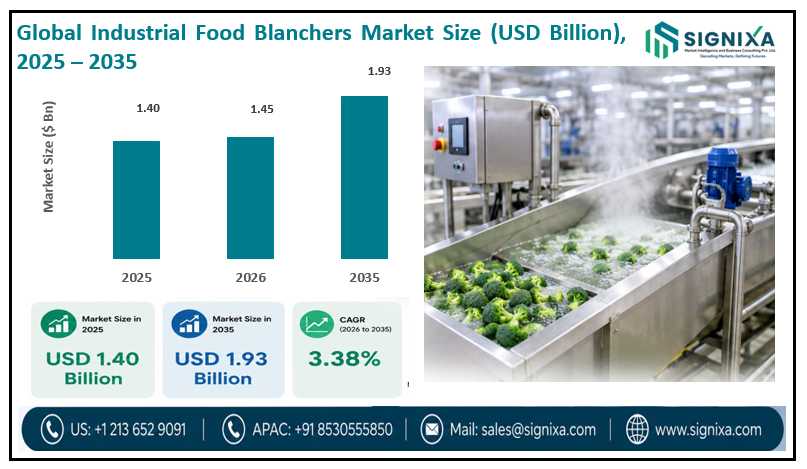
The size of the global Industrial Food Blanchers Market was valued at approximately USD 1.40 Billion in 2025 and is projected to reach around USD 1.93 Billion by 2035, growing at a compound annual growth rate (CAGR) of 3.38% from 2026 to 2035. The report analyzes the Industrial Food Blanchers market’s drivers and restraints, as well as their impact on demand throughout the projection period. In addition, the report examines global opportunities in the Industrial Food Blanchers market.
The Industrial Food Blanchers market includes equipment used to blanch food products such as vegetables, pasta, rice, and dry beans before further processing. Blanching improves product quality, texture, and shelf life by inactivating enzymes and preparing products for freezing, drying, or canning. Increasing demand for pre-processed and frozen foods, coupled with growing food processing industry investments worldwide, is boosting the demand for industrial food blanchers. Technological advancements, such as energy-efficient blanching systems and continuous flow blanchers, are further propelling market expansion.
Key Findings
- The global Industrial Food Blanchers market is expected to grow at a CAGR of 3.38% during the forecast period (2026–2035).
- The market was valued at USD 1.40 Billion in 2025 and is projected to reach USD 1.93 Billion by 2035.
- The market is projected to grow at a steady rate due to the rising global consumption of processed and convenience foods.
- Based on Type, the Belt Blanchers segment is growing at a high rate and is expected to dominate the market share.
- On the basis of Application, the Vegetables segment is anticipated to command the largest market share.
- By Region, Asia-Pacific is projected to lead the global market during the forecast period.
Industrial Food Blanchers Market Dynamics
One of the primary drivers of the Industrial Food Blanchers market is the growing demand for processed and convenience foods worldwide. Urbanization, busy lifestyles, and the preference for ready-to-cook and ready-to-eat meals are fueling the need for efficient food processing technologies. Industrial blanchers play a critical role in maintaining food quality, appearance, and safety before packaging or freezing, driving their adoption among food processors seeking consistent product quality and extended shelf life.
Technological advancements in blanching equipment are another significant factor boosting the market. Modern industrial blanchers offer higher energy efficiency, water recycling capabilities, and better process control through automation and real-time monitoring. Innovations such as multi-zone temperature controls and continuous belt blanchers allow precise treatment for different food products, ensuring uniformity and minimizing processing time. These improvements are making industrial blanchers more attractive investments for manufacturers focused on sustainability and production efficiency.
Furthermore, the expanding global frozen food sector is contributing to the growth of the industrial food blanchers market. Blanching is a crucial pre-treatment step for frozen vegetables, fruits, and even pasta, helping maintain color, flavor, and nutritional value during storage. With the frozen foods market projected to grow consistently, food processors are upgrading or investing in new blanching equipment to meet quality standards and regulatory compliance, particularly in developed economies where food safety is heavily emphasized.
Industrial Food Blanchers Market Segmentation Analysis
By Type Segment Analysis
Drum Blanchers are witnessing steady adoption, particularly for robust and large-volume processing applications. These blanchers accounted for approximately 25% of the global market share in 2025, supported by their ability to handle irregularly shaped products like vegetables and beans efficiently. Their rotating drum mechanism ensures even heat exposure, making them ideal for operations where consistent quality is paramount.
Screw Blanchers are gaining popularity, capturing close to 18% of the market in 2025. These systems offer enhanced agitation and flexibility, allowing uniform blanching of fragile products such as pasta or delicate vegetables. Their controlled screw movement enables gentle product handling, minimizing damage, which is a critical factor driving their demand in high-value food processing lines.
Belt Blanchers dominated the market in 2025, holding more than 50% of the global revenue share. Their continuous operation, high throughput capacity, and ability to process a wide range of products—from leafy greens to diced vegetables—make them the preferred choice for large-scale food processors. Belt blanchers' flexibility in adjusting blanching time and temperature zones further boosts their adoption in modern food processing facilities.
By Application Segment Analysis
Pasta processing accounted for approximately 15% of the global blancher market revenue in 2025. Blanching pasta before freezing or packaging helps maintain its texture and prevents overcooking during final preparation by consumers. Industrial blanchers designed for pasta applications ensure optimal moisture retention and consistent quality in mass production environments.
Rice processing applications contributed around 10% of the total market share in 2025. Pre-blanching rice improves its color and cooking consistency, critical for parboiled rice production. Food processors targeting the growing packaged rice and ready-to-eat meal segments are increasingly integrating blanching systems to improve final product quality and appeal.
Vegetable blanching dominated application use, commanding approximately 45% of the blanchers market in 2025. Vegetables like broccoli, green beans, carrots, and spinach require blanching to preserve their color, flavor, and nutritional value. As demand for frozen vegetables rises worldwide, investments in advanced vegetable blanching equipment are increasing, particularly in Asia-Pacific and North America.
Dry Beans processing captured nearly 12% of the global market share in 2025. Blanching dry beans helps reduce cooking time, remove anti-nutrients, and improve digestibility, making them more appealing for use in canned foods and prepared meal kits. The growing popularity of plant-based diets is driving the processing of beans, boosting demand for specialized blanchers.
Other applications—including fruits and specialty foods represented about 18% of the market in 2025. These niche sectors are expanding as manufacturers explore new product lines in frozen foods, exotic vegetables, and pre-cooked ingredients, all of which require tailored blanching processes to ensure quality and safety.
Report Attributes & Market Scope
| Report Attribute | Details |
|---|---|
| Market Size Value in 2025 | USD 1.40 Billion |
| Market Size Value in 2035 | USD 1.93 Billion |
| CAGR (2026–2035) | 3.38% |
| Base Year Used for Estimation | 2025 |
| Historic Data | 2020 - 2025 |
| Forecast Period | 2026 - 2035 |
| Segments Covered – By Product Type |
|
| Segments Covered – By Application |
|
| Regions Covered | North America, Europe, Asia Pacific, Latin America, Middle East and Africa |
| Major Countries Covered | U.S., Canada, Mexico, Germany, UK, France, Italy, Spain, Russia, China, Japan, South Korea, India, Southeast Asia Countries, Brazil, Argentina, GCC Countries, Turkey, Iran, Israel, South Africa, Egypt, Nigeria, etc. |
| Key Companies Profiled | Lyco Manufacturing, Buhler AG, Urschel Laboratories Inc., Cabinplant A/S, Heat and Control Inc., JBT Corporation, Turatti Group, Blentech Corporation, FPS Food Process Solutions Corp., and Eillert B.V., among others. |
Industrial Food Blanchers Market Regional Analysis
The global Industrial Food Blanchers market is witnessing steady growth across major regions, supported by the increasing demand for processed, frozen, and ready-to-eat food products. Asia-Pacific continues to be the dominant regional market, driven by rapid urbanization, changing dietary preferences, rising disposable incomes, and significant investments in food processing infrastructure. Countries such as China, India, Japan, and Southeast Asian nations are experiencing growing consumption of frozen vegetables, packaged meals, and convenience foods, encouraging food manufacturers to expand production capacities and invest in advanced blanching technologies.
North America represents a mature yet highly attractive market, supported by its well-established food processing industry and strong demand for frozen fruits, vegetables, and prepared meals. Stringent food safety regulations and quality standards are prompting manufacturers to modernize processing facilities with automated and energy-efficient blanching equipment. In addition, the growing preference for clean-label and minimally processed foods is driving the adoption of advanced blanching systems that help preserve nutritional value, texture, and product quality.
Europe remains a significant contributor to market growth, supported by a strong focus on food quality, sustainability, and operational efficiency. Food processors across countries such as Germany, France, Italy, the United Kingdom, and Spain are increasingly investing in energy-saving blanching technologies to reduce water consumption, lower operating costs, and comply with environmental regulations. The region's robust frozen food industry and increasing emphasis on sustainable food production practices continue to create favorable conditions for market expansion.
Latin America is emerging as a promising market, driven by the growth of the food processing sector and increasing consumer demand for packaged and convenience food products. Countries including Brazil, Mexico, and Argentina are witnessing investments in modern food manufacturing facilities, creating opportunities for blanching equipment suppliers. Similarly, the Middle East & Africa region is experiencing gradual growth as governments and private companies invest in food security initiatives, cold-chain infrastructure, and domestic food processing capabilities.
Furthermore, technological advancements are reshaping the competitive landscape of the Industrial Food Blanchers market. Manufacturers are introducing automated, continuous, and energy-efficient blanching systems equipped with advanced temperature controls, process monitoring capabilities, and water recycling features. These innovations help food processors improve productivity, reduce waste, maintain product consistency, and comply with increasingly stringent food safety requirements. As global demand for high-quality processed foods continues to rise, the adoption of advanced industrial food blanching equipment is expected to accelerate, supporting long-term market growth across both developed and emerging economies.
Recent Developments in the Industrial Food Blanchers Market
-
2026
JBT Marel expanded its food processing capabilities by strengthening its production and innovation infrastructure to support growing demand for advanced vegetable and food processing equipment across Asia-Pacific markets. The company focused on enhancing operational efficiency, automation, and sustainable food processing solutions.
Lyco Manufacturing continued to advance its blanching technology portfolio by promoting high-capacity blanching and cooling systems designed to reduce energy consumption, minimize water usage, and improve product quality for vegetable, pasta, rice, and prepared food processors.
-
2025
JBT Marel inaugurated a Global Production Center in Pune, India, aimed at expanding manufacturing capacity and accelerating the delivery of innovative food processing technologies to customers across India and the Asia-Pacific region.
JBT Marel introduced the CIPure™ Cleaning System, a digitally controlled clean-in-place solution designed to improve sanitation efficiency, reduce downtime, and support sustainable operations across food processing facilities.
JBT Marel launched the ProDOSE™ automated dosing technology, reinforcing its commitment to process automation and precision food handling solutions that help processors improve product consistency and operational performance.
Lyco Manufacturing emphasized the adoption of advanced steam and water blanching technologies that enable processors to lower operating costs, improve throughput, and enhance processing flexibility for a wide range of food applications.
Industrial Food Blanchers Market: Competitive Landscape
The global Industrial Food Blanchers market features major players such as Lyco Manufacturing, Buhler AG, Urschel Laboratories Inc., Cabinplant A/S, Heat and Control Inc., JBT Corporation, Turatti Group, Blentech Corporation, FPS Food Process Solutions Corp., and Eillert B.V., among others. Competition revolves around product innovation, operational efficiency, and service network expansion. Leading companies are investing in R&D to develop blanchers that offer enhanced water and energy savings, greater automation, and versatility to process multiple products. As the market continues to grow, companies that provide customized solutions, minimize operational costs, and ensure product quality will maintain a competitive edge.
Key Companies Profiled
- Lyco Manufacturing
- Bühler AG
- Urschel Laboratories, Inc.
- Cabinplant A/S
- Heat and Control, Inc.
- JBT Corporation
- Turatti Group
- Blentech Corporation
- FPS Food Process Solutions Corp.
- Eillert B.V.
- Marel hf.
- GEA Group AG
- Kiremko B.V.
- FENCO Food Machinery S.r.l.
- Vanmark Equipment LLC
- Allround Vegetable Processing B.V.
- Sormac B.V.
- OctoFrost Group
- Dodman Limited
- Key Technology, Inc.
- Nilma S.p.A.
- Rosenqvists Food Technologies AB
- Tomra Food
- ProEx Food, LLC
- Kanchan Metals Pvt. Ltd.
- Shandong Xiaokang Machinery Co., Ltd.
- Zhengzhou Taizy Machinery Co., Ltd.
- Food Machinery Australasia Pty Ltd.
- Scanvaegt Systems A/S
- DTS Food Processing Equipment Ltd.
Global Industrial Food Blanchers Market Segmentation Summary
By Type
- Drum Blanchers
- Screw Blanchers
- Belt Blanchers
By Application
- Pasta
- Rice
- Vegetables
- Dry Beans
- Others
By Region
- North America
- U.S.
- Canada
- Mexico
- Europe
- Germany
- France
- UK
- Spain
- Italy
- Rest of Europe
- Asia-Pacific
- China
- Japan
- India
- Australia
- South Korea
- Southeast Asia
- Rest of Asia-Pacific
- Latin America
- Brazil
- Argentina
- Rest of Latin America
- The Middle East & Africa
- GCC Countries
- South Africa
- Rest of the Middle East & Africa
Frequently Asked Questions (FAQs) About the Industrial Food Blanchers Market
What is an Industrial Food Blanchers?
An industrial food blancher is a specialized machine used to partially cook food, typically vegetables and fruits, through boiling water or steam before freezing, drying, or further processing, improving texture, color, flavor, and shelf life.
Which key factors will influence the Industrial Food Blanchers Market growth over 2026–2035?
The global industrial food blanchers market is expected to grow due to increasing demand for processed and convenience foods, advancements in food processing technologies, and rising investments in the frozen and packaged food sectors.
What will be the value of the Industrial Food Blanchers Market during 2026–2035?
The global Industrial Food Blanchers Market was valued at approximately USD 1.40 Billion in 2025 and is projected to reach around USD 1.93 Billion by 2035, growing at a significant pace over the forecast period.
What will be the CAGR value of the Industrial Food Blanchers Market during 2026–2035?
The Industrial Food Blanchers Market is expected to expand at a CAGR of 3.38% between 2026 and 2035.
Which region will contribute notably towards the Industrial Food Blanchers Market value?
The global industrial food blanchers market is led by the North American and Asia-Pacific regions, driven by the expansion of the food processing industry, technological innovations, and increasing consumption of frozen and packaged foods..
Which are the major players leveraging the Industrial Food Blanchers Market growth?
The global industrial food blanchers market is led by players such as Lyco Manufacturing, Hughes Equipment Company, Blentech Corporation, Cabinplant A/S, Heat and Control Inc., GEA Group AG, Buhler AG, Turatti Group, JBT Corporation, and DTS Food Processing Solutions.
What can be expected from the global Industrial Food Blanchers Market report?
The report explores crucial aspects of the industrial food blanchers market, including a detailed discussion of existing growth factors and restraints while also analyzing future growth opportunities and challenges that impact the market.