
Induction Motors Market Overview
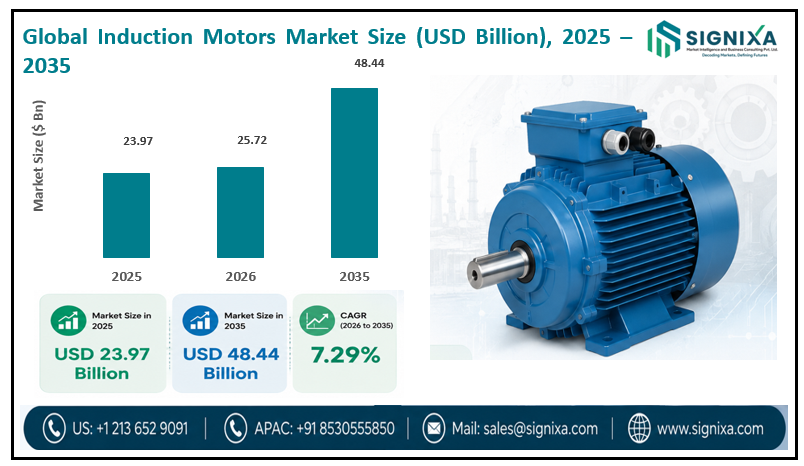
The size of the global Induction Motors Market was valued at approximately USD 23.97 Billion in 2025 and is projected to reach around USD 48.44 Billion by 2035, growing at a compound annual growth rate (CAGR) of 7.29% from 2026 to 2035. The report provides a comprehensive analysis of the market drivers and restraints influencing demand during the forecast period, alongside regional insights and growth opportunities.
The Induction Motors market features motors that are used primarily in residential, industrial, agricultural, and transportation applications due to their robustness, affordability, and low maintenance. Because industries are investing more into energy efficiency and automation, induction motors are increasingly being used in HVAC systems, pumps, conveyors, compressors, and equipment. Growing electricity consumption, technological advancements and continued infrastructure investments are also stimulating global demand.
The induction motors market is experiencing steady growth driven by rising industrial automation, energy efficiency demands, and the widespread application of these motors across multiple sectors. Induction motors, known for their robustness, simplicity, and low maintenance, are commonly used in manufacturing, HVAC systems, pumps, compressors, mining equipment, and transportation. Their ability to operate in harsh environments and handle fluctuating loads makes them ideal for both industrial and commercial use. The increased deployment of industrial machinery, rising demand for smart manufacturing solutions, and the electrification of transport systems are significantly contributing to market expansion.
Government regulations encouraging energy-efficient solutions are prompting industries to shift toward premium efficiency (IE3 and IE4) motors. This is boosting demand for high-performance induction motors that comply with global standards like IEC and NEMA. The transition toward Industry 4.0 is accelerating the adoption of variable frequency drives (VFDs) with induction motors, allowing better control, reduced energy usage, and predictive maintenance capabilities. Emerging economies are witnessing infrastructure development and industrial growth, further propelling motor installations.
Additionally, the global shift toward renewable energy is fostering the use of induction motors in wind energy and hydroelectric plants due to their durability and compatibility with fluctuating power sources. Despite competition from synchronous and permanent magnet motors in specific niches, the cost-effectiveness and operational simplicity of induction motors ensure their continued preference in a wide range of applications. Manufacturers are focusing on developing compact, noise-reduced, and thermally optimized motor designs to meet evolving industry needs, ensuring long-term market relevance and innovation in motor technologies.
Key Findings
- The global Induction Motors market is expected to grow at a CAGR of 7.29% during the forecast period (2026–2035).
- The market was valued at USD 23.97 Billion in 2025 and is projected to reach USD 48.44 Billion by 2035.
- IE3 motors are projected to dominate the market due to their high energy efficiency, reduced operating costs, and strong regulatory support promoting energy-saving industrial equipment.
- Industrial applications account for the largest market share, driven by the continued expansion of manufacturing activities, process industries, and industrial automation initiatives worldwide.
- Asia-Pacific leads the global Induction Motors Market, supported by rapid industrialization, infrastructure development, growing manufacturing investments, and government-led energy efficiency programs across major economies.
Induction Motors Market Dynamics
One of the main drivers of growth in the induction motor market is the rise in automation in manufacture and processing industrial sectors. More industries are adopting smart manufacturing and digital factories, and therefore induction motors are being used more often in robotic arms, conveyors, CNC machines, and material handling systems. According to the International Federation of Robotics, 2022 was recorded as the year with 553,000 industrial robot installations, and a substantial amount of these installations were driven by induction motors for mechanical drive.
Another important component driving the market is a growing emphasis on energy efficiency. Governments throughout the world are actively enforcing stringent standardization of high-efficiency motors (IE3 and IE4) which encourage decreased electricity costs and decreased emissions. The U.S. Department of Energy indicates that electric motors account for almost 47 percent of industrial electricity consumption globally, providing additional incentive for companies to replace legacy systems with energy-efficient induction motors to decrease operational expenditure costs and achieve sustainability goals.
Worldwide, there is a movement towards sustainable water infrastructure and strategic agricultural modernization, which is contributing to the very broad use of induction motors in irrigation systems, water pumps, and HVAC fans. Developing countries are putting significant resources into rural electrification, which has allowed for increased adoption of motorized water pumping for agricultural purposes. For example, India’s PM-KUSUM scheme is aiming to install 3.5 million solar-powered pumps, many of which require very efficient induction motors.
The induction motors market is witnessing growing momentum owing to their critical role in energy-efficient and automated industrial operations. A major driver is the global emphasis on reducing energy consumption in electric motor systems, which account for over 45% of total electricity usage in industries. Governments and international bodies are enforcing stringent energy-efficiency standards, such as IEC 60034-30 and NEMA Premium, thereby encouraging the adoption of IE3 and IE4 induction motors. The rise in smart manufacturing and Industry 4.0 initiatives across sectors like automotive, metals, cement, and food processing is fuelling demand for intelligent motor systems integrated with sensors and control units. Additionally, the resurgence of construction and infrastructure projects in emerging economies is boosting the use of HVAC systems, pumps, and conveyors, where induction motors play a central role. The electrification of public transport, including metros and railways, is also adding to motor demand. These applications highlight the widespread reliance on induction motors due to their reliability, scalability, and adaptability to fluctuating power inputs.
Despite strong demand, the induction motor market faces certain challenges. The high initial cost of energy-efficient motors compared to conventional ones can discourage small and medium enterprises from making the switch. Additionally, fluctuating raw material prices, particularly for copper and aluminum, can impact manufacturing margins. The growing popularity of permanent magnet synchronous motors in electric vehicles and robotics, due to their superior torque and compact size, poses competitive pressure. However, this challenge also drives innovation in induction motor design, such as better thermal management, noise reduction, and IoT integration. A significant opportunity lies in retrofitting aging equipment in mature industrial economies with newer high-efficiency motors. Moreover, expanding renewable energy installations—especially in wind and hydro sectors—present a promising avenue for induction motors that can operate effectively in variable power settings. The rising emphasis on predictive maintenance and remote monitoring is pushing manufacturers to develop motors with built-in diagnostics, enhancing performance and minimizing downtime. Thus, while the market navigates cost and competition pressures, innovation, retrofitting demand, and smart integration represent lucrative paths for sustained growth in the coming years.
Induction Motors Market Segmentation Analysis
By Product Type Segment Analysis
Synchronous motors provide precise speed control and are important in applications that require high positional accuracy, such as robotics and automation. Asynchronous (or induction) motors are dominant (over 70% of the electric motor market) due to their simplicity, low cost, and durability. Direct current (DC) motors are often seen in portable equipment and vehicles. The ‘Others’ category includes specialty motors with niche applications, such as servo and stepper motors, which are gaining traction in customized motion programs.
By Motor Type Segment Analysis
The IE1 and IE2 motors are still used in price-sensitive markets, demand is moving globally toward the IE3 motors due to the improved energy efficiency. Regulatory policies like the EU's Ecodesign directive and India's BEE rating systems require IE3 as a minimum standard. IE4 motors are beginning to gain traction for high-load industrial applications since they have the highest efficiency. They make sense for continuous operations and can reduce energy usage by 15% over IE3, resulting in savings in the long-term.
By Application Segment Analysis
Pumps are the leading application segment for induction motors, accounting for over 30% of the application market segment. This is especially true in industries like oil & gas, wastewater treatment, and construction, etc., where the end-user relies on a motorized pumping solution. The HVAC fan application is another important application segment, particularly in commercial buildings or industrial facilities where climate or environment control is a primary function. Motorized systems for material processing applications, in addition to compressed air systems and material handling systems account for significant use of induction motors due to their robust, load-tolerant nature and ease of control. Electric vehicle charging stations and food processing systems are emerging application markets for induction motors.
By End-Use Segment Analysis
In the global market, the industrial sector leads as the largest end-user accounting for more than 40% of the market. As the Fourth Industrial Revolution continues to take hold, factories and warehouses are investing more in electric motors to power machinery, conveyor belts, and robotic systems. The residential sector is growing with the increases in smart appliances and home based HVAC systems. The agricultural sector is benefitting from the automation of irrigation motors, grain mills, and dairy processing systems. Transportation use of induction motors includes railway cars, elevators, and escalators. Government funded infrastructure will further propel growth in all end-user categories.
Report Attributes & Market Scope
| Report Attribute | Details |
|---|---|
| Market Size Value in 2025 | USD 23.97 Billion |
| Market Size Value in 2035 | USD 48.44 Billion |
| CAGR (2026–2035) | 7.29% |
| Base Year Used for Estimation | 2025 |
| Historic Data | 2020 - 2025 |
| Forecast Period | 2026 - 2035 |
| Segments Covered – By Product Type |
|
| Segments Covered – By Motor Type |
|
| Segments Covered – By Application |
|
| Segments Covered – By End Use |
|
| Regions Covered | North America, Europe, Asia Pacific, Latin America, Middle East and Africa |
| Major Countries Covered | U.S., Canada, Mexico, Germany, UK, France, Italy, Spain, Russia, China, Japan, South Korea, India, Southeast Asia Countries, Brazil, Argentina, GCC Countries, Turkey, Iran, Israel, South Africa, Egypt, Nigeria, etc. |
| Key Companies Profiled | Siemens AG, ABB Ltd., WEG Industries, Toshiba Corporation, Nidec Motor Corporation, Schneider Electric, Regal Rexnord Corporation, TECO Electric & Machinery, Hitachi, and Emerson Electric Co, among others. |
Induction Motors Market Regional Analysis
The Asia Pacific region is at the top of the global induction motors market, owing to fast industrialization, growth in manufacturing, and government support for energy efficiency. Countries like China and India are the primary contributors to the region because of their advancing power infrastructure expansion and progress in agricultural automation. North America will follow the Asia Pacific region due to the U.S. investing in smart grid technologies, as well as electric vehicle infrastructure. Europe is another significant market because of strong regulations promoting IE3 and IE4 motor standards. Latin America and the Middle East & Africa are quickly emerging as regions of high growth as industrial automation and urbanization ramp up.
North America
In North America, the induction motors market is advancing steadily due to the region’s strong focus on industrial automation, energy efficiency, and infrastructure modernization. The U.S. remains the largest contributor, backed by high demand from industries such as manufacturing, HVAC, water treatment, and oil & gas. Government initiatives to replace aging electric motor systems with energy-efficient alternatives—aligned with Department of Energy (DOE) regulations—are prompting industries to adopt premium-grade IE3 and IE4 motors. Moreover, the widespread use of induction motors in conveyors, pumps, compressors, and fans across food processing and packaging sectors further drives regional adoption. Canada’s energy conservation programs and growing industrial sector are also boosting market prospects. North America’s technological maturity has led to early integration of smart motor technologies, including IoT-enabled predictive maintenance and variable frequency drives (VFDs), optimizing operational efficiency and lowering energy costs. The rise in electric public transportation, especially electric trains and buses, is increasing the need for robust and low-maintenance induction motors. Moreover, the region’s focus on localized production, especially in the post-pandemic scenario, is encouraging expansion of motor manufacturing facilities. Challenges such as high labour costs and raw material fluctuations persist, but incentives for energy-saving equipment help mitigate these effects. Collaborations between manufacturers and automation solution providers are also enhancing product development and adoption. Overall, North America’s induction motors market is poised for healthy growth, driven by modernization trends, sustainability targets, and a favourable regulatory landscape promoting advanced motor technologies.
Europe
Europe’s induction motors market is shaped by stringent energy efficiency regulations, a mature manufacturing base, and a growing emphasis on automation and sustainability. The European Union’s Ecodesign Directive and Minimum Energy Performance Standards (MEPS) have accelerated the shift toward high-efficiency induction motors, particularly IE3 and IE4 classes. Countries such as Germany, France, Italy, and the UK lead the regional adoption due to their strong industrial machinery, automotive, and HVAC sectors. The modernization of factory operations, coupled with the region’s push for Industry 4.0 adoption, is creating substantial demand for intelligent motor systems integrated with sensors and VFDs. In addition, Europe’s growing investment in renewable energy and electric mobility is contributing to the demand for reliable, low-maintenance induction motors in wind turbines, electric rail systems, and charging infrastructure. The region’s efforts to reduce carbon emissions have also led to the replacement of legacy motors with energy-efficient alternatives across utilities and municipal applications. Eastern European countries are emerging as new manufacturing hubs due to lower operational costs and increasing foreign investments. Challenges such as supply chain disruptions and rising input costs persist, but ongoing innovation, public funding for green technologies, and cross-border collaborations in research and development are supporting market expansion. Furthermore, a strong focus on training and skill development is ensuring the availability of a qualified workforce for advanced motor technologies. Overall, Europe’s induction motor market continues to grow steadily, fuelled by sustainability goals, industrial digitization, and robust regulatory frameworks that prioritize energy performance.
Middle East & Africa
The Middle East & Africa induction motors market is experiencing steady development, driven by rising infrastructure investments, ongoing industrialization, and increased adoption of energy-efficient technologies. Countries such as the UAE, Saudi Arabia, and South Africa are investing heavily in smart city projects, power generation, and water treatment facilities—sectors that demand durable and energy-efficient motor systems. Government-backed initiatives like Saudi Vision 2030 and UAE Energy Strategy 2050 have placed emphasis on modernizing industrial operations and reducing energy waste, prompting the replacement of traditional motors with IE2 and IE3-class induction motors in various applications. The region’s construction boom, especially in commercial buildings, airports, and metros, also fuels demand for induction motors used in HVAC systems, elevators, and pumps. In Africa, industrial development is gaining traction, supported by foreign direct investments and public-private partnerships, particularly in Nigeria, Kenya, and Egypt. Though challenges like unreliable power supply, limited access to advanced technologies, and cost constraints remain prevalent in parts of Africa, international support and local initiatives are driving progress in energy infrastructure and manufacturing sectors. Additionally, the expansion of oil & gas and mining industries across the Gulf and Sub-Saharan regions necessitates robust motor solutions capable of operating in harsh conditions. The trend toward localized production and aftermarket services is growing, enhancing product availability and technical support. While the market is fragmented and price-sensitive, increasing awareness about the long-term cost benefits of energy-efficient motors is gradually influencing procurement strategies. This is paving the way for more sustainable and modern motor applications across the Middle East and Africa.
Recent Developments in the Induction Motors Market
-
2026
ABB broadened its range of high-efficiency industrial motor solutions by introducing larger-frame IE6 synchronous reluctance motors. The expansion provides industrial operators with additional options to improve energy performance across applications such as pumps, compressors, and process equipment.
Nidec increased investments in manufacturing operations and supply chain infrastructure to address rising demand for industrial motors used in automation systems, production machinery, and energy-conscious industrial facilities.
Siemens highlighted advanced motor control and drive technologies integrated with digital automation platforms, enabling manufacturers to enhance productivity, optimize energy usage, and improve overall operational performance.
-
2025
Nidec inaugurated its Orchard Hub manufacturing campus in Karnataka, India, creating a major production base for motors, generators, drives, and industrial automation products while strengthening its presence in a rapidly growing industrial market.
Nidec Appliance, Commercial and Industrial Motors (ACIM) opened a new manufacturing facility in Qingdao, China, expanding production capabilities for industrial motors and drive systems serving commercial and industrial customers.
ABB expanded the availability of its energy-efficient motor technologies across multiple industrial sectors, supporting organizations seeking to reduce energy consumption, improve equipment performance, and comply with evolving efficiency standards.
Induction Motors Market: Competitive Landscape
Major participants in the worldwide induction motors sector comprise Siemens AG, ABB Ltd., WEG Industries, Toshiba Corporation, Nidec Motor Corporation, Schneider Electric, Regal Rexnord Corporation, TECO Electric & Machinery, Hitachi, and Emerson Electric Co. These firms devote a substantial amount of time on R&D to manufacture high-efficiency motors that obey global standards. Targeted/mergers, digital motor platforms, and geographical expansions are some of the methods employed to acquire market share. Innovations in motor control systems and progress with IoT platforms continue to help these companies provide value-added solutions to their customers.
The competitive landscape of the induction motors market is shaped by technological advancements, regulatory mandates, and energy efficiency requirements. Manufacturers are increasingly investing in research and development to design motors with higher efficiency classes, improved thermal performance, and longer operational lifespans. Innovation is particularly focused on the integration of smart sensors, predictive maintenance features, and compatibility with industrial automation systems like SCADA and IoT platforms. These developments cater to industries such as manufacturing, HVAC, oil & gas, and water treatment, which demand consistent performance under varying loads and conditions.
Companies are also expanding their global reach through strategic collaborations, joint ventures, and the establishment of localized manufacturing or service centers to address region-specific needs and reduce lead times. Price competitiveness plays a critical role in procurement decisions, especially in emerging markets where cost remains a major concern. Furthermore, compliance with international energy standards such as IEC, NEMA, and MEPS has become essential for market access, driving firms to upgrade their product lines accordingly. As the demand for sustainable and reliable industrial solutions continues to rise, the market remains dynamic, with players striving to differentiate through energy efficiency, customization, and lifecycle service offerings.
Key Companies Profiled
- Siemens AG
- ABB Ltd.
- WEG Industries
- Toshiba Corporation
- Nidec Motor Corporation
- Schneider Electric
- Regal Rexnord Corporation
- TECO Electric & Machinery Co., Ltd.
- Hitachi, Ltd.
- Emerson Electric Co.
- Mitsubishi Electric Corporation
- General Electric Company (GE Vernova)
- Rockwell Automation, Inc.
- Bharat Heavy Electricals Limited (BHEL)
- Crompton Greaves Consumer Electricals Ltd.
- CG Power and Industrial Solutions Ltd.
- Kirloskar Electric Company Ltd.
Global Induction Motors Market Segmentation Summary
By Product Type
- Synchronous Motors
- Asynchronous Motors
- Direct Current Motors
- Others
By Motor Type
- IE1
- IE2
- IE3
- IE4
By Application
- Pumps
- HVAC Fans
- Material Processing
- Compressed Air
- Material Handling
- Others
By End User
- Residential
- Industrial
- Agricultural Sector
- Transportation
- Others
By Region
- North America
- U.S.
- Canada
- Mexico
- Europe
- Germany
- France
- UK
- Spain
- Italy
- Rest of Europe
- Asia-Pacific
- China
- Japan
- India
- Australia
- South Korea
- Southeast Asia
- Rest of Asia-Pacific
- Latin America
- Brazil
- Argentina
- Rest of Latin America
- The Middle East & Africa
- GCC Countries
- South Africa
- Rest of the Middle East & Africa
Frequently Asked Questions (FAQs) About the Induction Motors Market
What is an Induction Motors?
An induction motor is an AC electric motor where power is supplied to the rotor by electromagnetic induction rather than direct connection. It is widely used in industrial, residential, and commercial applications due to its simplicity, durability, and cost-effectiveness.
Which key factors will influence the Induction Motors Market growth over 2026–2035?
The induction motors market is set to grow due to increasing industrial automation, stringent energy efficiency regulations (e.g., IE3 and IE4 standards), rising infrastructure development, and the expanding use of electric motors in HVAC, manufacturing, and transport applications.
What will be the value of the Induction Motors Market during 2026–2035?
The global Induction Motors Market was valued at approximately USD 23.97 Billion in 2025 and is projected to reach around USD 48.44 Billion by 2035, growing at a significant pace over the forecast period.
What will be the CAGR value of the Induction Motors Market during 2026–2035?
The Induction Motors Market is expected to expand at a CAGR of 7.29% between 2026 and 2035.
Which region will contribute notably towards the Induction Motors Market value?
Asia-Pacific will continue to lead the global market, fuelled by rapid industrialization in China and India, government investments in infrastructure, and the increasing adoption of energy-efficient motor technologies across industries.
Which are the major players leveraging the Induction Motors Market growth?
Key companies in the global induction motors market include ABB Ltd., Siemens AG, WEG Industries, Nidec Corporation, Toshiba Corporation, Schneider Electric, Regal Rexnord Corporation, TECO Electric & Machinery, Emerson Electric Co., and Kirloskar Electric Company.
What can be expected from the global Induction Motors Market report?
The report provides an in-depth analysis of market trends, key growth drivers and challenges, segmentation by motor type, efficiency class, application, and end-use industry, along with competitive landscape insights and regional market forecasts up to 2035.