
Interactive Whiteboard Market Overview
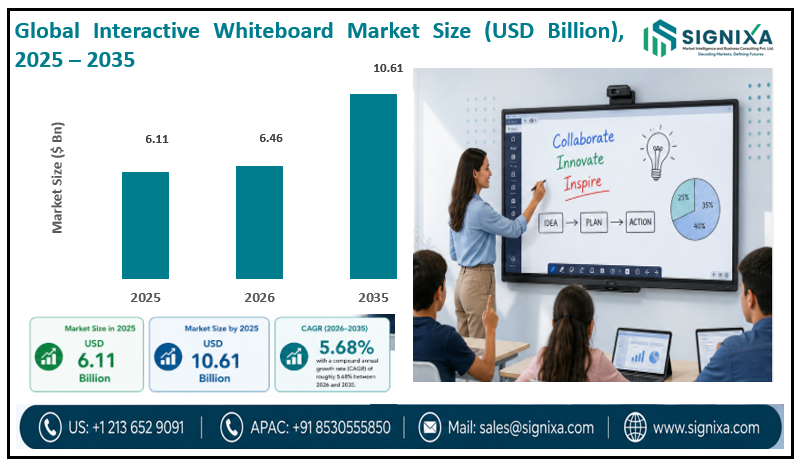
The size of the global interactive whiteboard market was worth around USD 6.11 Billion in 2025 and is predicted to grow to around USD 10.61 Billion by 2035, with a compound annual growth rate (CAGR) of roughly 5.68% between 2026 and 2035. The report analyzes the interactive whiteboard market's drivers and restraints, as well as the impact they have on demand throughout the projection period. In addition, the report examines global opportunities in the interactive whiteboard market.
The interactive whiteboard market includes technologically advanced touch-sensitive display panels widely adopted across educational institutions, corporate offices, and commercial facilities. Increasing demand for collaborative learning and remote working solutions, coupled with advances in touchscreen technologies, is propelling market growth. The growing trend toward digital classrooms, business meetings, and training sessions is significantly boosting the adoption of interactive whiteboards globally. These boards combine connectivity, multi-touch input, and software integration to create comprehensive communication hubs for both educational and corporate environments.
Rapid technological advancements are also bolstering market growth. Improvements in multi-touch capabilities, stylus recognition, wireless connectivity, and screen resolution have made interactive whiteboards more versatile and user-friendly. With the integration of AI and cloud-based functionalities, these boards are evolving into comprehensive communication hubs for both educational and corporate environments. Moreover, decreasing hardware costs and rising awareness regarding their benefits are making them more accessible across developing economies, supporting adoption beyond the traditional high-income institutional market.
Key Findings
- As per the analysis shared by our research analyst, the global interactive whiteboard market is estimated to grow annually at a CAGR of around 5.68% over the forecast period (2026–2035).
- In terms of revenue, the global interactive whiteboard market size was valued at around USD 6.11 Billion in 2025 and is projected to reach USD 10.61 Billion by 2035.
- Based on Technology, the Infrared segment is anticipated to dominate the global market due to its affordability and widespread adoption.
- In terms of Form Factor, the Fixed interactive whiteboard segment is projected to maintain the largest market share.
- On the basis of Projection Technique, the Front Projection segment is expected to command the largest share.
- In terms of Size, the 71 Inch to 90 Inch segment will dominate the market by 2035.
- Application-wise, the Education Sector will remain the largest and most influential end-user category.
- By Region, Asia-Pacific is projected to dominate the global market during the forecast period.
Interactive Whiteboard Market Dynamics
Government Smart Education Investments & Digital Classroom Mandates Accelerating Interactive Whiteboard Adoption
The growing emphasis on blended learning and digital classrooms has significantly accelerated the demand for interactive whiteboards. With governments across regions like North America, Europe, and Asia-Pacific investing heavily in smart education infrastructure, the adoption of interactive whiteboards is seeing robust growth. Several initiatives under the U.S. Department of Education's EdTech programs are driving smart classroom penetration, pushing institutions to replace traditional teaching methods with interactive learning technologies. Large-scale national digital education programs in China, India, and Southeast Asia are creating substantial volume demand for interactive whiteboard solutions that can be deployed efficiently across hundreds or thousands of classrooms simultaneously, driving both hardware and software revenue growth throughout the forecast period.
Hybrid Working Models & Remote Collaboration Needs Driving Corporate Interactive Whiteboard Demand
In the corporate world, the shift towards hybrid working models and remote collaborations has fueled the need for advanced meeting room solutions. Interactive whiteboards offer dynamic presentations, real-time collaboration, and data-sharing capabilities that are essential for modern business meetings. Increasing corporate investments in digital tools to enhance productivity, particularly post-pandemic, are contributing to the growing demand for both portable and fixed interactive whiteboard solutions. The acceleration of digital workplace transformation programs combined with growing enterprise adoption of video conferencing, collaborative cloud platforms, and remote-first work policies is making interactive whiteboards increasingly central to corporate communication infrastructure, supporting sustained demand from the commercial sector throughout the forecast period.
AI Integration, Declining Hardware Costs & Cloud Connectivity Broadening Market Accessibility Across Developing Economies
Rapid technological advancements are bolstering market growth. Improvements in multi-touch capabilities, stylus recognition, wireless connectivity, and screen resolution have made interactive whiteboards more versatile and user-friendly. With the integration of AI and cloud-based functionalities, these boards are evolving into comprehensive communication hubs for both educational and corporate environments. Moreover, decreasing hardware costs and rising awareness regarding their benefits are making them more accessible across developing economies. The convergence of interactive whiteboard hardware with popular cloud collaboration platforms like Google Workspace, Microsoft Teams, and Zoom is increasing the perceived value of interactive whiteboards as enterprise productivity tools beyond their traditional standalone application, supporting market expansion across a broader range of institutional and commercial buyers globally.
Interactive Whiteboard Market Segmentation Analysis
By Technology Segment Analysis
The market is segmented by touch detection technology, with each approach offering distinct trade-offs in cost, accuracy, durability, and multi-touch capability that determine suitability across education, corporate, and specialty applications globally:
Infrared
The infrared segment dominated the market in 2025 due to its cost-effectiveness and ease of installation. Infrared whiteboards offer durable performance and are widely used in educational institutions, capturing over 45% of the total market share in 2025. Infrared touch technology works by projecting an invisible grid of IR light beams across the board surface and detecting interruptions caused by touch — this approach eliminates surface overlays, provides excellent scratch resistance, and supports unlimited touch points with no calibration required. The combination of low manufacturing cost, reliable performance, and broad compatibility with educational software platforms makes infrared the preferred technology for large-scale institutional classroom deployments, particularly in budget-conscious emerging market education programs.
Resistive Touch
Resistive touch technology holds a steady share due to its multi-touch capability, preferred for rugged environments. Resistive boards detect touch through pressure applied to flexible top layers, making them responsive to any input object including gloved hands or styluses. This makes them suitable for demanding environments like industrial training facilities, vocational education centers, and outdoor installations. While resistive technology is gradually being displaced by infrared and capacitive alternatives in mainstream education and corporate applications, its lower cost and robust performance in challenging conditions maintain its relevance for specialized deployment scenarios that require reliable touch detection in environments where other technologies may be vulnerable to contamination or physical damage.
Electromagnetic Pen
Electromagnetic pen technology, favored for precision writing, is growing among design and training applications. Electromagnetic systems use a special stylus containing a coil that interacts with a grid of copper wires embedded in the board surface, providing extremely accurate and pressure-sensitive writing with no physical contact required. This technology is particularly valued in professional design, architectural drafting, medical training, and technical education applications where fine detail and precise input control are critical requirements. The growing adoption of digital inking workflows in professional and creative settings, combined with the superior handwriting recognition capabilities enabled by electromagnetic pen systems, is supporting segment growth in premium and specialized interactive whiteboard applications through the forecast period.
Capacitive
Capacitive boards, though more expensive, are gaining traction in premium segments due to their superior touch sensitivity. Capacitive interactive whiteboards detect touch through the electrical properties of the human body, offering faster response times, superior multi-touch accuracy, and a more natural touch experience compared to alternative technologies. These characteristics make capacitive boards particularly appealing for corporate boardrooms, university lecture halls, and premium educational institutions where superior user experience justifies higher acquisition costs. The declining cost of capacitive panel manufacturing — driven by scale economies from the smartphone and tablet industries — is gradually improving price competitiveness, enabling broader adoption in the mid-market institutional segment through the forecast period.
Others
The Others category encompasses ultrasonic, optical, and hybrid touch detection technologies that serve specialty applications not well-addressed by the mainstream technology options. Optical touch systems use cameras and image processing to detect touch, offering large-format capabilities suitable for very large display installations exceeding standard IWB dimensions. Ultrasonic systems detect stylus position through sound waves, providing high precision for annotation applications. Hybrid technologies that combine two detection methods are emerging to address the limitations of single-technology approaches in demanding use cases. This segment, while small in share, represents an important innovation space as manufacturers explore next-generation interactive display technologies that combine touch detection with gesture recognition, spatial computing, and augmented reality capabilities.
By Form Segment Analysis
Fixed
The fixed interactive whiteboard segment accounted for nearly 62% of the global market share in 2025. Fixed whiteboards are a staple in classrooms and conference rooms because they offer a stable and reliable installation for frequent use. Wall-mounted or stand-mounted fixed installations provide the optimal viewing angle, maximum display stability, and full integration with room audio-visual systems — making them the preferred format for dedicated teaching spaces, boardrooms, and training rooms where the board is used daily. The large-scale deployment programs by educational authorities across Asia-Pacific, the Middle East, and Latin America are disproportionately driving fixed installation volumes, as these programs typically equip every classroom in a school or district with a permanently mounted interactive display for consistent daily instructional use.
Portable
Portable interactive whiteboards are witnessing steady growth, especially among businesses and training organizations seeking mobility, with a projected CAGR of around 6.20% during 2026–2035. Portable IWBs allow organizations to deploy interactive presentation capabilities in multiple rooms or locations without the cost of installing dedicated fixed units in every space. This flexibility is particularly valued by corporate training departments, event organizers, small businesses, and educational institutions with budget constraints that need to share interactive display resources across multiple classrooms or meeting spaces. The growing popularity of rolling stand-mounted interactive display carts in K–12 schools — enabling a single device to serve multiple classrooms on a rotating schedule — is a significant driver of portable segment growth through the forecast period.
By Projection Techniques Segment Analysis
Front Projection
The front projection technique led the market with around 68% share in 2025. Front projection systems are easier to integrate with existing infrastructure and are comparatively less costly than rear projection. In a front projection setup, the projector is mounted on the ceiling or positioned in front of the board surface, projecting onto the interactive surface from in front — this configuration is straightforward to install in any standard classroom or meeting room and requires no structural modification. The vast majority of large-scale education sector deployments use front projection or flat panel display technologies, given their lower total installed cost, simpler maintenance requirements, and compatibility with standard room configurations across diverse global markets.
Rear Projection
Rear projection systems, while providing better visibility without casting shadows, are more expensive and thus are typically used in premium installations such as large lecture halls and corporate boardrooms. In a rear projection setup, the projector is positioned behind the board surface, projecting through a translucent screen — this eliminates the shadow-casting problem that occurs when presenters stand in front of front-projection setups and provides a cleaner, more professional appearance. The superior presentation quality and reduced ambient light sensitivity of rear projection systems make them the preferred choice for high-use, high-visibility environments where presenter shadow interference would significantly disrupt the user experience, such as large lecture halls, broadcast studios, and premium executive meeting spaces.
By Size Segment Analysis
71 Inch to 90 Inch
Interactive whiteboards in the 71 Inch to 90 Inch size category dominated the market, representing 41% of the global sales in 2025. These boards offer the right balance between size, affordability, and usability, making them ideal for standard classrooms and meeting rooms. The 75–86 inch range in particular has emerged as the sweet spot for most institutional deployments, providing adequate visibility from the back of a standard-sized classroom while remaining within the cost parameters of most school and corporate budget frameworks. Declining flat panel display manufacturing costs have further accelerated the shift toward this size range, as schools replace older projector-based IWB systems with direct-view LED or LCD flat panel interactive displays in the 75–86 inch class during technology refresh cycles.
Greater than 90 Inch
The greater than 90 Inch segment is anticipated to grow at a CAGR of 6.15%, driven by demand in large auditoriums and conference spaces. As interactive whiteboard technology matures and display manufacturing costs continue to decline, larger-format interactive displays are becoming viable for applications that previously could only be served by projector-based systems. University lecture theatres, corporate training centres, and large conference facilities are increasingly deploying 98–110 inch interactive flat panels to replace aging projection systems, benefiting from higher brightness, better color reproduction, and the elimination of projector maintenance costs. The growing availability of modular large-format interactive display solutions that tile multiple panels together is further expanding the addressable market for large-format interactive whiteboard installations through the forecast period.
Up to 70 Inch
Interactive whiteboards smaller than 70 inches serve the smaller meeting room, huddle space, and home office market segments where a full-size classroom or boardroom installation is neither necessary nor practical. These compact interactive displays are increasingly popular in corporate settings as organizations reconfigure their office spaces to include more small collaborative meeting rooms equipped with technology for hybrid work. The rapid growth of the "huddle room" concept in corporate office design — creating small informal collaboration spaces that seat 2–6 people equipped with video conferencing and interactive display technology — is driving demand for compact interactive whiteboard solutions in the sub-70 inch category, creating a growing installation base beyond the traditional large-format classroom and conference room deployment context.
By Application Segment Analysis
Education Sector
The education sector accounted for the largest market share at around 54% in 2025. Governments across emerging economies are heavily investing in digital classrooms, fueling demand for interactive whiteboards. Interactive whiteboards enable teachers to deliver more engaging, visually rich lessons incorporating multimedia content, internet resources, and interactive exercises that significantly enhance student engagement and learning outcomes compared to traditional blackboards or static display methods. Large-scale national smart classroom programs in China, India, Southeast Asia, the Middle East, and Africa are creating enormous institutional procurement volumes, with individual programs covering hundreds of thousands of classrooms. The growing body of educational research supporting the learning benefits of interactive technology in classrooms is strengthening government justification for continued investment in interactive whiteboard infrastructure throughout the forecast period.
Corporate Sector
The corporate sector is the second-largest contributor, driven by the rising adoption of collaborative workspaces and enhanced remote presentation tools. Interactive whiteboards in corporate settings enable hybrid meeting participants to engage with shared content in real time, annotate documents collaboratively, and integrate seamlessly with video conferencing platforms, making them essential tools for effective hybrid work operations. The trend toward activity-based working and the redesign of corporate office spaces to support collaboration is driving investment in interactive meeting room technology across enterprises of all sizes. Organizations that have successfully implemented interactive whiteboard-equipped meeting spaces consistently report improved meeting productivity and higher engagement from both in-person and remote participants, creating strong word-of-mouth advocates for broader corporate deployment through the forecast period.
Commercial Sector
The commercial sector is seeing gradual uptake, especially in training centers and retail spaces for customer engagement applications. Commercial applications include retail digital signage with interactive capabilities, hospitality and visitor information systems, museum and exhibition interactive displays, and specialized professional training environments such as medical simulation centers and military training facilities. The convergence of interactive whiteboard technology with digital signage platforms is creating new commercial application opportunities beyond the traditional education and corporate meeting room use cases. As interactive display costs continue to decline, the return on investment case for commercial interactive applications is improving, supporting broader adoption by customer-facing businesses that use interactive displays to improve customer experience and engagement through the forecast period.
Others
The Others application segment encompasses government, healthcare, broadcast, military, and other specialty installations that require interactive display technology for specific operational purposes. Government legislative chambers and public administration facilities use interactive displays for data presentation and voting systems. Healthcare applications include surgical training simulators, patient information systems, and clinical decision support displays. Military and defense training facilities use interactive whiteboards for mission planning, tactical training simulations, and intelligence briefing rooms. As interactive display technology becomes more affordable and the range of compatible software applications expands, the addressable market for specialty and non-traditional interactive whiteboard applications is broadening, creating incremental revenue opportunities beyond the core education and corporate segments through the forecast period.
Report Attributes & Market Scope
| Report Attribute | Details |
|---|---|
| Market Size Value in 2025 | USD 6.11 Billion |
| Market Size Value in 2035 | USD 10.61 Billion |
| CAGR (2026–2035) | 5.68% |
| Base Year Used for Estimation | 2025 |
| Historic Data | 2020 - 2025 |
| Forecast Period | 2026 - 2035 |
| Segments Covered – By Technology |
|
| Segments Covered – By Form |
|
| Segments Covered – By Projection Technique |
|
| Segments Covered – By Application |
|
| Regions Covered | North America, Europe, Asia Pacific, Latin America, Middle East and Africa |
| Major Countries Covered | U.S., Canada, Mexico, Germany, UK, France, Italy, Spain, Russia, China, Japan, South Korea, India, Southeast Asia Countries, Brazil, Argentina, GCC Countries, Turkey, Iran, Israel, South Africa, Egypt, Nigeria, etc. |
| Key Companies Profiled | Promethean World Ltd., SMART Technologies, BenQ Corporation, Boxlight Corporation, Google LLC, Cisco Systems Inc., Microsoft Corporation, Hitachi Ltd., LG Display Co. Ltd., and Ricoh Company Ltd., among others. |
Interactive Whiteboard Market Regional Analysis
The Asia-Pacific region led the market with a revenue share of nearly 38% in 2025. Rapid digitalization in education systems across China, India, and Southeast Asia is driving growth. North America remains a significant market due to early technological adoption and corporate investments in digital meeting tools. Europe is witnessing steady expansion, fueled by strong educational reforms and business digitization programs. Latin America and the Middle East & Africa are emerging as promising regions, driven by rising educational investments and infrastructure modernization efforts.
Asia-Pacific (Dominant Region)
The Asia-Pacific region led the interactive whiteboard market with a revenue share of nearly 38% in 2025. Rapid digitalization in education systems across China, India, and Southeast Asia is driving growth. China has deployed tens of millions of interactive whiteboards across its education system through large-scale government procurement programs, making it the single largest national market globally. India's Digital India initiative and Samagra Shiksha education program are driving significant interactive whiteboard deployments across government schools in multiple states. Southeast Asian nations including Indonesia, Thailand, Vietnam, and Malaysia are investing heavily in EdTech infrastructure as part of broader education modernization agendas. The combination of large school-age populations, strong government commitment to digital education, and improving disposable incomes is cementing Asia-Pacific's dominant position in the global interactive whiteboard market through the forecast period.
North America
North America remains a significant market due to early technological adoption and corporate investments in digital meeting tools. The U.S. market is characterized by a mature installed base undergoing technology refresh cycles, as early-generation IWB systems are being replaced with modern flat panel interactive displays. The strong EdTech investment culture in the U.S. — supported by federal programs like E-rate and state-level education technology funding — maintains steady institutional demand for interactive whiteboard upgrades and new installations. The corporate sector is a major demand driver in North America, with the rapid adoption of hybrid work models creating significant investment in interactive meeting room technology across enterprises and small businesses. Canada exhibits similar dynamics, with provincial education technology investment programs supporting continued classroom interactive display deployment.
Europe
Europe is witnessing steady expansion, fueled by strong educational reforms and business digitization programs. The UK has one of the highest interactive whiteboard penetration rates globally, reflecting decades of sustained investment in classroom technology. Germany, France, and the Nordic countries are investing in digital education infrastructure as part of broader national digitalization strategies. The European Commission's Digital Education Action Plan is providing policy and funding support for member state investments in educational technology including interactive whiteboards. In the corporate sector, European enterprises' strong adoption of hybrid work models post-pandemic is driving investment in smart meeting room technology, with interactive whiteboards increasingly specified as standard equipment in new office construction and major refurbishment projects across major European business centers through the forecast period.
Middle East & Africa
The Middle East & Africa region is emerging as a promising market, driven by rising educational investments and infrastructure modernization efforts. In the Middle East, GCC countries like the UAE, Saudi Arabia, and Qatar are investing significantly in smart education as part of broader national development agendas such as Saudi Vision 2030 and UAE's National Strategy for Education. These initiatives include large-scale smart classroom programs that are creating substantial demand for interactive whiteboards and other digital learning tools. In Africa, while adoption is still in early stages due to budget constraints and infrastructure challenges, growing government commitments to improving education quality and access — combined with increasing international development aid focused on educational technology — are creating gradual but meaningful market growth opportunities, particularly in South Africa, Nigeria, and Kenya through the forecast period.
Latin America
Latin America is emerging as a promising region, driven by rising educational investments and infrastructure modernization efforts. Brazil and Mexico are the primary markets, each benefiting from government education technology programs aimed at improving learning outcomes through digital tools in public schools. Brazil's national education technology initiatives have driven significant interactive whiteboard deployments in state and municipal school systems. The expanding middle class across Latin America and increasing private school sector investment in premium education technology are supporting growth in the commercial education segment. The relatively lower current penetration of interactive whiteboard technology across the region, combined with growing government and private sector commitment to digital education, positions Latin America for above-average growth rates through the forecast period as adoption accelerates from a lower installed base.
Recent Developments in the Interactive Whiteboard Market
-
2026
SMART Technologies: SMART Technologies expanded its interactive display portfolio with new education-focused solutions that combine advanced touch functionality, cloud-based collaboration tools, and enhanced classroom management features, helping schools improve engagement and digital learning experiences.
Promethean: Promethean introduced upgraded ActivPanel displays with enhanced software integration, improved connectivity options, and collaborative learning capabilities, supporting more interactive and flexible teaching environments across K–12 and higher education institutions.
ViewSonic: ViewSonic expanded its ViewBoard ecosystem with new interactive display solutions that support hybrid learning, real-time collaboration, and seamless integration with digital education platforms, addressing the growing demand for connected classroom technologies.
-
2025
Promethean: Promethean expanded its interactive learning portfolio through updates to its ActivPanel series, introducing enhanced collaboration tools, streamlined device management features, and improved compatibility with educational software platforms to support digital classrooms.
SMART Technologies: SMART Technologies introduced new interactive whiteboard solutions designed to improve classroom participation through advanced touch technology, integrated lesson delivery tools, and expanded cloud collaboration capabilities.
LG Electronics: LG Electronics launched upgraded interactive display solutions for educational institutions and corporate users, featuring enhanced screen performance, wireless connectivity, and intuitive collaboration tools that support interactive presentations and group learning activities.
ViewSonic: ViewSonic expanded adoption of its ViewBoard interactive displays by strengthening partnerships with educational institutions and training centers, supporting the growing shift toward technology-enabled teaching and collaborative learning environments.
Interactive Whiteboard Market: Competitive Landscape
The global interactive whiteboard market features major players such as Promethean World Ltd., SMART Technologies, BenQ Corporation, Boxlight Corporation, Google LLC, Cisco Systems Inc., Microsoft Corporation, Hitachi Ltd., LG Display Co. Ltd., and Ricoh Company Ltd. The competitive landscape is characterized by continuous innovation, with companies focusing on improving touch sensitivity, integrating AI-driven features, and offering cloud-based collaboration tools. As the demand for dynamic and interactive workspaces and classrooms increases, leading companies are enhancing their global footprints through strategic partnerships and new product launches.
Competition in the interactive whiteboard market centers on several key dimensions: display quality and resolution, touch sensitivity and accuracy, software ecosystem richness, cloud connectivity and collaboration features, total cost of ownership, and after-sales support and service. Companies are differentiating through the quality and breadth of their proprietary software platforms — with integrated lesson tools, content libraries, and student response systems for education, and video conferencing integration and whiteboarding tools for corporate customers. The growing importance of hardware-software integration is prompting both dedicated IWB hardware manufacturers and major technology platform companies like Google and Microsoft to develop tighter integration between their collaborative software platforms and interactive display hardware, reshaping the competitive dynamics of the market through the forecast period.
Key Companies Profiled
- Promethean World Ltd.
- SMART Technologies
- BenQ Corporation
- Boxlight Corporation
- Google LLC
- Cisco Systems Inc.
- Microsoft Corporation
- Hitachi Ltd.
- LG Display Co. Ltd.
- Ricoh Company Ltd.
- Samsung Electronics Co., Ltd.
- ViewSonic Corporation
- Newline Interactive Inc.
- Sharp Corporation
- Panasonic Holdings Corporation
- Seiko Epson Corporation
- Dell Technologies Inc.
- Optoma Corporation
- Genee World Ltd.
- QOMO HiteVision LLC
Global Interactive Whiteboard Market Segmentation Summary
By Technology
- Infrared
- Resistive Touch
- Electromagnetic Pen
- Capacitive
- Others
By Form
- Fixed
- Portable
By Projection Technique
- Front Projection
- Rear Projection
By Application
- Education Sector
- Corporate Sector
- Commercial Sector
- Others
By Region
- North America
- U.S.
- Canada
- Mexico
- Europe
- Germany
- France
- UK
- Spain
- Italy
- Rest of Europe
- Asia-Pacific
- China
- Japan
- India
- Australia
- South Korea
- Southeast Asia
- Rest of Asia-Pacific
- Latin America
- Brazil
- Argentina
- Rest of Latin America
- The Middle East & Africa
- GCC Countries
- South Africa
- Rest of the Middle East & Africa
Frequently Asked Questions (FAQs) About the Interactive Whiteboard Market
What is an Interactive Whiteboard?
An Interactive Whiteboard (IWB) is a large interactive display that connects to a computer and projector, allowing users to control the computer using a pen, finger, or other devices. It is widely used in education, corporate meetings, training sessions, and collaborative work environments.
Which key factors will influence the Interactive Whiteboard market growth over 2026–2035?
The global Interactive Whiteboard market is expected to grow due to the rising adoption of digital learning tools, increasing demand for blended learning environments, technological advancements like multi-touch and gesture recognition, and expanding usage across corporate and government sectors.
What will be the value of the Interactive Whiteboard market during 2026–2035?
According to the study, the global Interactive Whiteboard market size was worth around USD 6.11 Billion in 2025 and is predicted to grow to around USD 10.61 Billion by 2035.
What will be the CAGR value of the Interactive Whiteboard market during 2026–2035?
The CAGR value of the Interactive Whiteboard market is expected to be around 5.68% during 2026–2035.
Which region will contribute notably towards the Interactive Whiteboard market value?
The global Interactive Whiteboard market is led by the North American and Asia-Pacific regions, driven by the strong presence of EdTech companies, government initiatives to digitize education, and increasing demand for interactive collaboration tools in businesses.
Which are the major players leveraging the Interactive Whiteboard market growth?
The global Interactive Whiteboard market is led by players such as SMART Technologies, Promethean World, Boxlight Corporation, Cisco Systems Inc., Google LLC, Microsoft Corporation, Hitachi Ltd., LG Display Co. Ltd., BenQ Corporation, and Ricoh Company Ltd.
What can be expected from the global Interactive Whiteboard market report?
The report explores crucial aspects of the Interactive Whiteboard market, including a detailed discussion of existing growth factors and restraints while also analyzing future growth opportunities and challenges that impact the market.