
Invisible Orthodontics Market Overview
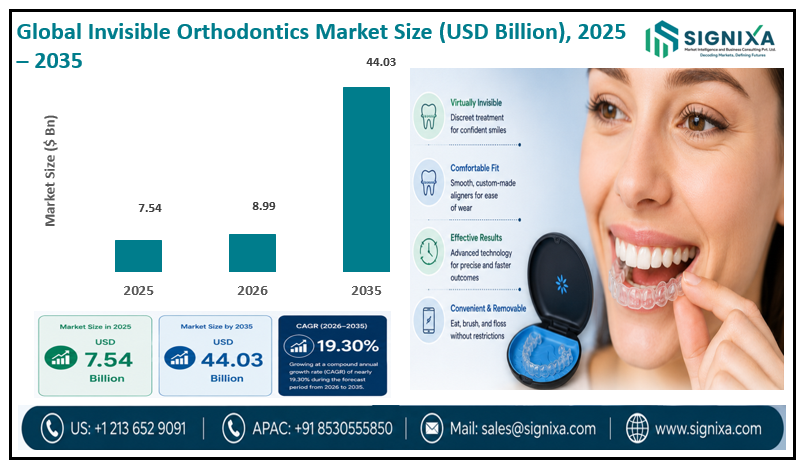
The size of the global Invisible Orthodontics market was valued at approximately USD 7.54 Billion in 2025 and is expected to reach around USD 44.03 Billion by 2035, growing at a compound annual growth rate (CAGR) of nearly 19.30% during the forecast period from 2026 to 2035. The report examines the invisible orthodontics market's key drivers, challenges, and emerging opportunities, offering a comprehensive view of market dynamics and growth potential.
Invisible orthodontics describes a range of dental procedures used to treat malocclusions while remaining cosmetically discreet. The market encompasses clear aligners, ceramic braces, and lingual braces — alternatives to traditional metal braces that appeal to both teens and adults seeking minimal-visibility orthodontic correction. Changing lifestyles that increase demand for cosmetic dentistry, the comfort advantages of modern orthodontic treatment over traditional metal appliances, and increasing awareness of oral health are major contributors to rising demand. Consumer preference for convenient and pain-free dental correction has fuelled rapid global adoption, with the rise of digital dentistry and direct-to-consumer models making treatment more accessible, especially in urban markets.
Advancements in the development of new aligner materials, the growing acceptance of 3D printing for aligner manufacturing, and the growing use of Artificial Intelligence (AI) for treatment planning are improving treatment accuracy and increasing patient satisfaction, driving growth in the worldwide market. Advancements in digital dentistry — including AI-powered diagnostics, intraoral scanners, and 3D imaging — have significantly improved treatment planning and delivery accuracy, enabling customized solutions. Direct-to-consumer platforms have simultaneously democratized access, offering more affordable solutions, while teledentistry is extending specialist-supervised invisible orthodontics to underserved geographic markets across the forecast period.
Key Findings
- The global invisible orthodontics market is projected to grow at a CAGR of 19.30% from 2026 to 2035, with market size increasing from USD 7.54 Billion in 2025 to USD 44.03 Billion by 2035.
- The Clear Aligners segment is expected to dominate the product category, comprising more than 65% of global market share in 2025, driven by removability, comfort, and discreet appearance.
- Adults are projected to account for the largest share by age group, representing over 60% of the market in 2025, driven by rising cosmetic dentistry interest and professional lifestyle considerations.
- Stand Alone Practices hold the largest share in terms of end use, commanding more than 50% of the global market in 2025 as patients' preferred entry point for cosmetic orthodontic care.
- Orthodontists dominate the dentist type segment with approximately 52% market share in 2025, as patients recognize their expertise particularly for complex lingual and ceramic brace treatments.
- North America will continue leading the market throughout the forecast period with over 35% of global revenue, while Asia-Pacific is the fastest-growing region.
Invisible Orthodontics Market Dynamics
Rising Adult Aesthetic Consciousness & Social Media-Driven Demand
The rising adult population interested in aesthetic dental improvement is one of the primary drivers of the invisible orthodontics market. The American Association of Orthodontists indicates that over 25% of orthodontic consumers are adults, most opting for discreet options such as clear aligners over traditional braces. Rising disposable incomes, combined with social media trends showcasing cosmetic self-enhancement and celebrity adoption of invisible orthodontic treatments, are amplifying consumer awareness and aspirational demand globally. Unlike traditional braces, invisible orthodontic devices align with modern lifestyle needs — being removable and less disruptive in daily professional and social interactions. Patients are now more inclined toward orthodontic treatments that offer minimal visibility, enhanced comfort, and the convenience of continued normal dietary and oral hygiene habits throughout the treatment duration.
Digital Dentistry Innovation: AI, 3D Printing & Teledentistry Expansion
Technological advances are a critical driver for invisible orthodontics market growth. Clear aligners that leverage 3D printing, AI-driven treatment planning software, and intraoral scanning technology are able to deliver highly individualized treatment plans and accelerate treatment outcomes with greater precision than was previously achievable. These advancements reduce the number of required clinical visits, improve patient comfort throughout treatment, and reduce total treatment duration, all of which improve patient experience and compliance, particularly among adult patients with demanding professional schedules. The expanded presence of at-home aligner models enabled by teledentistry and remote monitoring platforms is further supporting widespread acceptance of invisible orthodontic solutions across diverse geographic markets, including regions where specialist orthodontist density is limited.
High Treatment Cost, Insurance Limitations & DIY Orthodontics Safety Concerns
Despite compelling growth drivers, the invisible orthodontics market faces significant constraints and challenges. The high cost of invisible orthodontic treatments particularly branded clear aligner systems, compared to conventional metal braces remains a substantial barrier in price-sensitive regions and for lower-income patient populations. Limited insurance coverage for aesthetic dental procedures deters adoption in markets where orthodontic treatment reimbursement is minimal or excluded from standard dental insurance plans. The increasing popularity of at-home orthodontic kits without professional supervision raises serious concerns regarding treatment safety and effectiveness, particularly for complex malocclusion cases that require professional monitoring. Regulatory scrutiny over DIY aligner models is intensifying globally, adding complexity to the competitive landscape and creating potential market disruptions for direct-to-consumer brands operating with minimal clinical oversight of patient outcomes.
Invisible Orthodontics Market Segmentation Analysis
By Product Type Segment Analysis
The invisible orthodontics market is segmented by product type, with each category offering a distinct balance of visibility, cost, clinical applicability, and patient experience across diverse orthodontic treatment needs:
Clear Aligners
Clear Aligners lead the global invisible orthodontics market as the most aesthetic, convenient, and effective widely adopted method for teeth straightening. In 2025, clear aligners comprised more than 65% of the total market share. Market leaders including Align Technology's Invisalign platform have transformed orthodontic practice by providing virtually invisible, removable aligners that allow patients to eat, brush, and floss without restrictions — a significant lifestyle advantage over fixed appliances. Growing demand for individualized, minimally invasive dental treatment solutions, combined with the expansion of direct-to-consumer aligner brands offering lower price points and home-delivery models, has contributed to strong segment growth. Continuous material innovation — including newer aligner polymers that apply more controlled, progressive tooth-moving forces — is further improving clinical efficacy and expanding the range of treatable malocclusion complexity.
Ceramic Braces
Ceramic braces are growing in popularity due to their tooth-colored or clear brackets that blend with the natural surface of the tooth, offering significantly less visual impact than traditional metal braces while providing the reliable, constant force application characteristic of fixed appliance orthodontics. In 2025, ceramic braces accounted for approximately 18% of the overall global market. The brackets on ceramic braces tend to be somewhat more brittle and require careful handling, and the ceramic material can cause slightly more friction on archwires compared to metal alternatives factors that orthodontists consider in treatment planning. However, their less noticeable finish and ability to treat cases of greater complexity than clear aligners alone make them a popular option for appearance-conscious consumers who require comprehensive orthodontic correction that exceeds the current limitations of removable aligner therapy.
Lingual Braces
Lingual braces, which are bonded to the back (lingual) surface of the teeth, are 100% invisible from the front making them the most discreet fixed orthodontic option available for patients where complete invisibility is the overriding treatment priority. In 2025, the lingual braces segment represented approximately 12% of the total market. Their adoption is limited compared to other invisible orthodontic options, primarily due to higher fabrication and chair time costs and the greater technical difficulty of bracket placement and adjustment compared to labial fixed appliances. However, the segment is predicted to grow as more orthodontists complete specialized lingual orthodontics training and as computer-aided customization technologies reduce the complexity and cost of lingual bracket fabrication — expanding clinician confidence and treatment accessibility for this premium invisible orthodontic option.
By Age Group Segment Analysis
Adults
Adults are expected to hold the largest market share at over 60% in 2025, driven by increasing interest in cosmetic dentistry, growing affordability of orthodontic treatments, and the broad availability of nearly invisible treatment options. Adult users are a primary driving force behind market growth as they consistently choose invisible options due to professional and social considerations where traditional brackets and wires would create an aesthetically and professionally undesirable appearance. The growing social acceptance of adult orthodontic treatment driven partly by social media normalization of adult smile correction is removing previously significant stigma barriers and expanding the addressable adult patient population. Flexible payment plans and subscription-based DTC models have also lowered the financial accessibility threshold for adult patients who would previously have deferred treatment due to cost.
Teens
Teens held approximately 40% of the overall market based on age group in 2025. This segment's significance can be attributed to growing parental awareness of the benefits of early orthodontic intervention, increasing school-based dental education programs, and the availability of clear aligner products specifically engineered for teenagers, including features such as compliance indicators and additional aligner sets to accommodate accidental loss. Most adolescents prefer aligners for sports, social occasions, and school photographs where comfort, aesthetics, and usability are critical to treatment acceptance and compliance. The teen segment represents a particularly valuable market because parents rather than patients themselves — are often the purchasing decision-makers and are highly motivated by evidence of both clinical effectiveness and lifestyle compatibility of invisible treatment options.
By End Use Segment Analysis
The invisible orthodontics market is served across multiple end-use facility categories, each with distinct patient volume profiles, service capabilities, and orthodontic treatment specialization levels:
Stand Alone Practices
Stand-alone dental and orthodontic clinics are expected to dominate the global market with more than 50% share in 2025, as they are often the first point of contact for patients seeking cosmetic dental care. The ability to provide a personalized service experience, faster treatment turnarounds, and flexible payment plan arrangements — including monthly installment plans that align invisible orthodontic treatment costs with patient budgets continue to drive strong patient preference for these facilities. Stand-alone specialist orthodontic practices, in particular, offer the highest concentration of invisible orthodontic expertise and the most comprehensive range of clear aligner, ceramic, and lingual brace treatment options, positioning them as the dominant end-use channel through the forecast period.
Group Practices
Group practices played a role in approximately 25% of the invisible orthodontics market in 2025. Structured business models, larger clinical teams, greater investment in technology including intraoral scanners and digital treatment planning systems, and the ability to accommodate higher patient volumes allow group practices to deliver a high-volume, consistent treatment experience across multiple clinic locations. The ongoing consolidation of dental practice ownership with dental service organizations (DSOs) acquiring individual practices to form multi-location group practices is expected to gradually shift market share toward this end-use category as integrated orthodontic services become standard offerings across DSO networks. Group practices are also well-positioned to negotiate favorable aligner supply agreements with manufacturers due to their volume purchasing power.
Hospitals
Hospitals represented approximately 18% of the market in 2025. While they are less significant than private dental practices as an invisible orthodontics end-use channel, hospital dental departments serve patients covered by public insurance programs and those presenting with complex dental problems requiring multidisciplinary care coordination between orthodontists, oral surgeons, and other specialists. Hospital orthodontic services are particularly relevant for patients with cleft lip and palate, severe skeletal malocclusions requiring orthognathic surgery, and medically complex patients whose treatment is best managed in a hospital environment. The segment is anticipated to grow at a slower pace than private practices due to hospitals' limited specialization in elective cosmetic orthodontics and the typically longer referral and appointment pathways within hospital dental departments.
Others (Academic & Research Institutions)
Academic and research institutions collectively captured approximately 7% of the market in 2025. These entities primarily undertake studies, clinical trials, and educational training programs rather than providing commercial orthodontic services, but their contributions to technological innovation and the generation of clinical evidence supporting invisible orthodontic treatment efficacy are critical for market growth. University dental schools that train the next generation of orthodontists equipping them with digital workflow skills and clinical competency in clear aligner therapy are particularly important to sustaining the long-term expansion of invisible orthodontics adoption. Ongoing clinical research at academic centers continues to generate the evidence base that supports broader adoption in complex treatment cases and drives reimbursement policy evolution across major healthcare markets.
By Dentist Type Segment Analysis
Orthodontists
Orthodontists led the dentist type segment with approximately 52% market share in 2025, remaining the specialist preference for complex treatments including lingual and ceramic braces and cases involving significant tooth movement, skeletal correction, or multidisciplinary treatment coordination. Patients recognize orthodontists as the credentialed experts in dental alignment and attribute superior clinical outcomes particularly for complex malocclusion correction to their advanced specialty training. As demand for personalized care and clinical accountability increases, orthodontists are also adopting advanced digital tools including AI-powered treatment planning software, intraoral scanning, and remote monitoring platforms to deliver better outcomes more efficiently. Orthodontist-supervised invisible orthodontic treatment is increasingly recognized as the gold standard by patients, insurers, and regulators, sustaining their market leadership through the forecast period.
General Dentists
General dentists represent approximately 48% of the invisible orthodontics market share in 2025 a remarkably high proportion that reflects the success of clear aligner manufacturers in training general dentists to offer aligner therapy for straightforward cases. As orthodontic training programs for general dentists have become more accessible offered by major aligner brands as part of provider certification programs and with partnerships enabling aligner digital workflow access, general dentists have become a major and accessible channel for invisible orthodontic treatment delivery, particularly in rural markets and communities with limited orthodontist availability. General dentists are cost-competitive for simple to moderate alignment cases and benefit from existing patient relationships, making them an effective point of access for the large population of adults who would not seek out a specialist orthodontist independently but respond positively to aligner treatment recommendations from their regular dentist.
Report Attributes & Market Scope
| Report Attribute | Details |
|---|---|
| Market Size Value in 2025 | USD 7.54 Billion |
| Market Size Value in 2035 | USD 44.03 Billion |
| CAGR (2026–2035) | 19.30% |
| Base Year Used for Estimation | 2025 |
| Historic Data | 2020 – 2025 |
| Forecast Period | 2026 – 2035 |
| Segments Covered – By Product Type |
|
| Segments Covered – By Age Group |
|
| Segments Covered – By End Use |
|
| Segments Covered – By Dentist Type |
|
| Regions Covered | North America, Europe, Asia Pacific, Latin America, Middle East and Africa |
| Major Countries Covered | U.S., Canada, Mexico, Germany, UK, France, Italy, Spain, Russia, China, Japan, South Korea, India, Southeast Asia Countries, Brazil, Argentina, GCC Countries, Turkey, Iran, Israel, South Africa, Egypt, Nigeria, etc. |
| Key Companies Profiled | Align Technology, Dentsply Sirona, Straumann Group, SmileDirectClub, 3M, Henry Schein, Angelalign, Ormco Corporation, ClearCorrect, and American Orthodontics, among others. |
Invisible Orthodontics Market Regional Analysis
North America led the invisible orthodontics market in 2025, contributing greater than 35% of global revenue, fuelled by early adoption of dental technologies, strong cosmetic dental awareness, and established reimbursement policies. Europe followed with approximately 27% share. Asia-Pacific is anticipated to grow at the fastest CAGR, driven by increasing dental tourism, urbanization, and a rising middle-class population. Latin America and the Middle East & Africa are new markets where rising investments and healthcare awareness will spur adoption in the coming years.
North America (Leading Region)
North America leads the invisible orthodontics market due to early adoption of advanced dental technologies, high consumer awareness of cosmetic dental options, and relatively established insurance and financing structures that support adult orthodontic treatment uptake. The United States is the primary revenue contributor, home to major market leaders including Align Technology and a dense network of orthodontic specialists and general dentists certified to offer clear aligner therapy. The established culture of regular dental care attendance, combined with strong social media and influencer-driven awareness of aesthetic dentistry, has created a market environment where invisible orthodontics is increasingly viewed as a routine healthcare and wellness investment rather than an elective luxury. The region's mature dental practice landscape and strong digital dentistry infrastructure ensure continued leadership through the forecast period.
Europe
Europe plays a vital role in the invisible orthodontics market, driven by strong healthcare infrastructure, high aesthetic awareness, and rising adoption of advanced dental technologies. Countries including Germany, the UK, France, Italy, and Spain are at the forefront, with widespread acceptance of cosmetic dental treatments and a growing emphasis on oral health among young adults and professionals. The region benefits from a large pool of certified orthodontists and dental clinics equipped with state-of-the-art intraoral scanners, CAD/CAM systems, and AI-based treatment planning tools. Favorable reimbursement policies in some European countries and active professional associations promoting regular dental care further underpin market demand. Tele-dentistry and online consultation platforms are also gaining traction across Europe, enhancing patient engagement and enabling broader specialist access in areas with historically limited orthodontist density.
Asia Pacific (Fastest-Growing Region)
The Asia-Pacific region is experiencing rapid growth in the invisible orthodontics market, fueled by a rising middle-class population, growing cosmetic consciousness, and increasing investments in dental care infrastructure. China, India, Japan, South Korea, and Australia are emerging as key contributors. China leads the region with a booming dental services market and growing acceptance of technologically advanced treatment methods, supported by a strong domestic aligner manufacturing ecosystem including Angelalign that offers competitive pricing alternatives to international brands. Japan and South Korea, known for high healthcare standards and innovation-driven consumer markets, are embracing invisible orthodontic solutions supported by strong consumer demand. In India and Southeast Asia, expanding dental tourism, increasing awareness of orthodontic care, and the entry of global dental brands are reshaping the landscape. Digital dentistry adoption and mobile health platforms are helping bridge access gaps in markets where specialist availability is limited outside major urban centers.
Latin America
Latin America is an emerging and growing market for invisible orthodontics, with rising investments in dental care and growing awareness of aesthetic dental treatments across Brazil, Mexico, Colombia, Argentina, and Chile. Brazil in particular represents a significant market, driven by its large population, strong cultural emphasis on personal appearance and dental aesthetics, and a well-developed private dental service sector with high per-capita dental visit rates relative to regional peers. Mexico's proximity to the United States creates a significant dental tourism market, with American patients crossing the border for more affordable invisible orthodontic treatments. The increasing penetration of flexible financing models and subscription-based DTC aligner products is gradually making invisible orthodontic treatment accessible to a wider socioeconomic range of Latin American consumers beyond the historically affluent primary market for cosmetic dentistry.
Middle East & Africa
The Middle East and Africa region is steadily emerging as a significant market for invisible orthodontics, driven by increasing healthcare awareness, urbanization, and a rising focus on aesthetics. In GCC countries particularly the UAE and Saudi Arabia demand for clear aligners and advanced dental technologies has grown sharply, supported by high disposable incomes, a young and aesthetically conscious population, and modern dental infrastructure. The UAE has positioned itself as a regional medical tourism hub, attracting patients from neighboring countries for cosmetic dental procedures including invisible orthodontic treatments. Across Africa, while adoption remains comparatively lower due to affordability constraints and limited orthodontic specialist density, countries including South Africa, Egypt, and Kenya are witnessing growing urban demand. Tele-orthodontics and digital consultation services are helping bridge gaps in specialist availability in underserved areas, and expanding insurance coverage and investment in private dental clinic networks are creating conditions for sustained long-term market growth across the region.
Recent Developments in the Invisible Orthodontics Market
-
2026
Dentsply Sirona enhanced its SureSmile aligner portfolio by broadening treatment capabilities for patients in both mixed and permanent dentition stages, providing orthodontists with greater flexibility in treatment planning and case management.
Align Technology strengthened its international footprint by achieving significant growth in clear aligner case volumes across major regions, including Europe, Asia-Pacific, and Latin America, reflecting continued demand for Invisalign solutions.
-
2025
Align Technology introduced a comprehensive marketing initiative targeting both consumers and dental professionals to promote Invisalign treatment options for children and adolescents and increase awareness of early orthodontic care.
OrthoFX launched AirFlex with PrecisionFinish Aligners, expanding its clear aligner product offerings with a solution focused on improving treatment refinement and final-stage correction outcomes.
Dentsply Sirona advanced its SureSmile clear aligner business through updates to its digital treatment planning tools and workflow solutions, supporting wider adoption among orthodontic practitioners.
Invisible Orthodontics Market: Competitive Landscape
Key players in the invisible orthodontics market include Align Technology, Dentsply Sirona, Straumann Group, SmileDirectClub, 3M, Henry Schein, Angelalign, Ormco Corporation, ClearCorrect, and American Orthodontics. These companies are focusing on expanding product portfolios, enhancing digital treatment planning tools, and improving aligner material for better comfort and clinical efficacy. As market competition intensifies, players are leveraging teledentistry platforms and DTC models to reach untapped demographics, especially in emerging economies.
The competitive landscape of the invisible orthodontics market is characterized by technological innovation, digital workflow integration, and a focus on patient-centric solutions. Market participants are increasingly investing in R&D to develop more advanced materials and AI-driven treatment planning systems that enable faster and more precise orthodontic outcomes. Companies are leveraging 3D printing and intraoral scanning technologies to offer personalized aligners with improved fit and biomechanical force delivery. Strategic collaborations with dental professionals, dental school networks, and clinic chains are expanding market reach globally. Competitive pressure has led to increased emphasis on affordability and subscription-based models to attract younger demographics — particularly millennials and Gen Z adults who are comfortable with digital-first healthcare experiences but highly price-conscious as first-time orthodontic patients.
Align Technology's dominant market position built on its proprietary Invisalign SmartTrack material, the iTero intraoral scanner ecosystem, and the ClinCheck digital treatment planning platform creates substantial competitive moats through data network effects and practitioner switching costs that challenge new entrants. However, the expiration of key Align Technology patents has enabled a proliferation of generic and regional aligner manufacturers offering lower-cost alternatives, particularly in Asia-Pacific and emerging markets where price sensitivity is highest. This dynamic is intensifying competition and accelerating market expansion by bringing invisible orthodontic treatment within reach of patient populations previously priced out of the market a trend that will define competitive dynamics across the forecast period.
Key Companies Profiled
- Align Technology
- Dentsply Sirona
- Straumann Group
- SmileDirectClub
- 3M
- Henry Schein
- Angelalign Technology Inc.
- Ormco Corporation
- ClearCorrect
- American Orthodontics
- OrthoFX
- TP Orthodontics, Inc.
- GC Orthodontics
- Great Lakes Dental Technologies
- Rocky Mountain Orthodontics (RMO)
- Institut Straumann AG
- Envista Holdings Corporation
- K Line Europe GmbH
- Modern Dental Group Limited
- Shandong Huge Dental Material Corporation
Global Invisible Orthodontics Market Segmentation Summary
By Product Type
- Clear Aligners
- Ceramic Braces
- Lingual Braces
By Age Group
- Teens
- Adults
By End Use
- Hospitals
- Stand Alone Practices
- Group Practices
- Others
By Dentist Type
- General Dentists
- Orthodontists
By Region
- North America
- U.S.
- Canada
- Mexico
- Europe
- Germany
- France
- UK
- Spain
- Italy
- Rest of Europe
- Asia-Pacific
- China
- Japan
- India
- Australia
- South Korea
- Southeast Asia
- Rest of Asia-Pacific
- Latin America
- Brazil
- Argentina
- Rest of Latin America
- The Middle East & Africa
- GCC Countries
- South Africa
- Rest of the Middle East & Africa
Frequently Asked Questions (FAQs) About the Invisible Orthodontics Market
What is Invisible Orthodontics?
Invisible orthodontics refers to modern dental treatments that align teeth using discreet methods such as clear aligners, ceramic braces, and lingual braces. These alternatives to traditional metal braces are favored for their aesthetic appeal and convenience.
Which key factors will influence the Invisible Orthodontics market growth over 2026–2035?
The market is expected to grow due to increasing aesthetic awareness, rising cases of dental misalignment, advancements in 3D imaging and AI-based treatment planning, and growing adult participation in orthodontic procedures.
What will be the value of the Invisible Orthodontics market during 2026–2035?
The global invisible orthodontics market was valued at approximately USD 7.54 Billion in 2025 and is projected to reach around USD 44.03 Billion by 2035, driven by robust demand for minimally visible orthodontic treatments.
What will be the CAGR value of the Invisible Orthodontics market during 2026–2035?
The invisible orthodontics market is expected to grow at a CAGR of 19.30% from 2026 to 2035, owing to the increasing adoption of clear aligners, growing focus on cosmetic dentistry, advancements in orthodontic treatment technologies, and rising demand for comfortable and minimally visible teeth-straightening solutions.
Which region will contribute notably towards the Invisible Orthodontics market value?
North America currently leads the market due to advanced dental infrastructure and early adoption of new technologies. However, the Asia-Pacific region is projected to witness the fastest growth, fueled by increasing healthcare investments and rising aesthetic consciousness.
Which are the major players leveraging the Invisible Orthodontics market growth?
Key players include Align Technology Inc., Dentsply Sirona, Institut Straumann AG, Ormco Corporation, 3M Company, Henry Schein Inc., Angelalign Technology Inc., and TP Orthodontics Inc. These companies are focused on expanding their global presence through innovation, strategic partnerships, and the introduction of AI-powered aligner planning solutions.
What can be expected from the global Invisible Orthodontics market report?
The report offers a detailed analysis of the invisible orthodontics market, covering market sizing, segmentation by product, age group, end use, and provider type, along with regional insights. It evaluates key growth drivers, challenges such as treatment cost and insurance limitations, emerging trends in digital dentistry, and the competitive landscape shaping the market outlook from 2026 to 2035.